
Backbend Yoga: The Energy, Uplift And Calm Of Opening The Chest
Backbend yoga: the short answer
Backbend yoga poses open the chest and front of the body and strengthen the back, which is why so many students, me included, love the boost in energy and mood they give straight away. The main benefits of backbends are better posture against a day of slouching, a freer chest for breathing, a stronger back, and a lift in energy with a calm mind underneath. In Iyengar yoga, a chair, bolsters and blocks make backbends doable from the beginning, in Darwin or LIVE online. Here is what each backbend benefit means, what research has found, and how to start safely.
Iyengar yoga is the style developed by Mr BKS Iyengar. In the 20th century he did more than anyone to set down traditional Indian yoga, through his books and his teaching, and he pioneered the use of props. It is sometimes called modern classical yoga, and it’s the style we teach at Flametree. This page sits in our Poses And Practice notes.
Here is the article in short form:
- Posture: backbends reverse the slump of desks and phones.
- Breathing: an open chest gives the lungs room.
- Strength: the back, shoulders and hips get stronger.
- Energy and mood: many students feel more awake and uplifted.
- Calm under stress: staying steady in a strong pose carries into life.
- Start supported: a chair, bolster or blanket roll makes them doable.
- Camel Pose: the steps, and why it asks for courage.
- Take care: neck, back, bones, blood pressure and pregnancy.
- Next step: learn them with a teacher, in Darwin or LIVE online.
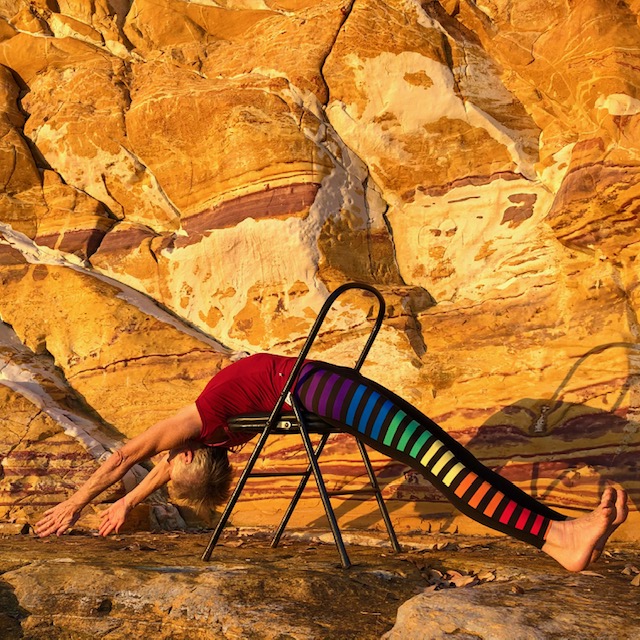
Two-Legged Inverted Staff Pose over a chair (Dwi Pada Viparita Dandasana). The chair supports the back so you can stay and breathe.
What are the benefits of backbends in yoga?
Posture, breathing, strength, energy and calm. Like many people, I love the boost in energy and mood that backbends deliver almost immediately. The experienced pose in the photo above is not where you start, but the benefits below apply to any backbend, to a greater or lesser extent.
From long practice in the Iyengar tradition, backbends:
- improve posture by reversing the slouch from sitting at a desk or looking at a phone;
- strengthen the back, shoulders, chest and hips, supporting a healthy, stable spine;
- increase mobility in the spine, chest and hip flexors (the muscles at the front of the hips), so you move more easily;
- ease tightness in the back, neck and shoulders, including after a lot of forward bending;
- open the chest, giving the lungs more room to breathe deeply;
- lift energy and alertness, so you feel more awake and less tired;
- help release stress and emotional tension, and build the confidence to face a challenge.
These are mostly known from practice. The next section covers what research has tested.

Camel Pose (Ustrasana) at Umbrawarra Gorge. The thighs stay upright while the chest lifts and opens.
What has research found about backbends and posture?
Research supports two pieces of the picture. Neither study tested backbends alone, but both bear on why opening the chest matters.
- Slumping squeezes the lungs. A 2006 study of 70 adults in the Archives of Physical Medicine and Rehabilitation measured breathing in different postures. Slumped sitting significantly reduced lung capacity and the force of breathing out, compared with upright sitting and standing.
- Yoga can reduce a rounded upper back. A 2009 trial in the Journal of the American Geriatrics Society gave 118 people aged 60 and over, all with a rounded upper back (hyperkyphosis), yoga classes three times a week for 24 weeks. Compared with the control group, one measure of the curve improved by 4.4% and another by 5%. Other measures, including physical performance, did not change significantly.
In plain terms: a slumped chest restricts breathing, and a regular yoga programme designed for a rounded upper back can improve it a little. The other benefits listed above are known from practice and not yet tested by modern research.
Flametree has also published on posture in Yoga For Posture, and on how held poses load muscle and bone in Yoga For Strength.

Bridge Pose with the feet on a chair and the shoulders on blankets. A beginner-friendly backbend.
Why do backbends make you feel energised?
Students commonly describe backbends as waking them up. In the Iyengar tradition, backbends are taught to bring energy and alertness, and they are often practised when people feel dull or tired. Many students find their mood lifts and they feel more confident, because a backbend asks you to face a challenge and let go of fear.
At the same time, staying steady and breathing evenly in a strong pose trains the body to stay calm under stress. That carries over into everyday life. It is uplift and calm together, which is the mix I love.
Those effects are known from long practice. If you want the science of calming the system, see How To Calm Your Nervous System.
Why are chairs so good for backbends?
Because time is what opens the chest, and a chair lets you stay. For many people even the thought of going backwards feels scary. The body stiffens, the breath catches, and fear makes us rigid, which makes opening harder. In Iyengar yoga the chair is one of the best props for backbends. It is supportive, accessible and gives you courage.
Without a chair, deep backbends usually belong to people with a lot of natural flexibility. With a chair, even beginners can lie back, feel the chest open and taste that freedom. A chair does not take away the challenge, but it does take away much of the fear. And when you stay for a while, many students describe a feeling of lightness, as if the world has opened up around you.

A chair lets the chest open while the back is supported.
Lying over something: the easiest start
You can find the right-sized object and lie back over it. Students have used a rock, a bolster, a stack of folded blankets or a chair. It can be a small bend or a big bend, and it is an easy way to feel the front of the body open. Here are three ways to begin, from gentler to stronger:
- Bolster on bolster. Rest one bolster on another bolster, on folded blankets or on blocks, and lie back over it. This is the gentlest start.
- Over a chair with the feet at a wall. Lie back over the chair with your feet against a wall and a belt looped around your legs. This is one easy place to start.
- Over the top of the chair. Once you have practised the earlier versions enough, put some padding on the top of the chair, keep your feet against the legs of the chair, and stretch backwards. Do it in short bursts, and each time just do what you can do.
A teacher can set up the chair, the padding and the belt for you in a class, which is the best way to begin.

A supported chair backbend with a belt around the legs and a bolster under the head. The chair lets you stay and breathe.
A supported chest opener over a rolled blanket
This is one of the gentlest ways to feel what a full breath is like. Most of us breathe high and shallow in the chest, especially when we sit, scroll and rush. With the back held up, the muscles around the chest can let go, and the ribs get room to move.
- Roll a firm blanket into a long log. A bolster (a firm, long cushion) works too.
- Lie back with it running along your spine, knees bent and feet on the floor.
- Put a small folded towel under your head, so your chin is not tipping up.
- Rest your arms out to the sides, palms up.
- Breathe slowly through your nose for 3 to 5 minutes. Notice the ribs widening at the sides, not only the chest rising.
- To come up, roll onto your side first and rest there for a few breaths.
Keep it comfortable. If you feel any pinching in your back or neck, add more padding or stop. If you are pregnant, or have a neck, back or eye problem, check with your teacher first.

Cobra lifts the chest while the hands press firmly into the floor.
How do you start backbend yoga safely?
With support, slowly, and with a teacher. You can work towards Two-Legged Inverted Staff Pose simply by lying back over a chair, with your teacher setting it up. Use a mix of supports to take it further step by step.
- Start supported: lying over a bolster, blocks or a chair.
- Prepare first: a few Downward-Facing Dogs (Adho Mukha Svanasana), a plank and some standing poses before deeper backbends. Open the spine, chest and hips first.
- Go slowly: build up over weeks, using smaller backbends to extend and strengthen the back.
- Work evenly: open the front and back of the body together. Over-bending in one part can cause injury.
- Keep the breath smooth: no holding the breath, no forcing.
- Come out gently: release the spine carefully, and finish with something that soothes the nervous system, such as a supported Half Plough Pose (Ardha Halasana), or a twist or gentle forward bend if your teacher suggests it.
Take extra care, and tell your teacher, if you have back or neck problems, osteoporosis (thin, fragile bones), high blood pressure, or are pregnant. Supported versions are usually taught instead. If you have a neck issue, do not take your head back. Look towards your chest instead.
Talk to your yoga teacher, yoga therapist, and your doctor if you wish. See a doctor straight away for numbness or weakness in the legs, a change in bladder or bowel control, or pain after a fall.
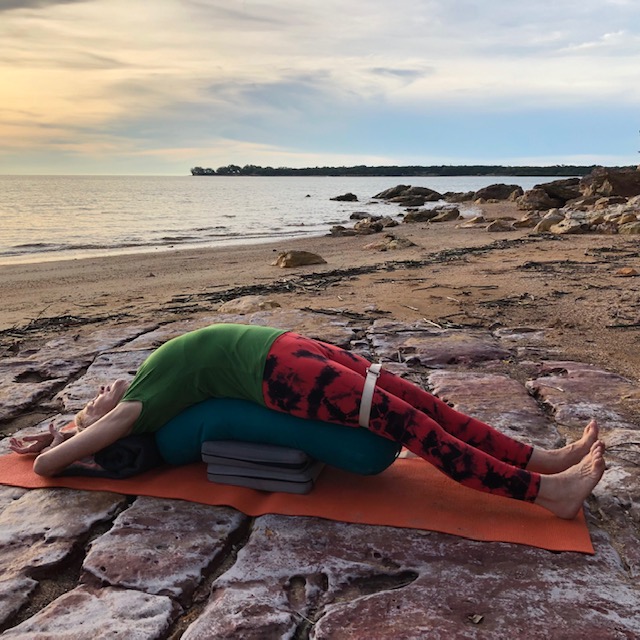
A resting backbend over a bolster and blankets. Supported backbends open the chest with very little effort.
Backbend yoga poses taught in Iyengar classes
Common backbends, from gentle to strong, include:
- Supported backbends over a bolster, blocks or crossed bolsters;
- Bridge Pose (Setu Bandha Sarvangasana), with or without a chair;
- Cobra and Upward Facing Dog (Urdhva Mukha Svanasana);
- Locust Pose (Salabhasana), a small lift of the chest and legs;
- Camel Pose, often with the hands on blocks or a chair at first;
- Two-Legged Inverted Staff Pose over a chair;
- Wheel Pose (Urdhva Dhanurasana), for experienced students. Our Wheel Pose note covers props, ropes and the fear of dropping back.

Wheel Pose (Urdhva Dhanurasana), an experienced backbend built up to over time.
How do you do Camel Pose (Ustrasana)?
Kneel with the thighs upright, lift the front body, and arch back from the chest while the hips stay forward. For most students Camel Pose is a big step from the introductory backbends, Locust Pose and Upward Facing Dog. You need courage, because you go backwards, take the spine inwards and look at the world upside down. It can feel scary at first. Gradually you learn to trust yourself, feel your back, and go into the unknown in a mindful way. Many students feel alive, alert and more optimistic afterwards.
Prepare well first, and open the spine, chest and hips before you start. These are the steps as Chris teaches them. Use chairs, bolsters and blocks to give you confidence, and learn it with a teacher.
- Kneel with the thighs upright, knees hip-width apart and in line with the hips.
- Watch your breath and become mentally present.
- Place your hands on your hips and keep both sides of the trunk parallel.
- Press the feet and shins down.
- Breathe in and lift the front body up, lifting the hips and trunk.
- Move the thighs and hips forward, firm the buttocks and draw the spine in. Check that the hips do not move backwards.
- Breathe out and arch back, drawing the shoulder blades in. Lift the abdomen and take the shoulders back.
- Extend the neck without straining and take the head back, if your neck is well. With a neck problem, look towards the chest.
- Reach the hands to a chair, to blocks, or to the feet. Keep the breath steady.
- Press the hands down, rotate the inner arms outwards, and keep moving the lower back forward and the back ribs up.
- To come up, shift your weight to the knees and use the buttocks as you breathe in. Sit back on your feet, rest and try again.
If it is hard to tell whether your thighs are upright, place your hips at a wall and press the thighs and pubic bone towards the wall as you arch back. Drop the shoulders away from the ears, and look for where you hold tension. Breathe to release it.

Camel Pose (Ustrasana) with the hands to the feet. Thighs upright, hips forward and the chest lifting.
Why do props help you feel the back of your body?
Because you cannot see your back, you have to learn to feel it. Backbends are interesting. For many of us they bring an immediate high, so we want more of them. For others they feel frightening, because we are approaching a part of the body we cannot see. In both cases, props let us step back from likes, dislikes and ego and become more objective.
A teacher might pin the elbows against a trestle, or put blocks against a wall and press the elbows into them, to feel the back body more clearly. Props let you stay longer in a pose, often with less effort, and the mind has time to settle and notice. You can learn to observe the feel of the skin over the front and back of the body, and to sense underdoing and overdoing and refine your effort.

Lying over a support lets the chest open without effort.
One cool morning in the tropics
On a chilly tropical morning, a Flametree teacher pulled on thick pants, a long-sleeved top and a beanie and took the practice outdoors. It seemed a perfect morning for backbends. The warm-up came first: Downward-Facing Dog, plank and some standing poses. Then out came a barrel, a chair and blocks.
It began with a wooden block between the shoulder blades. At first it felt hard and the chest felt tight, so the teacher got quiet and breathed through the sensation. Gradually the chest opened. Next came a roll over the barrel, then Two-Legged Inverted Staff Pose over the chair, working to open the hips and straighten the legs, and then some baby backbends, Locust Pose and Camel Pose. The props let the teacher ease in slowly, like a safety net. It was invigorating and uplifting, and as always there were areas that needed more work.

A supported backbend opens the front of the body and rests the back.
Backbend yoga in Darwin and live online
Flametree Yoga Studio teaches Iyengar yoga in Darwin and LIVE online, with Christine (Chris) Lalor, Senior Iyengar Yoga Teacher. Backbends are taught with chairs, bolsters and blocks, step by step, in the studio or online.
Related reading: yoga for posture, seated forward bend, yoga for neck pain, yoga inversions and our headstand note.
Backbend yoga: frequently asked questions
What are the benefits of backbends in yoga?
From long practice, backbends improve posture, strengthen the back, shoulders and hips, open the chest for breathing, ease tightness in the upper back and neck, and lift energy and mood. Research has shown slumped sitting reduces lung capacity, and that a yoga programme can modestly reduce a rounded upper back.
Are backbends good for posture?
Backbends open the chest and strengthen the back muscles, the opposite of a desk slump. A 2009 trial of 118 people aged 60 and over found 24 weeks of yoga improved measures of a rounded upper back by about 4 to 5% compared with a control group.
Do backbends help breathing?
An open chest gives the lungs room. A 2006 study of 70 adults found slumped sitting significantly reduced lung capacity compared with upright sitting and standing. Backbends counter the slump, which many students feel as easier, deeper breathing.
Why do backbends give you energy?
Students commonly feel more awake and uplifted after backbends, and in the Iyengar tradition they are taught to lift energy and mood. This is known from practice rather than tested in research.
Are backbends safe for beginners?
Supported backbends are, when taught well. Beginners start lying over a bolster, blocks or a chair, and in Bridge Pose, and build up slowly. Tell your teacher about back or neck problems, osteoporosis, high blood pressure or pregnancy.
What is chair backbend yoga?
In Iyengar yoga, a chair supports the back in poses such as Two-Legged Inverted Staff Pose (Dwi Pada Viparita Dandasana). The chair lets you stay longer and breathe, so the chest opens without strain.
What if backbends scare me?
That is common. For many people the thought of going backwards makes the body stiffen and the breath catch. Props are the answer. Lying over a bolster, a rolled blanket or a chair lets you feel the chest open while you are held up, so you can stay and breathe. Tell your teacher how you feel and they will set up the support to suit you.
How do you do Camel Pose?
Kneel with the thighs upright, breathe in and lift the front body, move the hips forward, then breathe out and arch back from the chest while reaching the hands to the feet, blocks or a chair. Keep the hips forward and the neck long. If you have a neck issue, look towards your chest instead of taking the head back. Learn it with a teacher.
Should I do a forward bend after a backbend?
Teachers often follow backbends with a gentle twist or forward bend to settle the spine, or with a soothing pose such as a supported Half Plough Pose. Your teacher will sequence the class so the back is looked after.
Where can I learn backbend yoga in Darwin or online?
Flametree Yoga Studio teaches Iyengar yoga, including supported backbends with chairs and bolsters, in Darwin and LIVE online with Senior Iyengar Yoga Teacher Christine (Chris) Lalor. Your first class is free if you are new to Flametree: in the studio, if you have lived in the NT for three months or more, and online, for anyone new.
Practise this at Flametree
Flametree Yoga Studio teaches Iyengar yoga in the studio at Woolner and Coolalinga in Darwin, and LIVE online.
- New to Flametree? Your first class is free. In the studio, just come along. Online, go to our online class list, click the class time you want and we email you the link to join.
- Beginners: new students, and anyone who has been away three months or more, can get a half price 10 class pass with 2 extra classes free, to use online, in the studio, or both. See the beginner half price pass.
- Already practising yoga? The same half price 10 class pass with 2 extra classes free, for new students and for anyone away three months or more, is also available as the non-beginner half price pass.
- See every class time, including online classes, on the timetable.
Can’t make a class? Practise at home with our video courses.
This article is general information, not medical advice. If you have a back condition, osteoporosis or high blood pressure, talk to your doctor and your teacher before starting. Flametree Yoga Studio, Darwin and LIVE online.
Sources: Lin F and colleagues, Effect of different sitting postures on lung capacity, expiratory flow, and lumbar lordosis, Archives of Physical Medicine and Rehabilitation, 2006, doi 10.1016/j.apmr.2005.11.031. Greendale GA and colleagues, Yoga decreases kyphosis in senior women and men with adult-onset hyperkyphosis: results of a randomized controlled trial, Journal of the American Geriatrics Society, 2009, doi 10.1111/j.1532-5415.2009.02391.x. Chris Lalor’s own practice and teaching.



