
Yoga For Chronic Pain: What Mr Iyengar, The Yoga Doctors And The Research Say
Pain that just won’t go away? An ache that has hung around for months, wakes you at night, makes you wary of bending or lifting, and wears down your mood and your patience. That is chronic pain, and you are far from alone with it. This guide brings together what Mr BKS Iyengar, Dr Timothy McCall and the research say about yoga, pranayama (yogic breathing), meditation and mindfulness for chronic pain, and points you to our guides for pain in one part of the body. Last updated: 9 November 2026.
By Chris Lalor, Certified Senior Iyengar Yoga Teacher and certified Yoga Therapist, Flametree Yoga Darwin.
Get 2 Free Yoga Classes And 2 Free Ebooks
Does yoga help chronic pain? The short answer
Yes. The research is strongest on coping with chronic pain and living better with it, and yoga, breathing and mindfulness all help with that. Reviews of mindfulness and acceptance courses found that people accepted their pain more and coped with it better, and several found better quality of life and mood. Reviews of yoga for long-lasting back pain, neck pain, knee arthritis and fibromyalgia found better everyday function and a little less pain. Slow breathing exercises eased low back pain and the fear of moving in a review of 17 studies. And Iyengar yoga, the style we teach, did well in three trials of back and neck pain. We do not say pain will disappear. On pain going down, the results are good but mixed, so that is not what we rate as strong. A good class gives you all three at once: steady movement, a slow breath and a quieter mind.
Overall evidence: Strong
The research here is strong. Reviews or large trials mostly agree that yoga helps, so you can have plenty of confidence in it.
What is rated Strong: coping with chronic pain and quality of life. What is not: pain going away. On pain getting lower the results are good but mixed, and no practice here is shown to remove chronic pain. Most of the trials were small and the reviewers grade how sure we can be as low, so we rate the many reviews that point the same way, not one big proof.
Best study (review of many trials): A 2026 review of 60 trials with 6,692 people found that mindfulness and acceptance programmes helped people accept their pain and cope with it. Other reviews found better quality of life and mood. A Cochrane review of 12 yoga trials with 1,080 people with long-lasting low back pain also found better everyday function at 3 and 6 months.
One thing to keep in mind as you read: most pain trials tested “yoga” of many styles, taught by teachers with very different training. Where yoga in general did about as well as other exercise, that was yoga in general. The Iyengar yoga trials, taught by trained Iyengar teachers, are listed on their own, and the one that compared Iyengar yoga with an exercise programme found less pain with the yoga. In our view as certified Iyengar teachers, well-taught Iyengar yoga is likely to go further than the average. Why the kind of yoga matters.
The bottom line: five key moves for chronic pain
- Go to a yoga class at your level, two or three times a week, and keep going. In a review of 70 back pain trials, programmes of 3 or more sessions a week were linked with less long-term disability than fewer sessions.
- Move, gently and with support. Props such as chairs, blocks, belts and bolsters let you take a pose without straining the sore part, so movement stops feeling dangerous.
- Add breath work (pranayama). A slow, quiet breath calms the mind and brings stress, worry and anger down. Slow breathing exercises also eased pain and the fear of moving in back pain studies.
- Cut back on what makes it worse. Long, still hours in one position, a held breath, forcing a stretch, and bracing against the pain. Yoga makes you notice these habits, so they are easier to change.
- Start now. New to Flametree, or away 3 months or more? 2 free classes, then 10 at half price, in Darwin or LIVE online.
Five Key Moves For Chronic Pain
1. Go to class
Two or three times a week, at your level.
2. Move with support
Props, so nothing is strained.
3. Add pranayama
A slow, quiet breath calms the mind.
4. Cut back
On still hours, held breath and forcing.
5. Start now
2 free classes, then 10 at half price.
Yoga for chronic pain in five moves: steady, supported movement and a slow breath, week after week.
Who was Mr BKS Iyengar? Iyengar yoga is the style we teach at Flametree. During the 20th century, Mr BKS Iyengar was the major teacher who codified traditional Indian yoga, through his seminal books and widespread teaching. He also pioneered the use of props, so poses can be adapted to almost any body, including a body in pain. His style is sometimes called modern classical yoga. This guide is part of our encyclopaedia of yoga for health conditions.
This guide in short
- Overall evidence: Strong, for coping with chronic pain and quality of life. Best study: a 2026 review of 60 trials with 6,692 people found that mindfulness and acceptance programmes helped people accept their pain and cope with it. Pain going away is not rated Strong: results on pain getting lower are good but mixed.
- Mr BKS Iyengar: never force; adapt each pose to the person with props; end with supported rest and a quiet breath.
- Dr Timothy McCall, an American medical doctor and yoga therapist who studied with Mr BKS Iyengar, author of Yoga as Medicine: chronic pain is no. 71 on his list of conditions helped by yoga.
- The research: more than 30 studies listed below, including three Iyengar yoga trials, a Cochrane review and reviews of thousands of people, for yoga, breathing and mindfulness.
- Pain in one place? We have full guides for back pain, neck pain, sciatica, arthritis, knee and hip pain, shoulder pain, headaches and fibromyalgia, linked below.
- Take it further: our free ebook Happy Backs, the 2027 masterclass on backs, and classes in Darwin and online.
Yoga For Chronic Pain On One Page
Three sources, one direction: gentle, supported movement, a slow breath and a quieter mind.
Mr BKS Iyengar
Never force. Adapt every pose with props. End with supported rest.
Dr Timothy McCall
Chronic pain is no. 71 on his list of conditions helped by yoga.
Yoga research
Less pain and better function in back and neck pain. Three Iyengar trials did well.
Breath and mindfulness
Linked with less pain, less low mood and less fear of moving.
Yoga for chronic pain at a glance. Each source is set out in full below.
“It is better to do a good pose minimum than a bad pose maximum.”
What chronic pain is
Chronic pain is pain that lasts beyond the usual healing time, generally taken as 12 weeks or more. People also call it persistent pain, long-term pain or ongoing pain. It can come from joints, muscles or nerves, or from the way the nervous system handles pain signals. It often affects sleep, mood and everyday activity, which is one reason a whole-person approach like yoga suits it.
It is common. The Australian Institute of Health and Welfare reports that 1.6 million Australians aged 45 and over, about 1 in 5, had chronic pain in 2016. Worldwide, a Cochrane overview put it at about 20% of adults.
Chronic Pain In Australia
1 in 5
Australians aged 45 and over had chronic pain in 2016: 1.6 million people.
Source: Australian Institute of Health and Welfare, chronic pain in Australia.
Most research on yoga and pain has looked at one kind of pain at a time. So if your pain sits mainly in one place, our guide for that part of the body goes into more detail, with what Mr Iyengar taught for it:
- Back pain and yoga and sciatica
- Neck pain and cervical spondylosis
- Arthritis and knee and hip pain
- Shoulder pain and frozen shoulder and wrist and hand pain
- Fibromyalgia, chronic fatigue and fatigue
- Headaches and migraine and tension headache
- Nerve pain (neuropathy) and period pain
Where Does Your Pain Sit?
Back or down a leg?
Back pain and sciatica guides.
Neck, shoulder or arm?
Neck pain and shoulder pain guides.
Knees, hips or other joints?
Arthritis and knee and hip guides.
All over, with tiredness?
Fibromyalgia and fatigue guide.
Start here for chronic pain in general, then go to the guide for your part of the body.
What did Mr BKS Iyengar teach about pain?
In short: work with the pain, never against it. Mr Iyengar built a whole method around adapting poses so that people in pain can still practise, and his specific courses for back, neck, joint and other pain are set out in our guides for each of those. What follows is known from long practice and teacher experience, and much of it has not yet been tested by modern research. Not yet tested is not the same as wrong.
- Never force. His line “It is not yoga that injures” makes the point: forcing does (Light on Life, print edition, p. 34). Sharp pain means come out and change something.
- Props, so the sore part is not strained. Chairs, blocks, belts, bolsters and the wall let a person take the shape of a pose without bracing against pain.
- Adapted pose by pose. In an Iyengar class the teacher gives a different version of a pose for each person’s pain, rather than one version for all.
- Supported rest and breath to finish. Lying-down restorative poses with a supported, quiet breath come near the end of a class, so the nervous system can settle.
- A good pose done a little. “It is better to do a good pose minimum than a bad pose maximum” (Light on Life). For a body in pain, a short, well-supported pose repeated is kinder than one long struggle.
How yoga breaks into the chronic pain circle
Breaking The Chronic Pain Circle
Pain
An ache that has lasted months.
Fear and tension
You brace and avoid moving.
Less movement
A held breath, fewer activities.
On alert
Stiffer body, busier mind, more pain.
↻ Gentle, supported poses, a slow breath and steady attention break the circle at every step.
A simplified picture, known from practice. In the research, breathing practice lowered fear of moving (Chen 2025) and mindfulness lowered thinking the worst about pain (Walsh 2026).
What Dr Timothy McCall says
In short: chronic pain is on his list. Dr Timothy McCall, an American medical doctor and yoga therapist who studied with Mr Iyengar and wrote Yoga as Medicine, published a list of 117 health conditions helped by yoga in June 2019. “Pain, Chronic” is no. 71. Our encyclopaedia uses his list as its backbone and builds on it with newer research.
By 2019 the research had mostly looked at pain one condition at a time: a Cochrane review of yoga for chronic low back pain (12 trials, 1,080 people), a review of yoga for chronic neck pain (10 trials, 686 people), a review comparing mindfulness courses with cognitive behavioural therapy for chronic pain (21 studies), and the Iyengar yoga back pain trials of 2005 and 2009. All of these are described below. Since 2019 many more reviews have been published, and they are added here too.

What does the research say about yoga for chronic pain?
In short: yoga, slow breathing and mindfulness all helped people cope with chronic pain in reviews and trials, mostly in back pain, neck pain, knee arthritis and fibromyalgia. The firmest finding is on coping and quality of life. On pain going down, the results are good but mixed. Mindfulness courses have the largest body of pain research. Yoga improved everyday function and lowered pain, and in back pain did about as well as other exercise, which in our view is a good result for a practice that also calms the mind. Yoga research is hard to fund, because it depends on universities and governments, not on drug companies. Some of the exercise reviews below also included tai chi and qigong, which are a different practice and are not counted here. Most reviews tested yoga in general, of many styles; the Iyengar yoga trials are listed on their own below. Why the difference matters.
How Much Research On Yoga, Breath And Mind For Pain
People in some of the reviews in this guide.
Yoga for chronic pain has a large research base. Bars drawn to scale from zero.
Iyengar yoga studies
These studies tested Iyengar yoga specifically, taught by trained Iyengar teachers, with props and adapted poses.
- Pain fell by 64%, disability by 77% and use of pain medicine by 88% with Iyengar yoga, and the gains held 3 months later. 16 weeks of classes, against an education programme. Williams 2005, a trial of 60 people with chronic low back pain. Read the study.
- Iyengar yoga lowered disability, pain and depression more than standard medical care, and the gains were still there 6 months later. Twice-weekly classes for 24 weeks. Williams 2009, a trial of 90 people with chronic low back pain. Read the study.
- Iyengar yoga lowered neck pain by 13.9 points (out of 100) more than a home exercise manual, with less disability and better mental wellbeing. A 9-week course. Cramer 2013, a trial of 51 people with chronic neck pain, average age 48, 82% women. Read the study.
Three Iyengar Yoga Trials For Pain
60 people, back pain
Pain down 64% after 16 weeks (Williams 2005).
90 people, back pain
Less disability, pain and low mood than standard care, still there at 6 months (Williams 2009).
51 people, neck pain
13.9 points less pain than a home exercise manual (Cramer 2013).
Iyengar yoga for chronic pain: three trials taught by trained Iyengar teachers, and all three did well.
- Everyone in the Iyengar yoga group benefited, to different degrees, and weekly pain rose and fell on the way down rather than dropping in a straight line. Allende 2017, a closer look at the yoga group of the same neck trial (23 people). Read the study.
- People described feeling more in balance and more aware of their bodies. Cramer 2013, interviews with 18 people from the Iyengar neck pain trial. Read the study.
- Seated Iyengar yoga lowered depression and raised self-compassion in people with spinal cord injury. Six weeks, against a waiting group. Curtis 2017, a pilot trial of 23 people. Read the study.
Most of the 12 trials in the Cochrane back pain review below also used Iyengar, Hatha or Viniyoga yoga. Iyengar yoga has not yet been tested against general exercise for back pain on its own; for neck pain, it did better than a home exercise manual.
What 16 weeks of Iyengar yoga did for back pain
Iyengar Yoga For Chronic Low Back Pain
Drops in the yoga group, Williams 2005.
Iyengar yoga for chronic low back pain: large drops in pain, disability and pain medicine, held 3 months later.
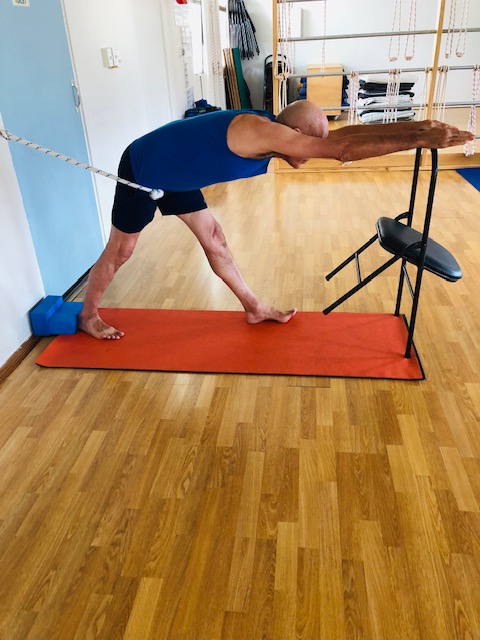
Ropes and a chair take the load, so a sore body can move without strain.
Chronic pain in general
- Exercise, including yoga, Pilates and tai chi, improved pain and physical function, and the usual side effect was soreness that settled within a few weeks. Geneen 2017, a Cochrane overview of 21 reviews, 381 studies and 37,143 people. None of its reviews studied chronic pain as one condition; each looked at one kind of pain. Read the study.
- Mind-body exercise (tai chi, yoga and qigong) lowered chronic pain in middle-aged and older people. Wen 2022, a review of 17 studies and 1,332 people. Tai chi and qigong are not yoga, and the review did not separate yoga out, so we do not count it as a yoga result. Read the study.
- Yoga had strong effects on low mood, blood pressure, blood sugar and fatigue; for pain and arthritis the evidence was weaker. Wang 2025, a review of 51 reviews, 579 studies and 28,403 people. Read the study.
Chronic Pain In General: What The Big Reviews Found
381 studies, 37,143 people
Exercise, including yoga, improved pain and function (Geneen 2017).
Side effects
Usually soreness that settled within a few weeks (Geneen 2017).
579 studies, 28,403 people
Yoga helped mood and fatigue strongly; pain results were weaker (Wang 2025).
Yoga for chronic pain in general: better function and mood, with pain results more mixed.
Chronic low back pain
- Yoga improved everyday back function at 3 and 6 months compared with no exercise, and pain was a little lower. Wieland 2017, a Cochrane review of 12 trials and 1,080 people. Against other exercise, function was about the same. Read the study.
- Yoga was linked with less disability in the short term, and programmes of 3 or more sessions a week with less disability in the long term. Blanco-Heras 2026, a review of 70 trials and 3,991 people. The authors advise choosing what you will keep doing. Read the study.
- Mind-body exercise (yoga, Pilates, tai chi and qigong) lowered back pain by 1.56 points on a 10-point scale, with no clear difference between them. Xiang 2026, a network review of 25 trials. Read the study.
- Yoga with education lowered pain clearly more than usual care in people with back pain and low mood. Haller 2026, a network review of 5 studies and 834 people. Read the study.
- Yoga improved emotional wellbeing and, in two studies, physical function compared with other exercise; for pain it did about as well. Li 2026, a review of 7 trials. This was yoga in general, not Iyengar yoga. Read the study.
Yoga in general and Iyengar yoga for chronic pain
Yoga In General And Iyengar Yoga
Yoga in general
About as good as other exercise for back pain.
Better for emotional wellbeing.
Many styles, many kinds of teacher training.
Iyengar yoga
Did better than education and standard care for back pain.
Did better than a home exercise manual for neck pain.
Taught by trained Iyengar teachers.
Iyengar yoga has not yet been tested against general exercise for back pain on its own.
Neck pain, knee arthritis, fibromyalgia and nerve pain
- Yoga lowered neck pain and disability and improved quality of life and mood. Li 2019, a review of 10 trials and 686 people. More in our neck pain guide. Read the study.
- Yoga, tai chi and qigong each lowered knee arthritis pain. Wu 2025, a review of 13 trials and 558 people aged 61 to 76 on average. More in our arthritis guide. Read the study.
- Mind-body exercise, including yoga, lowered fibromyalgia pain and its impact on daily life. Zhang 2026, a review of 21 trials and 1,155 people. More in our fibromyalgia guide. Read the study.
- Mind-based programmes, including mindfulness, lowered nerve pain and pain-related disability. Bäckryd 2024, a review of 15 studies and 764 people, including 2 yoga studies. More in our nerve pain guide. Read the study.
Breathing practice and pranayama
- Breathing exercises lowered low back pain, improved function and eased the fear that movement will cause harm. Chen 2025, a review of 17 studies and 633 people. The breathing was belly, slow or deep breathing and forced out-breaths, for 2 to 12 weeks. Read the study.
- Slow, deep breathing lowered short-term pain. Joseph 2022, a review of 7 trials. This was acute pain, such as burns, not chronic pain. Read the study.
These studies tested breathing exercises, not pranayama as we teach it. No trial has yet tested classical pranayama, such as alternate nostril or humming breath, for chronic pain in general. Not yet studied is not the same as not working. The pranayama we teach (staircase, ocean, alternate nostril, humming and a gentle shining skull breath) is slow, nasal and taught step by step, often lying down with the chest supported. Why the kind of breathing matters.
Slow Breathing For Back Pain
17 studies
found breathing exercises lowered low back pain, improved function and eased the fear of moving.
Chen 2025, 633 people. Pranayama itself has not yet been tested for chronic pain.
Meditation and mindfulness
Mindfulness means paying attention on purpose, in the present moment, without judging. Mindfulness-based stress reduction (MBSR) is an 8-week group course of mindfulness meditation and gentle movement.
- A mindfulness course that included gentle yoga helped people with long-lasting low back pain move and cope better, and more of them had a clear drop in how much the pain bothered them, than with usual care. After 26 weeks, 60.5% of the course group had a clear gain in everyday function, against 44.1% with usual care, and 43.6% had a clear drop in pain bothersomeness, against 26.6%. The gains held at 52 weeks, and the course did about as well as cognitive behavioural therapy. Cherkin 2016, a trial of 342 adults, with 8 weekly 2-hour classes. The course tested (MBSR) is mindfulness meditation with gentle yoga, so it counts for what our classes build. Read the study.
More People Improved With A Mindfulness Course
Share with a clear gain at 26 weeks, long-lasting low back pain (Cherkin 2016).
Yoga and mindfulness for chronic back pain: more people improved with the course. Bars drawn to scale from zero, out of 100%.
- Mindfulness courses lowered pain intensity and low mood, and MBSR gave the most promising results; the best dose looked like 8 weekly sessions of 90 to 120 minutes. Zhu 2025, a network review of 68 studies and 5,339 people with chronic pain. Read the study.
- Mindfulness and acceptance programmes helped people accept their pain and cope better with life alongside it. Sanabria-Mazo 2026, a review of 60 trials and 6,692 people. The reviewers rated how sure we can be as low to very low, because most of the trials had weaknesses in how they were run. Read the study.
- Mindfulness programmes lowered chronic low back pain intensity. Paschali 2024, a review of 18 studies. Read the study.
- MBSR improved back function at 8 weeks. Soundararajan 2022, a review of 6 trials. Read the study.
- Group MBSR and cognitive behavioural therapy both clearly improved function, pain and low mood, and did about as well as each other. Khoo 2019, a network review of 21 studies. Read the study.

- Mindfulness and acceptance programmes lowered the severity of body symptoms, including fibromyalgia. Maas genannt Bermpohl 2023, a review of 16 trials and 1,288 people. Read the study.
- MBSR improved quality of life and lowered thinking the worst about pain in fibromyalgia, though pain itself was about the same as with other active programmes. Walsh 2026, a review of 11 trials and 1,153 people, nearly all women. Read the study.
- Mantra meditation (repeating a calming word or phrase) improved mental quality of life and lowered negative mood, but did not clearly change pain. Coitinho Biurra 2026, a review of 7 studies and 374 people with acute or chronic pain. Read the study.
- Reviews of mindfulness for long-lasting muscle and joint pain gave mixed results. Cardle 2023, a review of 19 reviews covering 194 studies, looking at pain, sleep, mood, quality of life and function. The authors put the mixed picture down to low-quality reviews and very different course designs. This is one reason we do not rate pain going away as strong. Read the study.
- Yoga nidra (guided deep relaxation, lying down) lowered pain compared with doing nothing. Ghai 2025, a review of 12 studies and 1,176 people. Against other active programmes it did about as well. Read the study.
- People in an Australian hospital pain service described deep relaxation, better self-management and a changed relationship with their pain after 6 weeks of yoga nidra. Barber 2025, interviews in Victoria. Read the study.
Three Routes, One Direction
What each group of studies found for chronic pain.
Yoga
Better function and less pain in back and neck pain. Three Iyengar trials did well.
Breathing
Less back pain and less fear of moving: a review of 17 studies.
Mindfulness
Less pain intensity and less low mood: a review of 68 studies.
Yoga for chronic pain, slow breathing and mindfulness all point the same way.
How long and how often?
The trials ran for 6 to 24 weeks. The Iyengar back pain trials ran 16 and 24 weeks, the Iyengar neck pain trial 9 weeks. The best mindfulness dose in one review was an 8-week course, once a week. In back pain, 3 or more sessions a week were linked with less long-term disability. Pain often eases unevenly, rising and falling from week to week, so give it time.
What The Trials Used
1. 8 weeks
Best mindfulness dose: once a week.
2. 9 weeks
Iyengar yoga course for neck pain.
3. 16 to 24 weeks
Iyengar yoga trials for back pain.
4. 3 a week
Linked with less long-term back disability.
How long yoga for chronic pain takes in the trials: weeks to months of regular practice.
“It is not yoga that injures.”
Yoga, pranayama and mindfulness: how they work together
Many of the studies above tested mindfulness or meditation courses, or breathing exercises, not yoga poses. That still counts for our classes. Mindfulness is steady, present attention, and yoga poses and pranayama (yogic breathing) are old routes to that same state. So the large body of mindfulness research on chronic pain also shows what a good yoga and pranayama class can build. No trial separates which part does the work.
Two routes to one steady mind
A steady body, with attention held on the pose.
A steady breath, with attention held on the breath.
Mindfulness: steady, present attention. Each makes the other easier.
A simplified picture, known from practice. No trial separates which part does the work.
We suggest coming to both a yoga class and a pranayama class. Mr Iyengar taught that asana (poses), pranayama and meditation are not divided, and in our experience the two together do more than either alone. See every class time. We trace the history and the links in Yoga And Mindfulness: Why The Mindfulness Research Points Back To Yoga And The Breath.
How this comes together in a Flametree class
Everything above points the same way, and it is how we teach yoga for chronic pain in Darwin and online.
- Props in every class: chairs, belts, blocks, blankets, bolsters, the wall and the ropes, so each pose fits your body and your pain.
- Classes adapted to the people in them. Tell your teacher about your pain, and the poses are changed for you.
- Steady, attentive work. Holding a pose gives a busy mind one job to do, which is mindfulness in action.
- Short holds, repeated, so the body learns that movement is safe.
- Rest and breath to finish: every class ends with supported rest, and our pranayama classes go further.
- Gentle options: gentle yoga and restorative yoga for sore days, and our Back, Neck And Shoulder Focus class.
See the timetable and book a class. Body, then breath, then a quieter mind: that is the path a class follows, and it is why we offer poses and breathing together.

A supported forward bend, head on blocks. Props let a body in pain rest into a pose.
Read more on chronic pain
- Yoga for back pain over 50
- Yoga for spondylolisthesis, bulging discs and scoliosis
- Yoga for arthritis
- How to quiet the mind
- Nearby guides: stiff joints, stress and burnout, menopause and sleep and energy
Take it further
Free ebook: Happy Backs. Back pain is the most studied kind of chronic pain, and this book has even more on it: the trials, the Iyengar approach and real stories. By Chris Lalor, Certified Senior Iyengar Yoga Teacher and certified Yoga Therapist. Then do the free classes, see what you think, and buy a pass that puts it all into action.
New to Flametree, or away 3 months or more? 2 free classes + 2 ebooks, only available via this offer. Already a student? You can still get this book. Get your free copy of Happy Backs
- Classes, in Darwin or LIVE online: new, or away 3 months or more? 2 free classes, then 10 at half price. Already practising yoga? See the non-beginner half price pass. See the timetable and book.
- Masterclasses: Yoga for backs, Sunday 21 February 2027, one of our 2027 masterclasses with Chris Lalor, where you get the poses, sequences and breathing that put this guide into action for back pain. See the 2027 masterclasses.
- Retreats: a week of daily, adapted yoga in Bali. See the retreats.
2027 Masterclasses From 28 December
Over four months, learn the poses and breath practices that make the biggest difference for a range of key health conditions: arthritis, sleep and energy, pelvic floors, backs, wisdom, and anxiety, upsets and anger. In Darwin or LIVE online.
Other conditions are in our encyclopaedia of yoga for health conditions.
Yoga for chronic pain: questions people ask
Does yoga help chronic pain?
Yes, for many people. Reviews found yoga improved function and lowered pain in long-lasting back pain, neck pain, knee arthritis and fibromyalgia. A Cochrane review of 12 trials and 1,080 people with chronic low back pain found better everyday function at 3 and 6 months than with no exercise (Wieland 2017). In an Iyengar yoga trial of 60 people with back pain, pain fell by 64% (Williams 2005).
Can yoga cure chronic pain?
No. Chronic pain has many causes, and no practice can promise to remove it. What yoga can do is ease pain, help you move and function better, and calm the mind that lives with it. Reviews found less pain and better function with yoga, slow breathing and mindfulness, and in one trial the gains from Iyengar yoga for back pain were still there 6 months later (Williams 2009).
What Yoga Can And Cannot Do For Chronic Pain
Yoga can
Ease pain.
Help you move and function better.
Calm the mind that lives with it.
Yoga cannot
Promise to remove chronic pain.
Yoga for chronic pain: living better with it, week by week.
Is yoga better than other exercise for chronic pain?
In back pain, yoga in general did about as well as other exercise for pain and function, and better for emotional wellbeing (Li 2026). That was yoga of many styles. In the one trial that compared Iyengar yoga with an exercise programme, a home exercise manual for neck pain, the Iyengar group had less pain (Cramer 2013). Choose what you will keep doing.
Does mindfulness or meditation help chronic pain?
Yes. A review of 68 studies and 5,339 people found mindfulness courses lowered pain intensity and low mood, with mindfulness-based stress reduction giving the most promising results (Zhu 2025). Mindfulness also helped people accept pain and get on with life (Sanabria-Mazo 2026). A good yoga and pranayama class builds the same steady attention.
Do breathing exercises help chronic pain?
They can. A review of 17 studies found slow, deep and belly breathing lowered low back pain, improved function and eased the fear that moving will cause harm (Chen 2025). No trial has yet tested classical pranayama for chronic pain in general; not yet studied is not the same as not working. We teach slow, nasal pranayama step by step.
The Calm Breath, Step By Step
1. Supported
Lie down, the chest on a bolster or blanket.
2. Through the nose
Smooth and quiet.
3. Longer out-breath
Let it lengthen a little, without strain.
4. Soften
Let the sore part soften on each out-breath.
Breathing for chronic pain: a slow, smooth breath, learned with a teacher. Known from practice.
Is yoga nidra good for pain?
Yoga nidra (guided deep relaxation, lying down) lowered pain compared with doing nothing in a review of 12 studies and 1,176 people, and did about as well as other active programmes (Ghai 2025). People in an Australian hospital pain service described deep relaxation and better self-management (Barber 2025). Every Flametree class ends with supported rest.
Can yoga make my pain worse?
It can stir things up at first if poses are forced. In the Cochrane back pain review, about 5 more people in 100 had a flare of back pain with yoga than with no exercise, the same as with other exercise (Wieland 2017). Across exercise trials the usual side effect was soreness that settled within a few weeks (Geneen 2017). In an Iyengar class poses are adapted with props and never forced. Tell your teacher about your pain.
Practising Safely With Chronic Pain
Sharp pain in a pose?
Come out and change something.
Sore the next day?
Shorter holds, repeated. Soreness usually settles.
One part very sore?
More props, so it is not strained.
Not sure?
Tell your teacher. Poses are adapted for you.
Yoga for chronic pain is never forced: each pose is adapted to you.
How long does yoga take to help chronic pain, and how often should I go?
The trials ran 6 to 24 weeks. The Iyengar back pain trials ran 16 and 24 weeks, and the best mindfulness dose was an 8-week course (Zhu 2025). In back pain, 3 or more sessions a week were linked with less long-term disability (Blanco-Heras 2026). Pain often eases unevenly, so give it at least a few months.
Can I do yoga for chronic pain in Darwin or online?
Yes. Flametree Yoga teaches Iyengar yoga in Woolner and Coolalinga in Darwin, and LIVE online, with gentle and restorative classes for sore days and pranayama classes for the breath. New students can begin with our new-student offer of 2 free classes, then 10 at half price. Book a class
Where this comes from: BKS Iyengar, Light on Life (print edition, p. 34). Timothy McCall MD, his June 2019 list of 117 health conditions helped by yoga, and Yoga as Medicine (Bantam). Australian Institute of Health and Welfare, chronic pain in Australia (retrieved 6 November 2026). Studies as linked above, each looked up in PubMed in November 2026. Everything is summarised in our own words.
This page is general information, not medical advice. Flametree Yoga Studio, Darwin and LIVE online.
