
Neck Pain And Cervical Spondylosis: What Mr Iyengar, The Yoga Doctors And The Research Say
Neck sore again? Turning to back the car out, looking up at a screen, waking with a crick, or a dull ache that climbs into the back of your head. Neck pain is one of the most common reasons people walk into a yoga class, and it is one of the best studied. This guide brings together what Mr BKS Iyengar, his daughter Geeta, the medical doctors who worked with him and the research say about neck pain, cervical spondylosis (wear in the neck joints), neck and shoulder pain and a pinched nerve in the neck. Last updated: 1 November 2026.
Get 2 Free Yoga Classes And 2 Free Ebooks
Does yoga help neck pain? The short answer
Yes. Yoga helps chronic neck pain, and it is very likely to help yours and certainly worth trying. In two German trials, nine weeks of Iyengar yoga lowered neck pain far more than a self-care exercise programme or a home exercise manual, and a year later the gains were still there in people who kept practising. Reviews of 10 trials, 18 trials and 30 trials found yoga lowered pain and disability, and one ranked yoga first of nine kinds of exercise for neck disability. Mr Iyengar set out a yoga approach for cervical spondylosis, and the yoga doctors explain why it works: get the upper back and shoulders carrying their share, keep the neck soft, and use props so nothing is forced.
One thing to keep in mind as you read: most neck trials tested “yoga” of many styles, taught by teachers with very different training. Neck pain is unusual, because two of the best trials tested Iyengar yoga specifically, taught by trained Iyengar teachers, and both did well. In our view well-taught Iyengar yoga is likely to go further than the average. Why the kind of yoga matters.
The bottom line: five key moves for neck pain
- Go to a yoga class at your level, once or twice a week, and keep going. The Iyengar trials ran weekly 90-minute classes for 9 weeks, and a year later the people who kept practising kept their gains.
- Work the upper back and shoulders, not just the neck. When the upper back stops carrying its share, the neck takes the load. Lift the chest, open the armpits, keep the chin level.
- Add breath work (pranayama). It calms the mind and brings stress, worry and anger down. A tense mind tightens the throat, jaw and neck, and a slow, quiet breath lets them soften.
- Cut back on what makes it worse. Hours with the head poking towards a screen, driving with the shoulders up, piles of soft pillows, and loading the neck in a poorly set up shoulder stand or headstand. Yoga makes you notice these habits, so they are easier to change.
- Start now. New to Flametree, or away 3 months or more? 2 free classes, then 10 at half price, in Darwin or LIVE online.
Iyengar yoga is the style we teach at Flametree. During the 20th century, Mr BKS Iyengar was the major person who codified traditional Indian yoga, through his seminal books and widespread teaching. He also pioneered the use of props, so poses can be adapted to almost any body. His style is sometimes called modern classical yoga. This guide is part of our encyclopaedia of yoga for health conditions.
This guide in short
- Mr BKS Iyengar: a yoga approach for cervical spondylosis that works the trunk and shoulders first and keeps away from forcing the neck.
- Geeta S Iyengar: open the armpits to safeguard the neck; soft throat, soft jaw; standing poses before upside-down ones.
- Dr Timothy McCall: chronic neck pain is no. 62 on his list of conditions helped by yoga.
- Dr Krishna Raman: keep the trapezius soft, breathe freely, and lift the shoulders on blankets in shoulder stand.
- The research: 20 studies listed below, including two Iyengar yoga trials, a year-long follow-up and reviews of thousands of people.
- Take it further: our free ebook Happy Backs, the 2027 masterclass on backs, and classes in Darwin and online.
Neck Pain And Yoga On One Page
Five sources, one answer: free the upper back and shoulders, and the neck can let go.
Work the trunk and shoulders first. Do not force the neck.
Open the armpits. Soft throat, soft jaw, chin level.
Chronic neck pain is no. 62 on his list of conditions helped by yoga.
Soft trapezius, free breath, blankets under the shoulders.
Two Iyengar trials beat self-care and home exercise. A 30-trial review ranked yoga first for neck disability.
Each source is set out in full below. Research: Michalsen 2012 and Cramer 2013, Iyengar yoga trials; Shen 2026, a review of 30 trials.
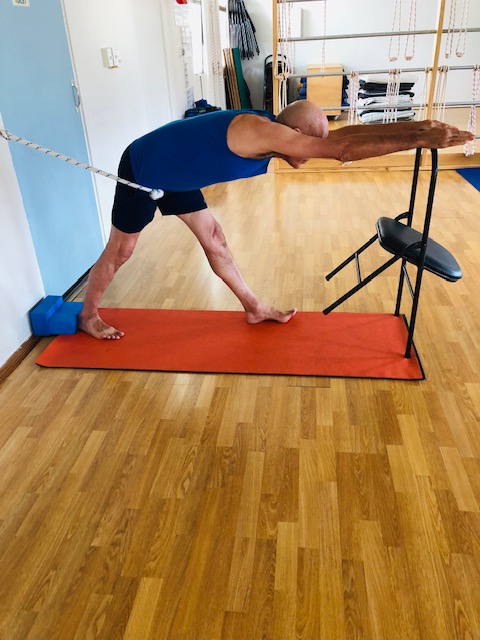
Working the upper back and shoulders with the ropes and a chair. Free the upper back and the neck has less to carry.
“Shoulders are not meant to hang the overcoat on but to carry responsibilities.”
What neck pain and cervical spondylosis are
Neck pain is pain, stiffness or aching anywhere from the base of the skull to the top of the shoulders. It is called chronic neck pain when it lasts for three months or more, or keeps coming back. Most of it is what doctors call non-specific: no single cause shows up on a scan. People describe it in their own words:
- Neck and shoulder pain: a band of tightness from the neck across the tops of the shoulders, often from long hours at a desk or driving.
- Cervical spondylosis: wear and tear in the joints and discs of the neck (the cervical spine). It is sometimes called arthritis in the neck.
- A pinched nerve in the neck: pain, pins and needles or numbness that runs from the neck down an arm, when a nerve root is pressed or irritated. Doctors call this cervical radiculopathy.
- Neck pain and headache: a dull ache that climbs from the neck into the back of the head. A headache that starts in the neck is called a cervicogenic headache.
Other names you may hear include a stiff neck, tech neck and forward head posture. Each has its own article, linked below. Cervical spondylosis is one form of osteoarthritis, so our arthritis guide applies too.
“It is better to do a good pose minimum than a bad pose maximum.”
What did Mr BKS Iyengar teach about neck pain?
In short: work the trunk and shoulders first, keep away from forcing the neck, and let the upper back carry its share.
In Yoga: The Path to Holistic Health, Mr Iyengar sets out a yoga approach for 72 health conditions. Cervical spondylosis has its own course (p. 326). His ideas, in our words:
- What it is. He describes wear and tear in the neck joints, with pain in the neck and arms, headaches and dizziness.
- Trunk and shoulders first. The course works the trunk and shoulders before the neck, through twists, standing poses, gentle backbends and supported inversions, and keeps away from forceful neck movement.
- Neighbours of the neck. He gives the upper back (p. 322), the shoulder joints (p. 328) and the tension headache that sits at the back of the skull (p. 353) courses of their own. Each one touches the neck.
- Work from the edges in. Unless a problem is fresh, he works from the parts around it towards the sore part (p. 263), and chooses the poses to suit the person, because wrongly chosen poses can do harm (p. 260).
- Calm the brain. A quiet brain lets energy go to healing (p. 263). His claim, from a lifetime of teaching, is that yoga may not bring full recovery in a serious or long-standing condition, but can ease much of the suffering (p. 260).
In The Tree of Yoga (pp. 95 to 96) he gives a picture we find useful for an older neck. A fresh problem is like a sapling, which can still be shaped; an old, set problem can be held steady and kept from spreading. He also puts the neck near the start of the order of work for a sore back, so the neck is part of the whole spine, not a separate problem.
He was a careful watcher of necks. In his 1992 remedial classes in Australia he worked with Christina, whose rounded upper back had left her neck doing its work, and with Peter, who had broken two neck bones in a riding accident decades earlier and had a neck fusion. Peter still had pain shooting into his head and down his arms. Mr Iyengar sat him on a chair, put a bolster on his thighs and asked him to fold forward over it, to see how far he could go. Watching a teacher adjust a woman with a painful neck, he said: “Never keep long for any person. Just touch and go, touch and go.” Both stories are told in full in our ebook Happy Backs.
When The Upper Back Stops, The Neck Pays
Why an Iyengar class for a sore neck starts below the neck.
1. The upper back rounds
Hours at a desk or the wheel. The chest drops and the shoulders roll in.
2. The head drifts forward
The chin pokes out. The muscles at the back of the neck hold the head up all day.
3. The neck does two jobs
Its own, and the upper back's. It tightens, aches and wears.
4. The class turns it round
Lift the chest, open the armpits, shoulder blades in, chin level. The neck gets its own job back.
In our words, after Mr BKS Iyengar, 1992 Australian remedial classes and Yoga: The Path to Holistic Health, p. 326, and Geeta S Iyengar. A simplified picture.
We do not publish his sequences. A sequence needs a teacher who can see your neck and adapt each pose, which is what a class is for.
“Open the armpits and you are safeguarding the neck.”
What Geeta S Iyengar says about the neck
In short: open the armpits, soften the throat and jaw, and let standing poses do the early work.
Geeta Iyengar, Mr Iyengar’s daughter, taught for decades in Pune and in Australia. Her book Yoga: A Gem for Women and her classes add practical points for a sore neck. Her claims, in our words:
- Standing poses for the neck. She lists Triangle Pose for backache and neckache (p. 124), and Intense Side Stretch (Parsvottanasana) for stiffness in the neck and shoulders and a hunched back (p. 135).
- Ropes and the wall. Work on the wall ropes takes the jerk out of the spine, and she lists it for back, shoulder, neck and waist pain (p. 260).
- A blanket for rest. A folded blanket under the shoulder blades and head helps in lying rest and breath work when the chest will not lift (pp. 315 to 316).
- Breathe through the nose, and do not hold the breath in poses (p. 84).
- Upside-down poses come in pairs. Headstand is always followed by shoulder stand (pp. 180 to 181). With a neck disc problem she told one woman she was not to do headstand, and gave her standing poses instead (as told in Happy Backs).
- Open the armpits. Teaching in Sydney in 2003, she said that opening the armpits safeguards the neck, and closing them does not.
“Don’t hold your head and neck tight.”
What Dr Timothy McCall says
In short: neck pain is one of the conditions yoga helps, and the review he cites is of Iyengar yoga.
Dr McCall is a US medical doctor and yoga therapist, author of Yoga as Medicine and former medical editor of Yoga Journal. His June 2019 list of conditions helped by yoga includes chronic neck pain (no. 62), with ten studies behind it. The one he lists that is Iyengar-specific is the 2015 review of six Iyengar yoga trials for back and neck pain (below).
- No neck chapter, but neck lessons. Yoga as Medicine has no chapter on neck pain. Its other chapters still carry lessons for the neck, in our words: a student finally found shoulder stand comfortable when an expert suggested far more blankets under his shoulders than he had used, five in all, with a mat wrapped round them so they could not slip; and a senior teacher in the book sometimes has heavier students leave out headstand because of the load it puts on the head and neck.
- The neck in his headaches chapter. His chapter on headaches (chapter 18) links the most common kind, tension headache, to tight muscles in the neck, head and shoulders. He says poses build strength and better habits, such as not carrying the head forward of the spine, and that growing body awareness helps people catch habits like cradling a phone against the shoulder.
- Yoga as medicine, not instead of it. His overall view is that yoga is a well-supported, drug-free tool that works alongside care, built up slowly and adapted to the person.
- Not “Saving My Neck”. Dr McCall’s other book, Saving My Neck, is about his own cancer of the throat, not neck pain.
“When the throat is loose and free from contraction, the brain is bound to be calm and peaceful.”
What Dr Krishna Raman says about the neck and shoulder stand
In short: neck pain in poses usually comes from a held breath and a tight head, neck and jaw; and in shoulder stand, the shoulders go up on blankets.
Dr Raman is a Chennai physician who trained in yoga under Mr Iyengar. His question-and-answer book on yoga and medical science says a good deal about necks. His views, in our words:
- Spondylosis and alignment. He groups spondylosis (wear in the spine) and whiplash with conditions where research supports exercise, and says yoga’s special gift is alignment. In his view pain can ease even when a bony curve cannot change (Q243 to Q251).
- Soft trapezius, free breath. Neck pain in standing poses, he says, comes from holding the breath and tightening the head and neck. Keep the trapezius (the muscle from the neck to the shoulder) soft (Q127 to Q128).
- Tight tongue, tight neck. Headaches in forward bends come from a tight breath, belly, neck and tongue (Q153 to Q157).
- Chin lock without strain. In the gentle chin tuck used in pranayama, do not force the chin down with the neck; let the spine lift to meet it (Q110).
- Headstand. Neck pain in headstand should ease as the shoulder muscles strengthen, and after a neck strain in an upside-down pose, headstand waits (Q184, Q198).
- Sit up for meditation. Sitting upright, he says, keeps off dullness and back and neck pain (Philosophy, Q11).
His strongest claim is about shoulder stand. In our words: shoulder stand done flat on the floor, with no lift under the shoulders, is likely in time to lead to cervical spondylosis, and it squeezes the heart and lungs as well (Q475). Two to four blankets under the shoulders protect the curve of the neck, depending on the person (Q187 to Q189). This is his claim, from one doctor’s long experience; we have not seen a trial that tested it. Our own guidance at Flametree is practical and close to his: in shoulder stand the shoulders are lifted on a platform of firm folded blankets so the neck is free, and with a sore neck, shoulder stand is left out until a teacher says otherwise. The steps are on our shoulder stand page.
Shoulder Stand: Platform, Not Floor
Where the weight goes decides what happens to the neck.
The shoulders sit on firm folded blankets and the head is lower, on the floor. The neck keeps its curve and is free of weight. The body rises in one straight line, steady for minutes.
The neck is bent hard against the floor. The back curves, the hips sag, the legs drift (the “banana”). Body weight presses down through the neck.
With a sore neck, shoulder stand waits. When it comes back, a teacher sets up the blankets, belt and chair for your body.
After Dr Krishna Raman, Yoga and Medical Science: FAQ, Q187 to Q189 and Q475, and Flametree's own teaching. A simplified picture.
“Books are only rough guides.”
Other yoga voices on neck pain
- Right pain and wrong pain. Mr Iyengar separates the two in Light on Life (p. 50, print edition): right pain is a slow feeling of lengthening or strengthening; wrong pain is sharp and sudden, or keeps getting worse. Wrong pain means come out and change something. His line “It is not yoga that injures” makes the point: forcing does (p. 34).
- Eyes, tongue, throat and jaw. Stress shows up as tension in the eyes, tongue, throat and jaw, and he asks students to let these go on purpose (Light on Life, pp. 37 to 38). That is why an Iyengar teacher keeps saying “soft jaw”.
- Short holds, repeated. For a sore neck or back, staying a short time and going in again is kinder than one long struggle. Chris Lalor, Certified Senior Iyengar Yoga Teacher and certified Yoga Therapist, in Happy Backs, after Mr Iyengar’s “touch and go”.
- A teacher matters. Mary Flaherty, in Does Yoga Work? (pp. 193 to 197), names the neck among the parts most often strained in yoga, and reports a German survey of 1,702 people with about 0.6 injuries per 1,000 hours of practice, more when practising alone without a teacher.
- Pain is the alarm turned up. She describes long-lasting pain as the brain’s alarm turned up by fear, poor sleep, weakness and stiffness, and turned down by safe movement and breath (pp. 51 to 53). The pain is real; the alarm can be retrained.
- A mainstream medical view. Harvard Medical School’s An Introduction to Yoga calls Iyengar yoga precise, with props, and good for injuries and pain (p. 17). It lists headstand, shoulder stand and plough as risky for beginners and people with neck problems (p. 49). In Iyengar teaching these poses are learned step by step, with props, and left out for a sore neck until a teacher brings them back.
Right Pain Or Wrong Pain?
What to listen for in a sore neck during a class.
A slow, spreading feeling of lengthening or strengthening. It eases when you come out. The breath stays smooth.
Sharp or sudden. Pins and needles down the arm. Pain that builds with each go. A held breath or a clenched jaw.
In our words, after Mr BKS Iyengar, Light on Life, p. 50 (print edition), and Dr Krishna Raman, Q127 to Q128. Tell your teacher what you feel, and the pose is changed for you.
A story: back from whiplash
Gitte Lindgaard, from Denmark, was in a car crash that left her with whiplash and concussion. Afterwards, bright light and noise bothered her, and she could not cope with being in a group of people. She started yoga with just 15 minutes a day, then built up to 45 minutes. A year on, she says, she was told she was “85 percent healthy”. She now teaches people who live with pain and disability.
Source: Gitte Lindgaard, “Crash Into Me”, in Jeannie Page (editor), The Yoga Diaries: Stories of Transformation Through Yoga, Kindle edition, p. 23.
Iyengar yoga for cervical spondylosis: a classic Yoga Rahasya article
In short: make room between the neck bones by lengthening the neck, roll the shoulders back and down first, and support the neck’s natural curve.
Sam N Motiwala and Dr Rajvi H Mehta, of Mumbai, wrote a series on treating long-term problems with Iyengar yoga, thanking Mr BKS Iyengar, Geeta and Prashant Iyengar for their constant guidance. Their article on cervical spondylosis first appeared in Yoga Rahasya, the Iyengar journal from Pune, in 1996, and was reprinted in Yoga Vaani, the journal of Iyengar Yoga Australia, in 1997. Their points, in our words:
- A very busy part of the spine. They write that about a third of people have neck pain at some time, and that the neck moves nearly 6,000 times a day, which makes it an easy target for strain.
- What cervical spondylosis is. Wear in the neck bones, joints and discs (cervical osteoarthritis). The spaces between the bones narrow, and bony outgrowths can press on the nerve roots. They list neck and arm pain, headache, dizziness, a stiff neck and tingling in the arms among the signs, and note it is common in people who sit at a desk or drive for long hours, use soft or stacked pillows, or have drooping shoulders.
- The aim: space and line. “A proper alignment of the vertebrae is a must,” they write. Their poses lengthen the neck to open the spaces between the vertebrae and bring them back into line, so the nerve roots are less squeezed.
- Shoulders first. Their first steps are not neck poses at all. A belt worn like a backpack rolls the shoulders back and the shoulder blades in. Lying with a rolled blanket supporting the whole curve of the neck, a half forward bend with the chin resting on a chair, Downward Dog with the head released, and standing poses with the back of the head supported on a wall follow. Supported Bridge Pose (Setu Bandha Sarvangasana) is done with the shoulders on blankets.
- Their caution. The poses are best learnt with an experienced teacher. If pain stays or grows in a pose, come out, readjust and try again, because pain means the pose is not yet set up right.
This matches what Mr Iyengar and Geeta Iyengar teach above: broaden the upper back and shoulders, support the neck, and never force it. It comes from long teaching practice rather than a trial. In Darwin (Woolner and Coolalinga) and LIVE online, your teacher sets up these supports for you.
Source: Sam N Motiwala and Rajvi H Mehta, “Treating Chronic Ailments With Yoga II: Cervical Spondylosis”, Yoga Vaani 48, March 1997, pp. 35 to 42, reprinted from Yoga Rahasya vol. 3, no. 2, 1996. Yoga Vaani is the journal of Iyengar Yoga Australia; members can read the issue in its e-library.
What does the research say about yoga for neck pain?
In short: neck pain has some of the best yoga research there is, and much of it tested Iyengar yoga. Yoga lowers neck pain and disability, the gains can last a year in people who keep practising, and in the biggest comparisons yoga stood with or ahead of other exercise. Most of the reviews tested yoga in general, of many styles; the Iyengar yoga trials are listed on their own below. Why the difference matters.
The Research At A Glance
Four studies that sum up the evidence. All of them, with links, are listed below.
Iyengar yoga cut neck pain at rest from 44 to 13 out of 100; self-care exercise only to 34. Michalsen 2012: 77 people, 9 weekly classes.
A year later, pain and neck disability were still lower, and the more people practised, the better they did. Cramer 2013: 12-month follow-up of an Iyengar yoga trial, 51 people.
Yoga ranked first of nine kinds of exercise for neck disability. Shen 2026: a review of 30 trials.
Yoga gave large short-term drops in neck pain and disability, with no serious harms. Cramer 2017: 3 trials, 188 people.
Every study is listed in full in this section, with a link to read it.
Iyengar yoga studies
These studies tested Iyengar yoga specifically, taught by trained Iyengar teachers, with props and adapted poses. In both German trials the comparison was a self-care or home exercise programme.
- Neck pain at rest fell from 44.3 to 13.0 (out of 100) with Iyengar yoga, against 41.9 to 34.4 with a self-care exercise programme, and disability, pain on movement and quality of life all favoured yoga. Nine weekly 90-minute classes. Michalsen 2012, a trial of 77 people in Germany with chronic neck pain. Read the study.
- Iyengar yoga lowered neck pain by 13.9 points more than a home exercise manual, with less disability, better mental wellbeing, more neck movement and a better sense of where the head is. Nine weekly classes. Cramer 2013, a trial of 51 people with chronic neck pain, average age 48. Read the study.
- A year after a 9-week Iyengar course, neck pain was still down from 48.8 to 32.3 and neck disability was lower. The more people had kept practising, the better they were. Cramer 2013, a 12-month follow-up of everyone in the trial above, once all had done the course. Read the study.
- Everyone in the Iyengar yoga group benefited, though not in a straight line: pain went up and down on the way down. Allende 2018, a week-by-week analysis of an Iyengar yoga trial for chronic neck pain, 23 people in the yoga group. Read the study.
- In all six trials, the Iyengar yoga group did better for pain or disability than the comparison group. Crow 2015, a review of 6 trials and 570 people with back or neck pain, with strong evidence for short-term benefit. Read the study. Note: this review covers back and neck pain together, not neck pain alone.
- People described better body awareness, more control over their health, more acceptance of pain and a return to an active life. Interviews after 9 weekly Iyengar classes. Cramer 2013, a study of 18 people with chronic neck pain. Read the study.
- Neck pain scores fell, and 91% said they were more aware of their posture at work. A 15-minute Iyengar yoga video, three times a week for 4 weeks, made by an ophthalmologist who is a certified Iyengar teacher. Akler 2024, a pilot of 22 eye surgeons who finished. Read the study.
Reviews of yoga for chronic neck pain
- Yoga ranked first of nine kinds of exercise for neck disability, and every kind of exercise lowered pain. Shen 2026, a review comparing exercise types across 30 trials of non-specific neck pain. Read the study. Note: this pooled many styles of yoga and teachers. Iyengar yoga has not yet been tested against other exercise on its own. Why it matters.
- Yoga, alone or with heat, came out the most effective mind-body exercise for neck pain, and yoga did best of all for neck movement. Gao 2024, a review of 18 trials and 1,442 people comparing yoga, Pilates, qigong and tai chi. Read the study.
- Mind-body exercise, the group that includes yoga, came out with the strongest link to less neck disability. Guo 2026, a review of 51 trials and 4,140 people with non-specific neck pain. Read the study.
- Yoga gave large short-term drops in neck pain and disability, and better quality of life and mood. No serious harms were found. Cramer 2017, a review of 3 trials and 188 people. Read the study.
- Yoga lowered neck pain and disability and improved neck movement, quality of life and mood. Li 2019, a review of 10 trials and 686 people. Read the study.
- Yoga lowered neck pain in the short term, alongside other kinds of exercise, against no exercise. Rasmussen-Barr 2023, a summary of 25 reviews on exercise for chronic neck pain. Read the study. Note: no one kind of exercise came out clearly best, and this was yoga in general, not Iyengar yoga.
- Yoga eased pain in older adults with long-term joint and muscle problems, including neck pain, with props and changes to suit. Denham-Jones 2021, a review of 11 studies and 2,221 people over 50. Read the study.
The Research On Yoga For Neck Pain
Reviews and trials by number of people. Each one found yoga helped.
Mind-body exercise, including yoga, best linked to less disability. Guo 2026: 4,140 people, 51 trials.
Yoga the most effective mind-body exercise. Gao 2024: 1,442 people, 18 trials.
Less pain and disability, more movement. Li 2019: 686 people, 10 trials.
All six trials favoured Iyengar yoga. Crow 2015, back and neck: 570 people, 6 trials.
Large drops in pain and disability. Cramer 2017: 188 people, 3 trials.
Pain at rest down from 44 to 13. Michalsen 2012, Iyengar trial: 77 people.
Bar length shows the number of people. Teal: yoga in general. Terracotta: Iyengar yoga. Reviews overlap, so some people are counted twice. Shen 2026 (30 trials) did not give a total in its summary, so it is not drawn.
Neck and shoulder pain at work
- Yoga lowered neck and shoulder pain a little more than stretching after 4 weeks, and matched it for mood, flexibility and neck function. Over 9 in 10 in both groups said they were better. One 30-minute class a week for 4 weeks, with home practice. Kuptniratsaikul 2023, a trial of 150 office workers in Thailand. Read the study.
- Yoga lowered neck disability and pain, while a group with no classes did not change. Twelve small classes. Dunleavy 2016, a study of 56 people with chronic neck pain, comparing yoga, Pilates and no classes. Read the study.
- Pain, neck disability and grip strength all improved after 4 weeks of yoga. Sharan 2014, a pilot of 8 physiotherapists with muscle and trigger-point pain in the neck. Read the study.
- Yoga lowered neck and shoulder pain and lifted quality of life in office workers, as did stretching. Four weeks. Thanasilungkoon 2023, a trial of 80 office workers in Thailand. Read the study. Note: this was yoga in general, not Iyengar yoga.
How Much Yoga, How Often
What the studies that worked actually did.
9 weekly classes
of 90 minutes, in both Iyengar yoga trials
12 months
later, gains still there in those who kept practising (Cramer 2013)
Once a week
for 4 weeks eased office workers' neck and shoulder pain (Kuptniratsaikul 2023)
15 minutes
three times a week, in the Iyengar video pilot for eye surgeons (Akler 2024)
All four studies are listed in this section, with links.
Cervical spondylosis and a pinched nerve in the neck
- Neck disability fell from 17.8 to 7.4 after 8 weeks of a set group of yoga poses, added to usual care. Jain 2021, a study of 30 people with mild to moderate cervical spondylosis, at a hospital in India. Read the study.
No randomised trial has yet tested yoga on its own for cervical spondylosis or for a pinched nerve in the neck (cervical radiculopathy). Not yet studied is not the same as not working. Mr Iyengar gives cervical spondylosis a course of its own, and the trials above, of everyday, long-running neck pain, point the same way. With arm pain or pins and needles, tell your teacher, so the poses can be changed for you.
Breathing practice and pranayama
- Breathing exercises lowered pain and disability in persistent neck pain in the short term, and improved lung function. Cefalì 2025, a review of 5 trials. Read the study.
These trials tested breathing exercises taught in rehabilitation settings, not pranayama. No trial has yet tested pranayama on its own for neck pain. Not yet studied is not the same as not working. Breathing high in the upper chest, with the neck muscles helping to lift the ribs, is linked to neck pain in this research, and Dr Raman links neck pain in poses to a held breath. The pranayama we teach (staircase, ocean, alternate nostril, humming and a gentle shining skull breath) is slow, nasal and taught step by step, lying with the chest supported before sitting. Why the kind of breathing matters.
Meditation and mindfulness
No trial has yet tested mindfulness on its own for neck pain. Not yet studied is not the same as not working. For back pain, eight weeks of mindfulness with gentle yoga gave 6 in 10 people a clear gain in function (see our back pain guide). In our view mindfulness and yoga overlap: the German neck trials found that people became more aware of their bodies, and you cannot hold a pose well without attending to it.
For men
Most people in the neck trials were women: 82% in one Iyengar trial, 67 of 77 in the other. Men get neck pain too, from desks, driving, lifting and sport, but they do far less yoga than women, so they are less studied, and fewer of them get the benefit. In a trial of military personnel with back and neck pain, 59% of them men, those who came to at least half the yoga classes did better (Groessl 2022). Our advice to men: bring a mate or come alone, but give it 12 weeks.
“No grip from the lower jaw.”
How this comes together in a Flametree class
Everything above points the same way, and it is how we teach in Darwin and online.
- The upper back and shoulders first. Standing poses, arm work with a belt, and chest openers over a bolster get the upper back carrying its share.
- Props in every class: chairs, belts, blocks, blankets, bolsters, the wall and the ropes, so each pose fits your neck.
- Soft neck, soft jaw, level chin. You will hear it again and again, because it works.
- Short holds, repeated, and upside-down poses only when your neck is ready, set up by a teacher on blankets.
- Classes adapted to the people in them. No one-size-fits-all. Tell your teacher about your neck, and the poses are changed for you.
- A class for necks: our Back, Neck And Shoulder Focus class, plus gentle yoga and restorative yoga for sore days.
- Breath and calm: every class ends in rest, and our pranayama classes go further.
In Darwin, air conditioning, long drives and screens are part of daily life. In class we see the same pattern every week: a forward head, shoulders up near the ears, a held breath. As the upper back comes back to life, the neck lets go.

A standing forward bend with the head resting on blocks. The neck hangs free with no work to do.
Read more on the neck
- Yoga for neck pain: what the Iyengar trials found, and safe poses
- Stiff neck: why it keeps coming back
- Tech neck: what it is and the yoga that undoes it
- Forward head posture, starting with the upper back and legs
- Upper back pain and a rounded upper back
- Dowager’s hump and the UCLA trial
- Uneven shoulders
- Shoulder mobility: five supported moves
- Shoulder stand, set up with blankets
- Iyengar yoga for migraine and tension headaches
- Numb hands at night and carpal tunnel
- Nearby guides: back pain and yoga, arthritis and yoga, stiff joints and stress and burnout
Take it further
Free ebook: Happy Backs. All the material above, and more: the trials, the desk back of neck, shoulders and upper back, and real stories, including Christina and Peter from Mr Iyengar’s 1992 classes in Australia. By Chris Lalor, Certified Senior Iyengar Yoga Teacher and certified Yoga Therapist. Then do the free classes, see what you think, and buy a pass that puts it all into action.
New to Flametree, or away 3 months or more? 2 free classes + 2 ebooks, only available via this offer. Already a student? You can still get this book. Get your free copy of Happy Backs
- Classes, in Darwin or LIVE online: new, or away 3 months or more? 2 free classes, then 10 at half price. Already practising yoga? See the non-beginner half price pass. See every class time.
- Masterclasses: Yoga for backs, Sunday 21 February 2027, one of our six 2027 Sunday Arvo Masterclasses with Chris Lalor, where you get the poses, sequences and breathing that put this guide into action. Before that, the 2026 masterclass on bone strength, including the neck, shoulders and upper body, runs LIVE online on Sunday 15 November. See the masterclasses.
- Retreats: a week of daily, adapted yoga in Bali. See the retreats.
Other conditions are in our encyclopaedia of yoga for health conditions.
Neck pain and cervical spondylosis: questions people ask
What is cervical spondylosis, and can yoga help?
Cervical spondylosis is wear and tear in the joints and discs of the neck, sometimes called arthritis in the neck. Mr BKS Iyengar gave it a yoga course of its own in Yoga: The Path to Holistic Health, working the trunk and shoulders first and keeping away from forcing the neck. A 2021 study of 30 people with mild to moderate cervical spondylosis found neck disability fell from 17.8 to 7.4 after 8 weeks of yoga poses added to usual care.
What is a pinched nerve in the neck, and can yoga help?
A pinched nerve in the neck (cervical radiculopathy) is pain, pins and needles or numbness running from the neck down an arm, when a nerve root is pressed or irritated. No trial has yet tested yoga on its own for it; not yet studied is not the same as not working. In an Iyengar class the neck is never forced, the upper back and shoulders do the early work, and the poses are changed for you. Tell your teacher about any arm symptoms.
Why do neck pain and headaches often come together?
Tight muscles at the back of the neck and skull can send an ache up into the head, and a headache that starts in the neck is called a cervicogenic headache. Mr Iyengar describes stress-related headache as a dull ache at the back of the skull from tight scalp and neck muscles, and Dr Krishna Raman links headaches in poses to a tight breath, neck and tongue. Soft jaw, soft throat and a free breath are part of every Iyengar class.
Why does Iyengar yoga start with the upper back and shoulders, not the neck?
Because a sore neck is often doing the upper back’s job. In his 1992 classes in Australia Mr BKS Iyengar showed teachers a student whose rounded upper back had left her neck and lower back doing its work. Geeta Iyengar taught that opening the armpits safeguards the neck. So a class lifts the chest, frees the shoulders and levels the chin, and the neck gets its own job back.
Does a tight jaw have anything to do with neck tension?
Yes, in the Iyengar view. Mr Iyengar wrote in Light on Life that stress shows as tension in the eyes, tongue, throat and jaw, and asked students to let it go on purpose. Geeta Iyengar told students to keep no grip in the lower jaw, and Dr Krishna Raman links neck pain in poses to a tight head and neck and a held breath. A soft jaw helps the neck let go.
Do breathing exercises help neck pain?
Yes, in the short term. A 2025 review of 5 trials found breathing exercises lowered pain and disability in persistent neck pain and improved lung function. Those trials used clinic breathing exercises, not pranayama, and no trial has yet tested pranayama on its own for neck pain. The pranayama taught in Iyengar yoga is slow and nasal, starting lying down with the chest supported on props, so the neck does not have to help lift the ribs.
How often should I do yoga for neck and shoulder pain?
Once a week, with some practice in between, is what the trials used, and more is better. Both Iyengar yoga trials ran one 90-minute class a week for 9 weeks, and a year later neck pain was still lower in people who kept practising; the more they practised, the better they did. Office workers in a 2023 trial had less neck and shoulder pain after just one 30-minute class a week for 4 weeks, with home practice.
What did Dr Krishna Raman say about shoulder stand and the neck?
Dr Raman, a Chennai physician who trained with Mr BKS Iyengar, claims that shoulder stand done flat on the floor, with no lift under the shoulders, is likely in time to lead to cervical spondylosis, and that two to four blankets under the shoulders protect the neck’s curve. That is his claim, not yet tested in a trial. At Flametree shoulder stand is taught on a platform of firm folded blankets, and with a sore neck it is left out until a teacher says otherwise.
What do Iyengar teachers use for cervical spondylosis?
Writing in Yoga Rahasya, Sam Motiwala and Dr Rajvi Mehta said the aim is to lengthen the neck, make room between the neck bones and bring them into line. They start with the shoulders, using a belt worn like a backpack, then add supported poses: lying with a rolled blanket under the neck, a half forward bend with the chin on a chair, Downward Dog with the head released, and Supported Bridge Pose with the shoulders on blankets. Their article was reprinted in Yoga Vaani 48 (1997). At Flametree in Darwin and online, your teacher sets these up for you.
Where this comes from: Sam N Motiwala and Rajvi H Mehta, “Treating Chronic Ailments With Yoga II: Cervical Spondylosis”, Yoga Vaani 48 (Iyengar Yoga Australia), March 1997, pp. 35 to 42, reprinted from Yoga Rahasya, 1996. BKS Iyengar, Yoga: The Path to Holistic Health (Dorling Kindersley), cervical spondylosis (p. 326), upper backache (p. 322), osteoarthritis of the shoulders (p. 328), stress-related headache (p. 353) and the opening principles (pp. 260 to 263); Light on Life (print edition, pp. 34, 37 to 38, 50); The Tree of Yoga (pp. 95 to 96); his 1992 remedial classes in Australia, as told in Happy Backs. Geeta S Iyengar, Yoga: A Gem for Women (pp. 84, 124, 135, 180 to 181, 260, 315 to 316), and her classes in Sydney, 1996 and 2003. Timothy McCall MD, Yoga as Medicine (Bantam), chapter 18, Headaches, and his June 2019 list of health conditions helped by yoga. Krishna Raman MD and S. Suresh MD, Yoga and Medical Science: FAQ, questions as given. Mary Flaherty, Does Yoga Work?. Harvard Medical School, An Introduction to Yoga. Chris Lalor, Happy Backs (Flametree). Studies as linked above. Everything is summarised in our own words.
This page is general information, not medical advice. Flametree Yoga Studio, Darwin and LIVE online.
