
Menopause And Perimenopause Symptoms: What Mr Iyengar, The Yoga Doctors And The Research Say
Hot at night, foggy by day, and snapping at the people you love? Perimenopause symptoms can arrive in your forties, sometimes earlier, and hang around for years. The great yoga teachers and the medical doctors who worked with Mr BKS Iyengar have a lot to say about this time of life, and so does the research. This guide brings it all together. Last updated: 31 October 2026.
Get 2 Free Yoga Classes And 2 Free Ebooks
Perimenopause symptoms and yoga: the short answer
Does yoga help perimenopause and menopause symptoms? Yes. In the trials, yoga improved sleep, mood, anxiety, tiredness and overall menopause symptom scores, and women rated their quality of life higher. Mindfulness training made hot flushes less bothersome. Mr Iyengar and his daughter Geeta Iyengar set out a cooling, supported practice for these years, and the yoga doctors explain why it works: calm the stress that feeds the symptoms, then build the bone and muscle that the change wears away.
One thing to keep in mind as you read: the menopause trials tested “yoga” of many styles, taught by teachers with very different training. No trial has yet tested Iyengar yoga on its own for menopause. In our view as certified Iyengar teachers, a well-taught Iyengar class, adapted to heat, tiredness and the day of the cycle, is likely to go further than the average. Why the kind of yoga matters.
The bottom line: five key moves for menopause and perimenopause
- Go to a yoga class at your level, several times a week. The trials that helped ran for 8 to 12 weeks or more, so give it time. Classes keep you going on the days you would rather not.
- Add pranayama (breath practice). Slow, steady breathing calms the nerves, settles mood swings and anxiety, and helps you sleep. Geeta Iyengar taught her two menopause breaths lying down.
- Keep cool when the heat comes. Rest the head, free the throat, and use props. Strong effort, a jammed neck and a squeezed belly can bring a flush on, so the practice changes on a hot day.
- Keep the standing poses. Bone and muscle fall faster around menopause. Standing poses load the hips and spine, and mind-body exercise improved bone density in the trials.
- Start now. New to Flametree, or away 3 months or more? 2 free classes, then 10 at half price, in Darwin or LIVE online.
Iyengar yoga is the style we teach at Flametree. During the 20th century, Mr BKS Iyengar was the major person who codified traditional Indian yoga, through his seminal books and widespread teaching. He also pioneered the use of props, so poses can be adapted to almost any body. His style is sometimes called modern classical yoga. His daughter, Geeta S Iyengar, did more than anyone to work out how yoga should change for women at each stage of life. This guide is part of our encyclopaedia of yoga for health conditions.
This guide in short
- Mr BKS Iyengar: a supported practice of reclining poses, forward bends, standing poses and inversions, ending in breath and rest.
- Geeta S Iyengar: a change of gears, not an illness. Keep practising, keep cool, and breathe lying down.
- Dr Timothy McCall: calm the stress first, then build bone and muscle, in two stages.
- Dr Krishna Raman: menopause is a natural stage of life; the practice changes around periods.
- Chris Lalor’s own story: no hot flushes and no drama.
- The research: 16 studies listed below. Sleep, mood, anxiety, tiredness and overall symptoms improved.
- Take it further: a free ebook, a bone strength masterclass, and classes in Darwin and online.
Menopause And Yoga On One Page
Five voices and the research, one answer: calm the system, keep cool, stay strong.
Supported poses, forward bends and inversions, ending in slow breath and rest.
A change of gears, not an illness. Keep practising, rest the head, breathe lying down.
Stress feeds flushes and mood swings. Calm first, then build bone and muscle.
Menopause is natural. Change the practice around periods.
Yoga from her late 30s. Menopause came with no hot flushes and no drama.
Yoga eased overall menopause symptoms across 13 trials and 1,306 women, and helped sleep, mood and anxiety.
Each source is set out in full below. Research: Cramer 2018, a review of 13 trials.

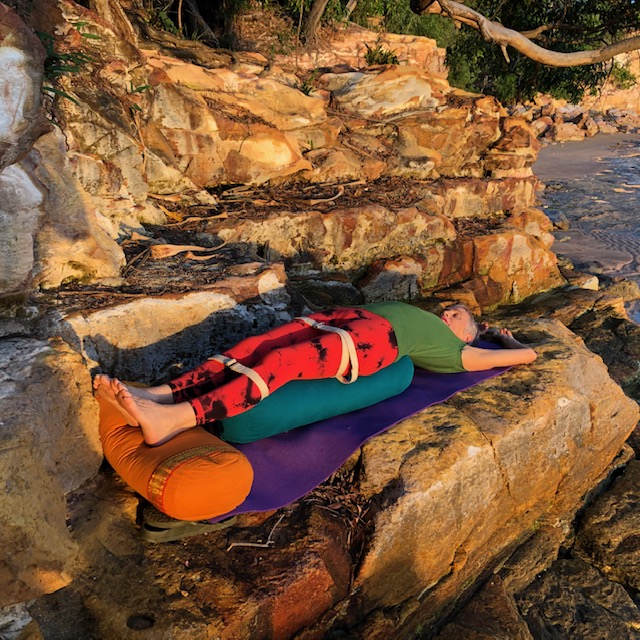
A resting head and a quiet belly. Supported forward bends like this are the tradition’s answer to heat and a busy mind.
“All the time hormonal changes will be happening at different stages in the body.”
What menopause and perimenopause are
Menopause is your last period. You know you have reached it after 12 months without one. In Australia it comes at about 51 on average. The years before it, when hormones rise and fall unevenly, are called perimenopause (“around menopause”). It usually starts in the forties, often around 47, and lasts 4 to 6 years on average, anywhere from 2 to 10. Postmenopause is the rest of life.
The first signs of menopause are often irregular periods, then broken sleep. In Yoga: The Path to Holistic Health, Geeta Iyengar lists what the change can bring:
- In the body: hot flushes and sweating, headaches, breast discomfort, weight gain, broken sleep and a general slowing down.
- In the mind: menopause mood swings, anger, low mood, anxiety and a loss of self-esteem.
- Later on: weaker bones and the first signs of osteoporosis (thin, fragile bones).
Menopause fatigue is one of the most common things women bring to class. Post menopause symptoms are often quieter but last longer: in a long US study of women through the change (SWAN), fat gain sped up and muscle fell from the start of the change, then levelled off about two years after the last period. Joints, bones and the pelvic floor need more care from then on. Every woman’s experience is different.
Three Stages, One Change
What each stage tends to bring, and where yoga helps.
- Usually starts around 47
- Lasts 4 to 6 years on average
- Irregular periods, broken sleep, mood swings, first flushes
- Yoga helps: sleep, mood, anxiety
- The last period
- Confirmed after 12 months without one
- About 51 in Australia
- Yoga helps: overall symptoms, quality of life
- The rest of life
- Muscle and bone need more care
- Joints and pelvic floor change
- Yoga helps: bone density, strength, tiredness
Ages from Jean Hailes for Women’s Health and the Australian Government Department of Health. What yoga helps: the studies listed on this page. A simplified picture.
“Maintaining the cool sensation in the brain is precision in pranayama.”
What Mr BKS Iyengar taught about menopause
In short: a supported practice of reclining poses, forward bends, standing poses and inversions, ending in slow breath and rest.
In Yoga: The Path to Holistic Health (pp. 383 to 385), Mr Iyengar sets out a yoga approach for menopause. He names the sweating, hot flushes, low mood, insomnia and mood swings it can bring. His course combines supported reclining poses, forward bends, standing poses and inversions (upside-down poses), and ends with breath practice and rest. The breaths are Ujjayi (ocean breath) and Viloma (staircase breath, taken in stages with pauses).
We do not publish his sequences. A sequence needs a teacher who can see how you are on the day and change it, which is what a class is for.
“Hence it is never too late to begin.”
What Geeta S Iyengar taught about menopause
In short: menopause is a change of gears, not an illness. Keep practising, change the practice with the day, and keep the head and nerves cool.
Geeta S Iyengar, Mr Iyengar’s daughter, wrote Yoga: A Gem for Women, the book that set out how yoga changes at each stage of a woman’s life. For women’s health, her teaching is as important as his. She went through menopause herself while teaching, and taught and wrote about it for decades: in a question-and-answer session with Mr Iyengar at Panchgani, India, in 1992, and in two articles in the Iyengar journal Yoga Rahasya in 2003.
In Yoga: The Path to Holistic Health, she writes that the hormonal change between about 45 and 55 “can lead to mental instability and physical changes” (p. 31). Her claim is that regular practice helps to balance hormones and keep weight under control. Her view of the change, in our words:
- A change of gears. Her words: “Menopause should be interpreted as a psychological and emotional shifting of gears.” In her view it is not a disease but a natural milestone, better accepted than fought, and the gears change more smoothly with practice.
- A time for yourself. She likens these years to an empty nest. After decades of living for others, a woman now has every right to use her time for her own practice.
- Never stop; change the practice. Asked what to do on tired days before a period, she began: “I will never say, ‘don’t practise’.” Even long-time students can find the hips and groins suddenly stiff at this time. Her answer is to keep going and adapt the poses.
- Do not wear yourself out in standing poses just before or during a period. Do them at the wall. On other days, do them fully.
- After each period, inversions first, before going back to backbends and strong work. In her view this settles irregular bleeding (her claim).
- Quiet poses calm you. Her words: “Straight asanas keep you cool, calm, quiet.”
Geeta Iyengar On What Each Kind Of Pose Does
Her menopause practice, by family of poses, in our words.
Broaden the pelvis and help keep bone density. Head-supported forward bends cool the brain in a flush.
Supported Bound Angle and Wide Angle poses bring calm and steady heavy or irregular bleeding.
Soothe the nerves and quieten the mind, for irritability, anger and anxiety.
For broken sleep and mood swings. In her words, they “uplift the sinking heart”.
Ujjayi and Viloma in the resting pose, to cool down and restore energy.
Geeta S Iyengar, Menopause: Practical Management Through Yoga, Yoga Rahasya, vol. 10, no. 3, 2003. Her claims, from long teaching; not yet tested in trials. She says the order of the poses matters, and that is taught in class.
What she taught for the heat, in our words:
- Breathe lying down. She taught Ujjayi and Viloma lying down, to cool down, restore energy and avoid night sweats (her claim, from long teaching).
- Rest the head. Supported forward bends and head support settle heat and a busy mind.
- Support the standing poses. Use the wall, a chair or a doorway. She relearned Warrior I in a doorway during her own menopause, and found that coming into Triangle Pose from the wide-legged forward bend cooled her flushes.
- Shorter stays when the heat comes. Her words: “When the hot flush increases then sitting is better.”
- Soft on the belly. No crunches or leg lifts while the body settles.
- Headstand only for experienced students, and never during a flush or a period.
Women’s published accounts in the Iyengar journal Yoga Rahasya show how this works in a life. One woman, Ina Dani, practised Viloma through her menopause and says it “brought peace to me as well as my family”. When she missed 4 or 5 days, her flushes came back. These are single accounts, known from practice, not trials.
What Brings A Flush On, And What Settles It
From long teaching of women through the change.
- Strong muscular effort
- A jammed neck or a squeezed belly
- Hard twists and full backbends
- Fast, vigorous sequences
- Headstand during a flush
- A resting head and a free throat
- Props, so nothing strains
- Supported forward bends
- A slow out-breath
- Ujjayi and Viloma, lying down
From Geeta S Iyengar’s teaching and Dr Timothy McCall’s menopause chapter (Yoga as Medicine, chapter 25), with Iyengar teacher Elise Browning Miller. Known from practice; not yet tested in trials.
Supported Bridge Pose over a bolster. Restful poses like this quieten the nerves, which helps the broken nights of the change.
“With problems, go down, stretch, but don’t strain.”
What Dr Timothy McCall says
In short: calm the stress that feeds the symptoms, then build bone and muscle.
Dr McCall is a US medical doctor and yoga therapist, author of Yoga as Medicine and former medical editor of Yoga Journal. His June 2019 list of conditions helped by yoga includes menopausal and perimenopausal symptoms (no. 54). His menopause chapter (chapter 25) is built around Elise Browning Miller, a senior Iyengar teacher since 1976. His points, in our words:
- Stress makes it worse. Stress is believed to worsen hot flushes and mood swings, so a calming practice fits this time of life.
- Two stages. While symptoms are active, Miller uses restful, supported work: supported standing poses at the wall or a chair, supported inversions and Bridge, ocean breath, rest and meditation. Once symptoms ease, she moves to stronger work for bone and muscle, with stronger inversions for women in their 50s and 60s.
- Bone and muscle. He links yoga with bone health and with holding on to muscle at midlife (his claim).
- A cooling breath. He mentions Sitali, the cooling breath taken in over a curled tongue.
- Watch the triggers. Full backbends, Boat Pose, strong twists, vigorous Sun Salutations and Headstand can bring flushes on in some women, so supported versions are used.
- What women report. He cites a Yoga Biomedical Trust survey in which 83% of people with menopause problems found yoga helpful.
- A restorative yoga pilot. He describes a small University of California, San Francisco study of restorative yoga. On PubMed’s figures: 14 women, eight weekly 90-minute classes, weekly hot flushes down by about 31%, and no one hurt. Small and without a comparison group, but a good start.
Two Stages, One Practice
The practice changes as the change does.
Restful, supported and cooling. Head support, supported inversions, slow breath, long rests.
Stronger standing poses and inversions, to load bone and keep muscle.
Same yoga, different dose. In a class, the teacher changes the poses with you, week by week.
Based on Dr Timothy McCall, Yoga as Medicine, chapter 25, Menopause, with Elise Browning Miller. A simplified picture.

Warrior 1, a weight-bearing standing pose. Geeta Iyengar relearned it in a doorway during her own menopause.
“The brain experiences a coolness after Pranayama. The mind becomes calm and exhilarated.”
What Dr Krishna Raman says
In short: menopause is a natural stage of life, and the practice is adapted around periods.
Dr Raman is a Chennai physician who trained in yoga under Mr Iyengar. His question-and-answer book on yoga and medical science has a women’s health section. He says little about menopause itself. His views, in our words:
- Menopause is natural. He sees it as a normal stage of a woman’s life, not an illness.
- Irregular and heavy periods. In his view inversions help with heavy flow and irregular cycles between periods, while inversions and twists are left out during a period itself (his claim, following Iyengar teaching).
“Good sleep makes consciousness brilliant. Poor sleep leaves it tarnished.”
Chris Lalor’s story, and other yoga voices
In short: women who practise through the change often find it far easier than they feared.
- Menopause came with no hot flushes and no drama. Chris Lalor, Certified Senior Iyengar Yoga Teacher and certified Yoga Therapist, came to yoga in her late 30s, looking for help with sleep. Her painful periods all but disappeared within months. By the time menopause came, she had a regular yoga and pranayama practice. Her caveat: every woman’s experience of menopause is different. Chris’s full story.
- “I tried everything. Only yoga worked.” Angie Sublime, a Darwin singer, tried hormone therapy, morning walks, a personal trainer and a dietician before she came to yoga. Angie’s menopause story.
- Yes for most menopause symptoms. Mary Flaherty, Does Yoga Work?, a careful review of the yoga research, gives yoga a yes for most symptoms of the change.
Stories from Iyengar students around the world
- Panic attacks at night, then a surprising boost. Judi Sweeting is a Senior Iyengar yoga teacher who runs the Cotswold Iyengar Yoga Centre in Cirencester, England. Her menopause began at about 53, with heavy, irregular periods and panic attacks in the middle of the night. She kept practising, and found the supported pose Viparita Karani the most helpful for the palpitations that came later. In her words, “My physical body experienced a surprising surge of ability.” Read her story on the Iyengar Yoga London (Maida Vale Institute) site.
- Hot flushes, and finding what soothes. Judith, a longstanding Iyengar yoga practitioner, had her first hot flushes at about 47. Forward bends and sitting up tall could bring one on, so she worked out which poses and ways of breathing calmed the heat. Lying down and resting poses helped most after a broken night. She says pranayama and supported poses eased her anxiety, and that past menopause, “I sense a mellower time ahead.” Read her story on the Iyengar Yoga London (Maida Vale Institute) site.
A Practice For Every Kind Of Day
The change has good days and hard ones. The practice changes with you.
Good days
Standing poses with support, for bone and muscle
Hot days
Supported forward bends, head resting, slow out-breath
Tired days
Restorative poses and supported inversions
Period days
No inversions; restful, supported poses
After Geeta S Iyengar’s guidance for women and Dr Krishna Raman’s advice on periods, as taught at Flametree.
“Right practice of pranayama soothes the nerves and quietens the mind.”
What the research shows
In short: yoga helps the symptoms that wear women down most: sleep, mood, anxiety and tiredness, and overall menopause symptom scores. Most of these studies tested yoga in general, of many styles. Why the difference matters.
The Research At A Glance
Four studies that sum up the evidence. All of them, with links, are listed below.
Yoga eased menopause symptoms overall, in body and mind. Cramer 2018: 13 trials, 1,306 women, compared with no yoga.
Mind-body exercise, yoga among it, improved sleep, mood, anxiety, tiredness and bone density. Xu 2024: 11 trials, 1,005 women in and after the change.
Yoga improved insomnia in the biggest yoga trial for menopause. Newton 2014, the MsFLASH trial: 12 weeks of classes, 107 women in the yoga group.
Mindfulness training eased how much hot flushes bothered women, about twice as much as waiting did. Carmody 2011: 110 women. Sleep, anxiety and stress improved too.
Every study is listed in full in this section, with a link to read it.
Menopause symptoms overall
- Yoga improved total, psychological, body, hot flush and sweat, and bladder and vaginal symptom scores. Against other exercise, yoga came out ahead on hot flush and sweat scores. No serious harms. Cramer 2018, a review of 13 trials and 1,306 women. Read the study.
- Yoga eased hot flush and sweat symptoms and psychological symptoms. Shepherd-Banigan 2017, a review of reviews. Read the study.
- Yoga improved menopause quality of life, including the hot flush and sexuality parts of the score. Twelve weeks of classes. Reed 2014, the MsFLASH trial, 355 women in three groups. Read the study.
- Yoga improved menopause quality of life, with gains on the hot flush and sexual parts of the score. Diem 2020, the MsFLASH trials pooled, 1,005 women. Read the study.
- Yoga improved physical quality of life. Nguyen 2020, a review of exercise trials in menopause. Read the study.
Sleep
- Yoga lowered insomnia severity and menopause symptoms, more than passive stretching or no change. Four months. Afonso 2012, a trial of 44 postmenopausal women with insomnia. Read the study.
- Yoga improved insomnia scores at 12 weeks. Twelve weekly 90-minute classes plus home practice. Newton 2014, the MsFLASH trial, 107 women in the yoga group. Note: this trial did not change how often flushes came. It tested a general yoga programme, not Iyengar yoga with its cooling, supported approach to heat. Iyengar yoga has not yet been tested for flushes. Why it matters. Read the study.
- Yoga lowered insomnia and sleep quality scores. Guthrie 2018, four MsFLASH trials pooled, 546 women with insomnia and hot flushes. Read the study.
- Yoga was among the most robust non-drug options for menopause insomnia. Bruyneel 2026, a review of 24 trials. Read the study.
- Yoga improved sleep quality in women. Wang 2020, a review of 19 studies and 1,832 women. Read the study.
Mood, anxiety, tiredness and bones
- Mind-body exercise, yoga among it, improved bone density, sleep, anxiety, low mood and tiredness. Xu 2024, a review of 11 trials and 1,005 women. Read the study.
- Mind-body practice eased poor sleep, low mood and anxiety by moderate to large amounts. Fan 2025, a review of 18 trials and 1,572 women. Read the study.
What The Trials Found Yoga Helps
Across the studies on this page.
Sleep
insomnia and sleep quality scores fell
Mood and anxiety
moderate to large gains
Tiredness
less fatigue with mind-body exercise
Bone density
improved with mind-body exercise
Overall symptoms
body and mind, and quality of life
Cramer 2018, Xu 2024, Fan 2025, Newton 2014, Reed 2014 and the other studies listed here.
Restorative yoga
- Weekly hot flushes fell by about 31%, and the flush score by about 34%. Eight weekly 90-minute classes of restorative yoga; 93% stayed to the end and no one was hurt. Cohen 2006, a pilot of 14 women with no comparison group. Read the study.
Iyengar yoga studies
No trial has yet tested Iyengar yoga, taught by trained Iyengar teachers, on its own for menopause. Not yet studied is not the same as not working. The Iyengar evidence for these years is Geeta Iyengar’s long teaching and women’s published accounts, such as Ina Dani’s.
- Bladder leaks fell by about two thirds. Twelve weeks of a pelvic yoga programme informed by Iyengar yoga, in women aged 45 to 90. Huang 2024, a trial of 240 women. Read the study.
The Research On Yoga And Mind-Body Practice In Menopause
Five large studies, over 6,500 women. Each found a benefit.
Better menopause symptoms, sleep, mood and less stress. Wang 2025, mindfulness: 1,670 women, 19 studies.
Better sleep, less low mood and anxiety. Fan 2025: 1,572 women, 18 trials.
Better overall menopause symptoms. Cramer 2018: 1,306 women, 13 trials.
Better bone density, sleep, mood and less tiredness. Xu 2024: 1,005 women, 11 trials.
Better menopause quality of life. Diem 2020, MsFLASH pooled: 1,005 women.
Bar length shows the number of women in each study. Teal: yoga and mind-body exercise. Blue-grey: mindfulness. Studies overlap, so some women are counted twice.
Meditation and mindfulness
These trials tested mindfulness programmes, not pranayama. The results are strong for the mind, and pranayama trains the same steady attention through the breath.
- Mindfulness training made hot flushes less bothersome, about twice as much as waiting, and improved quality of life, sleep, anxiety and stress. Bother fell 21.6% against 10.5% at 20 weeks. Carmody 2011, a trial of 110 women. Read the study.
- Mindfulness programmes improved menopause symptoms, quality of life, sleep, anxiety, low mood and stress. Wang 2025, a review of 19 studies and 1,670 women. Read the study.
Breathing practice (pranayama)
No trial has yet tested pranayama on its own for menopause. Not yet studied is not the same as not working. A large trial of breathing paced by a device found every group improved, including those breathing normally; that was a breathing machine, not pranayama taught by a trained teacher. Geeta Iyengar’s menopause breaths, Ujjayi and Viloma, are slow, nasal and taught step by step, and the cooling breaths Sitali and Sitakari have been taught for generations. Why the kind of breathing matters.
“You may not disclose your age but the muscles tell you what your age is.”
How this comes together in a Flametree class
Everything above points the same way, and it is how we teach.
- Props in every class: bolsters, chairs, blocks, belts and the wall, so you can stay in a pose without strain.
- Classes adapted to the people in them. No one-size-fits-all. Tell your teacher if it is a hot day, a tired day or a period day, and the poses are changed for you.
- Strong legs, strong bones: standing poses load the hips and spine, for the years after menopause.
- Cool in the Darwin build-up: on the hottest, stickiest days we give more supported forward bends, more head support and more slow breathing.
- Classes for these years: our Women’s Wellness, gentle yoga and restorative yoga classes, and our pranayama classes.
Read more on menopause and perimenopause
- Yoga for menopause and perimenopause: the research, and the poses we use
- Hot flushes: why they come, and what helps you ride them out
- Yoga for perimenopause: leaks, the pelvic floor and the 3am mind
- How long does menopause last? The three stages
- Perimenopause insomnia
- Menopause joint pain
- Frozen shoulder and menopause
- Menopause belly
- Painful intercourse after menopause
- Chris’s menopause story, with video
- Angie’s menopause story, with video
- Fuzzy thinking from menopause
- All our perimenopause and menopause notes
Take it further
This guide gives you the facts on what helps. The ebook has even more, including the stories of women it has helped. Go and do the free classes, see what you think, and then a pass puts it all into action.
Free ebook: Cool, Calm And Strong. Yoga for perimenopause, menopause and beyond: flushes, sleep, leaks and bones, with Chris’s and Angie’s stories.
New to Flametree, or away 3 months or more? 2 free classes + 2 ebooks, only available via this offer. Already a student? You can still get this book. Get your free copy of Cool, Calm And Strong
- Classes, in Darwin or LIVE online: new, or away 3 months or more? 2 free classes, then 10 at half price. Already practising yoga? See the non-beginner half price pass. See every class time.
- Masterclasses: bones need more care after menopause. Chris Lalor’s Yoga For Bone Strength live online masterclass runs again on Sunday 15 November. Our 2027 Sunday Arvo Masterclasses include sleep and energy, and the pelvic floor, two of the big issues of the change. Bookings open soon.
- Retreats: a week of daily, adapted yoga in Bali. See the retreats.
Other conditions are in our encyclopaedia of yoga for health conditions.
Menopause and perimenopause symptoms: questions people ask
What did Mr BKS Iyengar teach about menopause?
In Yoga: The Path to Holistic Health (pages 383 to 385), Mr Iyengar sets out a yoga approach for menopause that combines supported reclining poses, forward bends, standing poses and inversions, and ends with breath practice and rest. His daughter Geeta Iyengar taught the menopause breaths, Ujjayi and Viloma, lying down, and advised resting the head and keeping stays short when the heat comes.
Which doctors who worked with Mr Iyengar have written about menopause?
Dr Timothy McCall gives menopause a full chapter in Yoga as Medicine, built around senior Iyengar teacher Elise Browning Miller, and lists menopausal and perimenopausal symptoms as no. 54 on his list of conditions helped by yoga. Dr Krishna Raman, a Chennai physician who trained with Mr Iyengar, covers periods and the change in his question-and-answer book on yoga and medical science.
Can yoga help menopause mood swings and irritability?
Yes. Reviews of menopause trials found yoga and other mind-body practice eased low mood and anxiety by moderate to large amounts. Dr McCall notes that stress is believed to worsen mood swings, and slow breath practice calms the nerves. Many women in our Darwin classes say they feel steadier within weeks.
Can yoga help menopause fatigue?
Yes. A 2024 review of 11 trials with 1,005 women found mind-body exercise, yoga among it, reduced tiredness and improved sleep, mood and anxiety. On tired days an Iyengar class uses restorative poses and supported inversions, so you leave with more energy than you came with.
Is yoga safe during a heavy or irregular perimenopause period?
Yes, with changes. In the Iyengar tradition inversions and strong twists are left out during a period, and restful, supported poses are used instead. Geeta Iyengar advised that headstand is never done during a period or a flush. Tell your teacher, and the poses are changed for you.
What post menopause symptoms can yoga help?
After menopause, bone and muscle need more care, and joints and the pelvic floor change. Mind-body exercise improved bone density in a 2024 review, and standing poses load the hips and spine. In a 2024 trial, a pelvic yoga programme informed by Iyengar yoga cut bladder leaks by about two thirds in women aged 45 to 90.
How often should I do yoga for perimenopause symptoms?
Several times a week, for 8 to 12 weeks or more. The MsFLASH trial used 12 weekly 90-minute classes plus home practice. Ina Dani, who practised Iyengar yoga through her menopause, found her symptoms returned if she missed 4 or 5 days. Flametree classes run in Darwin, at Woolner and Coolalinga, and LIVE online.
What was Chris Lalor’s experience of menopause?
Chris Lalor, Certified Senior Iyengar Yoga Teacher and certified Yoga Therapist, came to yoga in her late 30s. Her painful periods all but disappeared within months, and menopause later came with no hot flushes and no drama. Her caveat: every woman’s experience of menopause is different.
Where this comes from: BKS Iyengar, Yoga: The Path to Holistic Health (Dorling Kindersley), the menopause course (pp. 383 to 385) and Geeta S Iyengar’s introduction on yoga for women (p. 31). Geeta S Iyengar, Yoga: A Gem for Women; “Menopause: The Indian Perspective” and “Menopause: Practical Management Through Yoga”, Yoga Rahasya, vol. 10, no. 3, 2003; her menopause question-and-answer session at Panchgani, 1992 (transcript in Yoga Vaani, September 2002); and her 1996 Sydney women’s classes. Timothy McCall MD, Yoga as Medicine (Bantam), chapter 25, Menopause, and his June 2019 list of health conditions helped by yoga. Krishna Raman MD and S. Suresh MD, Yoga and Medical Science: FAQ. Mary Flaherty, Does Yoga Work?. Chris Lalor, Cool, Calm And Strong (Flametree ebook). Jean Hailes for Women’s Health and the Australian Government Department of Health, on the stages of menopause. Greendale and colleagues, SWAN body composition study, JCI Insight, 2019. Studies as linked above. Everything is summarised in our own words.
This page is general information, not medical advice. Flametree Yoga Studio, Darwin and LIVE online.
