
Iyengar Quotes On Meditation And The Mind, Explained

Iyengar quotes on meditation and the mind: the short version
Why does the mind get louder the moment you try to be quiet? You are not alone. Mr BKS Iyengar, Geeta Iyengar and Prashant Iyengar all spoke about this. These Iyengar quotes on meditation and the mind are short, honest and often funny. They say what meditation is, what it is not, and why a busy mind is the reason to practise.
This page in short form
- Meditation is not just closed eyes: it is quiet and awake together.
- Concentration and meditation differ: one holds a point, one does not.
- A busy mind is normal: it is why we practise.
- Body, breath, mind: work on the body and breath and the mind often follows.
- You cannot force stillness: you can only set the scene.
- Try it: your first class is free if you are new to Flametree.
Iyengar yoga is the style developed by Mr BKS Iyengar. In the 20th century he did more than anyone to set down traditional Indian yoga, through his books and his teaching, and he pioneered the use of props. It is sometimes called modern classical yoga, and it’s the style we teach at Flametree. His daughter Geeta and his son Prashant trained with him and became senior teachers in their own right, and you will meet their words on this page too.
Quotes appear here in the words of Mr Iyengar, Geeta Iyengar and Prashant Iyengar, each with where it comes from. Our notes underneath say what it means and where you may meet it in a class. All the quotes are short, credited extracts. Pages for the other topics are listed at the bottom, and the main quotes page has them all.

Twist from the base of the spine and keep the chest lifting.
What did Mr Iyengar say meditation is, and is not?
He liked plain pictures: instant coffee, a cow, an Olympic final.
If closing the eyes and remaining silent is meditation, then all of us are meditating every day eight or ten hours in our sleep.
What it means: Mr Iyengar had a sharp sense of humour here. Shutting your eyes and sitting quietly is not, on its own, meditation. If it were, we would all be meditating for eight hours every night. In the Iyengar tradition meditation is something the mind does, not something that happens because the lights are off.
Read more: Meditation classes and how Flametree teaches them.

Chris Lalor seated on a block with a belt, watching the sunset over the sea in Darwin.
Meditation is really to do everything with love…
What it means: For Mr Iyengar, meditation is not only something you do sitting still with your eyes closed. It is a way of doing everything, with full attention and with care.
So meditation starts on the mat, in how you place your feet in a standing pose, and carries on off it, in how you wash the dishes or listen to a friend.
Read more: Stillness in yoga, Meditation classes in Darwin.
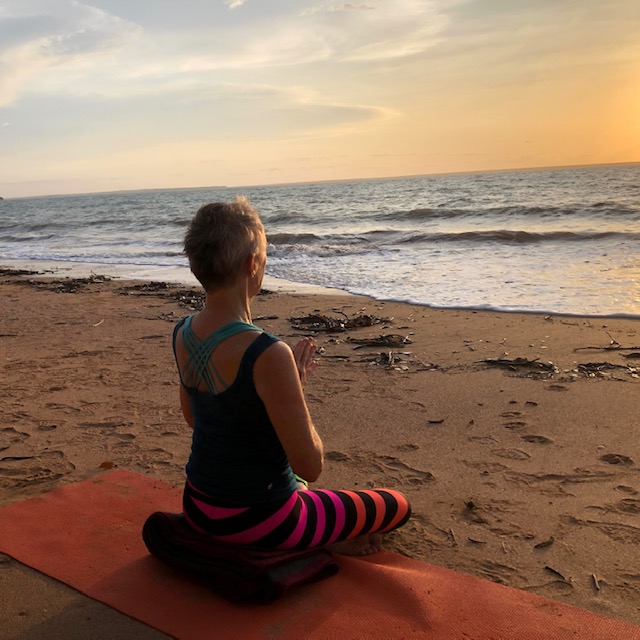
A steady, upright seat comes first, before any meditation.
Nowadays dhyana (meditation) has become like instant coffee.
What it means: Dhyana (the Sanskrit word for meditation) has become a quick fix, he said, like instant coffee. Add water, stir, done. Real meditation, in his view, is built slowly from the steps before it: living well, moving well, breathing well. You cannot skip to the last step and expect it to hold.
Read more: The eight limbs of yoga in plain words.
Meditation is the imitation of deep sleep in the wakeful state.
What it means: Think about how you feel in deep sleep: nothing to do, nothing to prove. Meditation is a kind of copy of that, but you are awake for it. Awake and quiet at the same time is the tricky part. It is why meditation takes practice and a nap does not.
Read more: Savasana: how to relax properly at the end of class.
Yogic meditation is not a benign somnolence or torpor. It is not placidity. A cow is placid, without practicing yoga.
What it means: Mr Iyengar did not want meditation mixed up with feeling dopey. Being calm and being dull are different things. A cow looks peaceful all day, he said, without any yoga. Meditation in the Iyengar tradition is quiet but alert, like a very clear glass of water.
Read more: Stillness in yoga.

Sit tall and let the breath do the work.
Concentration has a point of focus; meditation has no points. That is the secret.
What it means: This is a lovely way to tell two things apart. In concentration you hold the mind on one thing, such as the tip of your nose or the sound of a bell. In meditation the mind is not gripping anything, so there is no point to hold. Many students find it easier to practise concentration first, because you can feel when your attention has slipped.
Read more: Meditation classes in Darwin.
My asana is meditative…
What it means: Mr Iyengar did not keep meditation apart from the poses. When the attention is complete, the pose itself becomes meditation.
You do not need to wait for an advanced class. Any pose held quietly, with the mind on what the body is doing, is a step in this direction. Savasana at the end of class is a good place to feel it.
Read more: The eight limbs of yoga in plain words, Savasana: how to relax properly at the end of class.
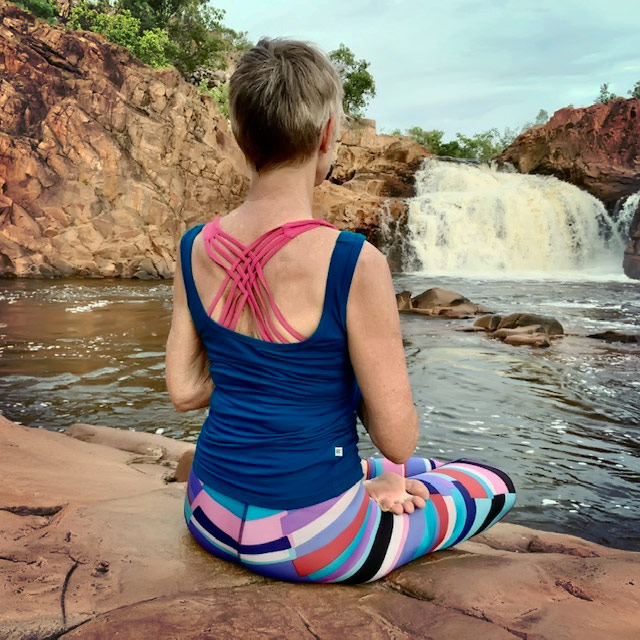
A steady, upright seat comes first, before any meditation.
I meditate, not sitting in a corner, but in every movement of life, in every position I perform, in every asana.
What it means: Mr Iyengar did not keep meditation for a cushion in the corner. He said he meditated in every movement and in every pose. That means paying such steady attention to the pose that the mind stops wandering. In class, you might notice it when you hold Tadasana (Mountain Pose) and realise you have not thought about your shopping list for a whole minute.
Read more: Mountain pose: how to stand properly | Yoga for body, breath and mind.
What does a quiet mind feel like?
Geeta and Prashant describe it with rivers, fullness and the sound of silence.
In meditation the mind is still but razor sharp, silent but vibrant with energy.
What it means: He describes a mind that is still and sharp at once. People often expect meditation to feel fuzzy or sleepy. This is the opposite: clear, awake and quiet. It is a good thing to hold in mind when your practice feels dull. Dull is not the goal.
Read more: Stillness in yoga.

A forward bend with support lengthens the back of the legs.
This state of mind is not an emptiness, but a fullness.
What it means: Geeta corrected a common idea. Many people think a good meditation is an empty head. She described a state that is full, not empty, like a glass filled to the brim and perfectly steady. Nothing is missing. Everything has just settled.
Read more: Yoga philosophy and Iyengar yoga: our Yoga Notes.
The deeper the waters of a river, the more quietly it flows. Similarly, the deeper the focusing of the citta, the more tranquil is the state.
What it means: Shallow streams splash and chatter. Deep rivers hardly make a sound. Geeta used that picture for the mind. Citta (the Sanskrit word for the mind, the part that thinks and feels) becomes quiet as it focuses more deeply. So if your mind is noisy, it may just mean it has not gone deep yet.
Read more: More on attention and awareness.
Silence has acoustics.
What it means: Prashant’s short line asks you to listen to silence. Try it for a moment. A quiet room is full of small sounds: a fan, a bird, your own breath. Silence is not nothing. It has texture and shape if you pay attention. It is a nice way into practice, because you start by noticing instead of trying.
Read more: Stillness in yoga.

A tall, steady seat is where the mind begins to settle.
In fact there is a pause of a few moments or a moment between each thought just as there is a full stop after every sentence. But these pauses go unnoticed by us.
What it means: Between one thought and the next there is a small gap, just as there is a full stop at the end of a sentence. We rush past it. This line, from the teachers’ guidelines written by Mr Iyengar and Geeta together, suggests the gaps are already there. Meditation practice is partly learning to notice them.
Read more: Stillness in yoga.
Why is the mind so busy?
If your head is noisy when you try to sit still, these quotes will sound familiar.
Mind produces thought and image all the time, like a television with no off switch.
What it means: Most of us know this feeling. The mind chatters all day, whether we ask it to or not. Mr Iyengar’s picture is a television with no off switch. The aim of practice is not to smash the television. It is to learn to turn the volume down and to choose what you watch.
Read more: Pranayama keeps me sane.
Have you ever noticed that when we have a problem we say, “Shh! Wait, let me think”? But what we really mean is “Shh! Wait, let me stop thinking.”
What it means: When we say “Let me think”, what we often want is quiet. The first thing a busy mind needs is a pause. This is a good small experiment: next time you have a problem, stop for ten slow breaths before you try to solve it. Mr Iyengar’s joke has a kind point. Thinking harder is not always thinking better.
Read more: Yoga for anxiety.
The mind can be a secret enemy and a treacherous friend.
What it means: Your mind can be your best helper or your worst critic, sometimes in the same hour. Mr Iyengar called it a secret enemy and a treacherous friend. The word “secret” matters, because we often do not notice it is working against us. Yoga practice is partly about getting to know your mind so it is more on your side.
Read more: Quotes on stress.

A wide-legged forward bend calms the mind.
As leaves move in the wind, your mind moves with your breath.
What it means: Watch leaves on a tree when the wind picks up. Your mind does the same thing with your breath. When the breath is rough and fast, the mind is restless. When the breath is smooth and even, the mind tends to follow. This is why Iyengar classes spend time on breathing before asking the mind to be still.
Read more: Yoga and breathing: our Yoga Notes | Quotes on the breath.
Chris Lalor seated on a bolster with her hands closing her eyes and ears in a quiet breath practice.
It is the nagging mind that expresses that yoga is hard. It is the mind that has the problem and not yoga.
What it means: When you think “this is too hard”, Mr Iyengar suggests asking who said it. Often it is the nagging mind, not the body. This is not about ignoring pain or pushing through. It is a gentle reminder that some of our “I can’t” is old habit. Try the pose, watch the voice, and see what is true.
Read more: Starting yoga at 40, stiff: Chris Lalor tells her story | Quotes for beginners.
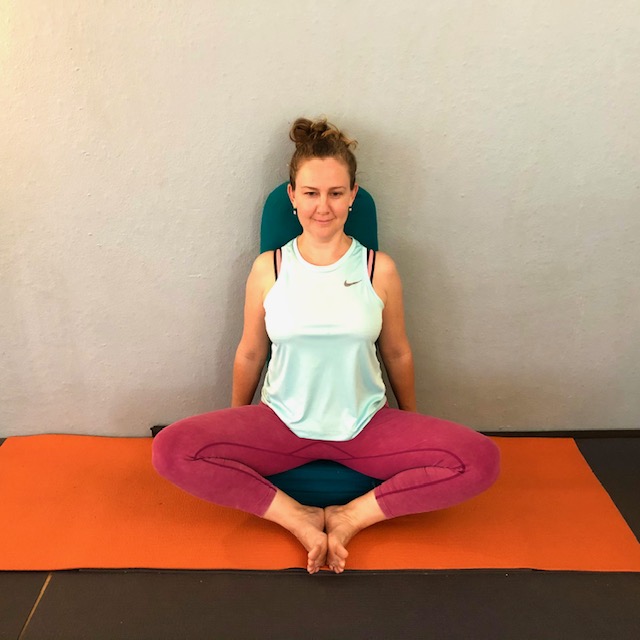
Bound angle pose with support opens the hips without strain.
If there was equilibrium of the mind then we would not have to do yoga. There is un-equilibrium. We have to do yoga to bring equilibrium of the mind.
What it means: Geeta’s logic is simple. If the mind were already steady, nobody would need to practise. Yoga exists because it is not. This is a kind thing to remember. A busy, unsettled mind is not a sign you are bad at yoga. It is the reason to do it.
Read more: Yoga for body, breath and mind | Quotes on practice.
Can you force the mind to be still?
The short answer from the Iyengar family is no. The longer answer is that you can prepare.
You can do everything up to it, but it happens when it happens. You can force a piano up three flights of stairs, but you cannot force the febrile human mind to be still.
What it means: You can drag a piano up three flights of stairs if you push hard enough. You cannot drag a restless mind into stillness the same way. You can do everything leading up to it, such as the poses, the breathing and the quiet time, but the stillness itself arrives when it arrives. Effort sets the scene. It does not command the result.
Read more: Managing effort in your yoga practice | Quotes on effort and discipline.

Seated forward bends lengthen the back of the legs and soothe the mind.
Meditation is the Olympic final for yoga. You cannot turn up half fit. All the preceding stages of yoga have served to train you up to tip-top condition.
What it means: A runner does not turn up to the Olympic final without training. Mr Iyengar said meditation is like that. The earlier steps of yoga, including poses, breath and a steady way of living, train you up for it. So if meditation feels hard right now, keep doing the poses. They are the training.
Read more: The eight limbs of yoga in plain words | Quotes on practice.
You can never do pranayama with an upset mind.
What it means: Pranayama (breathing practice) asks for a mind that can follow instructions. If you are upset or agitated, it is hard to do well. Mr Iyengar’s advice, passed on through his teaching, is to settle first. In class this is often done with poses and a steady lying-down rest, before any breath practice begins.
Read more: Pranayama keeps me sane | Quotes on the breath.
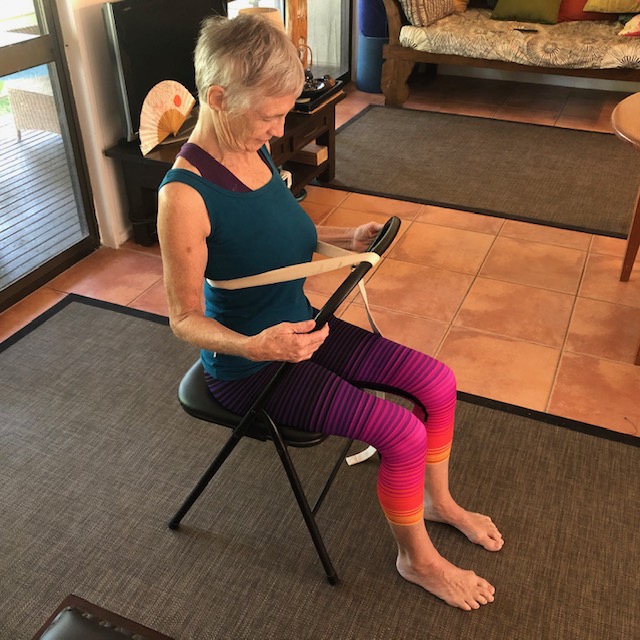
Chris Lalor seated on a chair with a belt around her upper back for breath practice.

Lying supported lets the breath slow and the body settle.
You should never allow the mind to wander. … A straight line is a difficult one, but it brings its own fruits…
What it means: Keeping the mind on one track is hard, and Mr Iyengar admits it: the straight line is the difficult one. But staying with it pays off in its own way.
In a pose, a wandering mind shows up as a sagging knee or a dropped chest. Each time you notice and bring your attention back, you are walking that straight line.
Read more: Yoga for anxiety, Managing effort in your yoga practice.
You say, Mind over matter. I say, Matter over mind.
What it means: People often say “mind over matter”. Mr Iyengar flipped it. He started with the body (matter) because that is where we can get hold of something. A restless mind is hard to grab, but a spine, a hip or a breath is not. Work with the body carefully and the mind often follows.
Read more: Quotes on the body and alignment.
Related Flametree pages
- Meditation Classes Near Me
- Stillness In Yoga
- Yoga For Body, Breath And Mind
- Yoga For Relaxation, Stress And Sleep: Notes And Articles From Flametree
- Yoga Philosophy And Iyengar Yoga: Notes And Articles From Flametree
More Iyengar quotes, by topic
- Attention And Awareness
- The Breath And Pranayama
- Relaxation, Rest And Sleep
- Stress
- Philosophy, The Sutras And The Ego

Supported rest is the heart of a restorative practice.
From class notes
Summaries made by students who took notes in classes taught by Geeta, Prashant or Mr Iyengar. They are the note-takers’ wording, not exact words, so they are not shown as quotes. Each is put in plain English as reported speech, with the class, place and year.
From class notes: Geeta taught that you have to develop a meditative nature before you attempt meditation.
Class notes, Geeta S Iyengar, talk in South Africa, 2011 #
What it means: Meditation is not something you switch on by sitting down. The calm, steady quality has to be built first, through the way you practise poses and breathing. For most of us that means a few years of paying close attention in ordinary classes. If you have tried to sit and found your mind racing, this is encouraging: it points you back to your asana and breath practice as the training ground.
Read more: Meditation classes and how Flametree teaches them · Stillness in yoga
From class notes: Mr Iyengar taught that concentration in meditation is open. There is no focal point, and the mind is not out and wandering.
Class notes, Mr Iyengar, Pune, 1997 #
What it means: Meditative attention is wide, not a narrow stare. Many people picture meditation as gripping one point very hard. Mr Iyengar described something looser: the mind stays present and is neither fixed on a spot nor wandering off. You can get a taste of it at the end of class, when you are resting, awake and aware of the whole body at once.
Read more: Meditation classes and how Flametree teaches them · Stillness in yoga
From class notes: Geeta taught that the work is not just physical. It is opening the mind.
Class notes, Geeta S Iyengar, class in Twin Waters, Australia, 2009 #
What it means: The pose is the doorway, and the mind is the room. Geeta kept reminding students that moving the body is only part of the task; the point is what happens to attention while you move. When you hold a pose, ask what your mind is doing: is it curious, or counting the seconds? Opening the mind means staying interested in the pose rather than waiting for it to finish.
Read more: Yoga for body, breath and mind · Stillness in yoga
From class notes: Geeta taught that sometimes you should just learn how to sit.
Class notes, Geeta S Iyengar, Pune, 1997 #
What it means: Sitting well is a skill worth its own practice. Sitting upright and still for even ten minutes shows you how the back, hips and mind behave when nothing else is going on. Use a folded blanket under the hips if your knees rise above your hips, and let the spine lift without strain. Many teachers find that simply learning to sit properly changes everything that comes after.
Read more: Meditation classes and how Flametree teaches them · Using props in yoga: cheating or teaching?
From class notes: Geeta said that when a student’s mind stays with the shinbone, that is called dharana.
Class notes, Geeta S Iyengar, Sydney, 2003 #
What it means: Dharana is simply steady attention on one thing. In the old texts it is one of the later limbs of yoga, and it sounds distant. Geeta pointed out that it shows up in an ordinary class: a student who keeps her mind on one part of the leg through a whole pose is already practising it. So meditation and a standing pose are not opposites; they are the same skill used in different places.
Read more: The eight limbs of yoga in plain words · Stillness in yoga
Frequently asked questions
What did BKS Iyengar say about meditation?
He said meditation is not just closing your eyes and staying quiet, because we do that in sleep every night. He described it as a mind that is still but razor sharp, and as the final test of yoga that you train for with everything before it. He also said he meditated in every pose he performed.
Is meditation different from concentration in Iyengar yoga?
Yes. Mr Iyengar said concentration has a point of focus and meditation has no points. In concentration you hold the mind on one thing. In meditation the mind is not gripping anything. Most students find concentration easier to learn first.
Why is my mind so busy when I try to be still?
Because that is how a mind works. Mr Iyengar compared it to a television with no off switch, and Geeta Iyengar said that if the mind were already steady we would not need yoga. A busy mind is a reason to practise, not a sign you are failing. Poses and breathing practice often help it settle first.
Where can I practise this kind of meditation in Darwin?
Flametree Yoga Studio in Darwin teaches Iyengar yoga in the studio and LIVE online, and the poses and breathing are the training for stillness. Your first class is free if you are new to Flametree. The meditation classes page and the timetable linked below show what is on.
Practise this at Flametree
Your first class is free if you’re new to Flametree. New students, and anyone who has been away three months or more, can also get a half price 10 class pass, in the studio or LIVE online.
- Beginners: see the half price 10 class pass for new and lapsed students
- Already done some yoga: see the half price 10 class pass for new and lapsed students
- See the timetable, including online classes
Can’t make a class? Practise at home with our video courses.
Flametree Yoga Studio teaches Iyengar yoga in Darwin and LIVE online. This page is general information about meditation and the mind, not medical advice. Every quote is a short, credited extract, and the notes under each one are Flametree’s own words.
