
Iyengar Quotes On Awareness And Attention, Explained

In short: The Iyengars said to look, not just see. Pay attention from the inside, notice the part of the body that is asleep, and be present, because the present is the perfect pose. Better perception leads to better actions. These are short lines from Mr Iyengar, Geeta and Prashant.
Iyengar quotes on awareness: the short version
Are you in your pose, or just near it? That’s the question behind most of what the Iyengar family taught about attention. These Iyengar quotes on awareness are short lines from Mr BKS Iyengar, his daughter Geeta and his son Prashant, each with a plain-English explanation and a way to see it in class. They are about looking carefully, being in the present moment, and paying attention from the inside.
These Iyengar quotes on awareness in short form
- Look, don’t just see: attention that is switched on.
- Notice what’s missing: send the eyes to the part that’s asleep.
- Be here now: the present is the perfect pose.
- Go inside: the body performs and the brain observes.
- Perceive, then act: better perception leads to better actions.
Iyengar yoga is the style developed by Mr BKS Iyengar. In the 20th century he did more than anyone to set down traditional Indian yoga, through his books and his teaching, and he pioneered the use of props. It is sometimes called modern classical yoga, and it’s the style we teach at Flametree. His daughter Geeta (1944 to 2018) and his son Prashant, who still teaches in Pune, became teachers too.

Tree pose trains balance, and a wall is always welcome.
What is the difference between looking and seeing?
You must not seek, you must search. You must not see, you must look at. You must not hear, you must listen to. You must not touch, you must palpate. You must not smell, you must sniff.
What it means: It sounds like word play, but each pair is a step up. Seeking becomes searching, seeing becomes looking, hearing becomes listening, touching becomes palpating (feeling with care, as a doctor would). Mr Iyengar is describing attention that’s switched on rather than left on autopilot. In class that’s the difference between going through a pose and actually meeting it.
Try this: Next time you stand in Mountain Pose, feel the soles of your feet as if you were reading them with your fingertips.
Read more: Mountain pose: how to stand properly · More quotes on learning
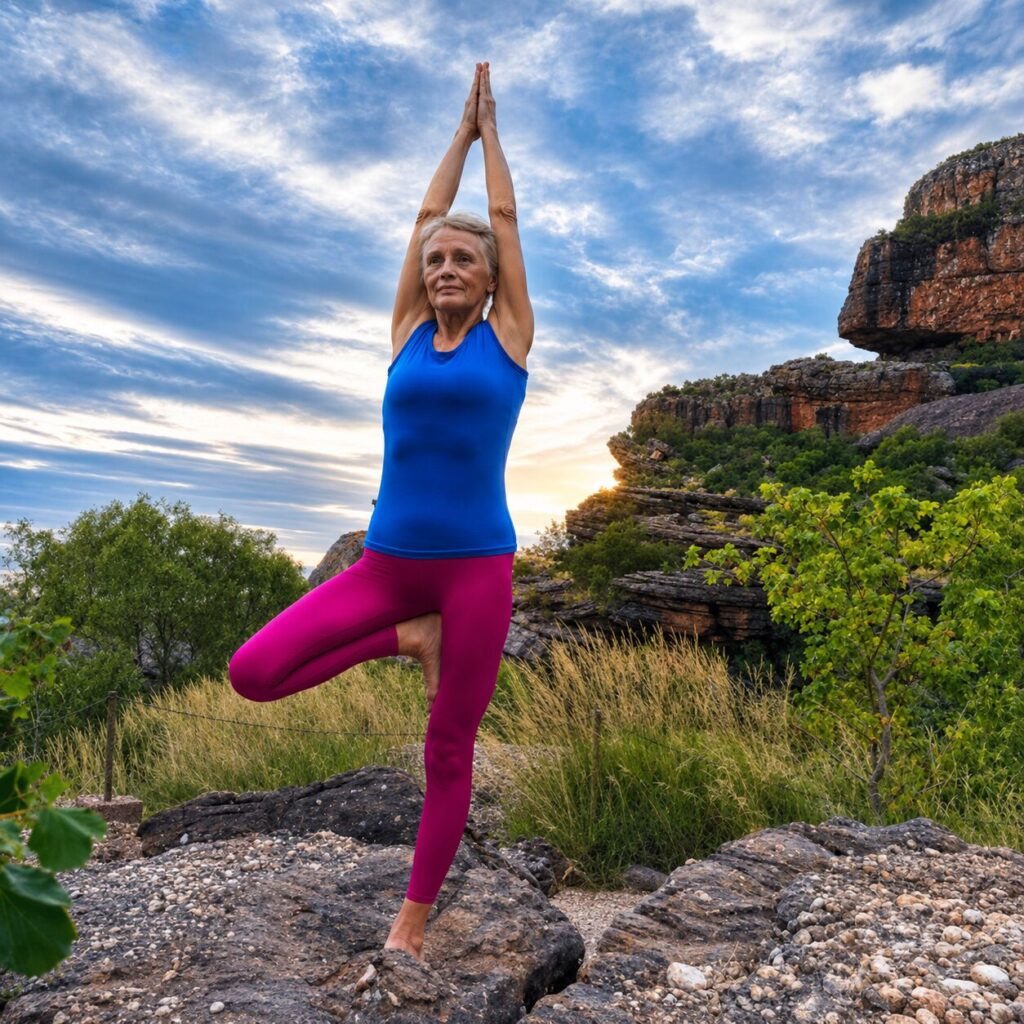
Balance is practised, and it can be learned at any age.
The art of yoga lies in the acuity of observation.
What it means: Observation is the art. The pose is the raw material, and seeing clearly what’s going on in it is the skill. Two people can hold the same shape: one is looking inside it, the other is waiting for it to end. Iyengar yoga is detailed because the details are where the looking happens.
Read more: Yoga for body, breath and mind · Pose and practice notes
A hunter hunts in the jungle, I hunt within me.
What it means: A hunter watches the jungle for movement. Mr Iyengar says he does the same thing inside himself, watching for the small movements in the body and mind. It’s a fun picture for anyone who finds “pay attention” too vague. Attention can be active, alert and a little bit playful.
Read more: Stillness in yoga

Standing balance builds steadiness in the feet and ankles.
We do not say of a deer in the forest, “Look, he’s concentrating.” The deer is in a state of total vibrant awareness in every cell of his body.
What it means: Nobody says a deer is “concentrating”. It’s simply awake to everything through the whole body. That’s a different feel to gritting your teeth and trying to focus. Awareness like this is wide and relaxed, and it can be trained a little at a time through practice.
Read more: More quotes on the mind and meditation
Consciousness is potentially in every cell of our body, but most of us are comatose.
What it means: A cheeky line with a real point: awareness could reach every part of us, but most of the time it only reaches a few. Here “comatose” is a joke about how little of the body we notice. Standing poses are a good test: can you feel your left little finger, your right heel, your back ribs, all at once?
Read more: More quotes on the body and alignment

Warrior three builds balance, strength and focus.
Take each pore of the skin for a conscious eye.
What it means: Imagine every pore in your skin is a tiny eye. It’s a way of spreading your attention out to the surface of the whole body. In a stretch, you may notice you’ve been only paying attention to one spot. This asks you to widen the look.
Read more: More quotes on the body and alignment
Even the little toe has to work to retain its awareness.
What it means: Even the smallest toe has a job to do in standing poses. If it goes dead, the foot gets lazy and the leg above it follows. Feeling the little toe is a simple, practical way to wake up the whole base of a pose.
Read more: Mountain pose · More quotes on the body and alignment

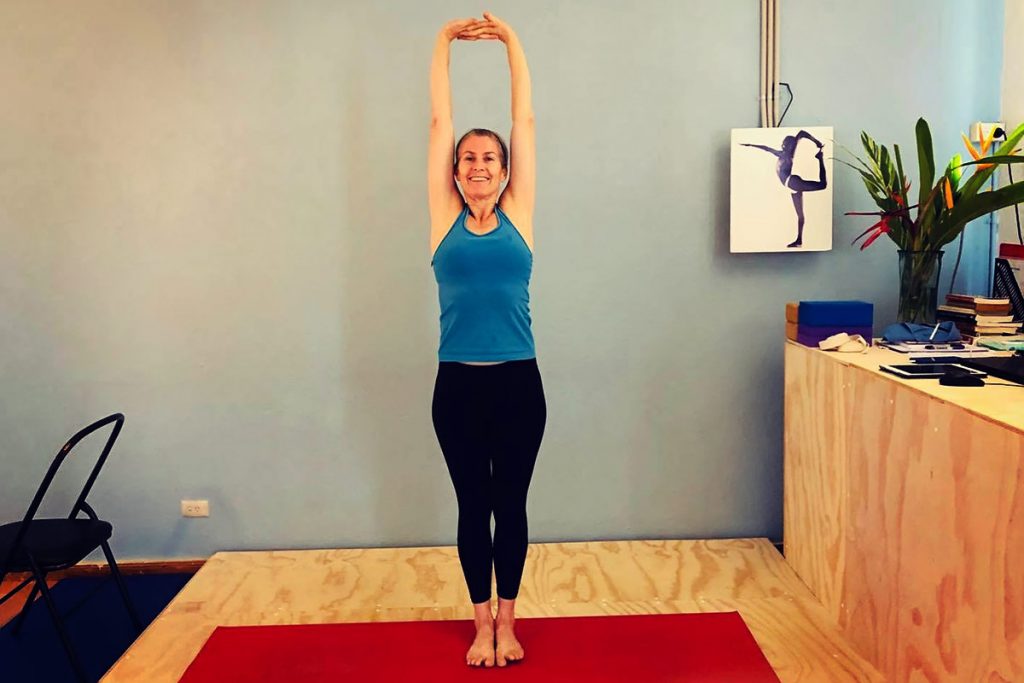
Mountain pose is the base for all the standing poses.
The eyes must go to the region that does not work, not to the one that does.
What it means: This is a teaching tip: send your attention to the part that’s asleep, not the part that’s already busy. In a twist or forward bend, the stretching side shouts and the lazy side stays quiet. Look at the quiet part and it often wakes up.
Read more: Are twists bad for your back? How to twist safely · Seated forward bend

Standing balance builds steadiness in the feet and ankles.
It is never a question of what I am doing but what am I not doing.
What it means: Most of us ask “What am I doing?” Mr Iyengar asks “What am I not doing?” Maybe the back leg isn’t working, or the breath isn’t moving into the ribs. It’s a question that keeps your attention curious and your pose growing.
Read more: Triangle pose: why it feels hard, and how props help

Pupils should be self-aware, not self-conscious.
What it means: Self-aware means you notice what you’re doing. Self-conscious means you worry what others think. The first helps you learn, the second makes you stiff. A class is a good place to practise the first, because everyone’s busy with their own pose.
Read more: More quotes for beginners · What to wear to a yoga class
How do you bring attention into the present moment?
The present is the perfect pose.
What it means: The present is the perfect pose. Not the pose you did last week, or the one you hope to do next month, but being fully here in this one. It’s a lovely way to turn a hard day around, too.
Read more: More quotes on life and happiness

Mountain pose is the base for all the standing poses.
Your bodies are in the past; your minds in the future. When you do yoga, they come together in the present.
What it means: Our bodies are heavy with the past (habits, old injuries, stiffness) while our minds run ahead (to-do lists, worries). Yoga puts them together in the present. You may feel this in the first quiet minute of a class, when the planning mind slows down.
Read more: More quotes on the mind and meditation · Savasana: how to relax properly at the end of class
An absent-mindedness is night, whereas the present-mindedness is day. You will enjoy the asanas, when you have present-mindedness.
What it means: Absent-mindedness is night, present-mindedness is day. Mr Iyengar says you enjoy the pose when your mind is there. A tired mind can be woken by something simple, such as giving the feet a task or counting the breath.
Read more: Managing effort in your yoga practice

Twist from the base of the spine and keep the chest lifting.
It is impossible, when we turn our attention to the inner movement of breath, to use our senses externally at the same time. You cannot also be thinking that you must stop at the supermarket on the way home after work.
What it means: He makes a very practical point: your attention can’t be on the inner breath and the shopping list at the same time. That’s why breath work is a good tool for settling the mind. When the breath has your attention, the supermarket has to wait.
Read more: What pranayama is · More quotes on the breath and pranayama
You can’t count back from ninety-nine (diversity, multiplicity) to zero (a calm meditative state) without passing through one (concentration).
What it means: Think of the mind counting down from 99 (many scattered thoughts) to 0 (a calm, meditative state). You can’t skip to zero. You have to pass through one, which is concentration, the mind on a single thing. It’s a map: first gather the scattered mind onto one point, and calm comes after.
Read more: More quotes on the mind and meditation · Our breath and pranayama notes

A strap lets you reach without rounding the back.
The moment you do penetrate, you are in the moment. The moment you don’t penetrate, you are out.
What it means: Geeta uses “penetrate” for entering a pose with your awareness, not just your limbs. When you penetrate, you’re in the moment. When you don’t, you’re out. It’s a handy test in class: am I in this pose or just near it?
Read more: Triangle pose

Sometimes you have to stop doing so that you can watch what you are doing. This is like watching your image in water. The image is clear only when the water is still.
What it means: Sometimes you have to stop doing so you can watch what you’re doing. Water that’s moving shows a blurred image, and still water shows a clear one. A short pause in the middle of a pose, or between poses, can show you far more than another repetition.
Read more: Stillness in yoga · Savasana
How do you pay attention from the inside?
The body should be the performer and the brain the observer.
What it means: The body performs, the brain observes. It’s a way of splitting the job so neither interferes. Let the body do the pose while the mind watches without nagging. If the brain tries to perform as well, everything gets tense.
Read more: Yoga for body, breath and mind

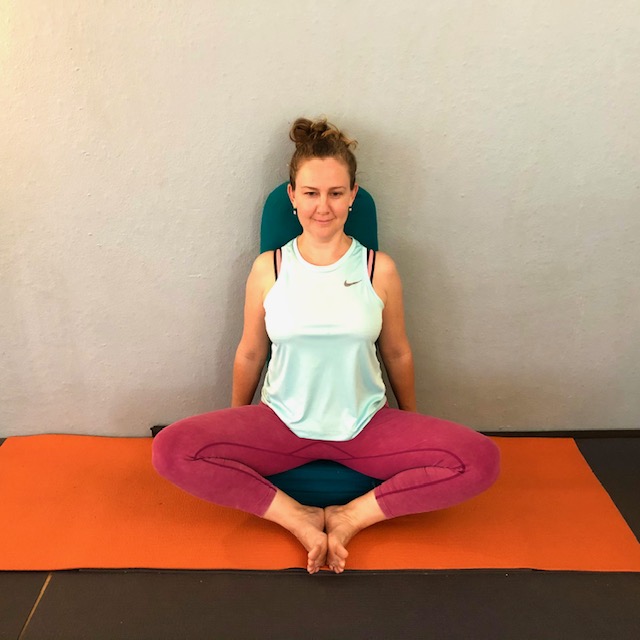
Bound angle pose with support opens the hips without strain.
You have to travel within and if you don’t, how will you penetrate?
What it means: Geeta says you must go inward if you want to get to the heart of a pose. You can’t get there by staying on the surface. In practice, that might mean closing your attention around a small detail, like the way the skin of the arm moves.
Read more: Our notes on Iyengar yoga and philosophy
Many people try to think their way into an asana, but you must instead feel your way into it through love…
What it means: You cannot work out a pose only in your head. Mr Iyengar asks you to feel your way into it, with care for the body rather than impatience.
Next time a pose feels stuck, stop thinking about the instructions for a moment. Feel where the weight is in your feet, where the breath moves, where something grips. That feeling tells you things the thinking mind misses.
Read more: Yoga for body, breath and mind, How long to hold yoga poses.
When experiencing comes, thoughts come later.
What it means: Experience first, thoughts later. Many of us run a commentary while we practise (“this is hard”, “I’m bad at this”). Geeta says thoughts come after experiencing. Try feeling first and judging afterwards.
Read more: More quotes on learning

Supported rest is the heart of a restorative practice.
People just want to do. They just want to finish. They don’t know what is collapsing, what is getting raised upwards, what is ascending, what is expanding.
What it means: People just want to finish. They don’t know what’s collapsing, what’s lifting or what’s expanding. If you notice what rises and what sinks in a pose, you are practising attention rather than just completing the pose.
Read more: More quotes on poses · How long to hold yoga poses
Do Asanas conscientiously and not just consciously.
What it means: Consciously means you know you’re doing it. Conscientiously means you care about doing it well. One is noticing, the other is taking care. Prashant asks for both in each pose.
Read more: More quotes on practice

Lying supported lets the breath slow and the body settle.
Unless you improve your perceptions, your actions will not improve.
What it means: Better actions start with better perception. If you can see that your knee is turning in, you can fix it, but if you can’t see it, no instruction helps. This is why Iyengar teachers ask you to look and feel before they ask you to change.
Read more: More quotes on learning · Why the order of poses matters
Related pages
- Yoga philosophy and Iyengar yoga: notes and articles
- Stillness in yoga
- Yoga for body, breath and mind
- Iyengar yoga poses: pose and practice notes
More Iyengar quotes, explained: The Body And Alignment, The Breath And Pranayama, Learning, Life And Happiness, The Mind And Meditation, Poses, Practice. Or see all the quotes on the Iyengar Yoga Quotes, Explained page.

A tall, steady seat is where attention begins.
From class notes
Summaries made by students who took notes in classes taught by Geeta, Prashant or Mr Iyengar. They are the note-takers’ wording, not exact words, so they are not shown as quotes. Each is put in plain English as reported speech, with the class, place and year.
From class notes: Geeta taught that you need to witness the very process of doing, while it is happening in you.
Class notes, Geeta S Iyengar, talk in Portland, 2010 #
What it means: Notice what you are doing while you do it. It is easy to move through a pose and only realise afterwards that you gripped your jaw or leaned to one side. Witnessing means part of your attention stays awake as an observer during the action. A good way to practise is to pick one thing, such as the weight on your feet, and check it every few breaths.
Read more: Mountain pose: how to stand properly · Stillness in yoga
From class notes: Geeta taught that attention on the left and action on the right have to synchronise, and then awareness spreads.
Class notes, Geeta S Iyengar, class in Twin Waters, Australia, 2009 #
What it means: Often one side of the body acts while the other is forgotten. In a standing pose, for example, you may work hard on the front leg while the back leg goes quiet. Geeta asked students to bring attention to the side that is not doing the obvious action, so both sides take part. When that works, awareness feels wider, more even across the body.
Read more: Triangle pose: why it feels hard, and how props help · Warrior 2 pose
From class notes: Geeta said that when she says shin ten times over, the question is whether your mind stays with the shinbone. That is how the mind has to work, she said, because you never know at which moment it hangs up.
Class notes, Geeta S Iyengar, Sydney, 2003 #
What it means: The mind wanders without telling you. Geeta used a plain instruction, shin, repeated, to test whether students could stay with it. Most of us find our attention has slipped away by the third time. The practice is to notice that quickly and return, and over months you get better at it. A class is a good place to train because the teacher keeps giving you something specific to follow.
Read more: Stillness in yoga · Yoga for body, breath and mind
From class notes: Geeta taught that your attention should be inside while your eyes stay outside.
Class notes, Geeta S Iyengar, Pune, 1997 #
What it means: Keep your eyes open and your awareness turned inward. Staring at the floor or closing the eyes both tend to cut you off. Geeta wanted students to look out softly while sensing inside the body, which is closer to how we live day to day. In a standing pose, let your gaze rest on one point and feel the legs and spine from within.
Read more: Stillness in yoga · Mountain pose: how to stand properly
From class notes: Geeta taught that the mind should not be given up at all while you are in the pose.
Class notes, Geeta S Iyengar, Pune, 1997 #
What it means: Do not switch off in the hard part. When a pose gets uncomfortable it is tempting to leave your mind somewhere else until it is over. Geeta said the opposite: stay present, because that is where the learning is. Try giving the mind a job, such as lengthening the back of the legs, so it has something useful to do.
Read more: How long to hold yoga poses · Managing effort in your yoga practice
From class notes: Prashant taught that when contact with the breath is lost, distraction comes and awareness goes.
Class notes, Prashant S Iyengar, Pune, 1977 #
What it means: The breath is an anchor for attention. When you can feel the breath, you know you are here. When you cannot, the mind has probably wandered. In class, that can be a handy check: if you realise you have lost the breath in a pose, take it as a sign that your attention left too, and bring both back.
Read more: Yoga for body, breath and mind · What pranayama is
From class notes: Geeta taught that a disciplined consciousness spreads, while an undisciplined one does not spread but moves from one object to another, which is the fluctuation of the mind.
Class notes, Geeta S Iyengar, class in Twin Waters, Australia, 2009 #
What it means: Steady attention is wide; scattered attention is jumpy. Geeta contrasted a mind trained to stay with its task, which can then take in the whole body, with a mind that hops from one thing to the next. Discipline here is not harshness; it is the habit of coming back to the same point. A class with a clear sequence helps, because each pose gives your mind one thing to do.
Read more: The eight limbs of yoga in plain words · Stillness in yoga
From class notes: Geeta taught that when you go fast, you disconnect the body from the brain.
Class notes, Geeta S Iyengar, Pune, 1997 #
What it means: Speed makes it harder to feel what you are doing. If you rush into a pose, the body arrives but your attention does not. Slowing down gives the brain time to receive information from the feet, hands and spine. If a pose feels automatic, try entering it at half speed and see what you find.
Read more: Why the order of yoga poses matters · How long to hold yoga poses
Frequently asked questions
What did Mr Iyengar mean by “the present is the perfect pose”?
He meant that the pose that matters is the one you are in right now, not last week’s or next month’s. It is a reminder to put your attention in the pose you are actually holding.
What is the difference between self-aware and self-conscious in yoga?
Mr Iyengar said, “Pupils should be self-aware, not self-conscious.” Self-aware means you notice what you are doing, which helps you learn. Self-conscious means you worry about how you look to others, which tends to make you stiff.
Is awareness the same as concentration in Iyengar yoga?
Not quite. Mr Iyengar said we do not say of a deer in the forest, “Look, he’s concentrating”, because the deer is in a state of total vibrant awareness in every cell of his body. He also described concentration as a step on the way from scattered thoughts to a calm mind. Awareness is wide and open. Concentration gathers the mind onto one thing.
Where can I learn to practise with this kind of attention in Darwin?
Flametree teaches Iyengar yoga in Darwin and LIVE online, and the detailed teaching style asks you to look and feel inside each pose. The timetable shows the classes.
Practise this at Flametree
Your first class is free if you’re new to Flametree. New students, and anyone who has been away three months or more, can also get a half price 10 class pass, in the studio or LIVE online.
- Beginners: see the half price 10 class pass for new and lapsed students
- Already done some yoga: see the half price 10 class pass for new and lapsed students
- See the timetable, including online classes
Can’t make a class? Practise at home with our video courses.
Flametree Yoga Studio teaches Iyengar yoga in Darwin and LIVE online. This page is general information, not medical advice. The quotes are short credited extracts from works by the Iyengar family; each credit names the source. Sources quoted on this page: Light on Life, Sparks of Divinity, Yoga Rahasya, Yoga Wisdom and Practice, Yoga: A Gem for Women. Further reading: Mr Iyengar on Wikipedia · Geeta Iyengar on Wikipedia
Last updated 1 November 2026
