
Naturopath Darwin? Or Yoga, Or Both?
By Chris Lalor, Certified Senior Iyengar Yoga Teacher and Certified Yoga Therapist, and Dr Stuart McGill, Yoga Teacher, Flametree Yoga Darwin
Naturopath Darwin or yoga: the short answer
Thinking of seeing a naturopath in Darwin for your gut, stress, sleep or energy? Yoga is worth trying as well, or instead. No trial has compared yoga with naturopathy. But yoga has been tested for many of the same everyday problems, from IBS to poor sleep, stress, menopause and weight. People with insomnia slept close to two hours longer in a review of 22 trials. And at Flametree, 12 yoga classes cost $59.50.
The article follows in short form:
- No yoga and naturopathy trial exists yet.
- Yoga has been tested for gut, stress, sleep and energy.
- Close to two extra hours of sleep (22 trials).
- Trials in menopause, PMS and weight too.
- You can’t eat mindfully until you are mindful.
- 12 hours of yoga cost less than one first visit.
- Start with 2 free classes and 2 free ebooks, or just walk in.
Tired, bloated and stressed?
Picture this. You are tired all the time. Your tummy is bloated by lunchtime. You sleep badly, and work is piling up. A friend says a naturopath helped them, so you book a visit.
That is a very common path, and plenty of people find it useful. But here is a question worth asking first. What if a class you go to every week could help with several of those things at once?
We teach yoga, so we have an interest here. We would rather say so. We also see, week after week, people arrive wound up and leave calmer, sleeping better and more aware of their own bodies. That is why we wrote this page.
Naturopath Darwin or yoga? Rest that you can feel

A restorative pose over two bolsters. Props hold the body, so the belly can soften and the breath can slow.
What is Iyengar yoga, the yoga we teach?
Iyengar yoga is a careful, prop-based style, and it is what we teach at Flametree in Darwin and live online. It was developed by Mr BKS Iyengar. In the 20th century he did more than anyone to set down traditional Indian yoga, through his books and his teaching, and he pioneered the use of props such as chairs, blocks, belts and bolsters. His style is sometimes called modern classical yoga.
Props mean a tired, stiff or stressed body can still do each pose well. The teacher adjusts the pose to suit you.
What does a naturopath do?
A naturopath looks at your diet, lifestyle and health as a whole, and suggests changes. The Victorian Government’s Better Health Channel describes naturopathy as alternative medicine that uses a range of approaches, such as diet and lifestyle advice, herbal medicine and manual therapy. Naturopaths say they aim to find the cause of a problem, not only ease the symptoms. You can book without a referral.
People often see a naturopath for gut and digestion problems, including IBS (irritable bowel syndrome, a long-term gut upset), stress, tiredness, poor sleep, menopause, period problems, weight and general wellbeing.
Naturopathy is not one of the health professions registered under the national scheme run by Ahpra (the Australian Health Practitioner Regulation Agency). Many naturopaths belong to industry bodies. Naturopathy is not covered by Medicare.
So this is not a page against naturopaths. Our point is simpler. Whatever a naturopath helps you with, yoga may help with some of it too, and it adds a lot of other benefits on top.
Has yoga been compared with a naturopath?
No. We could not find a trial that puts yoga and naturopathy head to head. So nobody can say from a trial that one beats the other.
A few studies, mostly in Indian residential hospitals, gave yoga and naturopathy together. In one, 120 teenage girls with PCOS (polycystic ovary syndrome, a hormone condition) did ten days of yoga plus naturopathy, and their hormone, weight and mood measures improved compared with a waiting group. Because the two were given together, yoga’s own share cannot be separated.
What does exist is a large body of yoga trials for the problems people bring to a naturopath. Here they are, one by one.
Yoga for digestion and a busy mind

A supported forward bend with the head resting. Resting the head is one of the ways a class quietens a busy mind.
What did yoga trials find for gut problems and IBS?
In trials, yoga was linked with fewer gut symptoms and less anxiety in people with IBS. A 2025 review of 10 studies found yoga went with lower gut symptoms, less anxiety and low mood, and better quality of life, compared with usual care or waiting lists.
In a 2025 Indian trial of 165 adults with IBS, 85 added yoga five times a week for three months to their usual treatment. IBS severity scores fell in the yoga group but not in the usual treatment group, and stress and anxiety scores fell too.
The gut and the mind are closely tied, which is one reason calm matters here. More in our guide to yoga and digestion.
Does yoga help with stress and anxiety?
Yes. Stress is the area where yoga has been tested most. In the 2022 Berlin RELAX trial, 102 stressed adults did 12 weeks of Iyengar yoga, a broader yoga programme, or a mindfulness course. All three gave a large drop in stress that was still there 12 weeks later.
A 2024 review of 24 studies with 1,395 people found yoga lowered depression scores compared with doing nothing, and more people recovered. Against other active treatments, the difference was smaller.
See our guide to yoga for stress management and our guide to yoga for stress and burnout.
Naturopathy Darwin or yoga: supported rest for stress

Kim rests forward over bolsters on a chair. Supported forward bends like this help a tired body and a busy mind settle.
Can yoga help you sleep better?
In people with insomnia, yoga added close to two hours of sleep a night in their own sleep diaries. A 2026 review in BMJ Evidence-Based Medicine pooled 22 trials with 1,348 people. Against active comparison groups, yoga likely increased total sleep time by about 111 minutes. The evidence for that figure was rated moderate. Other sleep measures were less certain.
Stress and sleep feed each other, which is why a calmer day often brings a better night. Read more in Stress And Sleep: Can Calmer Days And Better Nights Help You Live Longer? and our guide to sleep, insomnia and fatigue.
What about feeling tired all the time?
Trials on fatigue so far are in people with a medical condition, not people who are simply worn out. A 2026 review of 19 trials in people with cancer found mind-body exercise lowered fatigue, and in the yoga group of studies, yoga reduced it.
A 2026 review of 23 trials with 1,734 people with fibromyalgia (long-term widespread pain) found yoga, tai chi and qigong, pooled together, lowered fatigue. The certainty was very low. No trial has yet tested yoga for everyday tiredness on its own. Not yet tested is not the same as not working, and it is something our students often tell us changes.
Breath work for energy and calm

Chris in a breath practice with the ears gently closed. Slow, quiet pranayama (yogic breathing) calms the nerves.
Does yoga help with menopause?
In trials, yoga gave steady benefits for sleep in menopause. A 2025 review of 18 trials with 1,572 women pooled yoga, mindfulness, qigong and other mind-body methods. Together they improved sleep, low mood and anxiety. The authors found yoga and qigong gave stable benefits for sleep.
A separate 2025 review of 44 trials found yoga was one of eight non-drug approaches that improved sleep quality in menopausal insomnia. More in our guide to yoga and menopause.
What about period pain and PMS?
For PMS (premenstrual syndrome, the low mood and aches before a period), yoga trials point in a good direction. In a 12-week Turkish trial of 155 students, the 50 who did yoga had lower PMS scores than both an acupressure group and a group with no programme. In another trial of 80 students, yoga twice a week for 8 weeks lowered premenstrual symptoms and lifted quality of life.
For period pain the picture is mixed. In a 2026 trial of 36 women, pain fell over 12 weeks in both the yoga group and the comparison group, with no difference between them. See our guide to yoga and period pain.
Can yoga help with weight and metabolic health?
Yoga has been tested in large numbers of people carrying extra weight, and blood pressure was the clearest result. A 2026 review of 30 trials with 2,689 adults found yoga likely lowered blood pressure by about 4 points on the top number and 2 on the bottom. Weight itself was not the main finding.
In a 2026 review of 22 trials with 1,720 people with type 2 diabetes in Asia, yoga for 12 weeks or more lowered HbA1c (a long-term blood sugar measure). More in our guides to yoga and weight and yoga and weight loss.
Standing poses build strength

A strong standing pose. Standing poses work the big muscles of the legs and lift the heart rate.
And inflammation?
Mind-body practices, yoga among them, have been linked with lower levels of an inflammation marker. A 2014 review of 34 trials with 2,219 people pooled tai chi, qigong, meditation and yoga. Together they had a moderate effect on C-reactive protein (a blood marker of inflammation), a smaller effect on another marker that did not reach significance, and almost none on a third.
That is not yoga alone, so we hold it lightly. Our guide to yoga and the immune system goes further.
Can you eat mindfully if you are not mindful?
In our view, you can’t eat mindfully until you are mindful. Mindful eating means noticing when you are hungry, when you are full, and why you are reaching for food. That is hard to do with a racing mind.
Yoga gives you a way to become mindful. Holding a pose with care takes steady, present attention, and so does slow yogic breathing. Yoga poses and yogic breathing both produce mindfulness. More in our guide to yoga and mindfulness.
The research backs part of this. A 2024 review of mindfulness programmes (not yoga alone) found people became more aware of fullness, ate less from hunger cues, took in less energy and ate fewer sweet foods. Emotional and binge eating did not shift by a significant amount. Emotional eating, which includes stress eating, was the hardest to shift. That is why we think calming the mind comes first.
Mindful eating starts with a calm mind

Kim folds forward onto a bolster on a chair. Quiet, supported poses help build the steady attention that mindful eating needs.
A frozen shoulder that grew out of stress
Stress does not only live in the mind. Dr Stuart McGill, one of the two of us who wrote this page, found that out the hard way. During a stressful time, when he was not doing any yoga at all, he developed a frozen shoulder. It was a major problem.
He went to an osteo and a physio, did their exercises, and spent a lot of money over many months. What worked best in the end was going back to yoga. The classes were engaging, so he actually did them, and did a lot of them, because they cost little. Quite quickly he had his full range of motion and strength back. You can read more in Osteo Darwin? What A Frozen Shoulder Taught Us About Yoga.
His story is one person’s experience, not a trial. But it shows something we see often: when stress eases, the body often eases with it.
Why does yoga help with so many things at once?
Because a yoga class works on the body, the breath and the mind together. Whatever a naturopath helps you with, yoga may do some portion of it, sometimes more, and it can sit alongside it.
Strength and flexibility, built together
Yoga builds strength and flexibility at the same time, and you need both. In a held standing pose, your own body is the weight. Your muscles hold you there, and that load reaches the bones too.
What we find in class is this. Flexibility comes from extending your range of motion (how far a joint can move). That only really happens when you learn to straighten your limbs. Most people who play sport, or go to the gym, Pilates or CrossFit, cannot fully straighten their legs or arms. The hips are often stiff too, from short muscles and short, tight tendons. Until people build straight limbs through yoga, they rarely get enough flexibility.
The types of poses we use
- Standing poses build strong legs and lift the heart rate.
- Twists keep the spine turning both ways and work around the belly.
- Forward bends, often with the head resting, quieten a busy mind.
- Supported backbends, over a chair or bolster, open the chest for easier breathing.
- Restorative poses with props let the body rest and the nervous system settle.
- Pranayama (yogic breathing) slows and steadies the breath.
Your teacher picks and adapts these for you. You learn them in class, not from a page.
Six Types Of Yoga, And What Each Brings
Strong legs, a lifted heart rate.
A spine that turns both ways.
A quieter, calmer mind.
An open chest, an easier breath.
Rest for the body and the nerves.
A slow, steady breath.
Known from practice. Your teacher adapts each one to you.
Yoga as a naturopath Darwin alternative or partner: six kinds of yoga, each working in a different way.
Much more than one benefit
Yoga also builds muscle and bone strength, balance, calm, better sleep and a clearer sense of your own body. Dr Timothy McCall, a medical doctor who studied with Mr Iyengar, lists many more. See our page on the benefits of yoga, and what the research shows so far.
Twists work around the belly

A gentle lying twist over a bolster. Twists keep the spine turning and work gently around the belly.
What does it cost to try yoga instead of a naturopath in Darwin?
At Flametree, a newcomer gets 12 yoga classes for $59.50. That is 10 classes at half price plus 2 free, in our Darwin studios or live online.
A first naturopath visit is often around $100 or more. So for less than one first visit, you get about 12 hours of yoga.
What Your Money Buys
of yoga classes for $59.50, studio or online
with a naturopath, often around $100 or more
Visit cost from a national price guide and our experience. Class price from our beginner deal.
Naturopath Darwin NT or yoga: about 12 hours against one visit.
A teacher, a group and a class community
Advice on paper is hard to keep up on your own. In a yoga room, online or in the studio, a teacher takes you through the whole class with instruction. You do not have to remember what comes next, or talk yourself into starting.
Then there is the lift of doing it together. In a trial of 627 older adults in group exercise classes (Beauchamp and colleagues, Health Psychology, 2018), people in groups built to help them feel connected went to more sessions. It is easier to keep going when you feel part of the group. That trial was not yoga.
A 12-week study of 69 medical students (Yorks and colleagues, 2017) tested group fitness classes, not yoga. The 25 who went to classes ended with lower stress and better physical, mental and emotional quality of life. The students chose their own groups, so it was not random.
And you make new friends. A class community gives you people to chat with, a sense of belonging and a lift in your spirits, and that helps head off loneliness. In a review of 148 studies with 308,849 people, those with stronger social ties had a 50% higher chance of survival over the study periods (Holt-Lunstad and colleagues, 2010). That is a link, not proof that a class adds years. Making friends in class is something we see week after week, though no study has measured it yet.
Supported backbends open the chest
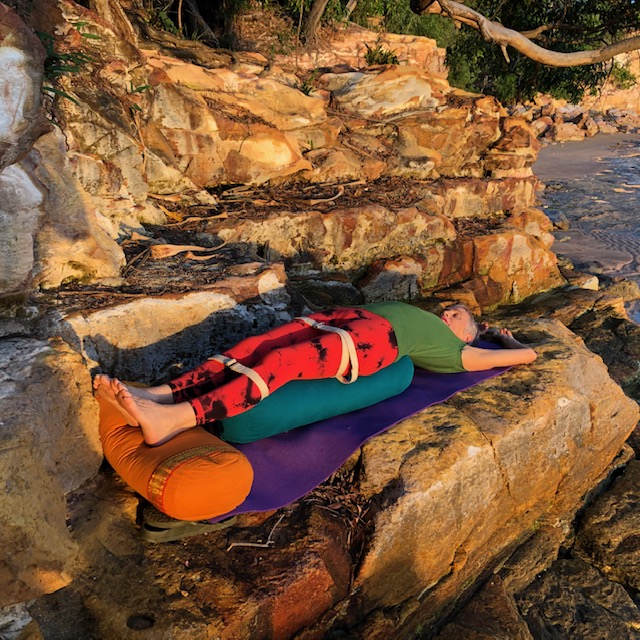
A supported backbend over a bolster. It opens the chest, so the breath can move more freely.
Yoga as well as a naturopath, or instead?
That is your choice. Some people see a naturopath and do yoga. Others find yoga is enough. Either way, regular yoga gives you a lot of practice for little cost, and you can see for yourself what it does.
In our view as teachers, one class a week helps, and more helps more.
Which classes suit stress, sleep and low energy?
Any beginner class is a good start, and these classes suit a tired or stressed body.
- Gentle Yoga: a slower class, in the studio and online.
- Restorative Yoga: supported poses for rest and calm.
- Live online classes for people in Palmerston, the rural area, or anywhere in Australia.
Our studios are at Woolner (19B Bishop St) and Coolalinga. See every class on the class timetable. If you play sport, our Yoga For Sport pages show how yoga fits with it.
How do I start?
- 2 free classes, plus 2 free ebooks. New to Flametree? Choose 2 free ebooks, including Cutting Stress With Yoga, and get 2 free classes, live online or in our Darwin studios. Claim them here.
- Or just come along, at the studio or online, and your first class is free. That is one free class. Register first and you get two free classes and two free ebooks, plus a few short reminders and tips to help you get started. So registering gets you more, and walking in is always welcome. See class times.
- Want more classes? The beginner deal gives you 12 classes for $59.50, studio or online, with a 14-day money-back guarantee.
Once you have started, learn much more. Our 2027 Masterclasses with Chris are six afternoons, in Darwin and live online, from Monday 28 December 2026 to 18 April 2027. Sleep and energy, and anxiety, are among the topics.
Naturopath Darwin and yoga: questions people ask
Can yoga help with the things people see a naturopath for?
Yoga has been tested for many of them. Trials have looked at IBS, stress, sleep, fatigue, menopause, PMS and weight, with some good results. People with insomnia slept close to two hours longer in a review of 22 trials. Yoga is not a substitute for any advice you have been given, and you can do both.
Has yoga been compared with naturopathy?
No. We could not find any trial that put yoga and naturopathy head to head. Some Indian studies gave yoga and naturopathy together, so yoga’s own share cannot be separated. What does exist is a large number of yoga trials for the same everyday problems.
Is naturopathy regulated in Australia?
Naturopathy is not one of the health professions registered under the national scheme run by Ahpra. Many naturopaths belong to industry bodies. Naturopathy is also not covered by Medicare.
How much does a naturopath cost compared with yoga?
A first naturopath visit is often around $100 or more. At Flametree, a newcomer gets 12 yoga classes for $59.50, in our Darwin studios or live online. That is about 12 hours of yoga for less than one first visit.
Can yoga help with weight loss and metabolic health?
In a review of 30 trials with 2,689 adults carrying extra weight, yoga lowered blood pressure by about 4 points (systolic). Weight itself was not the main finding. In people with type 2 diabetes, longer yoga programmes lowered a long-term blood sugar measure (HbA1c).
What is mindful eating, and where does yoga fit?
Mindful eating means noticing hunger, fullness and why you are eating. In our view, you can’t eat mindfully until you are mindful. Yoga poses and yogic breathing train that steady attention, and mindfulness programmes have improved fullness awareness and lowered how much people eat.
Can I see a naturopath and do yoga as well?
Yes. Many people do both. Tell your yoga teacher about any health issues, and they will adapt the poses to suit you.
How do I start yoga in Darwin?
Register for 2 free classes and 2 free ebooks, or just come along, at the studio or online, and your first class is free. The beginner deal then gives 12 classes for $59.50.
More in this series
Weighing up another kind of care? Here is how yoga fits with each.
- Considering Physio? Try Yoga First, Not Last!
- Chiro Darwin? Or Yoga, Or Both?
- Osteo Darwin? What A Frozen Shoulder Taught Us About Yoga
- Massage Darwin? Why Raj Tried Yoga Next, And What Changed
- Acupuncture Or Dry Needling Darwin? Add Yoga, Or Try It First
- Sports Doctor Darwin? Or Yoga, Or Both?
Sources
- Better Health Channel (Victorian Government). Naturopath. betterhealth.vic.gov.au
- Ahpra. Registers of practitioners. ahpra.gov.au
- Oneflare. Naturopath cost guide (national price range), read 14 November 2026.
- Shetty and colleagues. Naturopathy and yoga in obese adolescents with PCOS. International Journal of Yoga, 2024 (120 people). PubMed 39959507
- Pavan and colleagues. Yoga for irritable bowel syndrome: a systematic review. 2025 (10 studies). PubMed 41108584
- Devi and colleagues. Yoga for IBS, randomised trial. 2025 (165 people). PubMed 40365365
- Fischer and colleagues. The RELAX trial: Iyengar yoga, integrative yoga and mindfulness for stress. Journal of Clinical Medicine, 2022 (102 people). doi.org/10.3390/jcm11195680
- Moosburner and colleagues. Yoga for depression: a meta-analysis. Depression and Anxiety, 2024 (24 studies, 1,395 people). PubMed 40226719
- Bu and colleagues. Exercise for insomnia: a network meta-analysis. BMJ Evidence-Based Medicine, 2026 (22 trials, 1,348 people). PubMed 40664502
- Liu and colleagues. Mind-body exercise for cancer-related fatigue. Frontiers in Public Health, 2026 (19 trials). PubMed 41938918
- Fricke-Comellas and colleagues. Mind-body exercise in fibromyalgia. Journal of Bodywork and Movement Therapies, 2026 (23 trials, 1,734 people). PubMed 42264784
- Fan and colleagues. Mind-body therapies in menopause. Frontiers in Public Health, 2025 (18 trials, 1,572 women). PubMed 41341454
- Wang and colleagues. Non-drug approaches for menopausal insomnia. Maturitas, 2025 (44 trials). PubMed 40907338
- Simsek Kucukkelepce and colleagues. Yoga and acupressure for PMS. 2020 (155 people). PubMed 33310053
- Erdogan and colleagues. Yoga for premenstrual symptoms. 2024 (80 people). PubMed 39037430
- Bicici Ulusahin and colleagues. Yoga for period pain. 2026 (36 people). PubMed 42246696
- Wasityastuti and colleagues. Yoga in adults with overweight or obesity. PLOS Global Public Health, 2026 (30 trials, 2,689 people). PubMed 42018531
- Mahajan and colleagues. Yoga in type 2 diabetes in Asia. 2026 (22 trials, 1,720 people). PubMed 42006380
- Morgan and colleagues. Mind-body therapies and inflammation markers. PLOS ONE, 2014 (34 trials, 2,219 people). doi.org/10.1371/journal.pone.0100903
- Kao and colleagues. Mindfulness-based programmes and eating. Obesity Reviews, 2024. PubMed 39489689
- Beauchamp MR and colleagues. GOAL randomized controlled trial: exercise adherence outcomes. Health Psychology, 2018 (627 people). doi.org/10.1037/hea0000615
- Yorks DM and colleagues. Effects of group fitness classes on stress and quality of life of medical students. Journal of the American Osteopathic Association, 2017 (69 people). doi.org/10.7556/jaoa.2017.140
- Holt-Lunstad J and colleagues. Social relationships and mortality risk. PLoS Medicine, 2010 (148 studies, 308,849 people). doi.org/10.1371/journal.pmed.1000316
Flametree Yoga Studio, Darwin and live online. General information only, not personal health advice.



