
Sports Doctor Darwin? Or Yoga, Or Both?
By Chris Lalor, Certified Senior Iyengar Yoga Teacher and Certified Yoga Therapist, and Dr Stuart McGill, Yoga Teacher, Flametree Yoga Darwin
Last updated: 13 November 2026
Sports doctor Darwin, or yoga, or both: the short answer
Looking for a sports doctor in Darwin? A sports doctor diagnoses and manages sports injuries, and that work matters. Yoga is the part you can do yourself, alongside your treatment, between visits, and for years after. In a UK trial of 313 adults with long-term back pain, adding 12 weekly yoga classes to usual medical care gave better back function at 3, 6 and 12 months than usual care alone.
No trial has yet put yoga side by side with sports medicine for sports injuries, and we say so plainly below. Here is the whole article in short form.
- A sports doctor diagnoses and manages your injury.
- Yoga added to usual care gave better back function for a year.
- In another trial, 12 yoga classes did as well as a course of physio.
- Trials in cricketers, swimmers and more are on our sport pages.
- Yoga builds strength and flexibility together, plus balance and calm.
- 12 yoga classes cost $59.50, less than half the gap on one specialist visit.
- Your first class is free, at the studio or online.
Sports doctor Darwin, and the yoga you do yourself

Dr Stuart McGill, one of the two of us who wrote this page, at East Point, Darwin. A standing balance with one leg raised asks for straight, strong legs and steady hips.
Why would a Darwin sportsperson think about yoga as well?
Because the injury is only half the story. The other half is what you do every week to get strong again, and to stay strong.
Dr Stuart McGill, one of the two of us who wrote this page, found that out the hard way. He had a frozen shoulder that came on with stress, at a time when he was doing no yoga at all. It was a major problem.
He went to both an osteopath and a physio. Over many months, and for a lot of money, they worked on the shoulder and gave him exercises. What worked best in the end was going back to yoga and getting right into it.
Quite quickly he got back the full range of movement and the strength in that shoulder. Why? The yoga was engaging, so he got around to doing it. It was cost-effective, so he did a lot of it. He tells more of his story in our post Considering Physio? Try Yoga First, Not Last!
That is one person’s experience, not a trial. But it is the pattern this page is about. The doctor or therapist does their part. Yoga is the part you can keep doing.
Want to try it? Your first class is free, at our Darwin studios or live online. See how to start.
What does a sports doctor do?
A sports doctor works out what is wrong and manages it. Some are GPs with extra training in sport. Others are sports and exercise physicians (specialist doctors trained for years in sport and exercise medicine).
They examine the injury, order scans when needed, manage pain, and plan your return to training and games. They also look after problems that come with exercise, such as concussion and stress fractures (fine cracks in a bone from repeated load).
That is skilled work, and nothing on this page argues against it. A good sports doctor can tell you what you have, how serious it is, and what to leave alone for now.
What no doctor can do is the work in between visits. That part is yours. For most people it means weeks or months of rebuilding strength, range of movement and confidence. This is where yoga comes in.
Rebuilding range of movement, with the legs straight

Stuart at the rope wall, with the ropes holding his hips back and his hands on a chair. Supported forward bends like this lengthen the backs of the legs while the legs stay straight and working.
What kind of yoga do we teach?
Flametree teaches Iyengar yoga. Mr BKS Iyengar was the 20th-century teacher who codified traditional Indian yoga through his books and teaching, and pioneered the use of props such as chairs, blocks, belts and wall ropes. His style is sometimes called modern classical yoga.
Iyengar teachers train for years: at least 3 years as a student, then at least 3 more years of teacher training, before a panel of senior teachers assesses them. Mr Iyengar also wrote about yoga for sportspeople. Our page on why Iyengar yoga works for sport explains more.
What did the trials find when yoga was added to usual medical care?
Yoga added to usual care gave better back function, and the gain lasted a year. Here is the detail.
A UK trial of 313 adults: yoga plus usual care
In this trial (Tilbrook and colleagues, 2011, Annals of Internal Medicine), 313 adults with long-term or recurring low back pain took part at 13 sites. 157 kept to their usual care. 156 were also offered 12 yoga classes over 3 months, taught by 12 teachers. Everyone got a back pain booklet.
The yoga group had better back function at 3, 6 and 12 months. On the Roland-Morris score (a 24-point scale of how much back pain gets in the way of daily life), they did 2.17 points better at 3 months, 1.48 at 6 months and 1.57 at 12 months.
To be fair about it, pain scores ended up similar in both groups. And 12 of the 156 people offered yoga reported a side effect, mostly more pain, against 2 in the usual care group. That is one reason we set up every pose for the body in front of us, with props, and adjust it around any injury.
A chair makes a strong standing pose doable

Chris Lalor at Litchfield, with a chair under her and a block under her back heel. The chair lets the front leg take a deep bend with control, while the back leg stays straight and strong.
Did yoga cost the health system more?
A cost study of the same trial (Chuang and colleagues, 2012, Spine) found yoga was likely to be good value. Counting costs to society as a whole, yoga plus usual care cost less and gained more than usual care alone.
From the health service’s own point of view, it came to about £13,606 for each extra year of good health, with a 72 percent chance of being cost-effective at the usual £20,000 limit.
Yoga against a course of physio: 320 adults
In a Boston trial (Saper and colleagues, 2017, Annals of Internal Medicine), 320 adults with long-term low back pain had 12 weekly yoga classes, 15 physical therapy visits, or a self-care book. Yoga did as well as physical therapy for pain and daily function.
The yoga and physical therapy groups were 21 and 22 percentage points less likely than the book group to be using pain medicine at 12 weeks. The gains held at one year.
What has not been tested yet
No trial we know of has put yoga side by side with a sports doctor’s care for sports injuries. The trials above are about back pain, and the people in them were not all sportspeople. So we do not claim yoga beats a sports doctor.
What the trials do show is this. Yoga added to medical care did better than medical care alone for back function. Yoga used in place of a course of physio did as well. Both are good reasons to give it a try alongside whatever else you are doing.
Standing poses: strong legs, steady hips
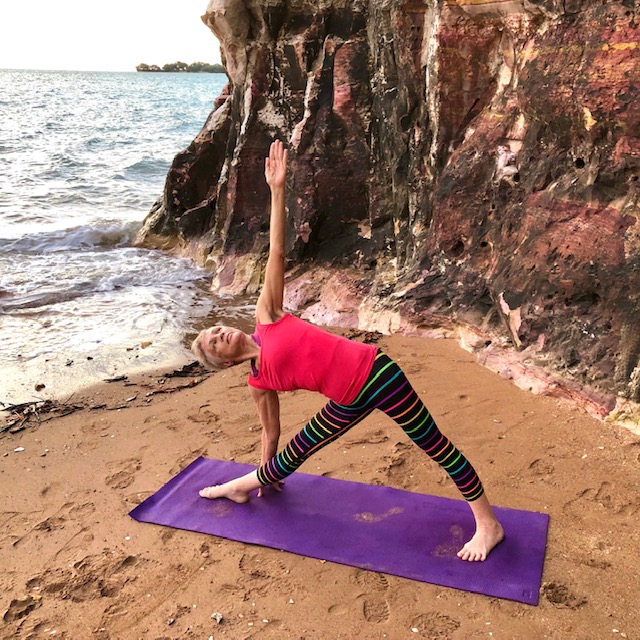
Chris Lalor on a Darwin beach. Standing poses like this build strong legs, open hips and a long, steady spine, with both legs fully straight.
What have trials found in sportspeople?
Several trials have tested yoga in athletes themselves. We have written each one up on our sport pages, so here is the short list, with a link to the full story.
- Cricket: 82 first-class cricketers did yoga five days a week for six weeks. Core stability, flexibility and balance improved, and the gains were still there at six months. See cricket yoga.
- Rugby union: in a New Zealand trial, players who added an hour of yoga twice a week kept their hamstring flexibility through the season, while those who did not lost some. See rugby yoga.
- Volleyball: 26 players who added yoga twice a week improved flexibility, balance, stamina and serving accuracy more than players who added strength work. See yoga for volleyball players.
- Swimming: 27 competitive swimmers did a month of yogic breathing, with better lung measures and more strokes per breath. See swimming yoga.
- Tennis: 40 junior players did eight weeks of online yoga, with better core strength, balance and body awareness, though the comparison group also improved on some tests. See yoga for tennis players.
- Badminton: 30 club players did three weeks of yoga, with better agility and endurance than the comparison group. See yoga for badminton players.
- Archery: 83 young state-level archers did eight weeks of yoga, with better attention scores. See yoga for archery.
Seated twists with props

Kim, one of our teachers, in a seated twist with a chair, a belt and a bolster. Props let the spine and hips turn further, with less strain.
The stories of athletes who credit yoga are on those pages too, from a Darwin golfer on our golf yoga page to the rugby players on our footy yoga page. There are also pages for running, cycling, basketball and lawn bowls. Start at the Yoga For Sport hub to find your sport.
Why does yoga help, whatever your sports doctor is doing?
Because yoga does some of the same work, and adds a great deal on top. Whatever a sports doctor or therapist does for you, yoga will do some part of it, or do it better, or fit in around it.
A return to sport usually needs three things: strength back in the injured area, range of movement back in the joint, and the confidence to load it again. Yoga works on all three at once, in every class.
Then it goes further. Yoga brings a whole mind and body set of benefits, many of them studied: muscle strength, bone strength, flexibility built together with strength, balance, calm, better sleep, and a clearer sense of what your body is doing. Dr Timothy McCall, a medical doctor and yoga therapist, lists 117 health conditions where studies had found yoga helpful. See our page on the benefits of yoga for his full list.
Wide standing poses work the whole leg

Chris Lalor beside the water. Wide standing poses work the legs hard, with the back leg straight, the front knee over the ankle and the arms long and level.
Strength and flexibility, built together
Yoga builds strength and flexibility at the same time, and you need both. A strong muscle that cannot lengthen pulls on the joints around it. A loose muscle with no strength leaves the joint unprotected.
Straight limbs, and why they matter
Here is what we find, after many years of teaching. Flexibility is built by extending your range of motion, and range of motion grows when the limbs are fully straightened. Until that happens, people do not get enough flexibility.
Most people who play sport, or train in the gym, at Pilates or at CrossFit, cannot fully straighten their legs, or often their arms. They are a little muscle-bound and never get quite straight enough. In our experience, until they build straightness in the limbs through yoga, they never get enough flexibility. On top of that, many have stiff hips, from short muscles and short, tight tendons.
The good news: straightness and range come back with regular practice, at any age. That is a big part of what an Iyengar class works on, week after week.
Twists free the trunk to turn

Stuart in a standing twist at the rope wall, one foot raised on a chair. Twists work the muscles around the spine and help the trunk turn freely.
The broad types of poses, and what each one builds
- Standing poses: strong legs and hips, straight knees, balance, and healthy load on the leg bones.
- Twists: a trunk that turns freely, which matters in any sport with a swing, a throw or a fast change of direction.
- Backbends, often supported on a chair: an open chest and shoulders, and a strong back.
- Forward bends: length in the backs of the legs and along the spine, with the legs kept straight.
- Restorative poses with props: deep rest that helps the body recover after hard training.
- Pranayama (yogic breathing): a steadier breath, which steadies attention when it counts.
In class, a teacher chooses which of these suit you, and changes them around an injury. This page does not teach poses. That happens in class, where a teacher can see you.
Yoga poses and yogic breathing both produce mindfulness (steady, present attention). Our post on yoga and mindfulness sets out how they connect.
Supported backbends open the chest

Stuart in a backbend supported by a chair on a Darwin beach. Supported backbends open the chest and the front of the body while the chair takes some of the load.
What does it cost, and do people keep it up?
Yoga costs far less per hour, and people tend to keep doing it.
The cost of a visit, against the cost of a class
Fees vary from clinic to clinic, so ask yours. As one published example, a Sydney sports physician charges $280 for a first visit on a GP referral, with $151.90 back from Medicare, so about $128 out of your own pocket. A review visit is $180, about $104 out of pocket (fees from July 2025).
At Flametree, a newcomer gets 12 yoga classes for $59.50: 10 at half price plus 2 free. That is 12 hours of guided yoga for less than half the out-of-pocket cost of one first specialist visit, at about $4.96 a class.
Do people do their home exercises?
Many do not. A 2010 review of 20 studies of physiotherapy patients (Jack and colleagues, Manual Therapy) looked at why people do not stick with treatment. It noted one earlier estimate that non-adherence (not doing the treatment or exercises as advised) could be as high as 70 percent.
The barriers it found included being inactive to begin with, low confidence, low mood, poor support, and more pain during exercise. The good news is that a class tackles several of these at once: a teacher, a group, a set time, and poses set up so they do not hurt.
Why a class is easier to keep up
In a yoga room, online or in the studio, it is easier to actually do the work. A teacher takes you through the whole class, with instruction, so there is nothing to remember and no exercise sheet to find.
Then there is the group effect. When people do something together, it is easier to do it, and easier to keep doing it. In a trial of 627 older adults in group exercise classes (Beauchamp and colleagues, Health Psychology, 2018), people in groups built to help them feel connected went to more sessions. It is easier to keep going when you feel part of the group. That trial was not yoga. You also make new friends and become part of a class community. That helps head off loneliness, and it generally lifts your spirits. A review of 12 papers on 651 older adults with heart disease (Heaney and colleagues, BMC Public Health, 2026) found face-to-face group exercise and education programmes went with less loneliness. Making friends in class is something we see week after week, though no study has measured it yet.
Research points the same way. In a 12-week US study of 69 medical students (Yorks and colleagues, 2017, Journal of the American Osteopathic Association), those who went to group fitness classes had less stress, and better physical, mental and emotional quality of life, by the end. Students who exercised on their own or with one or two partners showed no clear change in stress. That study tested group fitness classes, not yoga. In our experience, the same lift of doing it together happens in a yoga class.
A chair can hold a pose for you

Stuart on a Darwin beach, feet on a chair and hips lifted. With props, a pose can be held long enough to build strength in the back and legs without strain.
Many people find a sheet of home exercises boring, and it slips. That was Stuart’s experience too. People find a yoga class engaging, so they come back. And when they keep doing it, they get the result.
Restorative poses help the body recover

Kim resting back over a bolster and blankets. Supported poses like this let the body rest and recover after hard training.
Yoga as well as a sports doctor, or instead?
That is your choice. Many of our students see a sports doctor or a physio and come to yoga as well. Others come to yoga once their treatment has finished, to keep the gains and get stronger. Some start with yoga.
Whichever you choose, tell your teacher about any injury, so the class can be set up around it. In our experience as teachers, one class a week helps, and more helps more. Stuart does at least an hour of yoga and an hour of pranayama every day. Chris practises one to three hours a day, with pranayama almost every day.
Pranayama steadies the breath and the mind

Chris Lalor seated on a bolster in a yogic breathing practice. Pranayama (yogic breathing) steadies the breath, and a steady breath steadies attention.
How do I start yoga in Darwin or online?
- 2 free classes, plus 2 free ebooks. New to Flametree, or back after 3 months or more? Choose 2 free ebooks (the sport and men’s book is Stay In The Game) and get 2 free classes, live online or in our Darwin studios. Claim them here
Or just come along, at the studio or online, and your first class is free. That is one free class. Register first and you get two free classes and two free ebooks, plus a few short reminders and tips to help you get started. So registering gets you more.- Then the half price beginner 10-pass with 2 free. 10 half price classes plus 2 free, $59.50. That is 12 classes, $4.96 a class, in our Darwin studios or live online.
Good classes to start with: any beginner class, Gentle Yoga, Yoga For Backs (the whole back, including the neck and shoulders) and Restorative Yoga, at Woolner and Coolalinga or live online. Our live online classes are interactive, so a teacher can see you and guide you, wherever you live.
Once you have started, learn much more about how this yoga works. Our 2027 Masterclasses with Chris Lalor start on Monday 28 December, in Darwin or live online: six afternoons on arthritis, sleep, pelvic floors, backs, wisdom, and anxiety.
Rest after training, with props

Chris Lalor resting on bolsters and blocks. Restorative poses with props help the whole body let go after a hard week of sport.
Sports doctor and yoga questions, answered
Should I see a sports doctor or do yoga?
That is your choice. A sports doctor diagnoses and manages injuries. Yoga is something you can do alongside, and keep doing after treatment ends. Many of our students do both.
Can yoga help with a sports injury?
No trial has yet compared yoga with sports medicine for sports injuries. In back pain trials, yoga added to usual care gave better back function for a year, and 12 yoga classes did as well as a course of physio. In class, the teacher sets each pose up around your injury.
What does a sports doctor do?
A sports doctor examines and diagnoses injuries, orders scans when needed, manages pain, and plans your return to training and games.
How much does a sports doctor cost compared with yoga?
Fees vary. One Sydney sports physician publishes $280 for a first visit, about $128 out of pocket after Medicare. At Flametree, a newcomer gets 12 yoga classes for $59.50.
Will yoga make me stronger, or only more flexible?
Both. Yoga builds strength and flexibility at the same time. In a held standing pose your own body is the weight, and the limbs work while they straighten fully.
Can athletes do yoga online?
Yes. Our live online classes are interactive, with a teacher who can see you and guide you, from anywhere in Australia. A club or team can also book a live online group class.
How do I start yoga at Flametree?
Register for 2 free classes and 2 free ebooks, or just come along to the studio or online and your first class is free. After that, the beginner deal is 12 classes for $59.50.
More in this series
Weighing up another kind of care? Here is how yoga fits with each.
Closer to home: Coolalinga, Palmerston NT, Casuarina NT
- Considering Physio? Try Yoga First, Not Last!: why yoga is worth a try alongside physio or before it.
- Chiro Darwin? Or Yoga, Or Both? What The Research Says: what the research says about a chiro, yoga, or both.
- Acupuncture Or Dry Needling Darwin? Add Yoga, Or Try It First: what the trials found for needles, and where yoga fits.
- Osteo Darwin? What A Frozen Shoulder Taught Us About Yoga: Stuart’s frozen shoulder, and what an osteo does.
- Massage Darwin? Why Raj Tried Yoga Next, And What Changed: Raj tried massage, then yoga, and what each costs.
Sources
- Tilbrook HE and colleagues. Yoga for chronic low back pain: a randomized trial. Annals of Internal Medicine, 2011. Read the study.
- Chuang LH and colleagues. A pragmatic multicentered randomized controlled trial of yoga for chronic low back pain: economic evaluation. Spine, 2012. Read the study.
- Saper RB and colleagues. Yoga, physical therapy, or education for chronic low back pain: a randomized noninferiority trial. Annals of Internal Medicine, 2017. Read the study.
- Jack K and colleagues. Barriers to treatment adherence in physiotherapy outpatient clinics: a systematic review. Manual Therapy, 2010. Read the review.
- Yorks DM and colleagues. Effects of group fitness classes on stress and quality of life of medical students. Journal of the American Osteopathic Association, 2017. Read the study.
- Beauchamp MR and colleagues. Group-based physical activity for older adults (GOAL) randomized controlled trial: exercise adherence outcomes. Health Psychology, 2018. Read the study.
- Heaney S and colleagues. Impact of interventions targeting social isolation and loneliness for older adults with cardiovascular disease: a systematic review. BMC Public Health, 2026. Read the review.
- Published sports physician fees, effective 1 July 2025. See the fee page.
- Dr Timothy McCall’s list of 117 conditions, on our benefits of yoga page.
- The athlete trials, each with its own source list, on our Yoga For Sport pages.
Flametree Yoga Studio, Woolner and Coolalinga, Darwin, and live online. This page is general information about yoga, written by yoga teachers.



