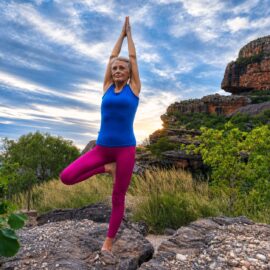
Yoga For Stress Relief: What The Research Says, And What To Do
Yoga for stress relief: the short answer
Yoga for stress relief is one of the most researched uses of yoga. A 2025 review of 36 studies found yoga lowered perceived stress (how stressed people feel) by a moderate amount, and the effect was biggest in people who started out most stressed. A 2017 review of 42 studies linked yoga poses with lower levels of the stress hormone cortisol, lower blood pressure during the day and a slower resting heart rate. So yes, yoga can help with stress, and it does it through the body as well as the mind. Here is the article in short form.
- Yoga for stress relief is backed by a 2025 review of 36 studies.
- People who were most stressed got the most out of it.
- Yoga poses were linked to lower cortisol and a slower heart rate.
- Slow breathing on its own lowered stress in 12 trials.
- Restorative poses switch the body towards “rest and digest”.
- The evidence is mostly short term, and trials are small.
- Your first class at Flametree is free, in Darwin or LIVE online.

Yoga for stress relief at its simplest: Reclining Bound Angle Pose over bolsters. The props do the holding, so the body can let go.
Stress that will not switch off
Most people who come to us about stress are not in a crisis. They are busy, capable people whose minds keep running at 10pm. Work, family, money and the news all pile on, and the body stays on alert long after the day is done.
Dr Timothy McCall, the US doctor who wrote Yoga as Medicine, puts stress at the centre. His poster “117 Health Conditions Helped by Yoga (as found in scientific studies as of June 2019)” lists stress and burnout among the conditions studies have found yoga helps. In a Yoga Journal article he called yoga “arguably the most comprehensive approach to fighting stress ever invented”, because it works on the body, the breath and the mind at the same time.
What does the research say about yoga for stress?
Here are the main studies, with what yoga was compared with.
Perceived stress: how stressed people feel
- Rhoads 2025, Health Psychology Review. 36 studies using the standard Perceived Stress Scale. Yoga gave a moderate reduction in stress. The more stressed people were at the start, the bigger the effect (Rhoads 2025).
- Schleinzer 2024, Frontiers in Psychiatry. 13 trials, 1,026 stressed adults. Compared with no treatment, yoga reduced stress in the short term, and quality of life improved with moderate certainty. No harms were reported in the trials that checked (Schleinzer 2024).
- Zhu 2025, Worldviews on Evidence-Based Nursing. 23 trials in older adults. Yoga ranked among the more promising ways to lower perceived stress, and the approaches studied lowered cortisol overall (Zhu 2025).
Stress in the body
A 2017 review of 42 studies in Psychoneuroendocrinology (the science of hormones and the nervous system) found that practices including yoga poses were linked with lower evening and waking cortisol, lower daytime blood pressure and a slower resting heart rate, compared with other active programmes (Pascoe 2017). In plain words, the body shows the change, not just the questionnaire.
Breathing on its own
A 2023 review of 12 trials in Scientific Reports found breathwork (deliberately slowing or shaping the breath) lowered self-reported stress by a small to medium amount compared with no breathwork (Fincham 2023). A large 2022 review found slow breathing raises heart rate variability (a sign the calming side of the nervous system is working), during a session and after training (Laborde 2022).

Supported relaxation, with a bolster under the knees. The breath slows by itself when the body is fully supported.
How does yoga reduce stress?
Your nervous system has two sides. One revs you up (the “fight or flight” side). The other calms you down (the “rest and digest” side). Chronic stress leaves the first one stuck on.
McCall’s point, drawn from research at the Vivekananda yoga research centre near Bangalore, is that an active practice followed by a quiet one gives deeper relaxation than quiet practice alone. That is exactly how an Iyengar class is built.
- Standing poses first. They use up the nervous energy and take all your attention, so the mind has nowhere else to go.
- Then supported, restful poses. Lying over bolsters or with the legs up a wall, the body shifts towards “rest and digest”.
- Then slow breathing. A longer out-breath tells the body it is safe.
Iyengar teaching holds that the attention a pose demands is itself the rest. Students commonly tell us the argument from work is simply gone by the end of class.
Yoga poses for stress relief: what an Iyengar class does
These are simple yoga poses for stress relief we use often. They are best learnt with a teacher first, then used at home.
- Legs Up The Wall (Viparita Karani). A bolster under the hips, legs resting on the wall, 5 to 10 minutes.
- Reclining Bound Angle Pose (Supta Baddha Konasana), lying back over a bolster with the soles of the feet together.
- Supported Child’s Pose (Adho Mukha Virasana), the forehead resting on a bolster.
- Standing forward bend with the head supported (Uttanasana) on a chair or blocks.
- Supported Bridge Pose (Setu Bandha Sarvangasana) over a bolster or block.
- Corpse Pose (Savasana), with the eyes covered, at the end.

Legs Up The Wall, here against a rock face. One of the simplest yoga poses for stress relief, and one you can do at home.
What a student says
Sharon Kyriacou came back to yoga after many years away. In her Google review (August 2026) she wrote:
“I had many years away from yoga & kind of felt I may have missed the boat. Flametree Yoga has led me slowly & surely back to strength, stability & confidence. No more back issues, up & down ladders again with ease, better sleep & lowered stress. Highly recommend!”
That is one person’s experience, in her own words.
Honest limits: where the evidence is still thin
- Most studies are small and short, usually 8 to 12 weeks.
- People know they are doing yoga, so some of the effect may be expectation.
- Studies differ a lot in style and length, which is why the results vary.
- Against other active programmes, the difference in how stressed people feel is smaller than against doing nothing.
Stress is normal. If stress has turned into constant worry, panic, low mood or not coping, talk to your GP. Yoga can sit alongside care from your doctor or psychologist, not replace it.

A supported squat with the head resting. Resting the forehead is one of the quickest ways to quieten a busy mind.
Yoga for stress relief in Darwin, or LIVE online
Flametree Yoga Studio runs restorative, gentle and beginner classes each week at Woolner in Darwin and LIVE online, and early morning pranayama (breath meditation) classes. Chris Lalor, Senior Iyengar Yoga Teacher and certified yoga therapist, has taught for more than thirty years.
- New to Flametree? Your first class is free. In the studio, just come along. Online, click the class time you want and we email you the link to join.
- Keep going at half price. 10 classes at half price plus 2 more free, $59.50, studio, online or both. No discount code is needed, and there is a 14-day money-back guarantee. It is for newcomers and anyone away three months or more.
- Already practising yoga? The non-beginner half price 10 pass with 2 free, $104.50, no code needed.
- See every class time on the beginner timetable.
Read more: how to calm your nervous system, what is restorative yoga, simple yoga poses for stress relief and the immune system, yoga for anxiety and breathing for anxiety, yoga for sleep, and the benefits of yoga hub.
Yoga for stress relief: questions people ask
Is yoga good for stress relief?
Yes, for most people. A 2025 review of 36 studies found yoga gave a moderate reduction in how stressed people feel, and a 2017 review of 42 studies linked yoga poses with lower cortisol, lower daytime blood pressure and a slower resting heart rate. The effect was largest in people who started out most stressed.
What type of yoga is best for stress?
A class that combines active standing poses, then supported restful poses, then slow breathing. Research on stress suggests an active practice followed by a quiet one relaxes people more deeply than quiet practice alone. Restorative Iyengar classes, which use bolsters, blankets and chairs, are built that way.
Which yoga poses are best for stress relief?
Legs Up The Wall, Reclining Bound Angle Pose over a bolster, supported Child’s Pose, a standing forward bend with the head resting, supported Bridge Pose and Corpse Pose. They are all supported, so they can be held for several minutes while the breath slows.
How does yoga reduce stress?
It works on the body and the mind together. Standing poses take your full attention and use up nervous energy. Supported poses and slow breathing shift the nervous system towards “rest and digest”. Reviews have found lower cortisol, a slower heart rate and better heart rate variability with yoga and slow breathing.
How long does it take for yoga to reduce stress?
Many people feel calmer after a single class, especially a restorative one. In the research, the measured drop in stress usually came after 8 to 12 weeks of regular classes, and the effect was clearer in people practising more often.
Can breathing exercises reduce stress on their own?
They can help. A 2023 review of 12 trials found slow, deliberate breathing lowered self-reported stress by a small to medium amount. Breathing is taught at Flametree as pranayama (breath meditation), usually after some poses so the body is ready to sit or lie still.
Can yoga help with burnout?
Burnout is on Dr McCall’s 2019 list of conditions studies have found yoga helps, though the research on burnout itself is thin. What yoga offers is regular, structured rest: restorative poses, slow breathing and a class where nothing is asked of you except attention. If you feel burnt out, talk to your GP as well.
Where can I do yoga for stress relief in Darwin?
Flametree Yoga Studio teaches restorative, gentle and beginner classes at Woolner in Darwin and LIVE online, plus early morning pranayama classes. If you are new to Flametree your first class is free, then there is a half price 10 class pass with 2 free, $59.50.
Sources
- Rhoads MC et al. Yoga as an intervention for stress: a meta-analysis. Health Psychol Rev 2025. doi:10.1080/17437199.2024.2420974
- Schleinzer A et al. Effects of yoga on stress in stressed adults. Front Psychiatry 2024. doi:10.3389/fpsyt.2024.1437902
- Zhu M et al. Interventions to reduce perceived stress among older adults, network meta-analysis. Worldviews Evid Based Nurs 2025. doi:10.1111/wvn.70004
- Pascoe MC et al. Yoga, mindfulness-based stress reduction and stress-related physiological measures. Psychoneuroendocrinology 2017. doi:10.1016/j.psyneuen.2017.08.008
- Fincham GW et al. Effect of breathwork on stress and mental health. Sci Rep 2023. doi:10.1038/s41598-022-27247-y
- Laborde S et al. Effects of voluntary slow breathing on heart rate and heart rate variability. Neurosci Biobehav Rev 2022. doi:10.1016/j.neubiorev.2022.104711
- McCall T. 117 Health Conditions Helped by Yoga (as of June 2019). Yoga As Medicine, DrMcCall.com. And McCall’s Yoga Journal article on yoga and the nervous system.
Flametree Yoga Studio, Darwin NT. This article is general information, not medical advice. Check with your doctor before starting yoga if you have a health condition.