
Glute Stretches For Tight Hips And A Sore Lower Back: Chair Yoga That Works
Glute stretches: the short answer
The best glute stretches (stretches for the big muscles of your buttocks) are slow forward folds, a chair Triangle and a knee-to-chest stretch lying down. They work because a day in a chair leaves the buttock muscles tight and switched off, and tight buttocks drag on the hips and lower back. Hold each stretch for about 30 seconds, breathe out as you go further, and let a chair or block do the holding. Here is the article in short form:
- Sitting all day tightens the buttocks and switches them off.
- Tight buttock muscles can press on the sciatic nerve (the big nerve down the back of the leg).
- Fold from the hips, not the back. A chair and a block make that easy.
- Hold about 30 seconds. Thirty worked as well as 60 in a trial of 57 people.
- Do not force it. The brain sets the limit, not only the muscle.
- Four poses below, none of them the deep-hip stretches on our piriformis page.
- In Darwin, learn them in a beginner class or online.
Last updated: 25 October 2026.
A quick word on Iyengar yoga. Iyengar yoga is the style developed by Mr BKS Iyengar. In the 20th century he did more than anyone to set down traditional Indian yoga, through his books and his teaching, and he pioneered the use of props. It is the style we teach at Flametree, in Darwin and live online.

Triangle Pose with a hand on a chair. The chair lets the hip open without the body collapsing.
Why do my glutes feel so tight?
Mostly because of how you sit. Rachel Krentzman, an American physical therapist (physiotherapist) and yoga therapist, explains in Yoga for a Happy Back that tight buttock muscles can press on the sciatic nerve. Tight hip flexors (the muscles at the front of the hip) from long hours of sitting pull the pelvis forward and squeeze the lower back. The buttocks sit in the middle of all this.
Leslie Howard, an American yoga teacher trained in the Iyengar tradition, asks her students how they sit. “Ten times out of ten,” she writes, they are sitting on their tail. The low back rounds and the tailbone tucks under. Howard adds that the buttock muscles tend to switch off when we live in a permanent tuck. Her line is worth keeping: “A tight muscle is not a strong muscle.”
The Starretts, an American physical therapist and his wife, a yoga teacher, count a typical day at about 12 hours in a chair: breakfast, the drive, the desk, lunch, the drive home, the couch. That is a long time with the hips folded and the buttocks doing nothing.
So the aim is two jobs in one. Release the buttocks, then wake them up. Stretching alone does the first. Standing poses, which we use in every class, do the second.

A day of chairs moves the hip mostly one way. A yoga class takes it in all six.
Which glute stretches release tight hips and a sore lower back?
These four, done with a chair, a block and a mat. They are different from the deep-hip stretches on our piriformis stretch page, so you can do both in one practice.
- Seated forward fold on a chair. Sit near the front of a chair and fold forward from the hips, resting your head on a block placed on your lap or the seat in front of you. The buttocks and the back of the hips lengthen while your spine stays long.
- Half forward bend, hands on a chair. Stand a leg’s length from a chair and rest your hands on the seat. Fold from the hips with a long back and straight legs. Press the thighs back and feel the stretch low in the buttocks.
- Triangle Pose (Trikonasana) with a chair. Stand with your legs wide, turn the front foot out and fold sideways over it, resting your hand on a chair seat. The front hip opens and the buttock of the front leg stretches. Do both sides.
- Wind-releasing pose. Lie on your back and draw one knee towards your chest, with the other leg long. The buttock of the bent leg stretches and the lower back rests on the floor.
In each pose, breathe out slowly as you go a little further. Never bounce and never hold your breath.

Seated forward fold on a chair, head resting on a block. The hips fold and the buttocks let go.
How long should you hold a glute stretch?
About 30 seconds, repeated. The best test we have is for the hamstrings. In a 1994 American trial, 57 people aged 21 to 37 with tight hamstrings held a stretch for 15, 30 or 60 seconds, five days a week for six weeks, or did not stretch (Bandy and Irion, Physical Therapy). Thirty seconds worked as well as 60, and both beat 15 seconds or no stretching. Nobody has yet tested hold times for glute stretches in yoga poses, so a steady half-minute is a good place to start.
A 1997 follow-up of 93 people also found that stretching three times a day gave no more than once a day (Bandy, Irion and Briggler, Physical Therapy). You do not need to stretch all day.
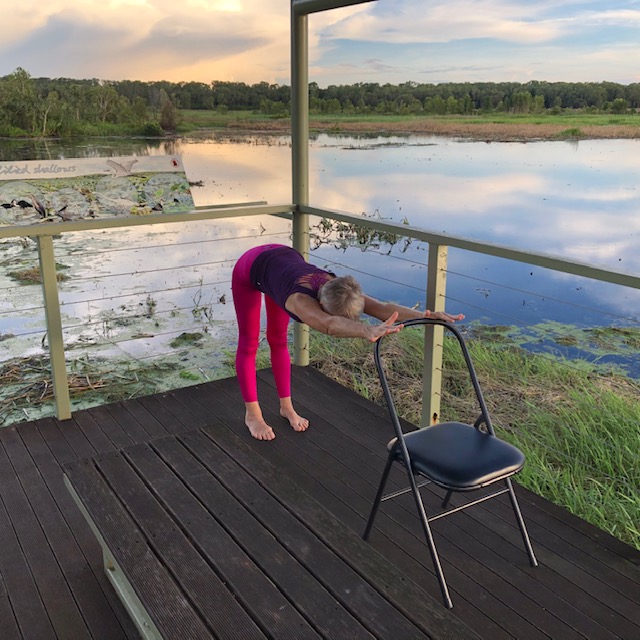
Half forward bend with hands on a chair. Fold from the hips and keep the legs straight.
Why does stretching not make my glutes stay loose?
Because the limit is partly in the brain. In a 1996 Danish study, seven healthy people stretched their hamstrings for three weeks (Magnusson and colleagues, Journal of Physiology). Their range grew. But when the researchers moved each leg to the same angle as before, the muscle pushed back just as hard as it had at the start. The gain was stretch tolerance (how much stretch the nervous system will allow before it says stop), not a longer muscle. A 2025 review of 65 studies found the same pattern.
So the buttock muscles are partly guarded. Force and fear make the guard hold on harder. Calm, steady holds teach it to let go. Mr Iyengar’s advice was not to force. A gain of 5 to 10% in a stretch is good. A stiff body can learn.
Keep the stretches regular and gentle, and add standing poses to teach the new range to the muscles around it. For the wider picture of why stiffness builds up, see Yoga For Stiff Guys, Or Anyone.

Wind-releasing pose. The knee draws in, the buttock stretches and the back rests.
Are tight glutes the same as weak glutes?
No. A muscle can be tight and weak at the same time. Howard’s point is that a buttock that clenches all day is not doing its job. Stretching releases the clench. Standing poses such as Triangle and Warrior then ask the buttocks to work while the hips are open, so the new range becomes range you can use.
A good rule: stretch, then stand. Finish a stretching session with two or three standing poses and your hips will feel steadier, not just looser.

Warrior II. After the stretch comes the stand: the buttock muscles work while the hips stay open.
For the front of the hip, the other half of the sitting story, see our guide to tight hips. For the hamstrings that sit next door, see tight hamstrings. If a deep buttock ache runs down the leg, read about the piriformis stretch and our lower back stretches.
Get the free ebook Too Stiff For Yoga?. New to Flametree, or away for 3 months or more? You get 2 free classes + 2 ebooks, only available via this offer. Already coming to class? You can still get the book.
Where can I get help with glute stretches in Darwin?
For glute stretches in Darwin, come to a beginner class at Flametree’s Woolner studio or join live online from anywhere in Australia. Every class uses chairs, belts, blocks and a wall, and the teacher adjusts each stretch to your body. You do not need to be flexible to start. Our guide to Yoga For Flexibility goes further. Chris also teaches a Sunday 6 December masterclass, Yoga for stronger and more flexible hips, in Darwin and online: see the Sunday Arvo Yoga Masterclasses.
Frequently asked questions
Which glute stretches release tight hips and a sore lower back?
A seated forward fold on a chair, a half forward bend with hands on a chair, Triangle Pose with a chair and a knee-to-chest stretch lying down. Fold from the hips, breathe out slowly and hold about 30 seconds.
Why do my glutes feel tight when I sit all day?
Long sitting keeps the hips folded and the buttock muscles switched off. Leslie Howard says the buttocks tend to stop working when we sit tucked under, and that a tight muscle is not a strong one.
How long should I hold a glute stretch?
About 30 seconds. In a 1994 trial of 57 people with tight hamstrings, 30 seconds worked as well as 60. Hold times for glute stretches in yoga have not yet been tested, so start with a half-minute.
Can tight glutes cause lower back or leg discomfort?
Rachel Krentzman writes that tight buttock muscles can press on the sciatic nerve, and that tight hips change how the pelvis tilts and load the lower back. Loosening the hips and buttocks takes load off the back.
Are tight glutes the same as weak glutes?
No. A muscle can be both. Stretch first to release the clench, then use standing poses so the buttocks work with the hips open.
Should I force a glute stretch to go deeper?
No. In a 1996 Danish study, three weeks of stretching raised stretch tolerance but the muscle pushed back as hard as before. Go a little further each time on the out-breath and let a prop hold you.
What is the best chair stretch for tight glutes?
A seated forward fold with your head on a block, folding from the hips with a long back. The half forward bend with hands on a chair is the standing version.
Where can I learn glute stretches in Darwin?
Flametree Yoga Studio teaches Iyengar yoga at Woolner in Darwin and live online. Beginner classes use chairs, belts and blocks, and the teacher adjusts each stretch to your body.
Where to next
- New to yoga, or coming back? Start with our half price 10 class pass with 2 classes free, in Darwin or live online.
- For a workplace, team or group: book private yoga classes for groups, online, at a Flametree studio or at your venue.
- Want to see class times first? Look at the beginner timetable.
Flametree Yoga Studio, Darwin and live online. This article is general information, not medical advice.
Sources: Bandy WD and Irion JM, The effect of time on static stretch on the flexibility of the hamstring muscles, Physical Therapy, 1994; Bandy WD, Irion JM and Briggler M, The effect of time and frequency of static stretching on flexibility of the hamstring muscles, Physical Therapy, 1997; Magnusson SP and colleagues, A mechanism for altered flexibility in human skeletal muscle, Journal of Physiology, 1996; Krentzman R, Yoga for a Happy Back; Howard L, Pelvic Liberation, 2017; Starrett K and Starrett J, Built to Move; Too Stiff For Yoga? and Happy Backs ebooks.



