
Tight Hamstrings? Why They Loosen, How Long To Hold, And The Yoga That Does It
Tight hamstrings: the short answer
Tight hamstrings loosen when your nervous system learns that a stretch is safe, not because the muscle suddenly grows longer. That is why slow, steady holds of about 30 seconds, repeated, work better than yanking or bouncing. A chair, a belt and a wall let you hold the stretch without strain. Yoga also keeps hamstrings loose through a hard sporting season. Here is the article in short form:
- After 3 weeks of stretching, the muscle pushed back as hard as before.
- The gain was stretch tolerance, not longer muscle.
- Thirty seconds worked as well as 60 in a trial of 57 people.
- Hold steadily and breathe out slowly. Do not bounce.
- Rugby players with yoga kept their hamstring flexibility; others lost about 15%.
- A chair and belt let a stiff body hold the stretch.
- In Darwin, learn it in a beginner class or online.
Last updated: 25 October 2026.
A quick word on Iyengar yoga. Iyengar yoga is the style developed by Mr BKS Iyengar. In the 20th century he did more than anyone to set down traditional Indian yoga, through his books and his teaching, and he pioneered the use of props. It is the style we teach at Flametree, in Darwin and live online.

Lying down with a belt: the leg stretches while your back rests and the belt does the holding.
Why do tight hamstrings loosen when you stretch?
Mostly because the brain allows more. In a 1996 Danish study, seven healthy people stretched their hamstrings (the muscles at the back of the thigh) for three weeks (Magnusson and colleagues, Journal of Physiology). Their range grew. But when the researchers moved each leg to the same angle as before, the muscle pushed back just as hard as it had at the start. The researchers concluded that the gain came from stretch tolerance (how much stretch the nervous system will allow before it says stop), not from a change in the muscle itself.
It was a small study, but it fits what Andrew McGonigle, a doctor and yoga teacher, and Matthew Huy, an exercise physiologist, report in The Physiology of Yoga: under a general anaesthetic, people become far more flexible. The muscles have not changed. The guard has simply gone to sleep.
So a tight hamstring is partly a guarded hamstring. Force and fear make the guard hold on harder. Calm, steady holds teach it to let go a little. The same Danish study found the muscle’s electrical activity stayed small during slow stretches, which is another reason to go slowly.
For more on why stiffness builds up in the first place, see Yoga For Stiff Guys, Or Anyone.
How long should you hold a hamstring stretch?
About 30 seconds, repeated. In a 1994 American trial, 57 people aged 21 to 37 with tight hamstrings held a stretch for 15, 30 or 60 seconds, five days a week for six weeks, or did not stretch (Bandy and Irion, Physical Therapy). Thirty seconds worked as well as 60, and both beat 15 seconds or no stretching.
A 1997 follow-up of 93 people found the same, and also that stretching three times a day gave no more than once a day (Bandy, Irion and Briggler, Physical Therapy). So you do not need to stretch all day. A steady half-minute, regularly, is enough.
McGonigle and Huy report research finding that most of the slow lengthening of a stretched muscle happens in the first 15 to 20 seconds. Nobody has yet tested ideal hold times in yoga poses, but it fits the Iyengar way with stiff beginners: short holds, repeated, going a little further each time, rather than one long strain.

Heel on a chair, belt round the foot, standing leg straight. A steady stretch you can hold.
What are the best yoga stretches for tight hamstrings?
Stretches where a prop does the holding, so the muscle can relax. Ask for these in class:
- Lying leg stretch with a belt. Lie on your back, loop a belt round one foot and lift the leg. Your back rests, your shoulders stay down, and you hold for 30 seconds. Do both sides.
- Standing leg stretch with the heel on a chair. A belt round the foot lets you hold without gripping. In Iyengar yoga this is a leg stretch on a rail or a chair, and it lengthens the back of the thigh while the spine stays tall.
- Half forward bend at a chair. Rest your hands on a chair seat and fold from the hips with a long back. Do not round the back to go lower.
- Standing forward bend (Uttanasana) with hands on blocks. Blocks bring the floor to you, so you fold from the hips, not the back.
In every pose, breathe out slowly as you go a little further. Never hold the breath, and never bounce.
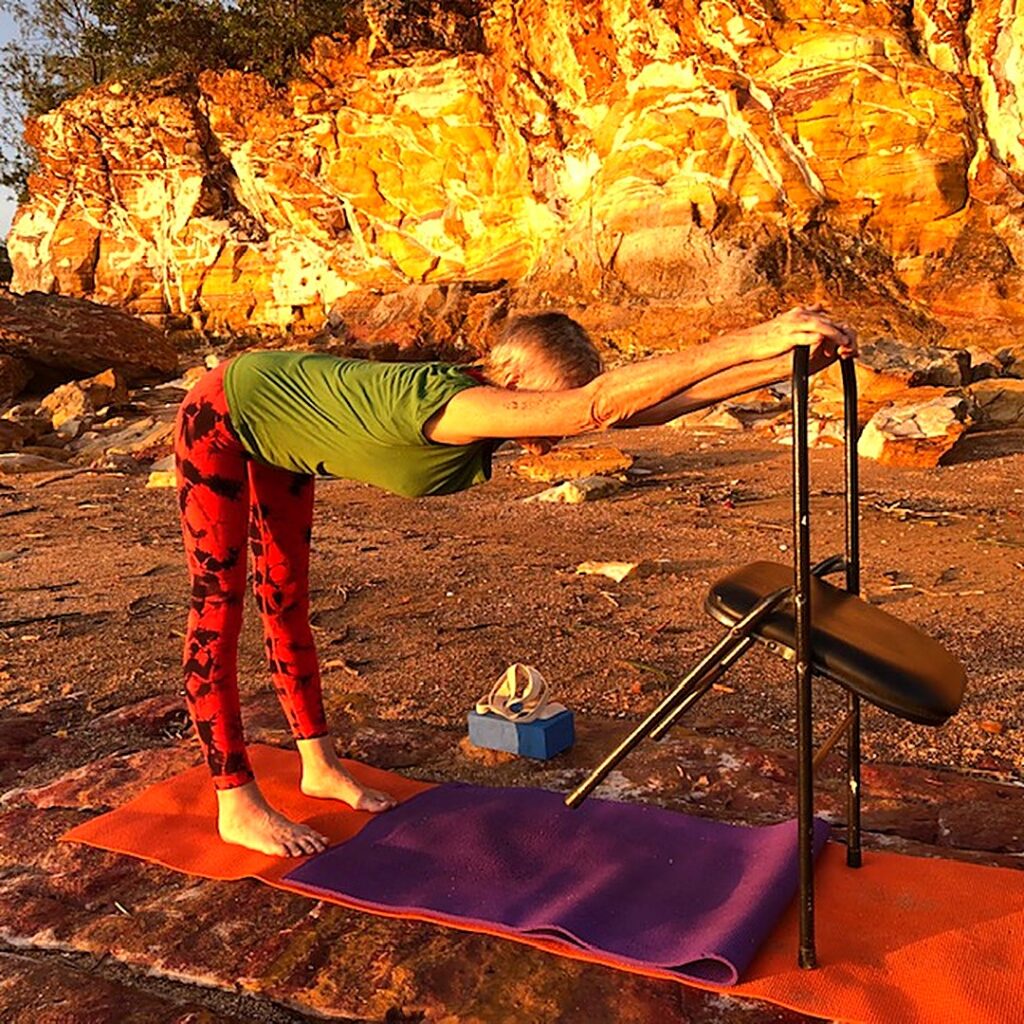
Half forward bend at a chair. Fold from the hips with a long back, so the hamstrings, not the spine, take the stretch.
Can yoga keep hamstrings loose through a season of sport?
In one small trial, yes. 31 New Zealand rugby players were tested before and during the season. Half added an hour of yoga twice a week for eight weeks, on top of their normal rugby training (Raj, Hamlin and Elliot, International Journal of Yoga, 2021). Hamstring flexibility was measured with a sit-and-reach test. The yoga group kept theirs, down just 1.2%, while the others lost about 15%. Sprint times barely changed in either group.
The trial was small, and the yoga group’s result was not clearly different from no change. But the drop in the others is the point: a hard season tightens the hamstrings.
In 2003, the Bath rugby club asked an Iyengar teacher, Richard Agar-Ward, to teach yoga to its first team three times a week. Mike Catt, then 31, had barely played for two seasons because of lower back and hamstring trouble. After less than two weeks of classes he said yoga had made an “incredible difference”, and he came on as a substitute in the 2003 World Cup final, which England won. One man’s story, not a trial, but a good one.
Standing poses help here because they stretch and strengthen at the same time, so new range is range you can use.

Standing forward bend (Uttanasana). The legs stay straight and the fold comes from the hips.
Get the free ebook Too Stiff For Yoga?. New to Flametree, or away for 3 months or more? You get 2 free classes + 2 ebooks, only available via this offer. Already coming to class? You can still get the book.
Where can I get help with tight hamstrings in Darwin?
For tight hamstrings in Darwin, come to a beginner class at Flametree’s Woolner studio or join live online from anywhere in Australia. Every class uses chairs, belts, blocks and a wall, and the teacher adjusts each stretch to your body. You do not need to be flexible to start. Our guide to Yoga For Flexibility and our piece on how to get more flexible go further. For stiff hips alongside the hamstrings, see tight hips.
Frequently asked questions
Why do my hamstrings still feel tight after I stretch?
Because the limit is often the nervous system, not the muscle. In a Danish study, three weeks of hamstring stretching raised how much stretch people could tolerate, but the muscle pushed back as hard as before. Calm, regular holds change the guard slowly.
How long should I hold a hamstring stretch?
About 30 seconds. In a 1994 trial of 57 people with tight hamstrings, 30 seconds worked as well as 60, and both beat 15 seconds or none. Hold steadily, breathe out slowly, and repeat.
How often should I stretch tight hamstrings?
Most days works. In the trials, people stretched five days a week for six weeks. A 1997 trial of 93 people found stretching three times a day gave no more than once a day, so do not overdo it.
Should I bounce to loosen tight hamstrings?
No. Iyengar yoga holds a stretch steadily. In the Danish study, the muscle’s electrical activity stayed small during slow stretches, so the guard is less likely to hold you back. Bouncing teaches the opposite.
What is the best chair stretch for tight hamstrings?
A half forward bend with your hands on a chair seat, folding from the hips with a long back. Or put one heel on the chair seat with a belt round the foot and hold the standing leg straight. Both let you hold the stretch without strain.
Can yoga keep hamstrings flexible during a sports season?
In a small trial of 31 New Zealand rugby players, those who added an hour of yoga twice a week for eight weeks kept their hamstring flexibility, while the others lost about 15 percent. Sprint times barely changed.
Are tight hamstrings short hamstrings?
Not necessarily. In a small Danish study, the gain from three weeks of stretching came from greater stretch tolerance, not a change in the muscle. A tight hamstring is partly a guarded one.
Where can I get help with tight hamstrings in Darwin?
Flametree Yoga Studio teaches Iyengar yoga at Woolner in Darwin and live online. Beginner classes use chairs, belts and blocks, and the teacher adjusts each stretch to your body. You do not need to be flexible to start.
Where to next
- New to yoga, or coming back? Start with our half price 10 class pass with 2 classes free, in Darwin or live online.
- For a workplace, team or group: book private yoga classes for groups, online, at a Flametree studio or at your venue.
- Want to see class times first? Look at the beginner timetable.
Flametree Yoga Studio, Darwin and live online. This article is general information, not medical advice.
Sources: Magnusson SP and colleagues, A mechanism for altered flexibility in human skeletal muscle, Journal of Physiology, 1996; Bandy WD and Irion JM, The effect of time on static stretch on the flexibility of the hamstring muscles, Physical Therapy, 1994; Bandy WD, Irion JM and Briggler M, The effect of time and frequency of static stretching on flexibility of the hamstring muscles, Physical Therapy, 1997; Raj T, Hamlin MJ and Elliot CA, Association between hamstring flexibility and sprint speed after 8 weeks of yoga in male rugby players, International Journal of Yoga, 2021; McGonigle A and Huy M, The Physiology of Yoga; Stay In The Game and Too Stiff For Yoga? ebooks.



