
Hip Flexor Stretch: Five Ways To Do It Without Straining Your Back
Hip flexor stretch: the short answer
You do a hip flexor stretch, and you feel it in your lower back instead of the front of your hip. That is the most common mistake, and it is easy to fix. A good hip flexor stretch takes the thigh back behind the body while the tailbone stays long, so the back does not arch. Lunges do it, and so do supported poses lying on a bolster. Hold each one for about 30 seconds and breathe out as you settle. Here is the article in short form:
- Your hip flexors are a group of muscles, not one.
- The back arches when the hip is too tight to give. Lengthen the tailbone instead.
- Lunge with the back leg straight and the tailbone down.
- Lie on a bolster and the front of the hip lengthens with no effort.
- Reclining Hero Pose stretches the front of the thigh as well.
- Hold about 30 seconds. Do not bounce.
- In Darwin, learn it in a beginner class or online.
Last updated: 25 October 2026.
A quick word on Iyengar yoga. Iyengar yoga is the style developed by Mr BKS Iyengar. In the 20th century he did more than anyone to set down traditional Indian yoga, through his books and his teaching, and he pioneered the use of props. It is the style we teach at Flametree, in Darwin and live online.

A lunge with the back leg long and straight. The front of the back hip opens as the thigh reaches behind you.
Which muscles are your hip flexors?
Your hip flexors are the muscles that lift the thigh towards the body. There is more than one. The deep one is the psoas (say “SO-as”), which runs from the lower spine to the thigh bone. Beside it sits the iliacus, which lines the inside of the pelvis. And at the front of the thigh, the rectus femoris, the long middle muscle of the quadriceps (the big muscles at the front of the thigh), also crosses the hip, so it lifts the thigh too.
That matters because one stretch rarely reaches all of them. A lunge reaches the deep ones best. Reclining Hero Pose reaches the rectus femoris. So the plan below uses both. If you want the deep muscle on its own, our psoas stretch guide goes into it in detail.

The quadriceps. The rectus femoris crosses the hip as well as the knee, so it is a hip flexor too.
Why do the hip flexors get tight?
Mostly because of the chair. Sit, and the hip folds. Drive, and it folds. Sit on the couch, and it folds again. Hardly anything in a modern day takes the thigh back behind the body. Kelly Starrett, an American physical therapist (physiotherapist) and mobility coach, and his wife Juliet describe a typical day at about 12 hours in a chair. Their goal is six hours or fewer.
Age is not the main cause. A large American national health survey measured the hips and knees of 1,683 people by age (Roach and Miles, Physical Therapy, 1991). Up to age 74, most joints had lost only 3 to 5 degrees. The big exception was hip extension, taking the leg back behind you, which lost more than a fifth of its range. The movement that chairs stop us using is the one we lose.

A day of chairs moves the hip mostly forward. A class takes it in every direction, including back.
How do you stretch a tight hip flexor without straining your back?
Keep the tailbone long, and let the front of the hip do the stretching. Rachel Krentzman, an American physical therapist and yoga therapist, explains in Yoga for a Happy Back that tight hip flexors from long hours of sitting pull the pelvis forward and squeeze the lower back. So when the hip is stiff and you push on, the easy way out is to arch the lower back. You feel a stretch, but it is in the wrong place.
The fix is a small action. Lengthen the tailbone towards the floor, lift the lower belly a little, and keep the ribs soft. If you cannot keep that and still feel the stretch, make the pose smaller or add a prop. Props are the Iyengar answer to this. They let a stiff body do the real pose, correctly, today.
What is the best hip flexor stretch for beginners?
Start with the first two, and add the others as the hips soften. We teach all five in Flametree classes.
- Lunge with the hands on the floor or a chair. Step one foot well forward, bend the front knee over the ankle and straighten the back leg. Lengthen the tailbone down, then reach the back heel away. If the floor feels far away, put your hands on a chair seat. Hold about 30 seconds each side.
- Supported bridge over a bolster, legs long. Lie back with a bolster under the lower back and ribs, and let the legs rest long on the floor. A belt round the thighs keeps the legs from rolling out. You do nothing. Gravity lengthens the front of the hips while the back is held up. Stay a few minutes and breathe out slowly.
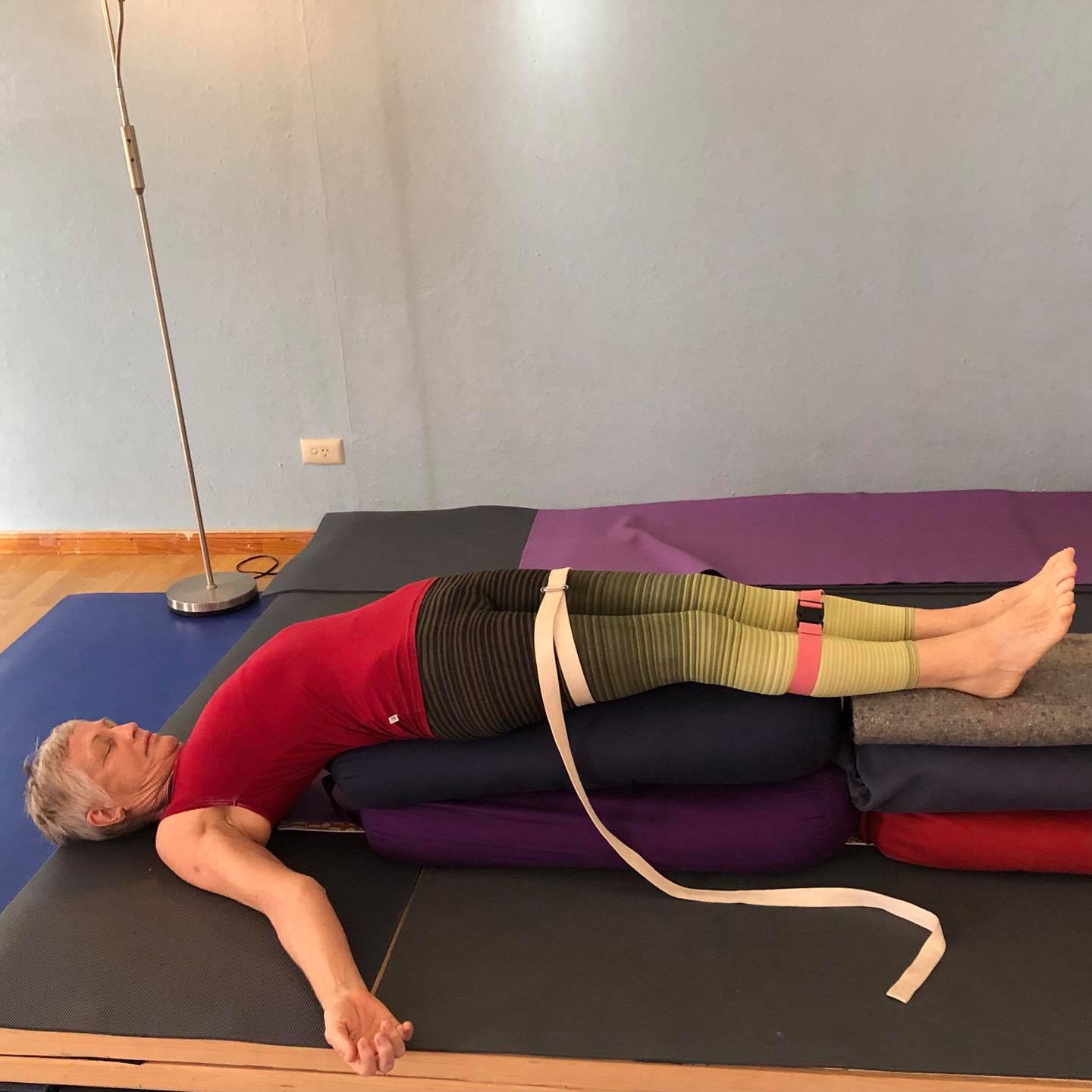
Lying back over bolsters with the legs long. The front of the hip lengthens while the back is fully held.
- Reclining Hero Pose (Supta Virasana). Kneel with the knees together and the feet a little wider than the hips. Sit between the feet, on a block if you need height, then lean back on your hands, then your forearms. This one stretches the front of the thigh (the rectus femoris) as well as the hip. Come out if your knees pinch.

Reclining Hero Pose (Supta Virasana), here lying fully back. Use a block under the seat and lean on your forearms to start.
- Bridge with the feet on a chair. Lie back with your calves or feet on a chair seat and lift the hips. The tops of the thighs lengthen as the hips rise. Keep the tailbone moving towards the knees so the lower back does not squash.
- Standing thigh stretch at a chair. Hold a chair back with one hand. Bend the other knee and take the foot behind you, with a belt round the ankle if you cannot reach. Keep the knees side by side and the tailbone long. Hold about 30 seconds, then change sides.

Bridge Pose with the feet on a chair. The hips lift and the front of the thighs lengthen.
Stuart McGill of Flametree grew up on cattle stations in the Northern Territory. At ten, over a lunch under a tree, his father noticed he could sit on his bottom between his feet. Years later he learned that was Reclining Hero Pose. Plenty of people lose that in a life of chairs. Many get it back.
How long should you hold a hip flexor stretch?
About 30 seconds, then repeat. The best test we have is for the hamstrings, the muscles at the back of the thigh. In a 1997 American trial, 93 people aged 21 to 39 with tight hamstrings stretched five days a week for six weeks (Bandy and colleagues, Physical Therapy). Thirty seconds was enough to gain range, and 60 seconds gave no more. Hold times for the hip flexors in yoga poses have not yet been tested, so a steady half-minute is a good place to start.
Do not force it. In a 1996 Danish study, three weeks of stretching raised how much stretch people could tolerate, but the muscle pushed back as hard as before (Magnusson and colleagues, Journal of Physiology). So part of the limit is in the brain. Calm, steady holds teach it to allow more.
Stretching does help the hip. In a 2012 Canadian trial, 24 young men with limited hip movement did six weeks of home stretching, with or without exercises for the trunk, and both stretching groups gained hip range (Moreside and McGill, Journal of Strength and Conditioning Research). It was a small group of young men, so treat it as a sign, not a promise for everyone.
Is a hip flexor stretch the same as a psoas stretch?
Nearly, but not quite. The psoas is one of the hip flexors, so a psoas stretch is a hip flexor stretch. This page covers the whole group, including the front of the thigh. Our psoas stretch page goes deep on the one muscle, with its own lunges and a chair version.
The hip flexors work with their neighbours. Tight hamstrings and buttock muscles add to the same pull on the lower back, so stretch all three. See tight hamstrings and glute stretches, and for the wider picture tight hips and lower back stretches.
Get the free ebook Too Stiff For Yoga?. New to Flametree, or away for 3 months or more? You get 2 free classes + 2 ebooks, only available via this offer. Already coming to class? You can still get the book.
Where can I learn a hip flexor stretch in Darwin?
For a hip flexor stretch in Darwin, come to a beginner class at Flametree’s Woolner studio or join live online from anywhere in Australia. Every class uses chairs, belts, blocks, bolsters and a wall, and the teacher adjusts each pose to your body. You do not need to be flexible to start. Our guide to Yoga For Flexibility goes further. Chris also teaches a Sunday 6 December masterclass, Yoga for stronger and more flexible hips: see the Sunday Arvo Yoga Masterclasses page for what is open.
Frequently asked questions
How do you stretch a tight hip flexor without straining your back?
Keep the tailbone long and the ribs soft, and let the front of the hip do the stretching. Use a lunge with the back leg straight, or lie back over a bolster. If you feel it in the lower back, make the pose smaller or add a prop.
Which muscles are the hip flexors?
The psoas and iliacus lift the thigh from the pelvis and spine, and the rectus femoris, at the front of the thigh, helps. Together they lift the thigh towards the body.
What is the best hip flexor stretch for beginners?
A lunge with the hands on a chair, and a supported bridge over a bolster with the legs long. Both are easy to hold and both keep the back safe from arching.
Can you stretch the hip flexors lying down?
Yes. Lying back over a bolster with the legs long lets gravity lengthen the front of the hip, and Reclining Hero Pose stretches the front of the thigh. Both are gentle and need no effort.
How long should you hold a hip flexor stretch?
About 30 seconds. In a 1997 trial of 93 people, 30 seconds gained range for tight hamstrings and 60 gave no more. Hold times for hip flexors in yoga have not yet been tested, so start with a half-minute.
Why does my back arch when I stretch my hip flexors?
Because a tight hip flexor pulls the pelvis forward, and the lower back gives instead of the hip. Lengthen the tailbone towards the floor and lift the lower belly a little, and the stretch moves back to the front of the hip.
Is a hip flexor stretch the same as a psoas stretch?
The psoas is one of the hip flexors, so yes in part. A hip flexor stretch aims at the whole group, including the front of the thigh. Our psoas stretch page covers the one deep muscle.
Where can I learn a hip flexor stretch in Darwin?
Flametree Yoga Studio teaches Iyengar yoga at Woolner in Darwin and live online. Beginner classes use chairs, belts, blocks and bolsters, and the teacher adjusts each stretch to your body.
Where to next
- New to yoga, or coming back? Start with our half price 10 class pass with 2 classes free, in Darwin or live online.
- For a workplace, team or group: book private yoga classes for groups, online, at a Flametree studio or at your venue.
- Want to see class times first? Look at the beginner timetable.
Flametree Yoga Studio, Darwin and live online. This article is general information, not medical advice.
Sources: Roach KE and Miles TP, Normal hip and knee active range of motion: the relationship to age, Physical Therapy, 1991; Bandy WD, Irion JM and Briggler M, The effect of time and frequency of static stretching on flexibility of the hamstring muscles, Physical Therapy, 1997; Magnusson SP and colleagues, A mechanism for altered flexibility in human skeletal muscle, Journal of Physiology, 1996; Moreside JM and McGill SM, Hip joint range of motion improvements using three different interventions, Journal of Strength and Conditioning Research, 2012; Krentzman R, Yoga for a Happy Back; Starrett K and Starrett J, Built to Move; Too Stiff For Yoga?, Happy Backs and Stay In The Game ebooks.



