Balance Exercises You Can Do At Home: Eight Simple Ones, With A Chair
Balance exercises: the short answer
Balance exercises are simple things you can do at home with a kitchen bench or a chair: standing tall, shifting your weight, spreading your toes, standing on one leg, and a few standing yoga poses. You do them a little each day, and you make them harder one step at a time. Start with a hand on the bench, then a chair close by, then no support. Keep your eyes open until last. Here is the article in short form:
- You need a bench or chair, and about five minutes.
- Start by standing tall and spreading the weight across your feet.
- Stand on one leg at the bench. Build up to a minute on each leg.
- Tree Pose, Warrior II and a supported lunge train the legs and ankles.
- Standing up from a chair is a balance exercise too.
- Make each exercise harder in steps: wall, chair, no support, eyes closed.
- In Darwin, learn them in a beginner class or online.
Last updated: 25 October 2026.
A quick word on Iyengar yoga. Iyengar yoga is the style developed by Mr BKS Iyengar. In the 20th century he did more than anyone to set down traditional Indian yoga, through his books and his teaching, and he pioneered the use of props. It is the style we teach at Flametree, in Darwin and live online.

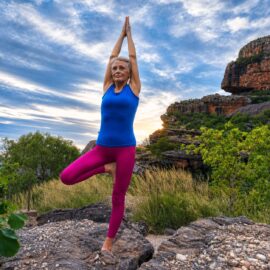
Tree Pose on the rocks at Edith Falls. At home, do it with a chair close by.
What are the best balance exercises to do at home?
These eight are the ones we teach, in the order we would do them. Do the first four every day. Do the others a few times a week. Stand next to a kitchen bench or a sturdy chair so there is always something to hold. Bare feet grip better than socks.
- Stand tall with a hand on the bench. This is Mountain Pose (Tadasana). Feet hip-width apart, toes pointing forward. Lift the chest and lengthen the spine. Spread your weight evenly across the “four corners” of each foot: the base of the big toe, the base of the little toe, and the two sides of the heel. Stay for 30 seconds.

Standing tall with one hand on a chair. The weight spreads across all four corners of the feet.
- Shift your weight. Stand as above. Slowly move your weight to the right foot, then the left, ten times. Then forward to the toes and back to the heels, ten times. Go only as far as you stay steady.
- Spread and lift your toes. Lift all ten toes, then spread them wide, then put them down one at a time, big toe last. Try it ten times. Strong toes help you balance, and most of us never use them.
- Stand on one leg at the bench. Hold the bench with one hand. Lift one foot a little off the floor and stand on the other leg for 10 to 20 seconds. Change sides. Build up slowly. When it feels easy, hold the bench with just one finger.
- Tree Pose with a chair close by. Stand on one leg. Place the other foot on the inside of the standing ankle or calf, never on the knee. Press the foot and leg together. Keep a chair within reach, so you can put a hand down if you need to. Hold 10 to 20 seconds each side.
- Warrior II. Step the feet wide apart. Turn the right foot out, bend the right knee over the ankle, and stretch both arms out. Look over the right hand. Hold 20 to 30 seconds each side. It builds the strength in the legs that balance rests on.

Warrior II. Press the back foot down and keep the front knee over the ankle.
- Supported lunge with a chair. Hold the back of a chair with both hands. Step one foot back, bend the front knee over the ankle, and keep the back leg straight. Lift the chest. Hold 20 to 30 seconds each side. The chair lets you work the legs without fear of falling.

A supported lunge. The chair holds you steady while the legs do the work.
- Stand up from a chair. Sit near the front of the chair. Lean forward and stand up without using your hands if you can, then sit down slowly. Do five. It is a balance exercise as well as a strength one, because you pass through a wobbly moment each time.
How do you make a balance exercise harder?
Move up one step at a time. Each step is still a real pose, not a lesser one. You move up when the last step feels steady.
- At the wall, with your shoulder or back against it.
- With a chair under one hand, held lightly.
- With no support, with the chair close by.
- With your eyes closed, only when a wall or bench is within reach.

The four steps of a balance exercise. Move up when the last step is steady.
You do not have to do all four. If you only ever reach step two, you are still training your balance.
How long should you stand on one leg?
Work up to about a minute on each leg. In a Japanese trial of 553 people at high risk of falls, average age 81.6, people stood on one leg for one minute on each side, three times a day, for six months (Sakamoto and colleagues, Journal of Orthopaedic Science, 2006). The group that did it had fewer falls. They were allowed to hold a bar if they felt unsteady. There was no difference in broken hips, but only one happened in each group.
So start with 10 to 20 seconds, with a hand on the bench. Add a few seconds each week. A short go, several times a day, is better than one long go that tires you.
Do balance exercises really prevent falls?
Yes. A 2020 review for the World Health Organization pooled 116 trials with 25,160 people aged 60 and over (Sherrington and colleagues, International Journal of Behavioral Nutrition and Physical Activity). Balance and functional exercise cut the rate of falls by 24 percent. Programs of 3 or more hours a week cut falls by 42 percent. That is the weekly total, so a class plus short daily practice at home counts. Our guide to how to improve balance goes through the full evidence and the Sydney trial in detail.

More hours a week of balance and functional exercise, fewer falls (2020 review of 116 trials).
In a Sydney pilot study, Iyengar yoga improved the main risk factors for falls (Tiedemann and colleagues, Journals of Gerontology Series A, 2013). It had 54 people, with an average age of 68. They did two classes a week for 12 weeks, mostly standing poses. Compared with the group that did not, they improved at standing balance, standing on one leg with eyes closed, standing up from a chair and walking speed. People came to 20 of the 24 classes on average, and nothing serious went wrong.

The 2013 Sydney pilot: 12 weeks of Iyengar yoga, with gains in balance and mobility.
Why do the feet and toes matter for balance?
Because the feet are where you meet the ground. In a study of 176 people with an average age of 80, those who went on to fall had stiffer ankles and weaker toes than those who did not (Menz and colleagues, Journals of Gerontology Series A, 2006). The toes are trainable. In a 2016 Australian trial, 85 people aged 60 to 90 did either supervised toe exercises or exercises at home, for 12 weeks (Mickle and colleagues, Clinical Biomechanics). Only the supervised group got stronger, by up to 36 percent, and their one-leg balance time improved too. A good teacher makes a difference to a small movement like this.
Get the free ebook Strong Bones, Steady Feet. New to Flametree, or away for 3 months or more? You get 2 free classes + 2 ebooks, only available via this offer. Already coming to class? You can still get the book.
Where can I learn balance exercises in Darwin?
For balance exercises in Darwin, come to a beginner class at Flametree’s Woolner studio or join live online from anywhere in Australia. Every class uses chairs, a wall, belts and blocks, and the teacher adjusts each pose to your body. You do not need to be fit or flexible to start. Our guide to yoga for seniors shows what a class looks like.
Frequently asked questions
What are the best balance exercises to do at home?
Standing tall with a hand on a bench, shifting your weight, spreading your toes, standing on one leg at a bench, Tree Pose with a chair close by, Warrior II, a supported lunge, and standing up from a chair. All eight need only a bench or chair.
How long should I stand on one leg?
A Japanese trial of 553 people (average age 81.6) used one minute on each leg, three times a day, for six months. Start with 10 to 20 seconds with a hand on the bench and build up. Stop before you wobble hard.
How often should I do balance exercises?
A little often works best. A 2020 review of 116 trials found people who did 3 or more hours a week of balance and functional exercise had 42 percent fewer falls. Short daily practice at home adds up alongside a weekly class.
Can I do balance exercises with my eyes closed?
Only as the last step, and only with a wall or bench within reach. Master the pose with your eyes open first, then with a hand under support, then with no support. Closing the eyes comes last.
What balance exercise is best for the feet and ankles?
Spreading and lifting the toes, then standing evenly on the four corners of each foot. In a 2016 Australian trial of 85 older people, a supervised toe programme raised toe strength by up to 36 percent.
Do I need any equipment for balance exercises at home?
No. A kitchen bench, a sturdy chair and a wall are enough. A yoga mat helps on a slippery floor, and bare feet grip better than socks.
Is Tree Pose a good balance exercise?
Yes, if you keep a chair within reach. The foot goes on the inside of the standing ankle or calf, never on the knee. Start with 10 to 20 seconds on each side.
Where can I learn balance exercises in Darwin?
Flametree Yoga Studio teaches Iyengar yoga at Woolner in Darwin and live online. Beginner classes use chairs, a wall and other props, and the teacher adjusts each pose to your body.
Where to next
- New to yoga, or coming back? Start with our half price 10 class pass with 2 classes free, in Darwin or live online.
- For a workplace, team or group: book private yoga classes for groups, online, at a Flametree studio or at your venue.
- Want to see class times first? Look at the beginner timetable.
Flametree Yoga Studio, Darwin and live online. This article is general information, not medical advice.
Sources: Tiedemann A and colleagues, A 12-week Iyengar yoga program improved balance and mobility in older community-dwelling people: a pilot randomized controlled trial, Journals of Gerontology Series A, 2013; Sakamoto K and colleagues, Effects of unipedal standing balance exercise on the prevention of falls and hip fracture among clinically defined high-risk elderly individuals, Journal of Orthopaedic Science, 2006; Sherrington C and colleagues, Evidence on physical activity and falls prevention for people aged 65+ years, International Journal of Behavioral Nutrition and Physical Activity, 2020; Menz HB and colleagues, Foot and ankle risk factors for falls in older people: a prospective study, Journals of Gerontology Series A, 2006; Mickle KJ and colleagues, Efficacy of a progressive resistance exercise program to increase toe flexor strength in older people, Clinical Biomechanics, 2016; Strong Bones, Steady Feet ebook.