
Lower Back Stretches: Which Ones Ease A Tight Back, And In What Order
Last updated: 25 October 2026
Lower back stretches: the short answer
Gentle lower back stretches, done in the right order, are very likely to help a tight back and are certainly worth trying, based on our experience at Flametree. The order is the secret. Rest the sore part first, then make space, then stand and stretch. Force and speed are what keep a back tight.
This article draws on our free ebook, Happy Backs: The Gentle Iyengar Way With A Sore Back, by Chris Lalor. In short:
- Start by resting. Lie with your calves on a chair or bolster before you stretch anything.
- Then make space lying down. A belt and a bolster do the work, so your back stays on the floor.
- Then stand. A chair and a belt bring the leg stretch and the half forward bend to you.
- One leg at a time. Lifting both legs together waits.
- Short holds, repeated. Ten to twenty seconds, two or three times, is kinder than one long struggle.
- Stretch from the hips. Tight legs and hips make the lower back do the bending.
Get Happy Backs free here or read about the book on its ebook page.
A quick word on Iyengar yoga. Iyengar yoga is the style developed by Mr BKS Iyengar. He pioneered the use of props such as chairs, belts and bolsters (firm, long cushions). It is the style we teach at Flametree, in Darwin and live online, and props are why a sore back can stretch without being forced.

The clench circle: pain makes you tense, and tension keeps the back tight. Gentle, supported stretches break the circle.
Which stretches ease a tight lower back, and in what order?
These six, in this order: rest with your calves up, a lying leg stretch with a belt, a lying leg stretch out to the side, a twist with the knees on a bolster, a standing leg stretch with your heel on a chair, and a half forward bend with your hands on a chair. The order follows a simple rule from Iyengar teaching: rest, then space, then strength.
Not sure where to start? Ask yourself one question. Does your back hurt more standing, or lying down? If standing hurts, start with the lying stretches. If lying hurts, start with the standing ones. Your answer sets your order.
1. Rest with your calves on a chair

Lower back stretches start with rest. Here the calves are on a bolster. A chair seat does the same job.
Lie on your mat with a folded blanket under your head. Rest your calves on a chair seat, so your knees and hips bend. Breathe slowly through the nose. On each out-breath, feel your lower back spread onto the floor. Stay for two to five minutes. This is not a stretch yet. It is the rest that lets the stretches work.
2. Lying leg stretch with a belt

The lying leg stretch (Supta Padangusthasana I). The back rests on the floor while the back of the leg lengthens.
Lie flat. Loop a belt around one foot and lift that leg, keeping the other leg long on the floor. If the raised leg will not straighten, bend the knee a little. The aim is to lengthen the back of the leg while the back stays still on the floor. Hold for 10 to 20 seconds, rest, then go again. Do both sides. One leg at a time, bit by bit, is exactly right for a tight lower back. The back of the thigh holds the muscles called hamstrings. When they are tight, the lower back bends for them.
3. Lying leg stretch out to the side, on a bolster

Reclining Big Toe Pose II, the simpler version. The bolster holds the leg, so the hip can let go.
Keep the belt on the same foot. Let the leg float out to the side and rest on a bolster, with the other leg long on the floor. The bolster carries the weight, so the hip and the buttock can soften. Geeta Iyengar wrote that this pose “soothes the nerves around the hips”. It is one of the best stretches for a back that is tight on one side. Breathe out and let the leg sink. Hold for 10 to 20 seconds, then repeat on the other side.
4. Twist with the knees on a bolster

A supine twist with the knees resting on a bolster. The lower back turns without strain.
Lie on your back with your knees bent and a bolster beside your hips. Lower both knees onto the bolster, to one side, and open your arms wide. The bolster takes the weight of the legs, so the lower back turns gently, without strain. Breathe out slowly and let the shoulder blades rest. Stay for 20 to 30 seconds, then come back and change sides. Twists work best when you lengthen first and turn from the upper back. We explain why in Are Twists Bad For Your Back?
5. Standing leg stretch with your heel on a chair

Extended Hand To Big Toe Pose I, the simpler version: heel on a chair, belt round the foot, both legs straight.
Stand tall in front of a chair. Place one heel on the seat, with a belt round the foot and both legs straight. Hold the belt, keep your chest lifted and stay tall. Do not round forward to reach. The chair brings the leg to you. Hold 10 to 20 seconds, step down and shake out, then go again. This and the lying leg stretch come into almost every back class we teach, for every kind of back.
6. Half forward bend with your hands on a chair
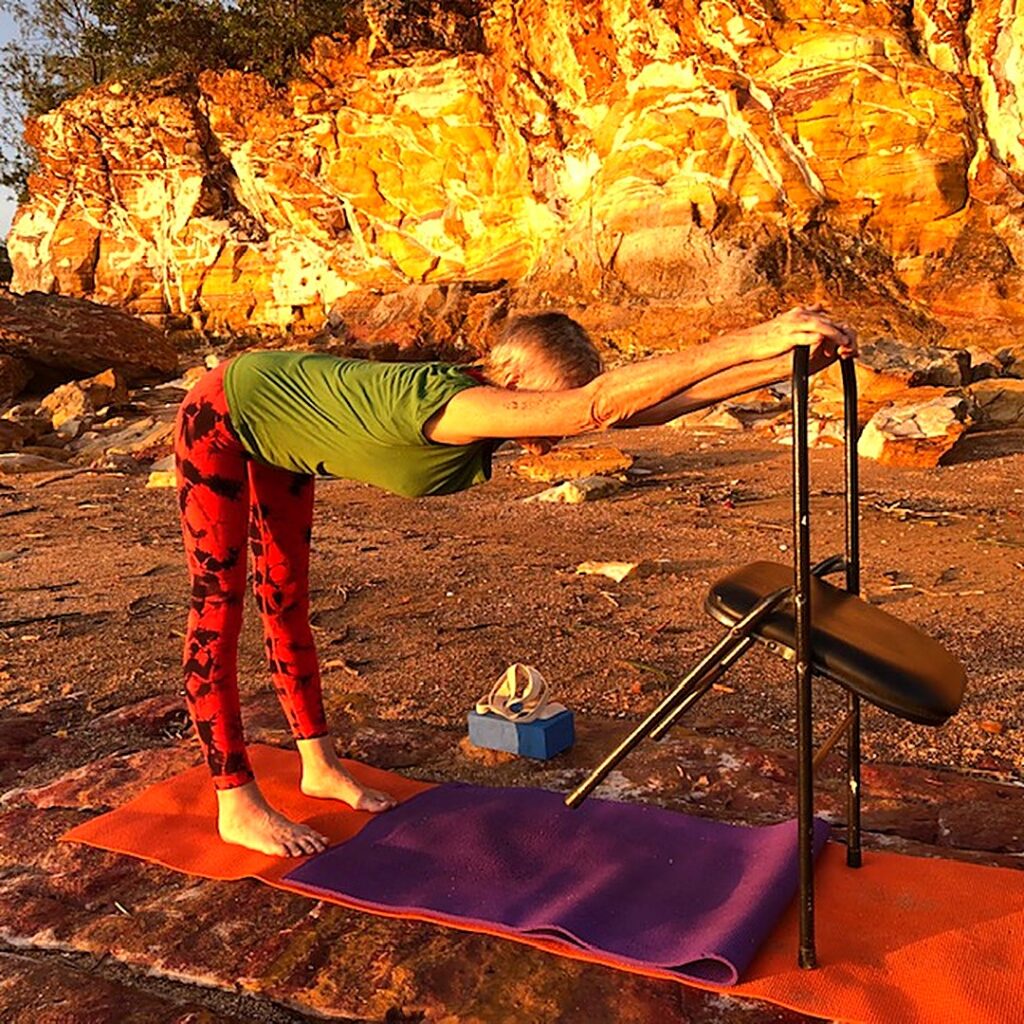
The half forward bend (Half Angle Pose) with the hands on a chair. The back spreads and lengthens.
Stand a leg’s length from a chair, put your hands on its back and walk your hips back until your spine is long and level. Your legs stay straight. Press your hands down and lengthen from your hips to your head. Breathe out and let the back broaden. Stay 10 to 20 seconds, come up, and repeat two or three times. Bend your knees a little if your hamstrings pull your lower back round.
Which lower back stretches should you skip?
Skip the ones that force or hurry the back. Four stand out.
- Lifting both legs together. Of this double leg lift, Geeta Iyengar wrote: “Those with slipped disc and backache should avoid this method.” One leg at a time is the safer start.
- Toe-touch rounding. When the hamstrings are short, people round their backs to reach. The physiotherapist Margaret Martin says to bend from the hips, and bend the knees if the hamstrings are short.
- Strong backbends too early. Geeta Iyengar said: “You cannot straight away do backbends. Learn proper standing poses then switch over to the backbends.” At Flametree, backbends wait.
- Long, strained holds. Mr Iyengar told a teacher adjusting a sore neck: “Never keep long for any person. Just touch and go, touch and go.”
Mr Iyengar also drew the line between pain and stretch: “Pain is unbearable; a stretch is bearable.” If a sensation is sharp, or is still there after you come out of the pose, stop. That is bad pain. Good pain feels like relief and fades when you leave the pose.
How long should you hold a lower back stretch?
Ten to twenty seconds, two or three times, then come out and go in again. That is how we teach it, and it fits what researchers have found. In a 1994 American trial, 57 people with tight hamstrings held a stretch for 15, 30 or 60 seconds, or did not stretch, five days a week for six weeks. Thirty seconds worked as well as a full minute, and both beat 15 seconds or none. A 1997 trial of 93 people found the same. So steady, unhurried holds, repeated over weeks, are what loosen a stiff muscle.
Those trials tested hamstrings in young adults, not yoga poses or sore backs, so we use them as a guide, not a rule. Researchers also report that most of the slow lengthening in a stretched muscle happens in the first 15 to 20 seconds. That is why short holds, repeated, make sense. A 2024 review of 77 stretching studies found that held stretches gave more lasting range than bouncing ones.
Why does a tight lower back need leg and hip stretches?
Because the legs and hips set how much the lower back has to bend. To bend forward well, the pelvis has to tip over the hip joints. If the hamstrings are tight, the pelvis cannot tip, so the lower back bends instead. The American physical therapist Rachel Krentzman adds the other side. Tight hip flexors, the muscles at the front of the hip, are often shortened by long hours of sitting. They pull the pelvis forward and squeeze the lower back. Tight buttock muscles can press on the sciatic nerve too.

A half forward bend with the hands on blocks. The bend comes from the hips, so the lower back stays long.
That is why a good lower back stretch session works the legs and hips as much as the back. Chris found it in her own body. She came to yoga in her late 30s with back pain, and says that stretching her hamstrings and building her core together took away a great deal of it. A belt was her way in.
For the wider picture, read How To Reduce Lower Back Pain and Yoga For Lower Back Pain. If your stiffness is all over, see Yoga For Flexibility. For aches higher up, between the shoulder blades, see Mid Back Pain.
Where can you learn lower back stretches in Darwin?
Flametree runs a Yoga For Backs class on Wednesdays at 7.15pm at our Woolner studio, in the studio only. Most of our beginner classes suit tight lower backs too, because every class is adjusted to the people in the room. If you are looking for lower back stretches in a Darwin class, you can also join us live online from anywhere in Australia. You will see the chairs, belts and bolsters in action.
If your pain is new or severe, came after a fall, or comes with numbness or weakness, tell your teacher before class. Feel free to check with your professional advisers if you wish, but also give yoga a try.
Frequently asked questions
What is the best stretch for a tight lower back?
For most people, the lying leg stretch with a belt. Your back rests on the floor while the back of the leg lengthens, so the tight hamstrings stop pulling on the lower back. Keep the knee soft if the leg will not straighten, and hold 10 to 20 seconds.
How long should I hold lower back stretches?
Ten to twenty seconds, repeated two or three times. A 1994 American trial of 57 people found 30 seconds as good as a full minute for tight hamstrings. Short holds, repeated, are kinder to a sore back than one long strain.
Should I stretch a sore lower back at all?
Gently, yes, when the stretch is supported and nothing is forced. Rest first, then make space, then stand. A prop does the work, so a sore back is never pushed. If a pose gives sharp pain that stays after you come out, stop and tell your teacher.
Is it better to stretch in the morning or at night?
Either works, so pick the time you will keep. Many students like a few lying stretches before bed, because they end with rest. Rest at the start and end is part of how we teach it.
Are lower back stretches different from yoga for a bad back?
They overlap. These six are the stretches that come into almost every Flametree back class. Yoga adds standing poses to build the legs and hips, rests and slow breathing, and a teacher who adjusts each pose. Our yoga for sore back guide explains the full approach.
Can I do lower back stretches if I sit all day?
Yes, and sitting is a big reason to. Long hours in a chair shorten the hip flexors and tuck the pelvis, which squeezes the lower back. The lying leg stretches and the standing leg stretch with a chair suit a desk week well.
Which lower back stretches should I avoid?
Lifting both legs together, rounding to touch your toes, strong backbends early on, and long strained holds. One leg at a time, bent knees where needed and short holds are safer. Tell your teacher where it hurts and they will adjust each pose.
Where can I learn lower back stretches in Darwin?
Our Yoga For Backs class runs on Wednesdays at 7.15pm at the Woolner studio. Our beginner classes, in the studio or live online, also suit tight lower backs. Start with the half price 10 class pass.
Where to next
- New to yoga, or coming back? Start with our half price 10 class pass with 2 classes free, in Darwin or live online.
- Want to see class times first? Look at the beginner timetable.
- Want the whole story on a sore back? Read Yoga For Sore Back: What Helps, Free Ebook, Darwin.
More on backs: back stretches for the upper and mid back, sciatica stretches, slipped disc and the piriformis stretch.
Flametree Yoga Studio, Darwin and live online. This article is general information, not medical advice. Feel free to check with your professional advisers if you wish, but also give yoga a try.
Sources: Chris Lalor, Happy Backs (Flametree, 2026) and Too Stiff For Yoga (Flametree, 2026); Bandy and Irion, Physical Therapy, 1994, 57 people (doi); Bandy, Irion and Briggler, Physical Therapy, 1997, 93 people (doi); a 2024 review of 77 stretching studies; Andrew McGonigle and Matthew Huy, The Physiology of Yoga (2022); Rachel Krentzman, Yoga for a Happy Back (2016); Margaret Martin, Yoga for Better Bones; Geeta S Iyengar, Sydney 1996 and Yoga: A Gem for Women; BKS Iyengar, Sparks of Divinity (1971). Full references are in the Happy Backs and Too Stiff For Yoga ebooks.



