Foot Pain? Why Your Feet Hurt, And The Yoga That Builds Strong, Steady Feet
Foot pain: the short answer
Foot pain very often comes from feet that are stiff, weak or loaded unevenly, and all three can change. Yoga works on them from the ground up: spread toes, an even press through the four corners of each foot, and standing poses that make the ankles and arches work. Studies of older people link weak toes, stiff ankles and foot pain with falls, and a 12-week trial found toe strength can rise by up to 36 percent. Here is the article in short form:
- Weak toes and stiff ankles went with falls in 176 older people.
- Feet can get stronger at any age, up to 36 percent in 12 weeks.
- Press evenly through the four corners of each foot.
- Leaning onto the ball of the foot loses the rebound.
- Warrior 2 gave the outer ankle its biggest workout.
- Foot pain programmes cut falls by 36 percent in one trial.
- In Darwin, learn it in a beginner class or online.
Last updated: 25 October 2026.
A quick word on Iyengar yoga. Iyengar yoga is the style developed by Mr BKS Iyengar. In the 20th century he did more than anyone to set down traditional Indian yoga, through his books and his teaching, and he pioneered the use of props. It is the style we teach at Flametree, in Darwin and live online.

Warrior 2 (Virabhadrasana II). Each foot points a different way, and the feet and ankles work to hold you.
Why do my feet hurt?
Many things can make a foot sore, and the cause is not always the same from person to person. But a pattern shows up again and again: the foot has stopped doing its job.
In an Australian study, 176 older people living in a retirement village had their feet tested and were followed for 12 months (Menz and colleagues, Journals of Gerontology Series A, 2006). About four in ten fell. Compared with those who did not fall, fallers had stiffer ankles, weaker toes, and were more likely to have disabling foot pain. Weak toes and disabling foot pain were each linked with falls even after age and other risk factors were allowed for.
The way we stand matters too. Chris Lalor, Flametree’s Senior Iyengar Yoga Teacher and Yoga Therapist, teaches that the feet are the foundation of every standing pose. Lean forward onto the ball of the foot, or sit back onto the heels, and the foot stops sharing the load. Very soft or very built-up shoes can stop the foot reading the ground at all.

Mountain Pose. Feet spread, weight even on the heel and the ball of each foot, so the foot can read the ground.
Which exercises strengthen the feet?
Standing poses done with attention, and a few simple toe exercises. Feet can get stronger at any age. In a 12-week Australian trial of 85 people aged 60 to 90, a supervised programme of toe-strengthening exercises raised toe strength by up to 36 percent. It also improved single-leg balance time (Mickle and colleagues, Clinical Biomechanics, 2016). A home-based group in the same trial did not gain toe strength, a good reason to learn exercises with a teacher watching.
In Iyengar yoga the work starts at the feet. You spread the toes, lift and spread the soles, and press evenly through the four corners of the foot: the base of the big toe, the base of the little toe, and the inner and outer heel. Geeta Iyengar, Mr Iyengar’s daughter, taught the same.
The idea is that when you press evenly into all four corners, the floor presses back, and that rebound travels up through the legs and hips into the spine. That is a way of teaching alignment, not a measured finding. But anyone who has been adjusted by a teacher in Tadasana (Mountain Pose) knows how different a foot feels when it is spread and awake.

The three arches of the foot. The four corners are the points the arches stand on.
What do standing poses do for the feet?
They make the feet, ankles and legs work together, which is what a foot has to do on a footpath. In wide-legged poses such as Wide Legged Forward Bend (Prasarita Padottanasana) and the Warriors, each foot sits at a different angle. You press all four corners of both feet into the floor, with the outer edge of the back foot pressing down.
A 2013 American study measured 20 older adults, average age 70.7, in seven standing poses after 32 weeks of twice-weekly classes (Wang and colleagues, BMC Complementary and Alternative Medicine). Warrior 2 and One-Legged Balance produced the biggest demands on the muscles that tilt the ankle outward and inward. Every pose worked the calf muscles. It was not a trial of foot pain, but it shows these poses give the ankle real work to do.

Press one heel down and a force travels up the whole body. The foot is where the pose starts.
What about the ball of the foot and the tops of the feet?
These are two of the most common places people ask about. We cannot diagnose from a distance, but here is what Iyengar teaching says, from long practice.
- Ball of the foot. A forward lean loads the front of the foot. Teachers ask you to shift weight back until the four corners are even, with the heels pressing down. Many students find the front of the foot calms as the heel starts working.
- Tops of the feet. Students often find the top of the foot is sore when the toes and ankle are stiff. Poses that stretch the top of the foot, done on a folded blanket, help it to lengthen gently.
Both are matters for a teacher watching you, which is a good reason to learn them in class rather than from a page. If it is cramping rather than aching, see Foot Cramps. For heel pain under the foot, see Heel Pain. For arches, see Yoga For Feet.

Warrior I. The back heel presses down and the arms reach up in line with the ears.
Does foot pain affect balance and falls?
It can. The 2006 retirement village study above found disabling foot pain went with falls. In a 2011 Melbourne trial, 305 people with disabling foot pain (average age 74) did a 12-month programme. It cut the rate of falls by 36 percent compared with routine podiatry care (Spink and colleagues, BMJ). The programme included a home exercise routine for the feet and ankles. It also had footwear advice, shoe inserts and a falls booklet, so the exercises were one part of what worked.
Falls often start with the feet. A Canadian study filmed 227 falls from 130 people in two care homes. The most common cause, 41 percent, was shifting weight badly from one foot to the other. A trip or stumble caused 21 percent (Robinovitch and colleagues, The Lancet, 2013). Both come back to the feet and legs.

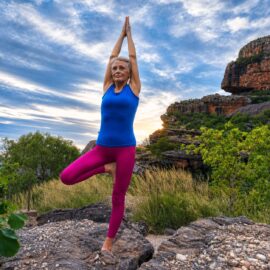
Tree Pose with a chair for safety. One foot learns to stand firmly while the other rests on the seat.
In a Sydney pilot study of Iyengar yoga, 54 older people did 12 weeks of mostly standing poses. They improved balance, walking speed and the time to get up from a chair, which are the main risk factors for falls (Tiedemann and colleagues, Journals of Gerontology Series A, 2013). Our guide to how to improve balance tells the full story.
Get the free ebook Strong Bones, Steady Feet. New to Flametree, or away for 3 months or more? You get 2 free classes + 2 ebooks, only available via this offer. Already coming to class? You can still get the book.
Where can I get help with foot pain in Darwin?
For foot pain in Darwin, come to a beginner class at Flametree’s Woolner studio or join live online from anywhere in Australia. Every class starts standing, on bare feet, with the teacher watching where your weight lands. Chairs, blocks, belts and blankets keep each pose within reach, and you do not need to be flexible to start. Tell your teacher before class which part of your foot is sore, so they can adjust the poses.
If your feet are numb, tingling or burning rather than sore, see our guide to neuropathy in the feet.
Frequently asked questions
Why do my feet hurt?
There are many causes, but feet that are stiff, weak or loaded unevenly are common ones. In a study of 176 older people, those who fell had stiffer ankles, weaker toes and more disabling foot pain. How you stand matters too: leaning onto the ball of the foot stops it sharing the load.
Which exercises strengthen the feet?
Toe-strengthening exercises and standing poses. In a 12-week trial of 85 people aged 60 to 90, supervised toe exercises raised toe strength by up to 36 percent. In class, you spread the toes and press evenly through the four corners of each foot.
What are the four corners of the foot?
The base of the big toe, the base of the little toe, and the inner and outer heel. Iyengar teaching asks you to press evenly through all four, so the floor presses back and the force travels up through the legs and hips into the spine.
Can yoga help foot pain?
Yoga trains the feet and ankles in every standing pose, and teaches even weight through the foot. In a Melbourne trial, a programme that included foot and ankle exercises, footwear advice and inserts cut falls by 36 percent in people with disabling foot pain. Yoga was not part of that trial.
Why does the ball of my foot hurt?
Often because weight leans forward onto the front of the foot. Iyengar teachers shift your weight back until the four corners are even and the heels press down. Many students find the front of the foot settles as the heels start working.
Does foot pain make you more likely to fall?
It can. In a 2006 study of 176 older people followed for 12 months, disabling foot pain and weak toes were each linked with falls, after allowing for age and other risk factors. Strengthening the feet is one part of steady balance.
Which yoga pose is best for strong feet?
Standing poses such as Mountain Pose, Warrior 2 and Wide Legged Forward Bend, done with the four corners pressing evenly. In a 2013 study of seven standing poses, Warrior 2 made the outer ankle muscles work hardest.
Where can I get help with foot pain in Darwin?
Flametree Yoga Studio teaches Iyengar yoga at Woolner in Darwin and live online. Beginner classes start with standing poses on bare feet, and the teacher adjusts each pose to your feet. You do not need to be flexible to start.
Where to next
- New to yoga, or coming back? Start with our half price 10 class pass with 2 classes free, in Darwin or live online.
- For a workplace, team or group: book private yoga classes for groups, online, at a Flametree studio or at your venue.
- Want to see class times first? Look at the beginner timetable.
Flametree Yoga Studio, Darwin and live online. This article is general information, not medical advice.
Sources: Menz HB, Morris ME and Lord SR, Foot and ankle risk factors for falls in older people: a prospective study, Journals of Gerontology Series A, 2006; Mickle KJ and colleagues, Efficacy of a progressive resistance exercise program to increase toe flexor strength in older people, Clinical Biomechanics, 2016; Wang MY and colleagues, The biomechanical demands of standing yoga poses in seniors: the Yoga Empowers Seniors Study, BMC Complementary and Alternative Medicine, 2013; Spink MJ and colleagues, Effectiveness of a multifaceted podiatry intervention to prevent falls in community dwelling older people with disabling foot pain, BMJ, 2011; Robinovitch SN and colleagues, Video capture of the circumstances of falls in elderly people residing in long-term care, The Lancet, 2013; Tiedemann A and colleagues, Journals of Gerontology Series A, 2013; Chris Lalor, talk on the feet; Strong Bones, Steady Feet ebook.