
Foot Cramps: Why They Grab You, And The Calf And Foot Stretches That Ease Them
Foot cramps: the short answer
Foot cramps are sudden, painful tightenings of the muscles in the foot or calf, and the best-tested way to ease them is a slow calf and hamstring stretch, done daily. In two trials of older adults who woke with night cramps, a few minutes of stretching before bed meant fewer and milder cramps after six weeks. Yoga adds to this by waking up the feet themselves. Here is the article in short form:
- A cramp is a muscle that tightens suddenly and will not let go.
- In a trial of 80 adults over 55, nightly stretching cut night cramps.
- Magnesium pills did not help older adults in a Cochrane review.
- When one grabs you, straighten the leg and draw the toes back.
- Four stretches below work the calf, the hamstring and the foot.
- Standing on awake, spread feet is how Iyengar yoga builds strong feet.
- Learn it in Darwin or live online, with a teacher watching your feet.
Last updated: 25 October 2026.
A quick word on Iyengar yoga. Iyengar yoga is the style developed by Mr BKS Iyengar. In the 20th century he did more than anyone to set down traditional Indian yoga, through his books and his teaching, and he pioneered the use of props. It is the style we teach at Flametree, in Darwin and live online.

A lying leg stretch with a belt. The belt holds the foot, so the calf and the back of the thigh can lengthen.
What is a foot cramp?
A foot cramp is a muscle that contracts (tightens) on its own, hard, and will not let go for seconds or minutes. The foot may curl, the toes may clench, or the cramp may start in the calf and pull the foot with it. According to a German medical review found through PubMed, cramps are painful, involuntary contractions of skeletal muscles, mostly in the calves, and they usually last from a few seconds to several minutes (Diener and Westphal, MMW Fortschritte der Medizin, 2013). The same review says most cramps have no clear cause.
That matters, because it means no one tidy fix exists. What we can say is what has been tested, and what Iyengar teaching does for the muscles and the feet.
Does stretching ease night-time foot and leg cramps?
In the best trial so far, yes. According to PubMed, 80 adults over 55 with night cramps either stretched the calf and hamstring muscles each night just before sleep, or did no special exercise. After six weeks the stretching group had about 1.2 fewer cramps a night than the other group, and their cramps hurt about 1.3 points less on a 10-point scale (Hallegraeff and colleagues, Journal of Physiotherapy, 2012).

What the 2012 trial found: nightly stretching meant about 1.2 fewer foot and leg cramps a night.
The same researcher tried a stretching routine in 15 frail adults over 75, using three daily exercises for the calves and hamstrings. After six weeks, cramp frequency and pain fell compared with the control group (Hallegraeff and de Greef, Geriatric Nursing, 2019). It was a small pilot, so take it as a good sign rather than a final word.
What about magnesium for cramps?
A Cochrane review (the most trusted kind of research summary) pooled 11 trials with 735 people. For older adults with ordinary night cramps, magnesium supplements gave small differences that were not statistically significant, and the authors concluded that magnesium is unlikely to give meaningful cramp prevention for them (Garrison and colleagues, Cochrane Database of Systematic Reviews, 2020). Stretching, by comparison, costs nothing and has a trial behind it.
What should you do when a cramp grabs your foot?

When a foot cramp grabs you: straighten the leg, draw the toes back, press the foot down.
Stop what you are doing and lengthen the muscle that is cramping. Straighten the leg, draw the toes back towards the shin, and breathe out slowly. If you are standing, press the whole foot into the floor and lean forward a little. Do not fight it or jump about. Once it lets go, walk gently for a minute.
Then use the stretches below to make the muscles less likely to grab next time.
Which stretches help foot cramps?
These four go from lying down, where the stretch is easiest to hold, to standing. They follow the calf and hamstring idea from the trials above, then add the foot. Move slowly, breathe out as you go a little further, and never bounce. Feel a firm pull, not a sharp pain. These are general steps; in class your teacher shapes each one to your body.
1. Lying leg stretch with a belt
Lie on your back, loop a belt round one foot and straighten that leg up towards the ceiling. Press through the heel so the calf lengthens, and keep the other leg long on the floor. The belt does the holding, so the leg can let go. This is the picture at the top of this page. Do both sides, and it is a good one to finish with before bed.
2. Standing leg stretch, heel on a chair

Standing leg stretch, heel on a chair, belt round the foot. Keep the standing leg straight and the chest lifted.
Stand facing a chair, place one heel on the seat with a belt round the foot, and keep the standing leg straight. Draw the toes back a little and feel the back of the leg lengthen. The chair takes the weight, so you can stay for several slow breaths without gripping.
3. Calf stretch at the wall
Stand an arm’s length from a wall with your hands on it and one foot back, heel pressed to the floor and toes pointing straight ahead. Keep the back leg straight and lean in until the calf lengthens. If the heel will not go down, put a folded blanket or a rolled mat under the front of the foot. Hold for a few breaths, then change sides.
4. Downward Facing Dog with the head on a block
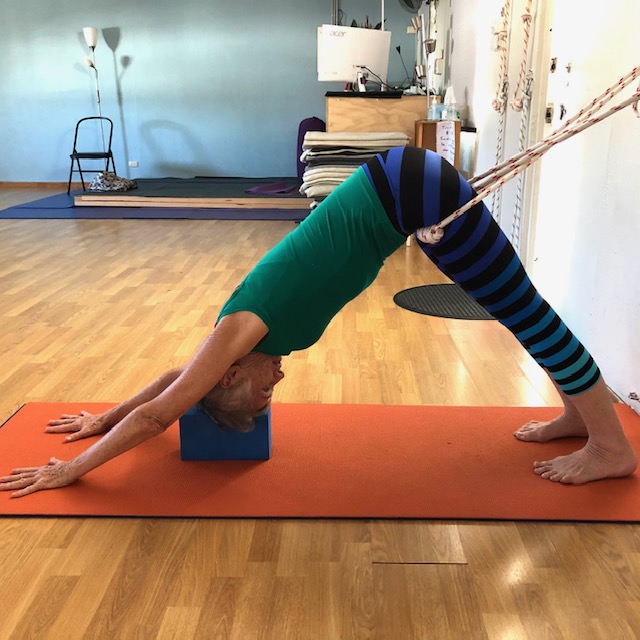
Downward Facing Dog (Adho Mukha Svanasana) with the head on a block. Press the heels down and the calves lengthen.
From hands and knees, lift the hips up and back so the arms and legs are straight, and rest the head on a block or bolster. Press the hands into the floor and the heels towards it. This lengthens the whole back of the leg, from heel to hip, and the block means you can stay for several breaths without strain.
How does yoga wake up the feet?
Stretching is only half of it. Iyengar teaching starts at the feet. In class you are asked to spread the toes, lift and spread the soles, and press evenly through the four corners of each foot: the base of the big toe, the base of the little toe, and the two sides of the heel. Chris Lalor, who runs Flametree’s teaching, puts it plainly: “Feet are the foundation for all standing asana.”
That kind of work asks the small muscles of the foot to do something, which is a different job from being squashed in a shoe all day. It fits what the toe-strength research found. According to PubMed, in a 12-week trial of 85 people aged 60 to 90, those in a supervised, progressive foot-strengthening class raised their toe strength by up to 36%, and their single-leg balance time improved too. The home-exercise group did not change (Mickle and colleagues, Clinical Biomechanics, 2016). That trial was not about cramps. It is a good reason to practise with a teacher rather than alone.

Warrior II (Virabhadrasana II). Each foot points a different way, and both press evenly into the floor.
Standing poses such as Warrior II give the feet exactly this. Each foot sits at a different angle, and the ankles keep adjusting to hold you. Our free ebook Strong Bones, Steady Feet covers the foot work in more detail. For sore feet rather than cramping feet, see Yoga For Foot Pain.
How do you rest the legs at the end of the day?

Supported relaxation with the calves on a bolster. The legs are held up, so the muscles can stop working.
Lie on your back with your calves on a bolster or a chair seat and a folded blanket under your head. Stay for five minutes, breathing out slowly. The leg muscles stop working for a while, which is a good way to end a day of standing. Our guide to the yoga bolster explains how a rolled blanket can do the job.
How often should you do these stretches?
A little, every day, is the lesson of the trials: the stretching group did it nightly for six weeks. Choose two of the four stretches, do them slowly before bed, and stay with them for six weeks before you judge. Come out of any stretch that hurts, and make it smaller or use a higher prop.
Get the free ebook Strong Bones, Steady Feet. New to Flametree, or away for 3 months or more? You get 2 free classes + 2 ebooks, only available via this offer. Already coming to class? You can still get the book.
Questions people ask
What causes foot cramps?
Often no clear cause is found. A cramp is a muscle contracting suddenly and involuntarily, most often in the calf, and lasting seconds to minutes. A German medical review says most cramps are of unknown cause.
How do you stop a foot cramp quickly?
Stop, straighten the leg and draw the toes back towards the shin while you breathe out slowly. If standing, press the whole foot into the floor and lean forward a little. When it lets go, walk gently for a minute.
Does stretching help night-time foot and leg cramps?
In one trial of 80 adults over 55, nightly calf and hamstring stretching before sleep for six weeks meant about 1.2 fewer cramps a night than no stretching, and milder ones. A small trial in 15 frail adults over 75 found the same direction.
Does magnesium help foot cramps?
For older adults with ordinary night cramps, a Cochrane review of 11 trials and 735 people found no meaningful benefit from magnesium supplements. Stretching has a trial behind it, and costs nothing.
What are the best stretches for foot cramps?
A lying leg stretch with a belt, a standing leg stretch with the heel on a chair, a calf stretch at the wall and Downward Facing Dog with the head on a block. They work the calf and the back of the leg, which is where the trials aimed.
How long should I hold each stretch?
Long enough to feel the muscle lengthen without pain, usually several slow breaths. The trial abstracts do not state a hold time, so this is the Iyengar way of teaching, not a tested number. Breathe out as you go a little further, and never bounce.
How often should I stretch to help cramps?
Daily. The trial group stretched every night just before sleep for six weeks. Choose two or three stretches, hold each steadily for a few breaths and go a little further as the weeks pass.
Where can I learn yoga for foot cramps in Darwin?
Flametree Yoga Studio teaches Iyengar yoga at Woolner and Coolalinga in Darwin and live online. Beginner and Gentle classes use belts, chairs, walls and bolsters, and the teacher adjusts each pose to your body and feet.
Where to next
- New to yoga, or coming back? Start with our half price 10 class pass with 2 classes free, in Darwin or live online.
- For a workplace, team or group: book private yoga classes for groups, online, at a Flametree studio or at your venue.
- Want to see class times first? Look at the beginner timetable.
Flametree Yoga Studio, Darwin and live online. This article is general information, not medical advice.
Sources (via PubMed): Hallegraeff JM, van der Schans CP, de Ruiter R and de Greef MHG, Stretching before sleep reduces the frequency and severity of nocturnal leg cramps in older adults, Journal of Physiotherapy, 2012; Hallegraeff J and de Greef M, Pilot testing a stretching regimen for prevention of night time nocturnal leg cramps, Geriatric Nursing, 2019; Garrison SR and colleagues, Magnesium for skeletal muscle cramps, Cochrane Database of Systematic Reviews, 2020; Diener HC and Westphal K, Differential diagnosis and treatment of cramps, MMW Fortschritte der Medizin, 2013; Mickle KJ and colleagues, Efficacy of a progressive resistance exercise program to increase toe flexor strength in older people, Clinical Biomechanics, 2016. The four corners of the foot and Chris Lalor’s quote are from the Strong Bones, Steady Feet ebook.



