Heel Pain? Why The First Steps Hurt, And The Yoga Stretches That Ease Plantar Fasciitis
Heel pain: the short answer
Heel pain under the foot, worst on your first steps after rest, is most often plantar fasciitis (irritation of the tough band of tissue along the sole of the foot). Trials have found that stretching that band, and stretching the calf, helps. Yoga does both, and adds something most people never learn: how to stand evenly on all four corners of each foot, so the heel is not carrying the load alone. These are the plantar fasciitis exercises that suit a yoga mat. Here is the article in short form:
- Plantar fasciitis is the most common cause of long-lasting heel pain in adults.
- The first steps after rest hurt most.
- A stretch of the sole beat a calf stretch in an 82-person trial.
- A downward dog and a toes-tucked kneel stretch the same tissues.
- Press the outer heel and spread the toes to share the load.
- Settling can take 3 to 6 months, so keep at it.
- In Darwin, learn it in a beginner class or online.
Last updated: 25 October 2026.
A quick word on Iyengar yoga. Iyengar yoga is the style developed by Mr BKS Iyengar. In the 20th century he did more than anyone to set down traditional Indian yoga, through his books and his teaching, and he pioneered the use of props. It is the style we teach at Flametree, in Darwin and live online.

“Press the outer back heel down.” The first thing an Iyengar teacher says about the foot.
What causes heel pain, and what eases it?
For most adults with pain under the heel, the cause is plantar fasciitis. A 2020 review in Foot and Ankle Orthopaedics calls it the most common cause of chronic heel pain in adults, in young active people and older sedentary people alike. It is also often found with a tight calf.
The pain is usually an ache under the heel. The review’s description will be familiar: it is worst with the first steps in the morning, or after sitting for a while. After a few minutes of walking it often eases, then comes back at the end of a long day.
You may also hear the words heel spur (a small bony bump on the heel bone) for the same area. Whatever the label, what eases a sore heel is much the same: stretch the sole and the calf, and change how weight lands on the foot.

The arches of the foot. The thick band under the arch (the plantar fascia) pulls on the heel bone, which is why heel pain sits where it does.
Here in Darwin, many of us live in thongs (flip-flops), which offer little heel support, and the calf gets short in a life of sitting and driving. Both are worth knowing about.
Which plantar fasciitis exercises help?
Stretches of the sole of the foot, and of the calf. Two pieces of research stand out.
In a US trial, 82 people with plantar fasciitis lasting more than ten months were taught either a stretch aimed at the band under the foot or a calf stretch. They were checked after eight weeks (DiGiovanni and colleagues, Journal of Bone and Joint Surgery). The group stretching the sole did better. Everyone was then taught the sole stretch. At two years, 66 people answered a follow-up. 94% of them (62 people) reported less pain. It was not a yoga class, and it had no comparison group at two years, but it shows the stretch is worth the time.
A 2020 review of eight trials found the same direction: the sole-specific stretch gave a larger drop in pain than calf stretching, on moderate-quality evidence (Siriphorn and Eksakulkla, Journal of Bodywork and Movement Therapies). Calf stretching alone still did better than sham stretching (a pretend stretch that does nothing), though that evidence was weaker.
The sole stretch is simple. Sit, cross the sore foot over the other knee, and pull the toes back towards the shin until you feel a stretch along the arch. Hold steadily, breathe out slowly, release and repeat. Do not bounce.
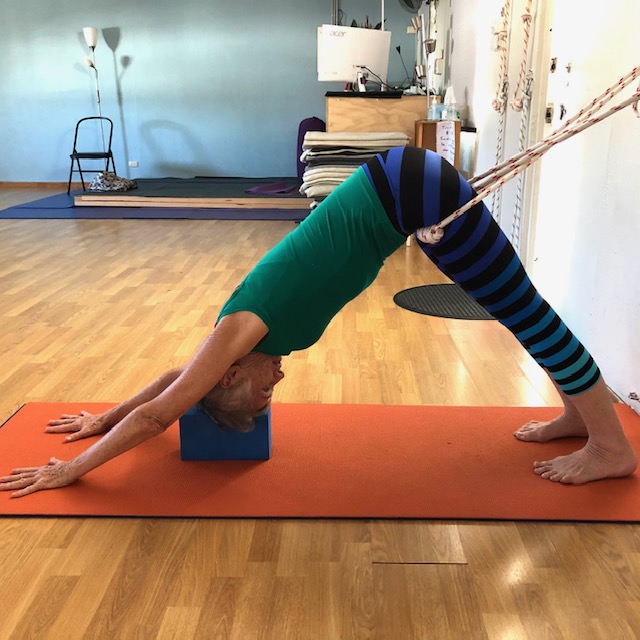
Downward-Facing Dog (Adho Mukha Svanasana) with the head on a block. The calves lengthen while the arms hold you up.
What do yoga poses add for sore heels?
Yoga does the stretches the trials tested, and teaches the standing habits that decide how much load your heel takes. Three poses to ask about in class:
- Downward-Facing Dog (Adho Mukha Svanasana). It lengthens the whole back of the leg, calf included. Rest the head on a block if you need to, and keep the legs working.
- Toes-tucked kneeling. Kneel on a folded blanket, tuck the toes under so the soles stretch, and sit back only as far as is comfortable. A block under the hips makes it gentler.
- Triangle Pose (Trikonasana) and Warrior 1 (Virabhadrasana I). Both ask you to press the outer edge of the back heel down. That wakes up the calf and the whole leg, and shares the work through the foot.
A tight calf often goes with plantar fasciitis, and these poses work on it while you stand.

Press one heel down and a force travels back up the whole body. An Iyengar teaching, and a way of making the heel a helper, not a victim.
How should I stand when my heel hurts?
On all four corners of each foot. Iyengar teaching starts at the feet. You press evenly through the four corners of the foot: the base of the big toe, the base of the little toe, and the inner and outer heel. Spread the toes and lift the arch gently.

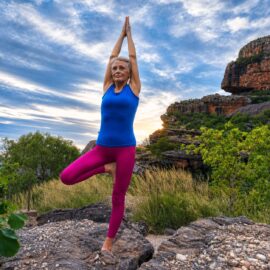
Mountain Pose. Weight sits evenly on the inner and outer heel and the ball of the foot, so the heel shares its work.
Chris Lalor’s idea is that when you press evenly into all four corners, the floor presses back. That rebound travels up through the legs and hips into the spine. Lean onto the toes or back onto the heels, and you lose it. This is a way of teaching alignment rather than a measured finding, but it is the reason a good teacher keeps adjusting how weight sits on your feet. A heel that is pressed evenly, not collapsed or slammed, is a heel that shares its work.
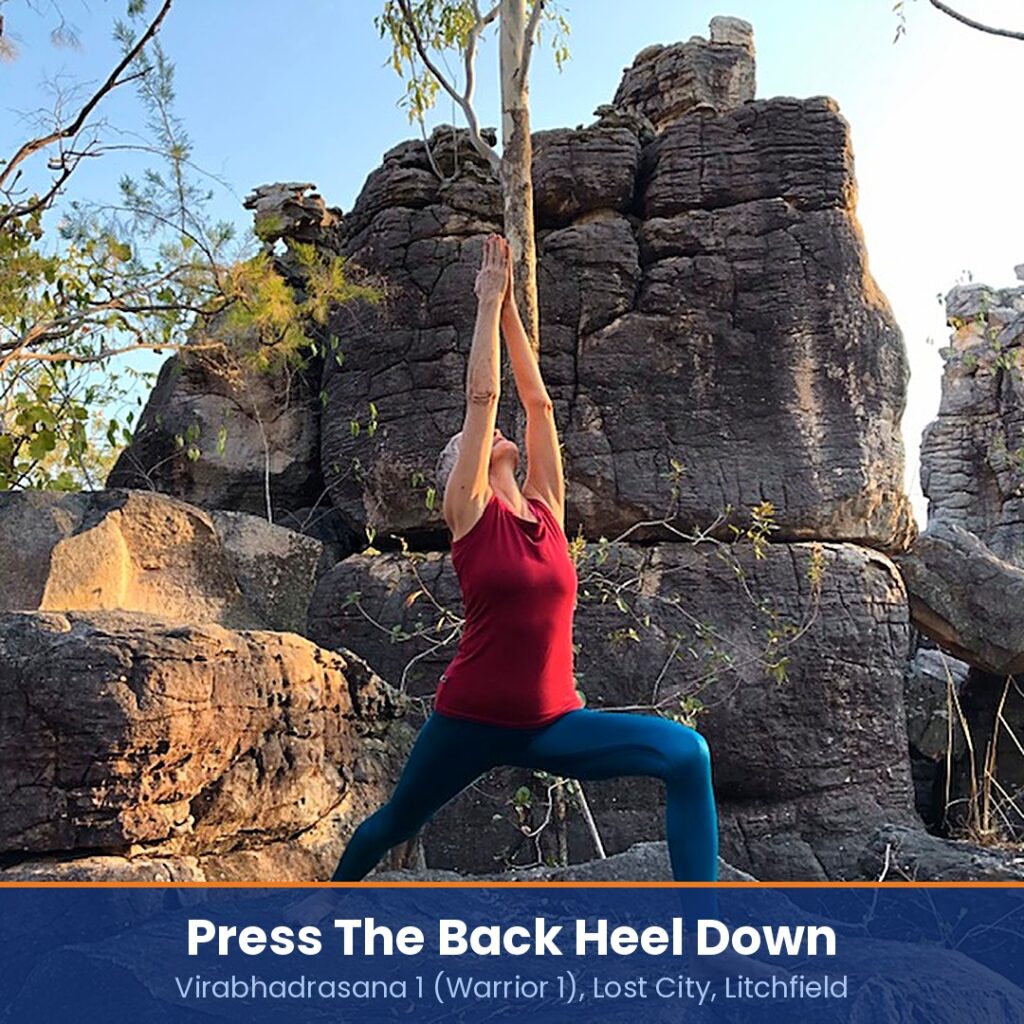
Warrior 1 at the Lost City, Litchfield: the back heel presses down while the legs work.
How long does heel pain take to settle?
Often months, and that is normal. The same 2020 review says simple, everyday measures (stretching the calf and sole, and cushioning the heel) settle the pain in about 90% of people. It can take 3 to 6 months. It is an expert-opinion review, not a trial, so take it as a guide.
That timeline is why regular, small stretches beat one big effort. A few minutes each day, with the first stretch before you get out of bed, will do more than one long weekly session.

Downward-Facing Dog with the head resting on a block. It stretches the calf and the sole while the heels press down.
Get the free ebook Strong Bones, Steady Feet. New to Flametree, or away for 3 months or more? You get 2 free classes + 2 ebooks, only available via this offer. Already coming to class? You can still get the book.
Where can I get help with heel pain in Darwin?
For heel pain in Darwin, come to a beginner class at Flametree’s Woolner studio or join live online from anywhere in Australia. Every class starts standing, on bare feet, with the teacher watching where your weight lands. Chairs, blocks, belts and blankets keep each pose within reach.
For feet in general, see Yoga For Feet and Yoga For Legs And Feet. For the bigger picture of strong bones and steady feet, see how to improve balance. Tell your teacher before class that your heel is sore, so they can adjust the poses.
Frequently asked questions
Why is my heel pain worst with the first steps in the morning?
That pattern is the classic sign of plantar fasciitis. A 2020 review describes aching heel pain that is worst with the first step in the morning or after rest. It often eases after a few minutes of walking, then returns later in the day.
What are the best plantar fasciitis exercises?
Stretching the sole of the foot and stretching the calf. In a trial of 82 people, a stretch aimed at the sole beat a calf stretch at eight weeks. Hold steadily, breathe out slowly, and do not bounce.
Can yoga help plantar fasciitis?
Yoga includes the stretches that trials have tested, such as calf stretching in Downward-Facing Dog and sole stretching with the toes tucked under. It also teaches you to press evenly through the four corners of the foot. The trials tested stretches, not a yoga class.
Does a tight calf cause heel pain?
A tight calf is often found with plantar fasciitis, according to a 2020 review. That is why calf stretching is part of the usual approach, and why poses such as Downward-Facing Dog are useful.
How long does plantar fasciitis take to settle?
Often 3 to 6 months. A 2020 expert-opinion review says simple measures such as stretching and heel cushioning settle the pain in about 90% of people, but it takes time. A small daily routine works better than a big occasional one.
Which yoga poses help sore heels?
Downward-Facing Dog stretches the calf, toes-tucked kneeling stretches the soles, and standing poses such as Triangle Pose and Warrior 1 teach you to press the outer heel and share the load through the foot. A teacher can adjust each one for a sore heel.
Is heel spur pain different from plantar fasciitis?
A heel spur is a small bony bump on the heel bone, and the words are often used for pain in the same area. The everyday approach is much the same: stretch the sole and the calf, and stand evenly on both feet. A teacher will adjust the poses for a sore heel.
Where can I get help with heel pain in Darwin?
Flametree Yoga Studio teaches Iyengar yoga at Woolner in Darwin and live online. Beginner classes start with standing poses on bare feet, and the teacher adjusts each pose to your feet and heels. You do not need to be flexible to start.
Where to next
- New to yoga, or coming back? Start with our half price 10 class pass with 2 classes free, in Darwin or live online.
- For a workplace, team or group: book private yoga classes for groups, online, at a Flametree studio or at your venue.
- Want to see class times first? Look at the beginner timetable.
Flametree Yoga Studio, Darwin and live online. This article is general information, not medical advice.
Sources: Latt LD and colleagues, Evaluation and Treatment of Chronic Plantar Fasciitis, Foot and Ankle Orthopaedics, 2020; DiGiovanni BF and colleagues, Plantar fascia-specific stretching exercise improves outcomes in patients with chronic plantar fasciitis: a prospective clinical trial with two-year follow-up, Journal of Bone and Joint Surgery (American), 2006; Siriphorn A and Eksakulkla S, Calf stretching and plantar fascia-specific stretching for plantar fasciitis: a systematic review and meta-analysis, Journal of Bodywork and Movement Therapies, 2020; Chris Lalor, talk on the feet; Strong Bones, Steady Feet ebook.