
Long Covid And Yoga: What Mr Iyengar, The Yoga Doctors And The Research Say
By Chris Lalor, Certified Senior Iyengar Yoga Teacher and Certified Yoga Therapist, and Dr Stuart McGill, Yoga Teacher, Flametree Yoga Darwin
Still exhausted, short of breath or foggy months after Covid? Maybe it is Long Covid. A short walk can flatten you for days, sleep does not refresh you, and pushing harder has not worked. The great yoga teachers and the medical doctors who worked with Mr BKS Iyengar never wrote about Long Covid, because they wrote before it existed. But they wrote a great deal about its pieces: fatigue, breathlessness, poor sleep and low immunity. This guide brings their approach together with what the new research on Long Covid has found. Last updated: 22 November 2026.
Get 2 Free Yoga Classes And 2 Free Ebooks
Video summary (6 min 52 sec): Yoga for Long Covid: does it help? Yes, the gentle, supported kind. Yoga, tai chi and qigong lowered fatigue and improved anxiety and sleep in a review of 13 trials. The video tells one woman’s story, explains the boom and bust trap, and shows what the Iyengar Yoga (UK) programme and the wider research found, and how to start without crashing. Watch on YouTube.
Can yoga help Long Covid? The short answer
It may help. Gentle, supported yoga and slow breathing practice may help with the main long covid symptoms: tiredness, breathlessness, poor sleep, anxiety and low mood. In 2021, 55 adults with Long Covid did ten weeks of online, one-to-one Iyengar yoga with Iyengar Yoga (UK), and their scores for fatigue and anxiety fell, while physical and mental well-being rose. Trials of yoga, pranayama (yoga breathing) and breathing training after Covid found better lung function, easier breathing, steadier nerves and better sleep. The key, in Mr Iyengar’s tradition, is to rest actively and never practise to exhaustion, so post covid fatigue may ease instead of flaring.
Overall evidence: Moderate
The research here is moderate. Several trials, or reviews with a more modest result, point to a benefit.
Best study (single trial): Jain 2026 tested 30 days of online Yoga Nidra (guided lying-down relaxation) in 90 adults recently out of hospital with Covid. It improved sleep, well-being and overall health. These were people recovering from acute Covid, not established Long Covid.
One thing to keep in mind as you read: most of these studies tested breathing training, exercise, or “yoga” of many styles, taught by teachers with very different training. The Iyengar Yoga (UK) pilot is the one programme so far that used Iyengar yoga taught by trained Iyengar teachers, and in our view well-taught Iyengar yoga is likely to go further than the average. Why the kind of yoga matters.
Plainly, the yoga results so far are early and mixed. Two 2026 trials tested yoga-based programmes in people with Long Covid, and neither found a clear benefit yet. In a trial of 34 people, six weeks of online yogic breathing was well received, but breathlessness was not clearly different from usual care, and attendance was patchy (Harvey-Dunstan 2026, read the study). In a trial of 29 people, 12 weeks of yoga was safe and people kept it up, but general health scores were not clearly different from a health programme (Welfordsson 2026, read the study). With 34 and 29 people, both trials could miss a real benefit. The Iyengar Yoga (UK) pilot had no comparison group. Most of the larger reviews that found help pooled breathing and exercise programmes, or yoga together with tai chi and qigong, not yoga alone.
Where The Long Covid Research Stands
Encouraging
55 adults in the Iyengar Yoga (UK) pilot: fatigue and anxiety fell, well-being rose. No comparison group.
Not yet clear
Two 2026 trials of yoga-based programmes, of 34 and 29 people: no clear difference from usual care or a health programme.
Clearest support
Reviews of breathing training and gentle rehabilitation, not yoga alone: less fatigue and breathlessness.
Long Covid and yoga: early, encouraging and not yet settled. The gentle, supported approach in this guide fits all three.
The bottom line: five key moves for Long Covid
- Go to a gentle, supported yoga class at your level, regularly. Once or twice a week is a good start. The Long Covid programmes that helped ran for 5 to 10 weeks or more, so give it time.
- Rest actively. Supported poses on bolsters, chairs and the wall let the body rest while the nerves recover. In the Iyengar pilot, students rested in supported poses on their hard days.
- Stop before you are spent. Little and often beats one big effort followed by a crash. Practice should leave you feeling better, not worse, the next day.
- Slow the breath down. A quiet, slow breath through the nose, with a soft out-breath, calms an over-alert nervous system. Your teacher brings in pranayama step by step, and breath holds come last.
- Start now. New to Flametree, or away 3 months or more? 2 free classes, then 10 at half price, in Darwin or LIVE online, so you can join from home on a low day.
Five Key Moves For Long Covid
1. Gentle, supported class, regularly
Once or twice a week is a good start. The programmes that helped ran 5 to 10 weeks or more.
2. Rest actively
Supported poses on bolsters, chairs and the wall let the body rest while the nerves recover.
3. Stop before you are spent
Little and often beats one big effort followed by a crash. You should feel better, not worse, the next day.
4. Slow the breath down
A quiet breath through the nose with a soft out-breath. Pranayama comes in step by step, and breath holds last.
5. Start now
New, or away 3 months or more? 2 free classes, then 10 at half price. Join from home on a low day.
In Darwin or LIVE online.
Iyengar yoga is the style we teach at Flametree. During the 20th century, Mr BKS Iyengar was the major person who codified traditional Indian yoga, through his seminal books and widespread teaching. He also pioneered the use of props, so poses can be adapted to almost any body. His style is sometimes called modern classical yoga. This guide is part of our encyclopaedia of yoga for health conditions. It is a hub: each main symptom of Long Covid has its own full guide, linked below.
This guide in short
- Overall evidence: Moderate. Best study: Jain 2026 tested 30 days of online Yoga Nidra (guided lying-down relaxation) in 90 adults recently out of hospital with Covid. It improved sleep, well-being and overall health. These were people recovering from acute Covid, not established Long Covid.
- Mr BKS Iyengar: no Long Covid entry, but clear approaches to its pieces: physical fatigue, breathlessness and low immunity, all built on support and rest.
- Geeta S Iyengar: practice should never end in fatigue; lying-down poses help recover lost energy.
- Dr Timothy McCall, an American medical doctor and yoga therapist who studied with Mr BKS Iyengar, author of Yoga as Medicine: with long-lasting fatigue, the biggest risk is enthusiasm; start small and build slowly.
- Dr Krishna Raman, a medical doctor in Chennai who trained in yoga under Mr BKS Iyengar and has used yoga in his medical practice for decades: passive, supported poses when exhausted, and formal pranayama left until after a serious illness has passed.
- Iyengar Yoga (UK): a 2021 pilot of one-to-one online Iyengar yoga for 55 adults with Long Covid.
- The research: 20 studies and reviews listed below, from early yoga and pranayama trials to a review of 37 trials and 3,363 people.
- Take it further: a free breathing ebook, our 2027 sleep and energy masterclass, and classes in Darwin and online.
Long Covid On One Page
Six sources, one answer: rest actively, breathe slowly, never practise to exhaustion.
Fatigue, breathlessness and low immunity each get a supported, restful approach.
Practice should not end in fatigue. Lie down to win back lost energy.
Too much too soon brings a flare-up. Start small, build over weeks.
Supported poses when spent. Formal pranayama waits until you are stronger.
55 adults, ten weeks, one-to-one online: less fatigue and anxiety.
Breathing practice, yoga and gentle rehabilitation eased fatigue, breathlessness and anxiety.
Each source is set out in full below. Research: Li 2025, Fricke-Comellas 2024, the Iyengar Yoga (UK) pilot report 2022 and the other studies listed in this guide.

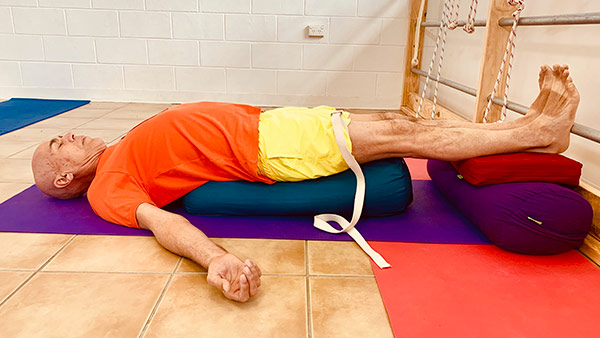
Chris Lalor lying back over a bolster. The chest opens and the breath slows, with no effort at all.
“Fear and fatigue block the mind. Face both, then courage and confidence flow into you.”
What is Long Covid?
Most people get over Covid in a week or two. Long Covid (also called post-COVID condition or post-COVID syndrome) is when symptoms last for months. The most common long covid symptoms are:
- Fatigue that rest does not shift, often called post covid fatigue. It looks much like post viral fatigue after glandular fever or another infection.
- A crash after effort. Many people feel fine while they do something, then collapse a day or two later. This is often called post-exertional malaise.
- Breathlessness, a tight chest and a lingering cough.
- Poor sleep, and brain fog: trouble thinking, remembering and concentrating.
- Anxiety and low mood, dizziness, a racing heart or faintness on standing up, headaches and aches.
It is one illness, but it touches many parts of the body, so this guide is a hub. Each main symptom already has a full guide of its own:
One Illness, Four Guides
Long Covid draws on four parts of our encyclopaedia.
Short of breath
Opening the chest, slowing the breath, the nose and humming.
Inflammation and infections
Balance, not boost: the calm side of the nervous system and immunity.
A simplified map. Many people have several of these at once.
Darwin adds its own load. The heat and humidity of the Build-Up drain energy, so the gentle, supported side of yoga matters even more here. And the authorities in this guide, from Mr Iyengar to Dr McCall, wrote before Long Covid existed. So below we set out their approach to its nearest pieces, in our words, and do not put words in their mouths about Long Covid itself.
What did Mr BKS Iyengar teach that applies to Long Covid?
In short: no Long Covid entry, but for fatigue, breathlessness and low immunity alike, his approach is support first, rest throughout, and stronger breath work only later.
Yoga: The Path to Holistic Health was written before Covid-19. Its nearest entries, in our words:
- Physical fatigue (p. 312): exhaustion after stressful effort, with no wish to do anything. He warns it can slide into chronic fatigue if rest and removing the stress do not help. His approach leans on supported reclining poses, restful forward bends and a few gentle standing and inverted poses. Energy comes back through rest and support, not effort.
- Breathlessness (p. 277): he ties it to lungs that have lost their spring, trapped air and a squeezed diaphragm. The work opens and lifts the chest through standing poses and backbends, supported inversions and reclining poses, with breath practice and rest.
- Low immune system (p. 308): weak immunity with infections, fatigue and fever. The approach is largely supported and restful: supported bridge-type and reclining poses, forward bends and supported inversions, ending in rest.
- Low blood pressure: fatigue and faintness, met with reclining poses, forward bends and a few supported inversions. Faintness on standing is common in Long Covid, though the book does not link the two.
Mr Iyengar’s Nearest Entries To Long Covid
Physical fatigue, p. 312
Supported reclining poses and restful forward bends. Energy comes back through rest and support, not effort.
Breathlessness, p. 277
Open and lift the chest, with breath practice and rest.
Low immune system, p. 308
Largely supported and restful, ending in rest.
Low blood pressure
Fatigue and faintness met with reclining poses, forward bends and a few supported inversions.
Mr Iyengar wrote before Long Covid existed. These are his nearest entries, in our words.
In the appendix to Light on Yoga he lists fatigue (p. 422) with supported inversions, forward bends, twists and a backbend, breathing without holding the breath, and a long rest. Breathlessness and broncho-pneumonia (p. 417) also lean on supported inversions and forward bends, with breathing practice and rest. For anaemia (p. 413) he leaves breath holding out for the first two to three months. The pattern is clear: rest and support first; breath holds wait until there is energy for them.
We do not publish his sequences. A sequence needs a teacher who can see how tired you are on the day and adapt each pose, which is what a class is for.
Supported Bridge Pose. Mr Iyengar’s approach to low immunity is built on supported, restful poses like this one.
“When the body, brain and nerves are tired, then one should stick to asana only.”
What Geeta S Iyengar taught about tiredness
In short: practice should never end in fatigue, and lying-down poses help win back lost energy.
Geeta Iyengar, Mr Iyengar’s daughter and author of Yoga: A Gem for Women, also wrote before Covid. Her guidance on tiredness, in our words:
- Never end in fatigue. Time in each pose should grow gradually, judged by your own strength, and “Practice of Yoga should not end in fatigue” (p. 92).
- Lie down to recover. She writes that lying-down poses help one recover lost energy (her claim).
- A tired brain needs quiet. She describes a resting practice with the eyes and ears covered (pp. 288 to 289), to shut out the senses, which suits the brain fog and overload many people with Long Covid describe.
Geeta Iyengar On Tiredness
Never end in fatigue
Grow the time in each pose gradually, judged by your own strength.
Lie down to recover
Lying-down poses help win back lost energy. Her claim.
Quiet a tired brain
A resting practice with the eyes and ears covered shuts out the senses.
Geeta S Iyengar, Yoga: A Gem for Women, in our words. Known from long practice.
“The student should not feel exhausted in any asana.”
What Dr Timothy McCall says
In short: his book (2007) pre-dates Long Covid, but his chapters on chronic fatigue, asthma and immunity all say the same thing: go gently, build slowly, and let the breath slow down.
Dr McCall is a US medical doctor and yoga therapist, author of Yoga as Medicine and former medical editor of Yoga Journal. Long Covid is not on his June 2019 list of conditions helped by yoga, because the list came first. His nearest entries are chronic fatigue syndrome (no. 17), fatigue (no. 32), asthma (no. 5), COPD (no. 18) and HIV/AIDS (no. 43). His views, in our words:
- Enthusiasm is the biggest risk. In his chronic fatigue chapter he says doing too much too soon can bring a flare-up. Start modestly, build over weeks or months, and scale back on exhausted days.
- Light-headed on standing? Common with long-lasting fatigue, he says: come up slowly, drink enough water, and use supported versions of head-down poses rather than hanging the head for long.
- Learn to listen to the body. Yoga’s inner awareness helps people tell when they are doing too much, and gauge what to take on.
- Breath for balance. His chronic fatigue teacher, Gary Kraftsow, says of pranayama: “It seems to be a homeostatic equalizer, to balance everything.” Even so, McCall notes that vigorous breathing can be too much for someone very depleted.
- Overbreathing. In his asthma chapter he explains that fast, shallow breathing feeds itself, and slow breathing with a longer out-breath breaks the cycle. Breathing practice should never leave you more anxious or short of breath than when you started.
- Immunity. In his HIV chapter he says anything that supports immune function could help, and yoga may do so by lowering stress hormones, improving sleep and mood, and easing isolation.
Stop Before You Are Spent
Long Covid tempts you to catch up on a good day, then pay for it.
boom and bust, round again
- Little and often, much the same on good days and bad
- Supported poses on low days, rather than nothing
- Stop while still fresh: practice should not end in fatigue
- Breath work later, slow and unforced, holds last
After Dr Timothy McCall, Yoga as Medicine, chapter 14; Geeta S Iyengar, Yoga: A Gem for Women, p. 92; Dr Krishna Raman, Yoga and Medical Science: FAQ. A simplified picture.
“In Yoga the bank balance is energy.”
What Dr Krishna Raman says
In short: passive, supported poses when you are exhausted, and formal pranayama left out after a serious illness until you are stronger.
Dr Raman is a Chennai physician who trained in yoga under Mr Iyengar. His books also pre-date Covid. His nearest answers, in our words:
- Chronic fatigue: passive, supported poses, with Legs Up The Wall (Viparita Karani) named.
- Exhausted? Rest in the poses. When worn out, he uses supported relaxation poses, such as reclining over a pillow, to renew the body.
- No formal pranayama when you are spent. He leaves formal breathing practice out with fever, fatigue, severe anaemia or after a serious illness. For COPD, he does not bring pranayama in at first.
- Yoga recharges. In his view yoga recharges where other exercise drains.
Dr Loren Fishman, an American medical doctor who studied with Mr BKS Iyengar and teaches yoga through his own programme, has nothing on Long Covid or viral illness in what we hold. Nor does Dr J. T. Shah, a medical doctor who was also an Iyengar yoga teacher, who worked closely with Mr BKS Iyengar for many years.

Lying down with the legs on a chair. On a low day, this is still yoga, and it still counts.
The Iyengar Yoga (UK) Long Covid pilot
In short: 55 adults with Long Covid, ten weeks of one-to-one online Iyengar yoga, and less fatigue and anxiety by the end.
In late 2021 Iyengar Yoga (UK) ran the first large Iyengar programme for Long Covid. It was started by Gerda Bayliss, who had Long Covid herself. Here is exactly what it was:
- Who: 55 adults aged 22 to 69, with Long Covid, October to December 2021.
- How: one-to-one. Each student had their own private online session once a week, with two qualified Iyengar teachers, and a senior Iyengar therapy teacher oversaw several of these sessions at once, dropping in on each. After a short opening interview, there were nine weekly classes of about 90 minutes. More than 100 Iyengar teachers gave their time.
- What: a basic recommended sequence, adapted from the respiratory work of the senior Iyengar teacher Lois Steinberg, who supervised the project, and then fitted to each student. Many poses were held for longer, with props, and the teachers put weight on the breath.
- What it found: on surveys before and after, students’ physical and mental well-being improved, and their scores for fatigue, anxiety, and cough, sore throat and phlegm fell, with all of these changes statistically significant (unlikely to be chance). The other symptoms measured, including difficulty breathing, headache, pain, palpitations, low mood and concentration, did not change by enough to count on the surveys. In interviews, students described less fatigue, easier breathing and sleep coming back.
- What kind of evidence it is: a project report, published by Iyengar Yoga (UK) with York St John University in September 2022. It is not a peer-reviewed journal paper, and there was no control group (no comparison group who did not do the yoga).
The Iyengar Yoga (UK) Long Covid Pilot, In Five Lines
Who
55 adults aged 22 to 69 with Long Covid, October to December 2021.
How
One-to-one online, once a week: a short interview, then nine weekly classes of about 90 minutes.
What
A basic sequence adapted from Lois Steinberg’s respiratory work, with props, longer holds and weight on the breath.
What it found
Well-being up. Fatigue, anxiety, and cough, sore throat and phlegm down. Other symptoms, including difficulty breathing, did not change enough to count.
What kind of evidence
A project report with York St John University, 2022. Not peer reviewed, with no control group.
Iyengar Yoga (UK), 2022. Encouraging, and not yet a controlled trial.
Read the pilot report and Iyengar Yoga (UK)’s summary. Lois Steinberg’s article “Iyengar Yoga for the Respiratory System” (2020) is listed under COVID Recovery by the US Iyengar association, and in 2025 Iyengar Yoga (UK) published recovery sequences for colds, immunity, breathing and Long Covid.
Here in Darwin, Chris Lalor, Certified Senior Iyengar Yoga Teacher and certified Yoga Therapist, works with people whose problems arise from repeated Covid, or Long Covid. Read about Chris’s yoga therapy work.
A story: Walking the dog again
“Mandy” (not her real name) had had Long Covid for 17 months: fatigue, headaches, dizziness and low mood. She joined the Iyengar Yoga (UK) pilot and worked online with the Iyengar teacher Ann Traynor, from Armagh in Northern Ireland, and a co-teacher. The first class went at a slow, steady pace. Then she caught Covid again and missed three weeks. She came back short of breath and rested in supported poses. In week 8 she walked her dog on her own for the first time, and felt she had her body back. By week 9 she could walk for 20 to 30 minutes. At the end she rated her health “very good”, against “quite bad” at the start.
Source: Ann Traynor, The Iyengar Yoga Long Covid Pilot Study: a teacher’s and a student’s perspectives, Iyengar Yoga London, 15 December 2022, first published in Dipika, issue 54. One person’s account.
“If breathing is defective, the energy does not circulate freely to ignite intelligence.”
What does the research show about yoga for Long Covid?
In short: the research is young, but it points one way. Breathing practice, pranayama, yoga and gentle rehabilitation eased fatigue, breathlessness, anxiety and poor sleep after Covid. Most of these studies tested breathing training and exercise, with yoga as one part or not at all, so we label each one. No large trial of yoga in Long Covid has reported yet; two are under way. The two yoga-based trials that have reported, in 2026, found no clear benefit over usual care or a health programme. Not yet studied is not the same as not working. Why the kind of yoga matters.
The Research At A Glance
Four studies that sum up the evidence. All of them, with links, are listed below.
Rehabilitation with breathing exercises improved walking, lungs, quality of life, fatigue and breathlessness. Li 2025: 37 trials, 3,363 people with Long Covid. Breathing training and exercise, not yoga.
Yoga, tai chi and qigong lowered fatigue and improved anxiety, depression and sleep. Fricke-Comellas 2024: 13 trials, 661 people with chronic fatigue or post-COVID syndrome.
One-to-one Iyengar yoga lowered fatigue and anxiety and lifted well-being. Iyengar Yoga (UK) 2022: 55 adults with Long Covid, 10 weeks; a project report with no control group.
Humming and cooling pranayama improved lung function and nervous-system balance. Rohini P 2025: 90 young adults after Covid, 6 months, against a control group.
Every study is listed in full in this section, with a link to read it.
Iyengar yoga
This programme tested Iyengar yoga specifically, taught by trained Iyengar teachers, with props and adapted poses. No Iyengar study of Long Covid has yet been published in a medical journal.
- Fatigue and anxiety fell, and physical and mental well-being improved. Iyengar Yoga (UK) and York St John University, 2022: 55 adults with Long Covid, ten weekly one-to-one online sessions. A project report, not peer reviewed, with no control group. Read the report.
- Restorative Iyengar yoga lowered fatigue and raised energy in women still exhausted after cancer care. Not Long Covid, but the one Iyengar trial with fatigue as its main target. Bower 2012, a trial of 31 women, 12 weeks. More on our fatigue guide. Read the study.
What Each Kind Of Study Tested
Iyengar yoga
1 project report: 55 adults with Long Covid.
Yoga of other kinds
5 studies after Covid.
Pranayama
2 studies: humming and cooling breath.
Breathing training and exercise
2 trials and 3 reviews. Not yoga.
Tai chi and qigong
2 reviews, one pooled with yoga. Not yoga.
Mindfulness
2 studies. They count for what a class builds.
Yoga for Long Covid research, by what each study tested. Every study below carries the same label.
Yoga trials after Covid
- Eight weeks of yoga raised lung function and lowered artery stiffness. Mundhe 2025, a before-and-after study of 30 people after mild to moderate Covid, India. Read the study.
- Yoga-based exercise improved strength, flexibility, walking distance, anxiety, depression and sleep. Önal 2023, a controlled (not randomised) trial of 41 health workers returning to work after Covid, Turkey, 8 weeks. Read the study.
- Live online yoga sharpened thinking, and people said they breathed more consciously and felt relaxed. Lundberg 2025, a feasibility study of twice-weekly online yoga for 7 weeks in people with post-COVID condition, Sweden. Some people found their symptoms rose, which is why pacing matters. Read the study.
- Yoga Nidra (guided lying-down relaxation) improved sleep, well-being and overall health. Jain 2026, a randomised trial of 90 adults recently out of hospital with Covid, India, 30 minutes a day online for 30 days. Acute, hospitalised Covid, not established Long Covid. Read the study.
- Pranayama and chanting lowered fatigue and an inflammation marker (hs-CRP). Dua 2023, a randomised trial of 20 people in hospital with moderate Covid, India, up to 14 days. Acute, hospitalised Covid, not Long Covid. Read the study.
Five Yoga Studies After Covid
Mundhe 2025
30 people after mild to moderate Covid, 8 weeks. Lung function up, artery stiffness down. Before-and-after study.
Önal 2023
41 health workers back at work, 8 weeks. Strength, walking, anxiety, depression and sleep improved. Controlled, not randomised.
Lundberg 2025
Live online yoga in Sweden, 7 weeks. Thinking sharpened. Some people found symptoms rose, which is why pacing matters.
Jain 2026
90 adults recently out of hospital, Yoga Nidra online for 30 days. Sleep and well-being improved. Acute Covid, not Long Covid.
Dua 2023
20 people in hospital with moderate Covid. Pranayama and chanting lowered fatigue and an inflammation marker. Acute Covid.
Early studies, each labelled by what it tested.
Breathing practice and pranayama
- Humming breath (Bhramari) and cooling breath (Sheetali) improved lung function and heart rate variability (a sign of a calmer, better-balanced nervous system). Rohini P 2025, a randomised trial of 90 people aged 19 to 40 after Covid, India: 15 minutes twice a day for 6 months, against a control group. Pranayama. Read the study.
- Humming breath lowered depression, anxiety and stress and improved sleep. Jagadeesan 2022, a before-and-after study of 42 people isolating at home with Covid, India, 20 minutes online a day for 15 days. Pranayama, in acute Covid. Read the study.
- Three weeks of online yogic breathing and meditation (Isha Kriya) lifted mood and vigour and eased fatigue and body symptoms in people with Long Covid, compared with a waiting list. Rayapuraju 2026, a randomised pilot of 188 adults with Long Covid in the US, with no harms reported; stress and quality of life did not change. A mix of yogic breathing and meditation, not Iyengar yoga. Read the study.
- Breathing exercises by video call improved lung function, quality of life and walking distance (up 54 metres, against 5). Okan 2022, a randomised trial of 52 breathless people after Covid, Turkey, 5 weeks. Breathing training, not yoga. Read the study.
Walking Distance After Breathing Exercises
Okan 2022: 52 breathless people after Covid, 5 weeks of breathing exercises by video call. Metres added to walking distance.
Breathing training, not yoga. Bars start at zero.
- An online breathing and singing programme improved mental well-being and breathlessness when running. Philip 2022, a randomised trial of 150 people with lasting breathlessness, referred from 51 UK Long Covid clinics (ENO Breathe). Singing-based breathing, not yoga. Read the study.
In the Iyengar tradition, breath work for a tired, breathless person is quiet: lying down, supported, the breath smooth and unforced, brought in by the teacher when the student is ready, with holds added last. The pranayama we teach (staircase, ocean, alternate nostril, humming and a gentle shining skull breath) is slow, nasal and taught step by step. In our view, pranayama and humming breath help balance and improve the immune system, and so help with what the immune system does, including helping to reduce infection. Humming raises nitric oxide in the nose about 15 times. More in our immune system guide and breathlessness guide.
Breathing training and exercise reviews (not yoga)
These reviews pooled rehabilitation programmes: breathing exercises, chest mobility work and gentle exercise. They are not yoga, but slow, deliberate breathing and opening the chest are at the heart of Iyengar yoga too.
- Rehabilitation improved walking, lung function, quality of life, fatigue, breathlessness and anxiety; breathing exercises on their own improved walking, lungs and quality of life, and breathing plus gentle exercise did best for fatigue. Programmes of 4 to 8 weeks worked well. Li 2025, a review of 37 trials and 3,363 people with Long Covid. Read the study.
- Exercise lowered long covid fatigue and breathlessness. Cheng 2024, a review of 9 trials and 672 people (aerobic, mixed, breathing exercise and tai chi). Read the study.
- Programmes of 6 weeks or more improved walking, lung function, breathlessness, pain and quality of life. Khuna 2026, a review of 10 trials and 602 people with post-COVID condition. Read the study.
Three Reviews Of Rehabilitation And Breathing Training
Li 2025
37 trials, 3,363 people. Walking, lungs, fatigue, breathlessness and anxiety improved. 4 to 8 week programmes worked well.
Cheng 2024
9 trials, 672 people. Exercise lowered Long Covid fatigue and breathlessness.
Khuna 2026
10 trials, 602 people. Programmes of 6 weeks or more improved walking, lungs, breathlessness, pain and quality of life.
Rehabilitation and breathing training, not yoga. None looked separately at people who crash after effort.
None of these reviews looked separately at people who crash after effort (post-exertional malaise), and how much effort suits them is not yet settled. That is one reason an Iyengar class keeps the work gentle and supported, and adapts it on the day.
The Reviews, By Number Of People
Four reviews of Long Covid and post-viral fatigue. Each one found help.
Walking, lungs, fatigue and breathlessness improved. Li 2025, rehabilitation with breathing: 3,363 people, 37 trials.
Fatigue and breathlessness improved. Cheng 2024, exercise and breathing: 672 people, 9 trials.
Fatigue fell; anxiety, depression and sleep improved. Fricke-Comellas 2024, yoga, tai chi and qigong: 661 people, 13 trials.
Walking, lungs, breathlessness and pain improved. Khuna 2026, exercise and breathing: 602 people, 10 trials.
Bar length shows the number of people in each review. Teal: a review that pooled yoga with tai chi and qigong, which are not yoga. Terracotta: breathing training and exercise, not yoga. Reviews overlap, so some people are counted twice.
Reviews that include tai chi and qigong (not yoga alone)
- Yoga, tai chi and qigong lowered fatigue and improved anxiety, depression and sleep. Fricke-Comellas 2024, a review of 13 trials and 661 people with chronic fatigue syndrome or post-COVID syndrome. Read the study.
- Qigong eased breathing symptoms, anxiety and sleep, and helped Long Covid dizziness and lingering chest symptoms. Antonelli 2024, a review of 9 studies. Qigong, a slow Chinese mind-body practice, not yoga. Read the study.
Meditation and mindfulness
These tested mindfulness programmes, not yoga or pranayama. They still count for our classes: yoga and yogic breathing produce mindfulness, the same steady, present attention, trained through the body and the breath.
- Mindfulness lowered anxiety and depression for a year, and eased pain and insomnia at 6 months. Murano 2025, a randomised trial of 105 Covid survivors, Italy. Read the study.
- Six weeks of online mindfulness eased insomnia and lowered a blood marker of stress-driven inflammation. Vandenbogaart 2025, a study of 20 women with Long Covid and a racing heart or faintness on standing. Read the study.
Mindfulness After Covid
Murano 2025
105 Covid survivors: anxiety and depression lower for a year; pain and insomnia eased at 6 months.
Vandenbogaart 2025
20 women with Long Covid: insomnia eased and a stress-driven inflammation marker fell after 6 weeks.
Counts for our classes
Yoga and yogic breathing produce the same steady, present attention.
These trials tested mindfulness courses. They still count for what a yoga and pranayama class builds.
What people with Long Covid say about yoga
- Those already doing yoga said it helped them manage their symptoms and felt safer than exercise. Many more were interested but held back by low energy, worry about group classes, and doubt that yoga would suit them. Cheshire and Cartwright 2026, a survey of 171 people with Long Covid in the UK. Read the study.
Trials under way
- Yoga for lasting fatigue after Covid: a trial of 100 people, 12 weeks of 90-minute group classes, in Germany. Cramer 2025, protocol. Read the study.
- Yoga for quality of life in post-COVID condition: a trial of 88 people at the Karolinska Institutet, Sweden. Brodén 2024, protocol. Read the study. Its pilot found 12 weeks of yoga safe, with people keeping it up well, but no clear difference in general health scores from a health programme in this trial of 29 people. Welfordsson 2026. Read the study.
Two Larger Yoga Trials Under Way
Germany
100 people with lasting fatigue after Covid: 12 weeks of 90-minute group yoga classes (Cramer 2025).
Sweden
88 people with post-COVID condition, at the Karolinska Institutet: quality of life (Brodén 2024).
Larger yoga trials for Long Covid are under way. Not yet studied is not the same as not working.
“Yoga generates energy and does not dissipate it.”
How does a Flametree class help with Long Covid?
This is how we teach, and it fits the early research above.
- Props in every class: bolsters, chairs, blankets, belts and the wall, so you can rest in a pose instead of fighting it.
- Classes adapted to the people in them. No one-size-fits-all. Tell your teacher you have Long Covid, and the poses are changed for you on the day.
- Pacing in every class. Your teacher keeps the work well inside what you can manage today. Resting during class is part of the practice, and on a low day the whole class can be supported poses.
- Active rest: our restorative yoga and gentle yoga classes are built on supported poses that rest the body while they restore it.
- Breath, step by step: every class ends in rest, and our pranayama classes go further when you are ready.
- LIVE online: the Iyengar pilot was taught online, and you can join our classes from home on days when getting to the studio is too much.
- Yoga therapy: Chris Lalor works one-to-one with people recovering from repeated Covid or Long Covid. Find out more.
How A Flametree Class Helps With Long Covid
Props in every class
Bolsters, chairs, blankets, belts and the wall, so you can rest in a pose instead of fighting it.
Adapted to the people in them
Tell your teacher you have Long Covid and the poses are changed on the day.
Pacing in every class
The work stays well inside what you can manage. On a low day the whole class can be supported poses.
Active rest
Restorative and gentle yoga rest the body while they restore it.
Breath, step by step
Every class ends in rest. Pranayama classes go further when you are ready.
LIVE online
Join from home on days when getting to the studio is too much.
Yoga therapy
Chris Lalor works one-to-one with people recovering from repeated Covid or Long Covid.
How we teach, in Darwin and LIVE online.
More breathing research
- Eight weeks of slow deep breathing improved lung function, walking performance and stress in older adults with Long Covid. In a randomised trial of 60 older adults, those who breathed slowly and deeply for 30 minutes, five days a week, had lower blood pressure and heart rate, stronger breathing muscles, better lung tests, better physical performance and lower stress, while the group that carried on as usual did not change. (Promsrisuk and colleagues, Annals of Geriatric Medicine and Research, 2025, read the trial, PMID 40045527.)
Yoga, pranayama and mindfulness: how they work together
Some of the studies above tested a mindfulness or meditation course, not yoga. That still counts for our classes. Mindfulness is steady, present attention, and yoga poses and pranayama (yogic breathing) are old routes to that same state. So the research on mindfulness and meditation for Long Covid also shows what a good yoga and pranayama class can build. No trial separates which part does the work.
Two routes to one steady mind
A steady body, with attention held on the pose.
A steady breath, with attention held on the breath.
Mindfulness: steady, present attention. Each makes the other easier.
A simplified picture, known from practice. No trial separates which part does the work.
We suggest coming to both a yoga class and a pranayama class. Mr Iyengar taught that asana (poses), pranayama and meditation are not divided, and in our experience the two together do more than either alone. See every class time. We trace the history and the links in Yoga And Mindfulness: Why The Mindfulness Research Points Back To Yoga And The Breath.
Read more on Long Covid symptoms
- Chronic fatigue syndrome, fibromyalgia and fatigue: active rest, pacing and post viral fatigue
- Yoga for asthma, COPD and breathlessness: opening the chest and slowing the breath
- Yoga and sleep, insomnia and fatigue: including Valerie Olleon’s story of sleeping again after Long Covid
- Yoga for inflammation and the immune system: balance, not boost
- Breathing exercises for sleep, including humming breath
- Looking for a certified yoga therapist? Chris Lalor’s yoga therapy work
- Yoga or Iyengar yoga? Why the difference matters in the research
Take it further
This guide gives you the facts on what helps. Classes are how you put them into action.
Free ebook: Breathwork’s Original Toolkit. All the material on pranayama and the lungs, the nose, humming and nitric oxide, with the stories of how it has helped people. Then do the free classes, see what you think, and buy a pass that puts it into action.
New to Flametree, or away 3 months or more? 2 free classes + 2 ebooks, only available via this offer. Already a student? You can still get this book. Get your free copy of Breathwork’s Original Toolkit
- Classes, in Darwin or LIVE online: new, or away 3 months or more? 2 free classes, then 10 at half price. Already practising yoga? See the non-beginner half price pass. See every class time.
- Masterclass: Yoga for sleep and energy, Sunday 10 January 2027, one of our 2027 Sunday Arvo Masterclasses with Chris Lalor, Certified Senior Iyengar Yoga Teacher and certified Yoga Therapist. You learn the restful poses, sequences and pranayama that put this guide into practice, in Darwin or online. The Immune System Masterclass is in the library of the 2026 Sunday Arvo Masterclass series.
- Retreats: a week of daily yoga and rest in Bali. See the retreats.
Other conditions are in our encyclopaedia of yoga for health conditions.
Long Covid and yoga: questions people ask
What is Long Covid, and what are the most common long covid symptoms?
Long Covid is when symptoms last for months after a Covid infection. The most common long covid symptoms are fatigue that rest does not shift, a crash a day or two after effort, breathlessness, poor sleep, brain fog, anxiety and low mood, with dizziness, a racing heart or headaches for some. It is also called post-COVID condition or post-COVID syndrome.
Is there research on yoga for long covid?
Yes, and it is growing. In 2021 Iyengar Yoga (UK) gave 55 adults with Long Covid ten weeks of one-to-one online Iyengar yoga, and their fatigue and anxiety scores fell while well-being rose; it was a project report with no control group. Early trials found yoga and pranayama after Covid improved lung function, breathing, anxiety and sleep, and a review of 13 trials found yoga, tai chi and qigong lowered fatigue. Two larger yoga trials, in Germany and Sweden, are under way. Two 2026 trials of yoga-based programmes, of 34 and 29 people, found no clear benefit yet over usual care or a health programme, so the yoga evidence is still early.
Yoga For Long Covid: The Short Version
Pace it
Little and often. Stop before you are spent.
Support it
Bolsters, chairs and the wall let you rest in the pose.
Slow the breath
Quiet and nasal, with breath holds added last.
Give it time
The programmes that helped ran 5 to 10 weeks or more.
Yoga for long covid in four lines: known from practice, and in line with the early research.
What did the Iyengar Yoga UK Long Covid pilot find?
Between October and December 2021, 55 adults aged 22 to 69 had one private online Iyengar yoga session a week for ten weeks, each with two Iyengar teachers and a senior therapy teacher overseeing. By the end, their physical and mental well-being scores had improved, and fatigue, anxiety, and cough, sore throat and phlegm had fallen. It was published in 2022 as a project report with York St John University, not a peer-reviewed paper, and there was no comparison group.
Can yoga help post covid fatigue and post viral fatigue?
It may help. Gentle, supported yoga suits post covid fatigue and post viral fatigue because it lets the body rest while the nerves recover. A 2024 review of 13 trials in chronic fatigue and post-COVID syndrome found yoga, tai chi and qigong lowered fatigue and improved sleep and mood, and fatigue fell in the Iyengar Yoga (UK) Long Covid pilot. Mr Iyengar’s approach to physical fatigue is built on supported, restful poses, and Geeta Iyengar said practice should not end in fatigue.
What is post-exertional malaise, and how is a yoga class different from exercise?
Post-exertional malaise is a crash a day or two after effort, common in Long Covid. Reviews of exercise programmes for Long Covid did not look at these people separately, and how much effort suits them is not yet settled. An Iyengar class can be almost entirely supported poses, lying and sitting with props, with rest built in, and the teacher adapts it to how you are on the day, so you stop before you are spent.
An Exercise Programme And A Supported Class
An exercise programme
Effort is built up over weeks.
The reviews did not look separately at people who crash after effort.
A supported Iyengar class
Almost all supported poses, if you need them.
Rest built in, and adapted to how you are on the day.
With post-exertional malaise, how much effort suits is not yet settled, so a class keeps the work well inside what you can manage.
Can breathing practice help breathlessness after Covid?
It may help. A 2025 review of 37 trials found rehabilitation with breathing exercises improved lung function, breathlessness and quality of life in Long Covid, and a trial of humming and cooling pranayama after Covid improved lung function and nervous-system balance over 6 months. In the Iyengar tradition the breath is slowed first, with a soft out-breath through the nose, and breath holds are added last, by the teacher, when you are ready.
Can yoga help brain fog after Covid?
There is early evidence. In a 2025 Swedish study of live online yoga for post-COVID condition, thinking improved after 7 weeks, and people said they breathed more consciously and felt relaxed. Better sleep and a calmer nervous system, both found in yoga and pranayama studies after Covid, also help a tired brain. Geeta Iyengar described a resting practice with the eyes and ears covered to quieten an overloaded brain.
Three Things That Help A Foggy Brain
Live online yoga
Thinking sharpened after 7 weeks, in a Swedish study.
Sleep and calm
Better sleep and a calmer nervous system, found in yoga and pranayama studies after Covid.
Quiet the senses
Geeta Iyengar’s resting practice, with the eyes and ears covered.
Brain fog after Covid: early evidence, and a long tradition of rest for a tired brain.
Where can I do yoga for long covid in Darwin or online?
Flametree Yoga Studio teaches Iyengar yoga at Woolner and Coolalinga in Darwin, and LIVE online across Australia, with gentle and restorative classes built on supported poses and props, adapted to how you are on the day. Chris Lalor, Certified Senior Iyengar Yoga Teacher and certified Yoga Therapist, works with people recovering from Long Covid. New, or away 3 months or more? You get 2 free classes, then 10 at half price.
Where this comes from: BKS Iyengar, Yoga: The Path to Holistic Health (Dorling Kindersley), physical fatigue (p. 312), breathlessness (p. 277), low immune system (p. 308) and low blood pressure; Light on Yoga, appendix (pp. 413, 417 and 422). Geeta S Iyengar, Yoga: A Gem for Women. Timothy McCall MD, Yoga as Medicine (Bantam), chapters on chronic fatigue syndrome, asthma and HIV/AIDS, and his June 2019 list of health conditions helped by yoga. Krishna Raman MD and S. Suresh MD, Yoga and Medical Science: FAQ. V. Shah, C. Boyes, A. Laver Fawcett, L. Lacock, L. Potts and S. Newcombe, Iyengar Yoga for Long Covid: Pilot Study Results, Iyengar Yoga (UK) and York St John University, 2022. Ann Traynor, Iyengar Yoga London, 2022. Lois Steinberg, “Iyengar Yoga for the Respiratory System”, 2020. Studies as linked above, checked on PubMed. Everything is summarised in our own words.
This page is general information, not medical advice. Flametree Yoga Studio, Darwin and LIVE online.
