
Breathing Exercises For Sleep: Calm The Busy Brain
Breathing exercises for sleep: the short answer
The best breathing exercises for sleep are slow, soft and calm: lying down, watching a quiet ujjayi breath (the ocean breath), letting the out-breath lengthen without force, and then adding a gentle hum (bhramari, the humming bee breath). They work on the part of you that stays awake, which is the busy brain, not the tired body. The strong, fast breaths are for the morning, not the evening.
- The problem: your body is tired and your brain is still running.
- The fix: slow, quiet breaths lying down, with a long, soft out-breath.
- The hum: bhramari, a soft hum on the out-breath, taught for bedtime.
- Skip at night: fast breaths, breath holds and the stepped in-breath of Viloma 1.
- What research shows: early, small studies are hopeful. Any calming ritual seems to help.
- How to learn it: in a Darwin studio or LIVE online class, with a teacher.
- The offer: 12 yoga-for-sleep classes for $59.50 in Darwin or LIVE online.
Last updated: 25 October 2026

Lying supported, with the head resting on a folded blanket. A quiet body makes a quiet breath.
Have you ever gone to bed worn out, and then lain there wide awake?
In 1996 Geeta Iyengar, the daughter of Mr BKS Iyengar, was in Australia showing a class how props can rest the body. She stopped to describe something almost everyone in the room knew. When you walk too much, or exercise too much, or work the whole day with business and management, you do not go to sleep easily. She said: “You want to go to sleep but the brain has been so active you find the brain is not resting.”
That is the whole problem of a bad night in one sentence. The body is tired. The brain is still running.
Mr Iyengar was the twentieth-century teacher who collected and passed on traditional Indian yoga, and he said something close. “If I say, ‘Relax your brain,’ you cannot do it,” he wrote in Light on Life. “If I put you in a certain asana, your brain relaxes, and you become quiet.” Breath works the same way. You cannot order a busy brain to stop, but you can give it something slow and quiet to follow.
Why does a busy brain keep you awake?
Sleep needs the brake. To fall asleep, the body has to shift into rest and digest, the calm side of the nervous system that slows the heart and softens the muscles.
Long stress keeps the accelerator down. The heart stays a little faster, the muscles a little tighter and the mind a little busier. So sleep is lighter and more broken. Then a poor night makes the next day’s stress harder to carry, and the loop runs both ways.
Breath is one of the few parts of the nervous system you can steer on purpose. A slow breath with a long, soft out-breath leans on the brake. That is why breath is such a useful tool when you cannot sleep.

Lie down, let the breath settle, lengthen the out-breath softly, then add a hum.
Which breathing exercises help you fall asleep?
Here are the calm breaths Flametree teachers use for the evening. All of them are slow, quiet and gentle.
- Watching the normal breath. Lie down and simply notice the breath, without changing it. This is the most important part, and it is where every pranayama (yoga breathing practice) class begins.
- Quiet ujjayi. A slow, smooth breath through the nose, with a very soft sound at the back of the throat, like distant waves. Keep it quiet at night.
- A longer out-breath. Let the out-breath grow a little longer than the in-breath, without any strain. If you cannot lengthen it easily, do less.
- Bhramari, the humming bee breath. A normal breath in, then a soft, long hum on the way out. It can be done lying down, and many students tell us it is what they do in bed.
Mr Iyengar wrote of the humming breath in Light on Pranayama: “The humming sound induces sleep and is good for persons suffering from insomnia.” Practitioners have found this for a very long time.
One student, J, wrote to us after a weekend pranayama course: “It was great to come back each day and feel the level of calm intensify. I have a more rested sleep after doing pranayama.” That is one person’s experience, not a promise. It is, though, what we hear again and again.
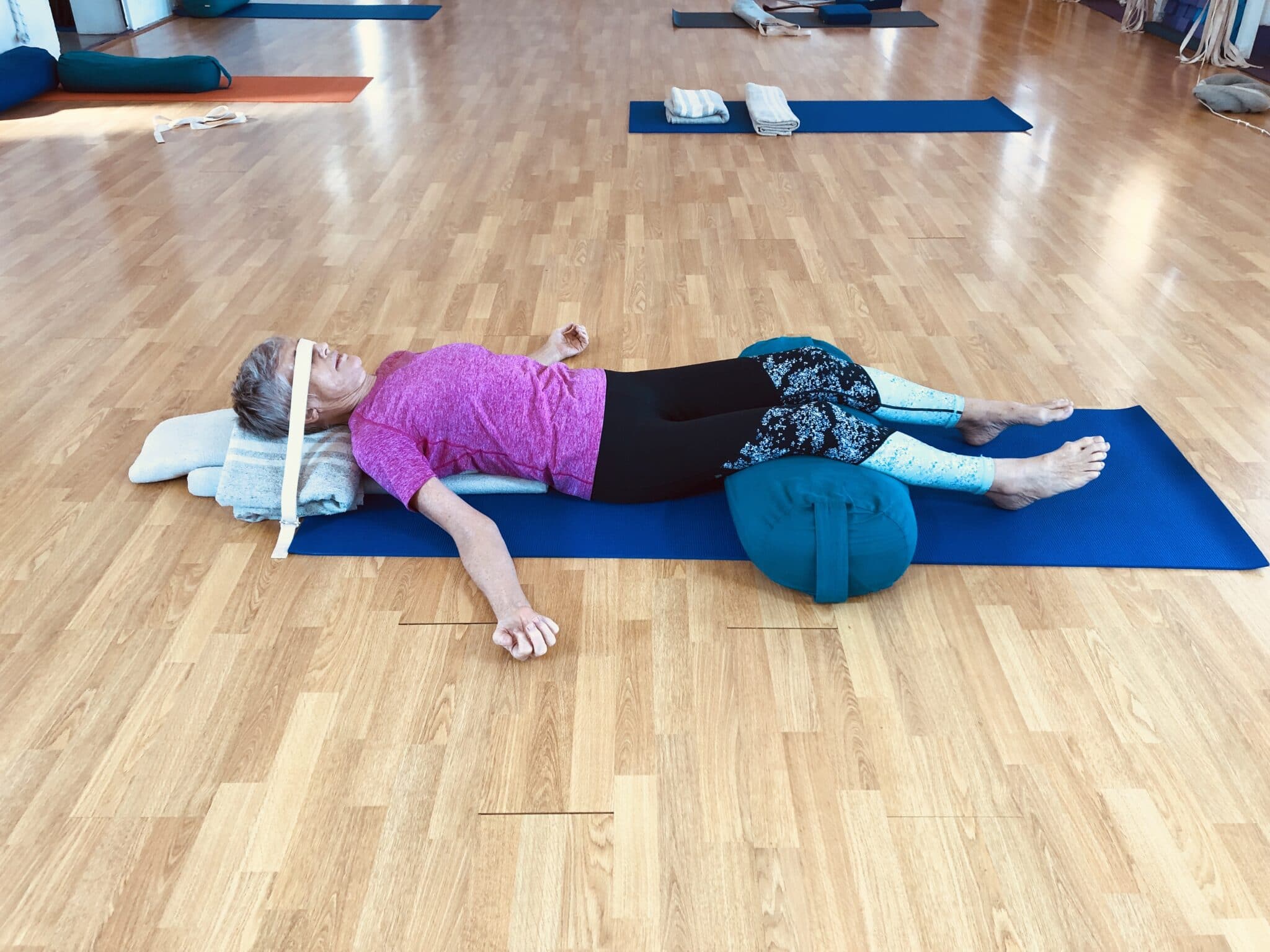
A bolster under the knees lets the back rest, so the breath can be slow and quiet.
How do you fall asleep fast with your breath?
Falling asleep fast is not about forcing it. Forcing keeps you awake. It is about setting up the conditions and letting the breath do its quiet work. Here is a simple evening routine.
- Lie down. On your back in bed, with a pillow or folded blanket under your head. If your back is sore, put a pillow under your knees.
- Watch the breath for two minutes. Do not change it. Just notice where it moves.
- Let the out-breath settle. Breathe in through the nose, and let the out-breath be a little longer and a little softer, like a slow sigh. Do not push.
- Add the hum. After a few rounds, hum softly on the out-breath. Feel the sound fill the head. There is no room left for chatter.
- Let go. After a few humming breaths, go back to normal breathing and rest.
Keep everything soft. A short, smooth breath is good pranayama. A long, forced one is not. If you feel dizzy, panicky or get a headache, stop and breathe normally.
What if you cannot sleep at all?
If you are lying there thinking “cant sleep” for the third night, a few things help. Start with the routine above. Then add a little common sense: put the phone away, keep the room cool, and do not watch the clock.
If you wake in the small hours and your mind starts up, read our post on waking up at 3am. For the poses side of the story, see yoga for improved sleep.
Poses matter too. A quiet class that finishes lying still gives the body what it needs before the breath can settle. Flametree’s evening classes are built that way.

Legs resting on a chair. A restful shape to wind the body down, ready for the breath.
Which breaths should you skip at night?
Not every breath is a bedtime breath. Some wake you up.
- Kapalabhati and bhastrika. These fast, strong breaths energise. They belong in the morning, with a teacher. Read more about bhastrika pranayama and breath of fire.
- Long breath holds. A hold is a real practice with real cautions, and it waits for a teacher.
- Viloma 1. The stepped in-breath can be too stimulating before bed. Viloma 2, where the out-breath is broken into steps, is the settling one, and it is best learnt in class.
What about the 4-7-8 breath you may have seen online? We have not found a trial that tests it for sleep, so we cannot tell you what the research says. The count of seven is a breath hold, and holds are best left to a teacher. Slow, soft breathing gives most of the benefit with the least risk.

Calm breaths for the evening. Strong breaths for the morning, taught in class.
What does the research say about breathing and sleep?
Here is what two studies found, according to PubMed. Research on breath practice and sleep is still young, and it is worth being clear about its limits.
The humming breath. In a 2022 Indian study, 42 people isolating at home with COVID-19 did 20 minutes of bhramari a day, online, for 15 days. Their sleep quality improved, and so did their stress, anxiety and low mood. It was a small study with no comparison group, and the authors said it needs to be confirmed by multi-site randomised trials. DOI: 10.1016/j.jaim.2022.100596
Slow breathing and any calming ritual. In a US trial of 161 women with overactive bladder, half used a device to guide slow-paced breathing for 12 weeks, and half used a device that played music without guiding the breath. Both groups slept a little better, with no significant difference between them. The authors said the results do not support recommending slow-paced breathing over other behavioural relaxation techniques for sleep. DOI: 10.1016/j.ajog.2019.12.005
So the fair reading is this. A calming bedtime ritual seems to help, and a slow breath is a good one. We do not claim it beats every other ritual. What it gives you is something you can do anywhere, for free, with nothing to buy.

Bhramari, the humming bee breath, shown sitting. The same hum can be done lying down at bedtime.
How does Flametree teach breathing for sleep?
In class, with a teacher, and in order. You start lying down, learn the calm breaths, and add the hum. Props are supplied. Our teachers watch your face and neck and adapt the practice to you.
In Darwin you can learn in the studio. You can also join LIVE online classes from anywhere, where the teacher can check your set-up on the screen. Many students practise at home from their own bed, and learn the breath live.
Want the wider picture? Read our guide to the benefits of breathwork, or the calm breath tested at Stanford, cyclic sighing. New to breathwork? Start with breathwork for beginners.
Try yoga for sleep
Our yoga for sleep pass gives you 12 classes for $59.50 (10 at half price plus 2 free). It covers Gentle Yoga, Restorative Yoga, meditation and Yoga for Backs, in the Darwin studios or LIVE online, with props supplied and a money-back guarantee. You are eligible if you are new to Flametree, or away for three months or more. Studio classes are for permanent NT residents, and online is open from anywhere.
For the full story on stress and sleep, our free Cutting Stress With Yoga ebook has a whole chapter on it, and explains how the stress brake works.
Breathing exercises for sleep questions
What is the best breathing exercise for sleep?
A slow, quiet breath lying down, with a long, soft out-breath, and then a gentle hum (bhramari). They are calm, easy and open to nearly everyone. We have not found a trial that proves one is best, and a calming routine seems to help.
How can I fall asleep fast?
Do not force it. Lie down, watch your breath for two minutes, let the out-breath settle a little longer, and add a soft hum for a few rounds. Keep everything soft. Putting the phone away helps too.
What can I do when I cannot sleep?
Try the evening routine, keep the room cool, and do not watch the clock. If you wake in the night, read our post on waking up at 3am. Regular classes help to wind the nervous system down in the evening.
Does the 4-7-8 breath work?
We have not found a trial that tests it for sleep, so we cannot say. The count of seven is a breath hold, and holds are best learned with a teacher. Slow, soft breathing is gentler and gives most of the benefit.
Does humming help you sleep?
Mr Iyengar wrote that the humming sound induces sleep. A small 2022 study of 42 people found their sleep quality improved after 15 days of bhramari, though it had no comparison group and needs to be confirmed by larger trials.
Should I do breathing exercises in bed?
Yes, calm ones. Lying down in bed is a fine place for slow breathing and a soft hum. Leave fast breathing and breath holds for a morning class with a teacher.
Sources
- Jagadeesan T, et al. Effect of Bhramari Pranayama intervention on stress, anxiety, depression and sleep quality among COVID 19 patients in home isolation. J Ayurveda Integr Med 2022. PubMed, DOI
- Savoie MB, Lee KA, Subak LL, et al. Beyond the bladder: poor sleep in women with overactive bladder syndrome. Am J Obstet Gynecol 2019. PubMed, DOI
- Iyengar BKS. Light on Pranayama (the humming breath) and Light on Life (relax your brain). Geeta Iyengar, class in Australia, 1996. Flametree Cutting Stress ebook, section 2.5, and Breathworks ebook, section 2.3.10.
This post is general information about yoga. Flametree Yoga Studio, Darwin, Northern Territory.



