Numb Hands At Night? Carpal Tunnel Symptoms, And What A Yoga Trial Found
Carpal tunnel symptoms: the short answer
Carpal tunnel symptoms are numbness, tingling and aching in the thumb and the first fingers, often worse at night or after hours of gripping, typing or holding a phone. In one randomised trial, 42 people with carpal tunnel syndrome who did a yoga-based programme twice a week for 8 weeks had stronger grip and less pain than people offered a wrist splint. The trial was small and early, and yoga is worth trying for your hands. Here is the article in short form:
- Carpal tunnel is a squeeze on a nerve at the wrist, and the whole arm and shoulder shape it.
- A 1998 trial of 42 people found better grip, less pain and a better Phalen sign after 8 weeks of yoga.
- Splint-only people did not improve on grip or pain in that trial.
- Arms, shoulders and upper back are stretched and strengthened, with the weight kept off the wrists.
- We found no breathing or meditation trials for carpal tunnel.
- Learn it in Darwin or live online, step by step.
Last updated: 25 October 2026.
A quick word on Iyengar yoga. Iyengar yoga is the style developed by Mr BKS Iyengar. In the 20th century he did more than anyone to set down traditional Indian yoga, through his books and his teaching, and he pioneered the use of props. It is the style we teach at Flametree, in Darwin and live online.

Arms up beside a chair. Long arms and open shoulders are the first thing a stiff wrist and hand ask for.
What are carpal tunnel symptoms?
The carpal tunnel is a narrow passage at the wrist, formed by small wrist bones and a tough band across the top. The median nerve (the main nerve to the thumb side of the hand) runs through it, along with the tendons that bend the fingers. When the space gets tight, the nerve is squeezed. That is carpal tunnel syndrome.
The signs are the ones many people know well. Tingling or numbness in the thumb, index and middle fingers. A dull ache in the hand or wrist. Hands that go to sleep at night and wake you. A weak grip, so you drop a cup or struggle with a jar lid. It tends to come on after years of repeated work with the hands, which is why it is so common in people who type, sew, garden, cook or hold a phone all day.
If you are one of them, you are in a big group. Dr Timothy McCall’s June 2019 list of 117 conditions helped by yoga, which Flametree keeps on its benefits of yoga page, includes carpal tunnel syndrome as number 15.
Why do my hands go numb at night?
At night the wrists tend to curl and rest bent, and the hands lie still. A bent wrist narrows the tunnel, so the nerve is squeezed for longer and the fingers go numb or tingle. Shaking the hands out brings the feeling back, which is why many people do it without thinking.
That is only part of the picture. The nerve does not start at the wrist. It runs down from the neck, through the shoulder and along the arm. A rounded upper back, shoulders that roll forward and a head that juts out can all change how much room the arm has. That is why a yoga class for carpal tunnel does not only look at the wrist. For the neck and shoulder side of this, see Tech Neck and Upper Back Pain.

What the 1998 carpal tunnel trial did and found, in three steps.
Can yoga help carpal tunnel symptoms?
This is the study to know. According to PubMed, in 1998 a team led by Marian Garfinkel at the University of Pennsylvania ran a randomised, single-blind, controlled trial of a yoga-based programme for carpal tunnel syndrome. It had 42 people, with a median age of 52 (the youngest was 24, the oldest 77). The yoga group did 11 yoga postures, chosen to strengthen, stretch and balance each joint of the upper body, plus relaxation, twice a week for 8 weeks. The comparison group was offered a wrist splint on top of their current treatment (Garfinkel and others, JAMA, 1998).
The results at 8 weeks:
- Grip strength in the yoga group rose from 162 to 187 mm Hg (a grip gauge reading), a change that was statistically significant (P = .009). It did not change significantly in the control group.
- Pain in the yoga group fell from 5.0 to 2.9 on the study’s pain scale (P = .02). Again, no significant change in the control group.
- Phalen sign (a test where the wrists are held bent to see if the numbness comes on) improved in 12 yoga people, against 2 in the control group (P = .008).
- No significant differences were found in sleep disturbance, the Tinel sign (a tap-over-the-nerve test), or nerve conduction time.
The authors called it a preliminary study, and concluded that the yoga-based regimen was more effective than wrist splinting or no treatment in relieving some symptoms and signs. That is a good result for 8 weeks of classes with no drugs and no surgery.
How strong is the evidence for carpal tunnel yoga?
Small, and still worth acting on. A 2012 Cochrane review (the gold-standard type of review) of exercise and mobilisation for carpal tunnel syndrome looked at 16 studies with 741 people in all, and called the evidence of benefit limited and of very low quality, mostly because the trials are small and use very different methods (Page and others, Cochrane Database of Systematic Reviews, 2012). A 2024 narrative review of yoga for nerve conditions said yoga may be a helpful extra for carpal tunnel syndrome, and also that larger trials are needed (Aruchunan and Loganathan, Advances in Mind-Body Medicine, 2024).
So no big trial has been done yet. Small studies are still real studies, and this one used a real comparison group. At Flametree we treat that as a good reason to try.
What about breathing and meditation for carpal tunnel?
We searched and found no trials of breathing practices or meditation for carpal tunnel syndrome. That does not mean they do nothing. It means nobody has studied it yet. In class, slow breathing and rest sit at the end of every session, which is where the shoulders let go.
What does a yoga class do for your hands?
The trial used 11 postures for the whole upper body, and a class does the same: it works the shoulders, the arms, the upper back and the hands as one line. The poses below are the kind we teach. In class your teacher sets each one to your body, and the props do the hard work for you.
1. Cow Face arms, with a belt
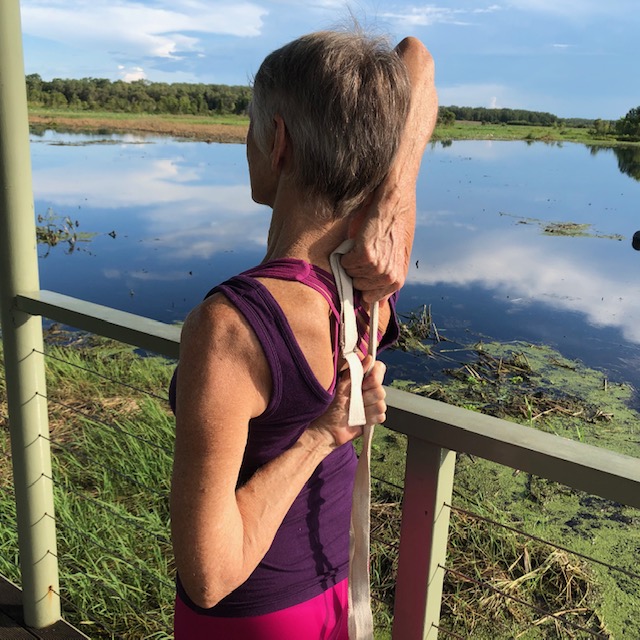
Cow Face arms (Gomukhasana arms) with a belt. The belt links the hands, so the shoulders and upper arms do the stretching and the wrists stay easy.
One arm goes up and bends behind your head, the other goes behind your back, and a belt links the two hands. This opens the shoulders and the front of the chest, where a desk worker tightens up. You hold the belt, so you do not have to clasp the fingers or force the wrists. Swap sides.
2. Arms up, fingers interlocked
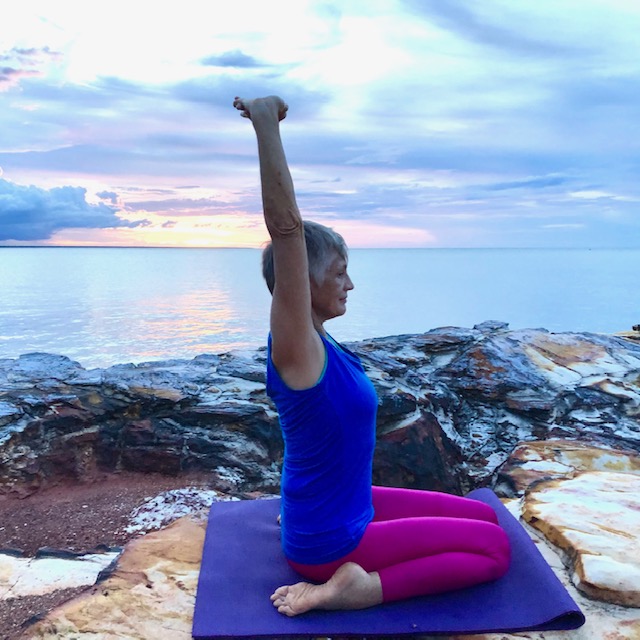
Arms stretched overhead with the fingers interlocked, kneeling. The arms lengthen from the armpits, not from the wrists.
Kneel or stand, interlock the fingers, turn the palms up and stretch the arms overhead, lifting from the armpits. Breathe out and reach a little more. This lengthens the arms and the sides of the body, and teaches the shoulders to sit back and down. If the interlock is awkward, hold a belt between your hands instead.
3. Hands on a chair, long back

Hands on a chair, arms long, back long. The legs and hips take the weight, so your wrists do not have to.
Stand an arm’s length from a chair, put your hands on it and fold forward from the hips until your back is long. The arms are straight, the legs are working, and the shoulders open. This gives the arm a long, steady stretch without putting your body weight on the hands, which is how we teach any pose that loads the wrists.
4. A standing stretch with the arms reaching up

Arms reach up a post while one foot rests on a chair. The arms stretch long and the hands hold lightly.
Stand beside a post or a wall, put one foot on a chair, and reach both arms up. Hold lightly with open hands. This is a long, even stretch from the hip to the fingertips. It is one of the ways we keep the arms working through their whole length, which is what the nerve needs.
5. Supported rest to finish

Supported relaxation. With the arms resting open at your sides, the hands, wrists and shoulders can let go.
Lie on your back with a bolster under your knees or calves and a folded blanket under your head. Let your arms rest open with the palms up and the wrists long, and breathe out slowly. Many people notice how much they were holding in their hands only when they rest.
Which yoga poses should I take care with if I have carpal tunnel?
Poses that put your body weight onto the hands, such as Downward Facing Dog, Plank and arm balances, load the wrists. In class we give you another way in. Put your hands on a chair seat or against a wall so your legs and hips take the weight, or leave the pose out until your wrists are happy. Tell your teacher about your hands at the start of class, so they can shape each pose for you. If a pose makes the tingling worse, come out of it and use the chair version.
What does a carpal tunnel yoga class look like in Darwin?
Flametree Yoga Studio teaches Iyengar yoga at Woolner and Coolalinga in Darwin, and live online for people elsewhere in Australia. Beginner and Gentle classes use chairs, belts, walls and bolsters, and your teacher sees what your shoulders and arms are doing. For the wider stiffness story that sits behind a lot of hand and wrist trouble, read our free ebook below. If your shoulders are the stiff part, see Yoga For Frozen Shoulder, and for the way you stand and sit all day, Yoga For Posture.
Get the free ebook Too Stiff For Yoga?. New to Flametree, or away for 3 months or more? You get 2 free classes + 2 ebooks, only available via this offer. Already coming to class? You can still get the book.
Questions people ask
What are the symptoms of carpal tunnel syndrome?
Numbness, tingling or aching in the thumb, index and middle fingers, often worse at night, with a weak grip. The median nerve is squeezed as it passes through a narrow tunnel at the wrist.
Why do my hands go numb at night?
A wrist that rests curled narrows the carpal tunnel, so the nerve is squeezed for longer. Shaking the hands out brings the feeling back. The shoulders, upper back and neck also change how much room the arm has.
Can yoga help carpal tunnel symptoms?
In a 1998 randomised trial of 42 people, 8 weeks of a yoga-based programme gave stronger grip, less pain and a better Phalen sign than a wrist splint. It was a small, early study. Yoga is worth trying for your hands.
Is yoga better than a wrist splint for carpal tunnel?
In that 1998 trial, the yoga group improved on grip strength, pain and the Phalen sign, while the group offered a splint did not improve significantly on grip or pain. Neither group changed much on sleep disturbance or nerve conduction.
What yoga poses are good for carpal tunnel?
Poses that lengthen the arms and open the shoulders and upper back, with the weight kept off the wrists. Cow Face arms with a belt, arms overhead, hands on a chair with a long back, a standing arm stretch and a supported rest are the kind we teach.
Which yoga poses should I avoid with carpal tunnel?
Poses that put body weight on the hands, such as Downward Facing Dog, Plank and arm balances, load the wrists. In class you take your hands to a chair or wall instead, or leave the pose out for now. Your teacher shapes it for you.
How long does yoga take to help carpal tunnel symptoms?
The 1998 trial measured results at 8 weeks of two classes a week. No trial can promise your result, but two classes a week for two months is a fair first try.
Where can I learn yoga for carpal tunnel in Darwin?
Flametree Yoga Studio teaches Iyengar yoga at Woolner and Coolalinga in Darwin and live online. Beginner and Gentle classes use chairs, belts and walls, and the teacher shapes each pose to your hands and shoulders.
Where to next
- New to yoga, or coming back? Start with our half price 10 class pass with 2 classes free, in Darwin or live online.
- For a workplace, team or group: book private yoga classes for groups, online, at a Flametree studio or at your venue.
- Want to see class times first? Look at the beginner timetable.
Flametree Yoga Studio, Darwin and live online. This article is general information, not medical advice.
Sources (via PubMed): Garfinkel MS, Singhal A, Katz WA, Allan DA, Reshetar R and Schumacher HR, Yoga-based intervention for carpal tunnel syndrome: a randomized trial, JAMA, 1998 (PMID 9820263); Page MJ, O’Connor D, Pitt V and Massy-Westropp N, Exercise and mobilisation interventions for carpal tunnel syndrome, Cochrane Database of Systematic Reviews, 2012 (PMID 22696387); Aruchunan M and Loganathan N, Exploring the impact of yoga on peripheral neuropathy: a narrative review, Advances in Mind-Body Medicine, 2024 (PMID 38837778). Carpal tunnel number 15 on Dr Timothy McCall’s June 2019 list, 117 Health Conditions Helped by Yoga.