
Yoga For Perimenopause: Leaks, A Too-Tight Pelvic Floor, Painful Sex And The 3am Mind
Yoga for perimenopause: the short answer
Yoga for perimenopause, menopause and the years after helps with most of what the change brings. A 2025 review of 24 trials found yoga improved menopause symptoms overall, and mood, anxiety, sleep, bladder and vaginal symptoms, and blood pressure. It helps you live with hot flushes more than it stops them. And it can help with the things women rarely talk about: bladder leaks, a pelvic floor that is too tight, and painful sex.
This article sums up our free ebook, Cool, Calm And Strong: Yoga For Perimenopause, Menopause And Beyond, by Chris Lalor. Here it is in short form:
- Perimenopause can start in your late 30s.
- Yoga eases mood, anxiety and sleep clearly.
- Hot flushes: easier to live with, not fewer.
- A pelvic floor can be too tight as well as too weak.
- The breath and the pelvic floor move together.
- Leaks fell by about two thirds in a 2024 trial.
- Pain with sex is not always hormones.
A quick word on Iyengar yoga. Iyengar yoga is the style developed by Mr BKS Iyengar. In the 20th century he did more than anyone to set down traditional Indian yoga, through his books and his teaching, and he pioneered the use of props. His daughter Geeta Iyengar did more than anyone to work out how yoga should change for women at each stage of life. It is the style we teach at Flametree, in Darwin and live online.

Supported poses and a slow out-breath switch the body from rev up to rest. Many women feel the heat and the worry settle.
When does perimenopause start, and what does yoga do for it?
Earlier than many women expect. Perimenopause means “around menopause”: the years before your last period, when hormones rise and fall unevenly. Jean Hailes for Women’s Health puts the usual start at around 47, but some women notice changes in their late 30s. It lasts 4 to 6 years on average. Menopause itself, the last period, comes at about 51 in Australia.

Three stages, one change. Yoga for perimenopause starts earlier than most women expect.
Yoga helps most with how perimenopause feels. A 2024 review of 11 trials with 1,005 women in peri- and postmenopause found mind-body exercise, yoga among it, gave less anxiety, less low mood, less tiredness and better sleep. The gains in anxiety and mood were large.
Brain fog is real too. Over four years, the SWAN study found women learnt less well in perimenopause, and their learning bounced back after menopause. The researchers called the difficulties “time-limited”.
Does yoga help hot flushes?
Honestly, it helps you live with them more than it stops them. When researchers count flushes in diaries, yoga has not cut how many come. But when women rate how much flushes trouble their lives, yoga has helped, and in one review it beat other exercise on this. The broken sleep, low mood and anxiety that come with flushes improve clearly.

The honest hot flush picture: yoga helps you live with flushes more than it stops them.
That matters, because flushes can last for years. In the SWAN study, frequent flushes lasted a median of 7.4 years. Geeta Iyengar described one to a room of Australian women in 1996: it rises, you perspire, then “suddenly you think it is the winter of Australia.” Many women in our classes find the cooling poses and a slow out-breath help them ride a flush out calmly.
Can a pelvic floor really be too tight?
Yes, and many women never hear this. Leslie Howard is an American yoga teacher who trained for many years with senior teachers in the Iyengar tradition and now works only on pelvic health. In her 40s, after a year of daily pelvic floor strengthening, sex began to hurt, and long drives brought a burning feeling between her sitting bones. A pelvic floor physiotherapist told her the muscles were too tight.
“I didn’t even know a woman could be too tight,” she writes in Pelvic Liberation. Her lesson: a pelvic floor can be “too tight, too loose, and often a combination of both.” A tight muscle is not a strong muscle. Sometimes the job is to learn to let go.

A tight pelvic floor is not a strong one. The aim is springy: lift when needed, let go fully.
So squeezing exercises are not the whole answer. Kegels help many women with stress leaks. But for a tight pelvic floor, and for urge leaks, more squeezing can make things worse.
What causes bladder leaks after menopause?
Leaks come in two main kinds, and they need opposite help. Stress leaks come with a cough, sneeze, laugh or lift, and usually go with a weak, stretched pelvic floor. Urge leaks come with a sudden, strong need to go, sometimes the moment the key is in the front door, and in Howard’s experience can go with a tight, over-busy pelvic floor.

Two kinds of bladder leaks, two different answers. Many women have both.
You are in very large company. In a study of nearly 65,000 American nurses aged 36 to 55, about 1 in 7 started leaking over two years, and only 38% told a doctor. A continence nurse or pelvic floor physiotherapist can tell you which kind you have.
What did the UCSF yoga trials find?
Researchers at the University of California, San Francisco have run three trials of yoga for bladder leaks. In 2014, 19 women did six weeks of yoga or waited: leaks fell 70% with yoga and 13% in the waiting group. In 2018, 56 women did three months of Iyengar-based yoga or stretching: leaks fell 76% and 56%.
In the biggest, in 2024, 240 women aged 45 to 90 did 12 weeks of pelvic yoga informed by Iyengar yoga. Leaks fell from about 3.4 a day to about 1.1, about two thirds fewer. To be honest about it, a matched stretching and strengthening programme did almost as well, falling to about 1.5 a day, and the researchers concluded yoga was not better than general exercise for leaks.

Fewer leaks in twelve weeks. Both groups improved a great deal, and general exercise did almost as well.
For us the message is simple. Moving regularly, with attention to the pelvic floor and the breath, cuts leaks a lot. A good yoga class gives you all of that, and much more besides.
Why can sex hurt in midlife?
Lower oestrogen and vaginal dryness are part of it. But Howard’s story shows that not all of it is hormones. Tight pelvic floor muscles can cause pain with sex too. Her rule of thumb: “Healthy pelvic muscles should be pain-free.” Pain with sex, passing urine or opening the bowels is worth getting checked by a pelvic floor physiotherapist.
She also writes frankly about slowing right down with her husband and making it a shared project. Their motto became “How slow can we go?” The yoga side is the same as for leaks: a softer breath, a pelvis that can widen, and muscles that can both lift and let go.

Two domes that breathe together, about 20,000 times a day. A soft belly on the in-breath lets the pelvic floor move.
What is inside the Cool, Calm And Strong ebook?
The book has three parts: women who came through the change, the science of the change, and how an Iyengar class supports you through it. Here are some highlights.
The stories
- Angie: “I tried everything. Only yoga worked.” A Darwin singer, she tried hormones, walking, a personal trainer and a dietician. With yoga she lost the menopause waist “without even trying”, and now lifts 30 kilos of sound equipment.
- “My partner used to be my personal PMS detector.” Chris’s own easy transition, and why she followed Geeta Iyengar’s advice from the start.
- Geeta went through it too. She did her breathing against a wall for months and relearned Warrior I in a doorway. Still, her Warrior I was better than three of the men in the room.
- Ina’s flushes came back when she stopped. “If I missed it for 4 or 5 days, the hot flashes and itching would return.”
- Lisa’s 3am Sun Salutations, and Ali MacGraw, who met an old friend with “a stillness and a focus about her” and went to class that very day.
- Carin started at 53. A relative said “You’ll never stick with this!” She was still practising past 60.

A supported forward bend over a bolster quietens a busy mind, which helps the broken nights of the change.
The intriguing facts
- 20,000 times a day. That is how often your diaphragm and pelvic floor move together as you breathe.
- The pelvic floor is a dome, not the sagging hammock drawn in old textbooks, as scans of living women show.
- “Just in case” teaches the bladder that any amount of urine means find a toilet, writes Howard.
- Over 70% of women get muscle and joint aches through the menopause transition, and 25% are disabled by them, a 2024 review estimated.
- Women can lose up to 10% of their bone in the first five years after menopause. Standing poses load the hips and spine from many directions.
Get the free ebook Cool, Calm And Strong. New to Flametree, or away for 3 months or more? You get 2 free classes + 2 ebooks, only available via this offer. Already coming to class? You can still get the book.
A few tips on how we do things
- Spread, don’t tuck. “Better to have the blocks higher and the buttocks spread than to tuck your tailbone under,” says Chris.
- Tone, don’t flop. Opening the pelvis is only half of it. It needs life and lift too.
- Soft on the belly, strong in the legs. No crunches while the body settles. Standing poses do the strengthening.
- Rest the head, cool the system. Supported forward bends and gentle inversions are the tradition’s answer to heat and a busy mind.
- Change the practice with the day. Hot day, tired day, period day: the order and the poses change.
Is menopause yoga in Darwin different in the build-up?
The build-up has just started in Darwin, the hot, sticky months locals call mango madness, and it runs on into the wet. Heat, broken sleep and irritability pile on top of the change itself. This is when the cooling, restful side of an Iyengar class earns its keep: supported forward bends, Legs Up The Wall and a slow out-breath.
Any of our beginner or non-beginner classes does this work, in the studio or live online. Our restorative, gentle, Women’s Wellness and pranayama classes add something extra.

Cool, Calm And Strong, our free ebook for every stage of the change.
Your free copy of Cool, Calm And Strong is waiting. New to Flametree, or away for 3 months or more? You get 2 free classes + 2 ebooks, only available via this offer. Already coming to class? You can still get the book.
We have written more on this elsewhere. Read Yoga For Menopause And Perimenopause and Yoga For Pelvic Floor.
Frequently asked questions
When does perimenopause usually start?
Often in the 40s, with Jean Hailes for Women’s Health putting the usual start at around 47, but some women notice changes in their late 30s. It lasts 4 to 6 years on average, and anywhere from 2 to 10. Irregular periods are often the first sign, then poor sleep, mood swings, anxiety, brain fog and the first hot flushes.
How long do hot flushes last?
Often longer than women expect. In the SWAN study, frequent hot flushes lasted a median of 7.4 years, and longer when they began early. Women who felt more stress, anxiety and low mood when flushes began had them for longer, which is one reason a calming practice is worth having for the long haul.
Is perimenopause brain fog real?
Yes, and for most women it passes. The SWAN study found women learnt less well during perimenopause, and their learning bounced back after menopause. Yoga eases the poor sleep, anxiety and low mood that make fog worse, and every pose asks for full attention, a kind of training for the brain.
What is the difference between stress leaks and urge leaks?
Stress leaks come with a cough, sneeze, laugh, jump or lift, and usually go with a weak, stretched pelvic floor, so building tone helps. Urge leaks come with a sudden, strong need to go, and can go with a tight, over-busy pelvic floor, so learning to relax it can help. Many women have both.
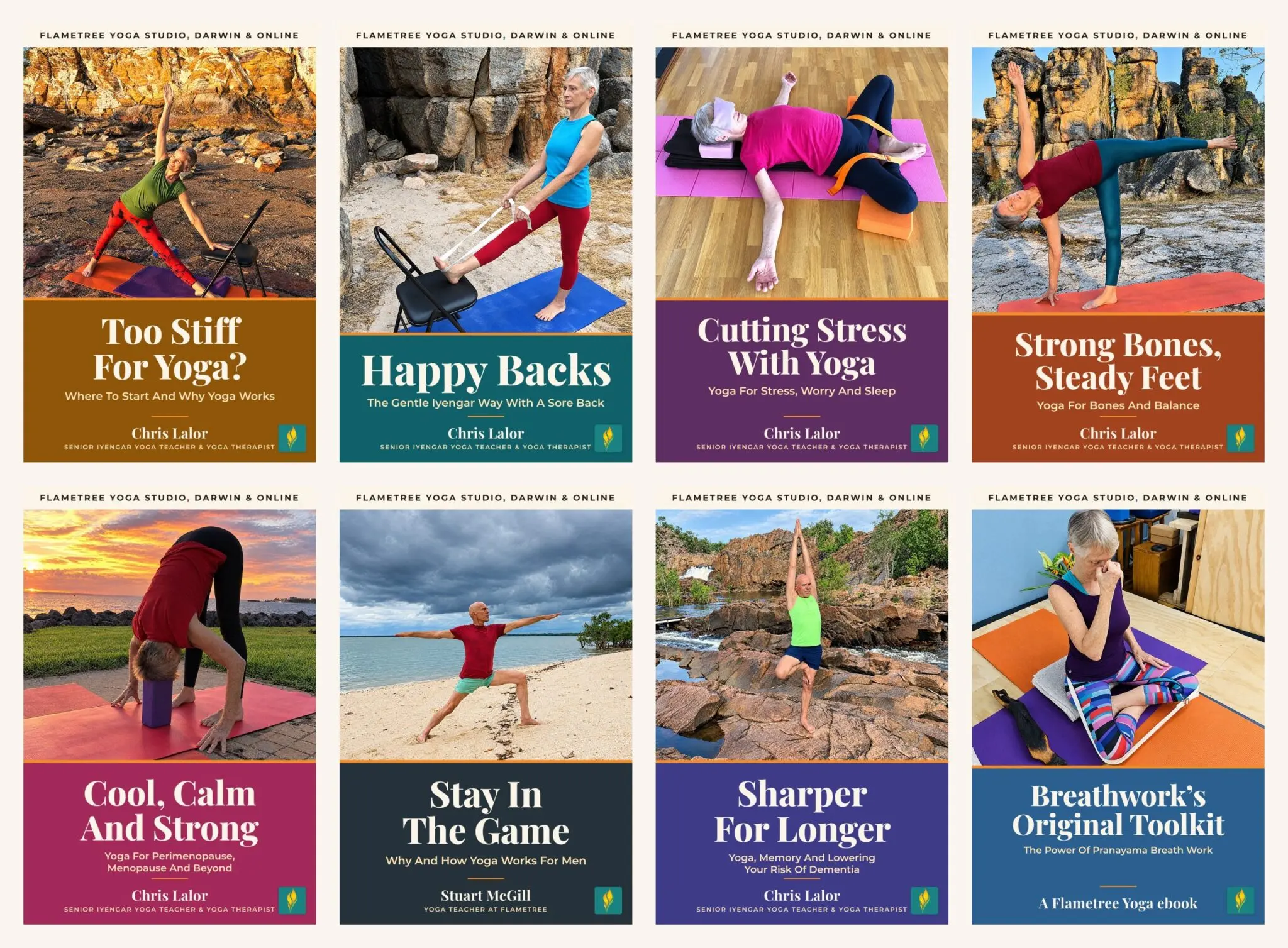
All eight free Flametree ebooks. New students choose two, with 2 free classes: Cool, Calm And Strong is one of them.
Does going to the toilet just in case make leaks worse?
It can, according to pelvic health teacher Leslie Howard. Going just in case teaches the bladder that any amount of urine means find a toilet. She also notes that hovering over a public toilet asks the pelvic floor to hold you up and let go at the same time, while sitting down lets it relax.
Was yoga better than exercise in the 2024 UCSF leak trial?
Not clearly. In the 2024 trial of 240 women aged 45 to 90, leaks fell from about 3.4 a day to 1.1 with 12 weeks of pelvic yoga, and to about 1.5 with a matched stretching and strengthening programme. The difference could have been chance. Both helped a great deal, and yoga did not make leaks worse.
What does spread, don’t tuck mean in yoga?
It is Chris Lalor’s cue for opening the pelvis. Many women tuck the tailbone under out of habit, which squeezes the pelvis. In class the props are raised until the buttocks can spread and the tailbone stays neutral. Tone, don’t flop is the other half: the pelvic floor needs life and lift as well as opening.
Is yoga useful for menopause in the Darwin build-up?
Yes. The Darwin build-up and wet season add heat, broken sleep and irritability to the change itself. Cooling, restful poses with the head supported, Legs Up The Wall and a slow out-breath help many women settle. Flametree’s restorative, gentle, Women’s Wellness and pranayama classes are good places to start, in the studio or online.
Where to next
- New to yoga, or coming back? Start with our half price 10 class pass with 2 classes free, in Darwin or live online.
- For a workplace, team or group: book private yoga classes for groups, online, at a Flametree studio or at your venue.
- Want to see class times first? Look at the beginner timetable.
Flametree Yoga Studio, Darwin and live online. This article is general information, not medical advice. Heavy or unusual bleeding, and pain with sex or passing urine, are worth checking with a doctor or pelvic floor physiotherapist. Choose an advisor you trust: your yoga teacher, a yoga therapist, and your doctor if you wish.
Sources: Wang and colleagues, review of 24 yoga trials in menopause, 2025; Xu and colleagues, review of 11 mind-body exercise trials, 2024; Newton and colleagues, MsFLASH yoga trial, 2014; Cramer and colleagues, yoga for menopausal symptoms, 2018; SWAN study, hot flush duration and cognition; Huang and colleagues, UCSF trials of yoga for urinary incontinence, 2014, 2018 and 2024 (2024 trial: Annals of Internal Medicine); Leslie Howard, Pelvic Liberation (2017); Geeta S Iyengar, Yoga: A Gem for Women. Full references are in the Cool, Calm And Strong ebook.



