
Yoga For Guillain-Barré Syndrome: What Mr Iyengar, The Yoga Doctors And The Research Say
The hospital stay is over and the nerves are healing. So why are you still so tired, sore and shaky, months or years later? Guillain-Barré syndrome (GBS) often leaves fatigue, nerve pain, weak legs, poor balance and worry long after the worst has passed. This guide brings together what Mr BKS Iyengar, Dr Timothy McCall and the research say about yoga for Guillain-Barré syndrome recovery, and for its long-lasting cousin, CIDP (chronic inflammatory demyelinating polyneuropathy), including pranayama (yogic breathing), meditation and mindfulness. Last updated: 8 November 2026.
By Chris Lalor, Certified Senior Iyengar Yoga Teacher and certified Yoga Therapist, Flametree Yoga Darwin.
Get 2 Free Yoga Classes And 2 Free Ebooks
Yoga for Guillain-Barré syndrome: the short answer
Yes, gentle, paced yoga with props and pranayama is well worth trying once you are home and recovering from GBS, or living with stable CIDP. In the one trial so far, adding pranayama, relaxation and guided meditation to hospital rehabilitation improved sleep more than rehabilitation alone. Trials of supervised, individual exercise (not yoga) after GBS and in CIDP found less fatigue, more strength and better quality of life. Yoga with props is exactly that kind of movement: paced, supported, adapted to you, with the breath and rest built in. It will not undo nerve damage. It works on what you can still change: strength you can use, balance, the breath, sleep, fatigue and mood. If weakness is spreading or breathing or swallowing is getting harder, that is an emergency: call 000.

Seated on a chair, a belt around the back lifts the chest. Much of yoga for Guillain-Barré recovery can start sitting.
Overall evidence: Limited
The research here is still limited: early pilots, a single trial, or evidence from a related condition. Not yet tested is not the same as does not work.
Best study (single trial): A randomised pilot trial in a hospital rehabilitation unit in Bangalore, India, published in 2013, added three weeks of daily relaxation, pranayama (yogic breathing) and guided meditation to usual rehabilitation for people with Guillain-Barré syndrome. Sleep improved more in the yoga group. Pain, anxiety, low mood and everyday function improved in both groups, with no clear difference between them. Twenty people finished the trial.
That trial tested yogic breathing, relaxation and meditation, not Iyengar yoga, and no trial has yet tested yoga poses in GBS or CIDP. In our view as certified Iyengar teachers, careful yoga with props, where the pose is adapted to the person and the effort is paced, fits what the GBS recovery research asks for better than most. Why the kind of yoga matters.
The bottom line: five key moves for yoga after Guillain-Barré syndrome
- Find a class that adapts the poses to you. Chairs, the wall, belts and bolsters carry weak legs and steady poor balance, so you can work without strain.
- Pace it, and build slowly. In the GBS trials, what helped was regular, individual, supervised work, built up over 12 weeks or more, never to exhaustion.
- Learn a slow, easy breath. Pranayama (yogic breathing), relaxation and meditation improved sleep in the one GBS trial.
- Rest on purpose. Fatigue is the most common lasting problem after GBS. Supported rest poses turn rest into energy.
- Start now. New to Flametree, or away 3 months or more? 2 free classes, then 10 at half price, in Darwin or LIVE online.
Five Key Moves For Yoga After Guillain-Barré Syndrome
1. An adapted class
Chairs, the wall, belts and bolsters.
2. Pace it
Regular, individual, built up slowly.
3. A slow breath
Pranayama, relaxation and meditation.
4. Rest on purpose
Supported rest makes energy.
5. Start now
2 free classes, then 10 at half price.
Yoga for Guillain-Barré syndrome recovery in five moves: paced, supported, with the breath and rest built in.
Who was Mr BKS Iyengar? Iyengar yoga is the style we teach at Flametree. During the 20th century, Mr BKS Iyengar was the major teacher who codified traditional Indian yoga, through his seminal books and widespread teaching. He also pioneered the use of props, so poses can be adapted to almost any body, including a body that is weak, numb or unsteady. His style is sometimes called modern classical yoga. This guide is part of our encyclopaedia of yoga for health conditions.

Chris Lalor seated on a bolster, a belt holding the legs so the muscles can let go. Support first, then the breath.
This guide in short
- Overall evidence: Limited. Best study (single trial): A randomised pilot trial in a hospital rehabilitation unit in Bangalore, India, published in 2013, added three weeks of daily relaxation, pranayama (yogic breathing) and guided meditation to usual rehabilitation for people with Guillain-Barré syndrome. Sleep improved more in the yoga group. Pain, anxiety, low mood and everyday function improved in both groups, with no clear difference between them. Twenty people finished the trial.
- Mr BKS Iyengar: we have found nothing he wrote on GBS itself. He built props into yoga so the pose comes to the person, and taught that the breath steadies the nerves.
- Dr Timothy McCall, an American medical doctor and yoga therapist who studied with Mr BKS Iyengar, author of Yoga as Medicine: Guillain-Barré syndrome is no. 38 on his list of conditions helped by yoga.
- The research: one pranayama and meditation trial in GBS; trials and reviews of supervised exercise (not yoga) after GBS and in CIDP; and yoga trials in related nerve conditions.
- Related guides: nerve pain and neuropathy, fatigue, post-polio syndrome, spinal cord injury and chronic pain.
- Take it further: our free ebook Strong Bones, Steady Feet, the 2027 masterclass on sleep and energy, and classes in Darwin and online.
Yoga For Guillain-Barré Syndrome On One Page
Mr BKS Iyengar
Props make the pose fit a weak or unsteady body.
Dr Timothy McCall
Guillain-Barré syndrome is no. 38 on his list.
Breathing trial
Pranayama and meditation improved sleep.
Exercise trials
Less fatigue, more strength (not yoga).
Yoga for Guillain-Barré syndrome at a glance. Each source is set out in full below.
What is Guillain-Barré syndrome, and what is CIDP?
In Guillain-Barré syndrome, the immune system attacks the nerves that run from the spine to the arms, legs and breathing muscles, often soon after an infection. Weakness and tingling spread over days, and some people need intensive care. Most recover a great deal over the following year, as the nerves slowly repair. CIDP is a related condition that comes on over months and lasts, often in waves, and many people with it need ongoing medical care.
Worldwide, about 1 to 2 people in every 100,000 develop GBS each year, and a 2026 audit in regional Victoria found rates of 0.9 to 3.0 per 100,000. In Australia that is about 270 to 540 new cases a year (our estimate). For CIDP, a 2022 study in North Queensland and Tasmania found 5 people in every 100,000 living with it: about 1,400 Australians (our estimate).
Guillain-Barré Syndrome In Australia
270 to 540
Australians develop Guillain-Barré syndrome each year (our estimate). About 1,400 live with CIDP.
Our estimates from Cutts 2026 (1 to 2 new cases per 100,000 a year) and Park 2022 (CIDP, 5 per 100,000).
Life after the hospital
Getting the nerves back is only part of recovery. A 2025 review of 12 studies and 1,498 people found that about one in three people still had marked fatigue in the recovery phase, and nearly four in ten in high-income countries like Australia. Reviews in 2025 and 2026 found nerve pain, poor sleep, anxiety, low mood and post-traumatic stress common for years, even when the muscles had come back well. In a Melbourne study of 76 people, a median of six years after GBS, 22% said it still had a substantial impact on their mood, confidence and independence.
How fatigue, fear and weakness feed each other
The Recovery Loop
Fatigue
You move less to save energy.
Less movement
Muscles and balance weaken.
Worry
Fear of falling or relapse, poor sleep.
More fatigue
Poor sleep and worry drain energy.
↻ Paced, supported practice with a calm breath breaks the loop.
A simplified picture of the GBS recovery loop. Trials found supervised, individual exercise lowered fatigue after GBS.
“My props became my guru and taught me how to use the body.”
What did Mr BKS Iyengar teach that bears on Guillain-Barré syndrome?
In short: we have found nothing he wrote about Guillain-Barré syndrome itself. What bears on it is his teaching on props, on effort, and on the breath and the nerves. This is known from long practice. Not yet tested is not the same as wrong.
- Props let a weak body practise. He first used a prop in 1948, bricks and stones from the street, when a pose would not come. Belts, blocks, bolsters, ropes and the chair followed, so that poses could be adapted to almost anyone, including people who cannot yet stand or balance well.
- Neither too much nor too little. He warned that too much tension is aggression and too little is weakness. That is the balance a recovering nervous system asks for.
- The breath steadies the nerves. He wrote that our nerves do not react well to wild swings, and that you have to tame the breath to tame the brain. That is the part of yoga the one GBS trial tested.
- Rest is part of the practice. He taught that forward bends give rest and help one recover from fatigue.
“You have to tame your breath to tame your brain.”

Kim in a supported seated forward bend, chest resting on a bolster on a chair. The props take the weight so tired muscles can lengthen and rest.
The Classic Pose And The Adapted Pose
The classic pose
Standing free or on the floor.
Needs strength, balance and feeling in the feet.
Easy to overdo.
The adapted pose
A chair, the wall, belts and bolsters.
Weak or numb parts supported.
Rest between poses.
Yoga for Guillain-Barré recovery adapts the pose to the person. Known from practice in the Iyengar tradition.
“Too much tension is aggression. Injuries come by aggression, by doing aggressive movements, not by doing yoga. But too little tension is weakness.”
What Dr Timothy McCall says
In short: Guillain-Barré syndrome is on his list. Dr Timothy McCall, an American medical doctor and yoga therapist who studied with Mr Iyengar and wrote Yoga as Medicine, published a list of 117 health conditions helped by yoga in June 2019. “Guillain-Barré Syndrome” is no. 38. Our encyclopaedia uses his list as its backbone and builds on it with newer research.
His reference for no. 38 is the pranayama and meditation trial from Bangalore (Sendhilkumar and colleagues, 2013), described below. No other yoga, pranayama or mindfulness trial in GBS or CIDP has been published since, as far as we can find. So this guide also draws on exercise research in GBS and CIDP, and on yoga in related nerve conditions, and says which is which.
What does the research say about yoga for Guillain-Barré syndrome?
In short: one trial has tested yogic breathing, relaxation and meditation in GBS, and sleep improved. No trial has tested yoga poses. Exercise trials after GBS and in CIDP found less fatigue, more strength and better daily function when the work was supervised, individual and built up over months. Yoga trials in related nerve conditions found less fatigue, less pain and better balance. None tested Iyengar yoga in GBS or CIDP. Why that matters.
The Research At A Glance
Better sleep
Pranayama and meditation, GBS, 20 people.
Less fatigue
Supervised exercise after GBS (not yoga).
Better function
Australian rehabilitation trial, 68% vs 32%.
Less fatigue (related)
Yoga in multiple sclerosis, 10 trials.
The research for yoga for Guillain-Barré syndrome, conclusion first. Only the first card tested a yogic practice in GBS.
Iyengar yoga and yoga pose trials in GBS and CIDP
No trial of Iyengar yoga, or any other yoga poses, in Guillain-Barré syndrome or CIDP has been published that we could find. Not yet tested is not the same as does not work.
Pranayama, relaxation and meditation
- Adding pranayama, relaxation and guided meditation to rehabilitation improved sleep. Sendhilkumar and others, 2013, a randomised pilot trial at a neurological rehabilitation unit in Bangalore, India: 22 people with GBS were randomised and 20 finished. The yoga group had 15 one-hour sessions over three weeks of relaxation, pranayama (breathing practices) and guided meditation, on top of usual rehabilitation. Sleep quality improved significantly more than with rehabilitation alone. Pain, anxiety, low mood and everyday function improved in both groups, with no clear difference between them; 20 people is too few to show a difference of that kind. This was yoga in general, not Iyengar yoga. Read the study.
- Breathing-muscle training with a device raised breathing strength, with no adverse effects. Almeida and others, 2025, a feasibility study of 11 people with GBS in inpatient rehabilitation: six weeks of twice-daily training with a breathing device, 4 to 6 minutes a session. Breathing-in strength rose from 39 to 61 units. This tested a breathing device, not pranayama. Read the study.
What Changed In The GBS Breathing Trial
Better with the yoga sessions
Sleep quality, more than rehabilitation alone.
Better in both groups
Pain
Anxiety and low mood
Everyday function
Sendhilkumar 2013: 20 people with Guillain-Barré syndrome finished. Pranayama, relaxation and guided meditation added to rehabilitation.
Exercise after GBS and in CIDP: what the trials found
These studies tested exercise and rehabilitation, not yoga. We include them because they show what kind of movement helps recovery, and yoga with props is paced, individual, supervised movement.
- Supervised, individual exercise lowered fatigue and raised strength and quality of life more than a home programme. Shah and others, 2022, a randomised trial in India of 16 adults with lasting disability at least six months after GBS: 12 weeks of physiotherapist-supervised strengthening, endurance and breathing exercises, walking practice and pain care. Six months on, fatigue was 13 points lower on a 63-point scale than in the home group. Read the study.
- More individual rehabilitation reduced disability in people living with the after-effects of GBS. Khan and others, 2011, a randomised trial of 79 people from the Royal Melbourne Hospital: over 12 months, function improved in 68% of the higher-intensity, individual programme group against 32% of the lower-intensity group, in moving about, transfers, continence and walking. Read the study.
Function Improved After 12 Months
Share whose function improved, Khan 2011, Melbourne. Bars drawn from zero. Rehabilitation, not yoga.
- Twelve weeks of training lowered fatigue by 20% in people severely tired after GBS or with CIDP. Garssen and others, 2004, a study of 20 people (16 after GBS, 4 with stable CIDP) doing 12 weeks of bicycle training, with no comparison group. Fitness, daily function and quality of life improved too. A follow-up found the gains in fatigue and how people felt were largely not explained by fitness, so something beyond fitness was at work. Read the study.
- In CIDP, training raised fitness by 11% and strength by 14%. Markvardsen and others, 2018, a study of 18 people with CIDP: 12 weeks of aerobic training, then 12 weeks of strength training, after 12 weeks without. Fitness and strength had not changed in the weeks without training. Read the study.
- A personal, gradually built activity plan lowered fatigue in most people years after GBS. Mudge and others, 2025, a study of 8 people with fatigue more than two years after GBS, run online. The authors conclude that carefully graded activity can improve fatigue after GBS. Read the study.
- Reviews: programmes mixing strength, fitness, balance and breathing work were linked with less fatigue and better function. De León-Muñoz and others, 2026, a review of 13 studies with 173 people with GBS or CIDP: the best results came with supervised, individual sessions of 45 to 60 minutes, 3 to 4 times a week, for 12 weeks or more. Read the study.

Chris Lalor in a supported reclining pose. Rest poses like this are part of every class, so effort and recovery go together.
What The Movement That Helped Had In Common
Individual
Fitted to the person, not one size.
Supervised
Someone watching and guiding.
Regular
2 to 4 times a week.
Built up slowly
Over 12 weeks or more.
What the movement that helped after Guillain-Barré syndrome had in common: the same principles as a supported Iyengar class.
Yoga in related nerve conditions
These studies were not in GBS or CIDP. They are in conditions that share its nerve damage, fatigue or poor balance, so they suggest what yoga could do.
- Yoga lowered fatigue in multiple sclerosis, as well as other exercise did. Shohani and others, 2020, a review of 10 randomised trials with 693 people with multiple sclerosis, another condition where the immune system damages nerve coverings. This was yoga in general, and Iyengar yoga has not been tested against exercise on its own. Read the study.
- Yoga improved strength, balance sense, pain, fear of falling and quality of life in diabetic neuropathy. Faridi Dastjerdi and others, 2024, a controlled study of 30 people with diabetic nerve damage: 8 weeks of yoga, three times a week, against no exercise. A 2026 review of 7 studies with 227 people (Vijay and others) found better nerve pain, balance, leg strength and walking speed, with no serious adverse events. Read the study.
- Yoga lowered fatigue and low mood in cancer survivors with nerve pain from chemotherapy. Knoerl and others, 2022, a pilot randomised trial of 44 people: 8 weeks of yoga, against usual care. Read the study.

Mountain Pose with a block between the thighs. Standing steady, feeling the feet on the floor, is where balance work begins.
- Iyengar yoga improved balance, walking speed and getting up from a chair. Tiedemann and others, 2013, a pilot randomised trial in Sydney of 54 people, average age 68: 12 weeks of Iyengar yoga, twice a week, improved the main risk factors for falls, with no serious adverse events. People with GBS were not studied, but poor balance is common after it. Read the study.
Twelve Weeks Of Iyengar Yoga
12 weeks
of Iyengar yoga improved balance, walking speed and getting up from a chair.
Tiedemann 2013, a Sydney pilot trial of 54 older adults. Not a study of people after GBS.
Meditation and mindfulness
No trial of a mindfulness or meditation course on its own in GBS or CIDP has been published. Guided meditation was part of the Bangalore trial above. Reviews in 2025 found anxiety, low mood and post-traumatic stress common after GBS, and mental health symptoms in 30 to 50% of people with CIDP, which is why our anxiety, low mood and trauma guides are worth reading alongside this one.

Sitting on a bolster with the attention on the breath. Slow, easy breathing is learnt step by step.
Yoga, pranayama and mindfulness: how they work together
The one trial in Guillain-Barré syndrome tested pranayama, relaxation and guided meditation, not yoga poses. That still counts for our classes. Mindfulness is steady, present attention, and yoga poses and pranayama (yogic breathing) are old routes to that same state. So the breathing and meditation study also shows what a good yoga and pranayama class can build. No trial separates which part does the work.
Two routes to one steady mind
A steady body, with attention held on the pose.
A steady breath, with attention held on the breath.
Mindfulness: steady, present attention. Each makes the other easier.
A simplified picture, known from practice. No trial separates which part does the work.
We suggest coming to both a yoga class and a pranayama class. Mr Iyengar taught that asana (poses), pranayama and meditation are not divided, and in our experience the two together do more than either alone. See every class time. We trace the history and the links in Yoga And Mindfulness: Why The Mindfulness Research Points Back To Yoga And The Breath.
“Nothing pertaining to pranayama can be forced. That is why it teaches humility.”
How this comes together in a Flametree class
Everything above points the same way, and it is how we teach yoga in Darwin and online. Flametree classes adapt poses with chairs and props, so people with weak legs, numb feet or poor balance can take part. Yoga is for the recovery stage, once you are home. Always follow the directions of any doctor you are consulting during recovery.
- Tell your teacher about your condition. Tell us when you had GBS or how your CIDP is, which parts are weak or numb, what tires you, and how you are on the day. Classes are adapted to the people in them.
- Chairs and props: many poses can be done seated or with the wall, belts, blocks and bolsters taking the weight, so you work at a moderate level.
- Care where feeling is poor: if your feet or hands are numb, padding goes under knees and elbows, and long kneeling or leaning on one spot is avoided.
- Paced, never to exhaustion: you can stop, sit or rest at any point. Doing less on a good day is part of the skill.
- Balance with support: standing poses are done by the wall or with a chair, which builds the balance and leg confidence that the falls research points to.
- Rest and breath to finish: every class ends with supported rest, and our pranayama classes teach the slow breath step by step.

Legs up the wall with a bolster under the hips. A restful pose for tired legs, with no effort from the leg muscles.
See the timetable and book a class. Online classes can be done from home, from your own chair, so you can save energy on travel.
Practising Well After Guillain-Barré Syndrome
Before class?
Tell your teacher what is weak or numb, and how you are today.
A muscle shakes or tingling grows?
Ease off and rest.
Tired the next day?
Do less next time, then build slowly.
Weakness spreading or breathing harder?
An emergency: call 000.
Yoga for Guillain-Barré recovery is supported, paced and never to exhaustion.
Read more on nerves, fatigue, pain and balance
- Nerve pain in the hands and feet (peripheral neuropathy): the wider research on yoga and damaged nerves
- Chronic fatigue, fibromyalgia and fatigue: yoga and deep tiredness
- Yoga for chronic pain: yoga, pranayama and mindfulness for long-lasting pain
- Post-polio syndrome: paced, supported yoga after another nerve illness
- Spinal cord injury: adapted, seated yoga after nerve injury
- Nearby guides: sleep and energy, bones and balance and Parkinson’s and MS
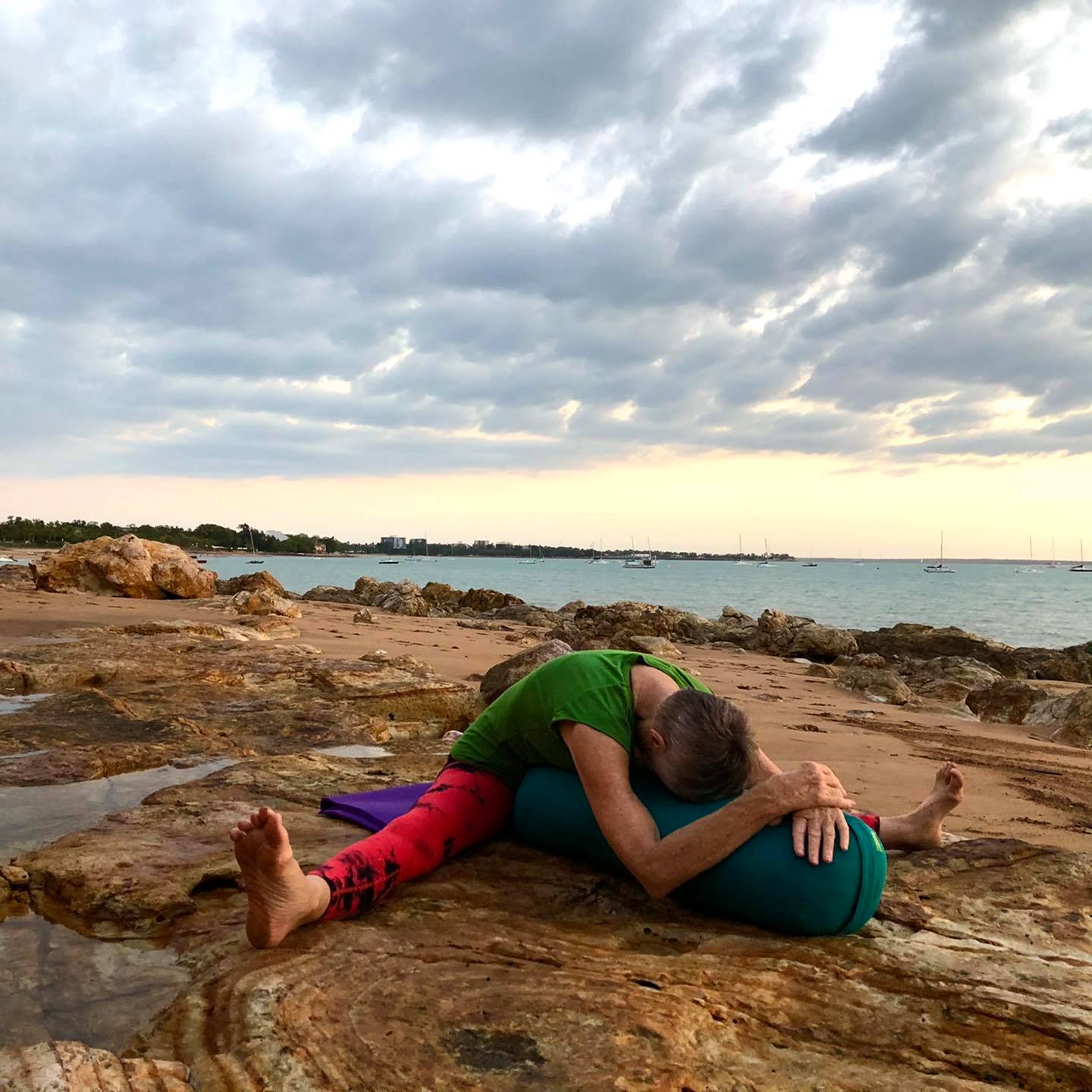
A seated forward bend resting over a bolster, by the sea in Darwin. Supported poses let tired muscles rest while the body lengthens.
Take it further
Free ebook: Strong Bones, Steady Feet. Weak legs and poor balance are common after GBS. This book sets out what the research says about yoga for balance, leg strength and bones, including stories about how it has helped people. Then do the free classes, see what you think, and buy a pass that puts it all into action.
New to Flametree, or away 3 months or more? 2 free classes + 2 ebooks, only available via this offer. Already a student? You can still get this book. Get your free copy of Strong Bones, Steady Feet
- Classes, in Darwin or LIVE online: new, or away 3 months or more? 2 free classes, then 10 at half price. Already practising yoga? See the non-beginner half price pass. See the timetable and book.
- Masterclasses: Yoga for sleep and energy, Sunday 10 January 2027, one of our 2027 masterclasses with Chris Lalor, where you learn the supported rest poses and the long, soft out-breath that turn rest into energy, the two things the GBS research points to. See the 2027 masterclasses.
2027 Masterclasses From 28 December
Over four months, learn the poses and breath practices that make the biggest difference for a range of key health conditions: arthritis, sleep and energy, pelvic floors, backs, wisdom, and anxiety, upsets and anger. In Darwin or LIVE online.
Other conditions are in our encyclopaedia of yoga for health conditions.
Yoga for Guillain-Barré syndrome: questions people ask
Is yoga good for Guillain-Barré syndrome recovery?
Gentle, paced yoga with props is well worth trying once you are home and recovering. In a randomised pilot trial in GBS, adding pranayama, relaxation and guided meditation to rehabilitation improved sleep more than rehabilitation alone. Trials of supervised, individual exercise after GBS lowered fatigue and raised strength. Yoga with props is paced, individual, supported movement with the breath built in.
Can yoga cure Guillain-Barré syndrome?
No. GBS needs hospital care, and nerve repair takes time. Yoga works on what you can still change during recovery: strength you can use, balance, the breath, sleep, fatigue and mood. In the one trial so far, pranayama, relaxation and meditation improved sleep.

Kim in supported relaxation (Savasana). Rest is part of every class, not an extra.
When can I start yoga after Guillain-Barré syndrome?
Yoga is for the recovery stage, once you are home and stable. Weakness that is spreading, or trouble breathing or swallowing, is an emergency: call 000. Always follow the directions of any doctor you are consulting during recovery. Then start gently, with chairs and props, and build slowly over weeks and months.
Can yoga help fatigue after Guillain-Barré syndrome?
It may. About one in three people still have marked fatigue in the recovery phase. Trials of supervised, individual exercise after GBS and in CIDP lowered fatigue, and in multiple sclerosis a review of 10 trials found yoga lowered fatigue. Supported rest poses and a slow breath are part of every class. Read the fatigue guide.
“The heart faces the floor in all the forward extensions and this gives rest and helps one recover from fatigue.”
Can breathing exercises help after Guillain-Barré syndrome?
Yes, gently. In a trial in GBS, pranayama, relaxation and guided meditation added to rehabilitation improved sleep. GBS can weaken the breathing muscles, and a breathing-device study raised breathing strength with no adverse effects. In class, the breath is slow and easy, never forced or held hard. Read the breathlessness guide.
An Easy Breath From Your Chair
1. Sit tall
Support behind the back, feet steady.
2. Lift the chest
Shoulders soft, collarbones broad.
3. Slow the out-breath
Let each breath out grow long and quiet.
4. Rest when needed
Go back to normal breathing any time.
An easy yogic breath for Guillain-Barré recovery, from a chair: known from practice, in line with the breathing trial.

Seated humming breath (Bhramari), a gentle pranayama that can be done from a chair.
Is yoga good for CIDP?
Gentle, adapted yoga suits stable CIDP. No yoga trial in CIDP has been published, but in CIDP, 12 weeks of fitness training and 12 weeks of strength training raised fitness and strength, and supervised, individual programmes lowered fatigue. Poses are done with chairs and the wall where balance or feeling in the feet is poor. Read the neuropathy guide.
Can yoga help balance after Guillain-Barré syndrome?
Poor balance and weak legs are common after GBS. In a Sydney pilot study, 12 weeks of Iyengar yoga improved balance, walking speed and getting up from a chair, the main risk factors for falls, in people with an average age of 68. In class, standing poses are done by the wall or with a chair. Read the bones and balance guide.

Triangle Pose, pressing the back heel into the floor. In class, standing poses start by the wall for support.
Is yoga safe after Guillain-Barré syndrome?
Yoga that is adapted and paced suits recovery. Poses are done with chairs, the wall and props, effort stays moderate, and you rest whenever you need to. Where feet or hands are numb, padding is used and long pressure on one spot is avoided. Tell your teacher about your condition and how you are on the day.
“Holding the trestler gives support and then the inner support of courage comes, giving them confidence.”
Can I do yoga for Guillain-Barré recovery in Darwin or online?
Yes. Flametree Yoga teaches Iyengar yoga in Woolner and Coolalinga in Darwin, and LIVE online, so you can practise from your own chair at home and save energy on travel. Flametree classes adapt poses with chairs and props. New students can begin with 2 free classes, then 10 at half price. Book a class
Where this comes from: BKS Iyengar, Astadala Yogamala (volume 6) and Light on Life (Kindle edition); BKS Iyengar and Geeta S Iyengar, Basic Guidelines for Teachers of Yoga; Geeta S Iyengar, a props demonstration in Sydney, 1996. Timothy McCall MD, his June 2019 list of 117 health conditions helped by yoga and its reference list, and Yoga as Medicine (Bantam). Australian figures: Cutts 2026 (Neuroepidemiology) and Park 2022 (Muscle & Nerve), with our own arithmetic. Reviews on life after GBS: Zuluaga Lotero 2025, Li 2025, Zahir Hussain 2026, Khan 2010 (Melbourne). Studies as linked above, each looked up in PubMed in November 2026. Everything is summarised in our own words.
This page is general information, not medical advice. Flametree Yoga Studio, Darwin and LIVE online.
