How Long To Hold Yoga Poses? Why The Pose Begins When You Want To Leave
How long to hold yoga poses: the short answer
How long to hold yoga poses is one of the first questions new students ask, usually while their legs are shaking in a standing pose. In Iyengar yoga, most standing poses are held for about 20 to 45 seconds each side, and some poses, such as headstand and supported restorative poses, are held for several minutes once you are ready. Beginners start with shorter holds and build up. The bigger answer, the one I learnt from my own teachers, is that holding yoga poses is less about stamina and more about training the mind.
This note in short form
- Typical holds: about 20 to 45 seconds for most standing poses.
- Longer holds: several minutes for headstand, shoulderstand and supported poses.
- Beginners: start short, repeat, and build up week by week.
- The real work: the pose begins when you want to leave it.
- The mirror: a longer hold shows what you like, resist or fear.
- The limit: watch the breath; never hold a pose by grunt.
- Next step: learn the timings with a teacher, in Darwin or LIVE online.
Iyengar yoga is the style developed by Mr BKS Iyengar. In the 20th century he did more than anyone to set down traditional Indian yoga, through his books and his teaching, and he pioneered the use of props. It is sometimes called modern classical yoga, and it’s the style we teach at Flametree.
This page sits in our poses and practice notes.

Triangle Pose (Utthita Trikonasana). A standing pose like this is commonly held for about 30 seconds each side.
Is holding a yoga pose about stamina, or a skill of the mind?
Both, but mostly the mind. When I started yoga, I felt we held some poses for an eternity! The longer I stayed, the louder my mind became. I felt I was suffocating in impatience, resistance, self-judgement and the urge to quit.
I had no idea what Mr BKS Iyengar meant when, as I remember it, he said, “The pose begins when you want to leave it.” In classes with his daughter, Geeta Iyengar, I often heard her say that holding a pose is a skill of the mind.
What they meant is that the time you spend in a pose (the timing) needs sustained holding, so the work goes beyond the muscles. When physical stamina runs out, the question becomes how you stay, how you handle the urge to quit, and how you develop the presence of mind to remain calm. In the Iyengar tradition, staying in a pose is a way to be in the present, and when the mind wanders you have left the pose in a sense.
So, the time in a pose becomes a method for training the mind.
How long should you hold a yoga pose?
It depends on the pose, your experience and the purpose of the practice. There is no single number, and good teachers do not set one as a formula.
As a guide, here are the holding times on a practice chart Flametree uses in its teacher training:
- Tree Pose and Triangle Pose: 30 seconds each side.
- Warrior I, Warrior II and Half Moon: 45 seconds each side.
- Wide Legged Forward Bend and Seated Forward Bend: 1 minute.
- Supported Reclining Hero Pose: 3 minutes.
- Headstand and Shoulderstand: 5 minutes each, for experienced students.
These are times for practised students. A beginner usually holds standing poses for less, comes out, rests, and repeats. Inversions (upside-down poses) are learnt in stages with a teacher, and some people need a different version or should leave them out. To see how these poses are taught, read our notes on Warrior 2 pose and Triangle Pose.

Warrior II with a chair at the Lost City, Litchfield. A chair lets you stay in a pose long enough to learn it.
How long should beginners hold yoga poses?
Shorter than you think, and more often. For beginners, the journey to refining breath, body and mind starts with holding poses for shorter periods. A short hold, done well and repeated, teaches more than one long hold done badly.
In Iyengar classes, props such as chairs, blocks, belts and the wall help here. They take away some of the struggle, so you can stay a little longer with good alignment instead of collapsing out of the pose.
Week by week, the holds lengthen. That is how strength and stamina build without strain. If your question is about building strength in particular, our post Can Yoga Build Muscle? covers holding times for strength.
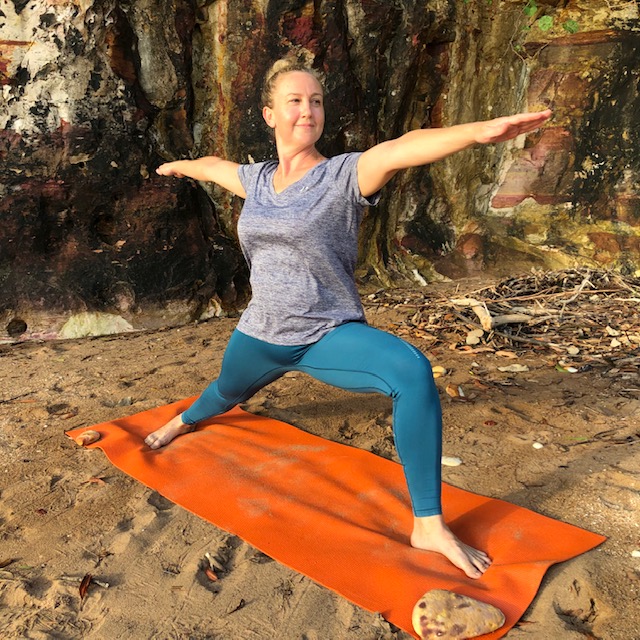
Kim in Warrior II. Beginners hold standing poses for shorter times, rest, and repeat.
Holding yoga poses with the breath, not by grunt
In classes, I heard Prashant Iyengar tell us not to hold poses aggressively. He meant that the length of time is not a fixed formula.
Instead, he said, timings should be used to assess progress, to discipline the mind, and to get to the deeper energetics of a pose. In particular, a pose should not be held through physical endurance alone. He encouraged us to watch the breath and to know when we were overdoing it. It is not about grunt!
What does holding a pose teach you?
Self-awareness, mostly. In my own practice, holding poses gradually changed me and my yoga. I learnt that timings built my self-awareness.
Time in a pose also shines a light on how the mind plays tricks, and can even keep us in a kind of delusion about ourselves.
I learnt that I was easily drawn to poses I liked, or thought I was good at, and that I avoided poses I didn’t like or was fearful about. A longer hold becomes a mirror. It shows what you like, what you resist and what you fear, and the habits that shape you. Longer holds showed me that pattern clearly.
With longer holdings, I also became more present in the moment, living less in the past or the future.
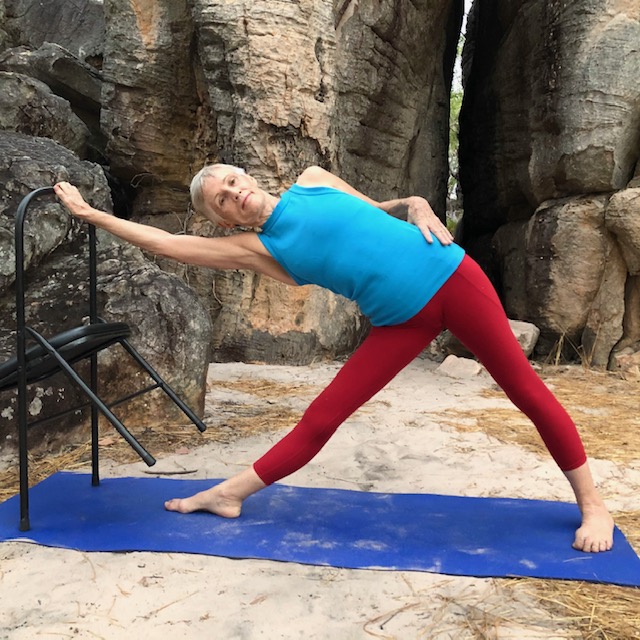
Triangle Pose with the hand on a chair. Support makes a longer, steadier hold possible.
Do different poses feel different when you stay longer?
Yes, and the Iyengar tradition describes why. With experience, longer holds begin to show the quality of each pose. In the tradition, backbends are said to energise, standing poses to steady, and forward bends to ground. This comes from long practice, not from research trials.
Timings work best alongside thoughtful sequencing. A steady set of standing poses can prepare the mind for Headstand. Longer holds in forward bends afterwards can help the mind settle further and turn inward. Our note on why the order of yoga poses matters explains how this works.
Supported restorative poses and long forward bends also show how much the nervous system can quieten. For many students they are the place where stillness first appears.
How do you know if you are holding a pose too long?
The breath tells you first. If you are holding your breath, gripping your jaw, or your alignment is falling apart, it is time to come out. An uneven breath is a sign you are overdoing it or are tired, so come out of the pose.
- Breath: it should stay smooth. Strained or held breath means ease off.
- Pain: sharp or joint pain is a signal to stop, not to push on.
- Shape: if the pose collapses, come out, rest and go again.
- Existing conditions: with joint, heart or blood pressure issues, ask your teacher which holds suit you.
Discomfort from effort is normal. Pain is not. Learning the difference is part of the skill.

Hold the pose only as long as the shape stays clean.
Is asana practice more about doing, or being?
My summary is that asana practice is less about doing, and more about being. Toning and flexibility are a by-product, not the end in itself!
For all of us, used wisely, timing is a powerful teacher. It guides us toward presence, steadiness and a clearer understanding of ourselves. That is part of what Iyengar yoga offers: you stay long enough to notice.
This is known from long practice in the Iyengar tradition rather than tested in research trials. What research does show is that Iyengar-based yoga, with poses held and built up over weeks, is practical for older people: a 2013 Sydney pilot trial of 54 adults with an average age of 68 found 12 weeks of Iyengar yoga improved balance, walking speed and getting up from a chair, with no serious adverse events.

A headstand variation at sunset. Experienced students build up to holds of several minutes in inversions.
Learn how long to hold yoga poses, in Darwin and live online
Flametree Yoga Studio teaches Iyengar yoga in Darwin and LIVE online, with Christine (Chris) Lalor, Senior Iyengar Yoga Teacher. In class, your teacher tells you how long to stay, adjusts the timing to you, and shows you how props let you hold a pose well. You can learn it in the studio or online.
Related reading: our poses and practice notes, can yoga build muscle, what is restorative yoga, how to calm your nervous system and yoga inversions.

Plough pose is held with the hips lifted and the spine long.
Practise this at Flametree
Flametree Yoga Studio teaches Iyengar yoga in the studio at Woolner and Coolalinga in Darwin, and LIVE online.
- New to Flametree? Your first class is free. In the studio, just come along. Online, go to our online class list, click the class time you want and we email you the link to join.
- Beginners: new students, and anyone who has been away three months or more, can get a half price 10 class pass with 2 extra classes free, to use online, in the studio, or both. See the beginner half price pass.
- Already practising yoga? The same half price 10 class pass with 2 extra classes free, for new students and for anyone away three months or more, is also available as the non-beginner half price pass.
- See every class time, including online classes, on the timetable.
Can’t make a class? Practise at home with our video courses.
How long to hold yoga poses: frequently asked questions
How long should you hold a yoga pose?
In Iyengar yoga, most standing poses are held for about 20 to 45 seconds each side by practised students, seated forward bends for about a minute, and headstand, shoulderstand and supported restorative poses for several minutes. Beginners hold for less and build up. The right time depends on the pose, your experience and your health.
How long should beginners hold yoga poses?
Beginners usually hold standing poses for less time than practised students, come out, rest and repeat. Props such as a chair, block or wall help you stay with good alignment. Holding times lengthen week by week as strength and understanding grow.
Why do Iyengar yoga classes hold poses longer?
Iyengar yoga uses timings so the work goes beyond the muscles. Holding a pose lets you refine the alignment, steady the breath and train the mind to stay calm when it wants to quit. Mr BKS Iyengar is remembered as saying: the pose begins when you want to leave it.
Is holding a yoga pose longer always better?
No. Prashant Iyengar taught that poses should not be held aggressively or through endurance alone. Watch the breath. If it strains, or the shape collapses, come out, rest and go again. A shorter hold done well is better than a long hold done badly.
What does the pose begins when you want to leave it mean?
It means the real learning starts when physical comfort runs out. At that point the work shifts to the mind: noticing impatience, resistance and self-judgement, and choosing to stay calm and steady while the breath stays smooth.
How do I know if I am holding a yoga pose too long?
Signs include an uneven breath, holding your breath, clenching your jaw, sharp or joint pain, or the pose falling apart. Effort and some discomfort are normal; pain is not. If you have a joint, heart or blood pressure condition, ask your teacher which holds suit you.
Do longer holds improve flexibility?
Flexibility and toning do improve with regular practice, but in the Iyengar tradition they are seen as a by-product. The main aim of timing is presence, steadiness and self-awareness. Iyengar-based yoga has also been found in a Sydney pilot study to improve balance and mobility in older adults.
Where can I learn Iyengar yoga timings in Darwin or online?
Flametree Yoga Studio teaches Iyengar yoga in Darwin and LIVE online, with Senior Iyengar Yoga Teacher Christine (Chris) Lalor. Your first class is free if you are new to Flametree (in the studio, if you have lived in the NT for three months or more; online, anyone new).
This article is general information, not medical advice. If you have a health condition, check with your doctor before starting. Flametree Yoga Studio, Darwin and LIVE online.
Sources: Tiedemann A, O’Rourke S, Sesto R, Sherrington C, A 12-week Iyengar yoga program improved balance and mobility in older community-dwelling people: a pilot randomized controlled trial, Journals of Gerontology Series A, 2013, doi 10.1093/gerona/glt087. Teachings of BKS Iyengar, Geeta Iyengar and Prashant Iyengar as heard by Chris Lalor in class. Holding times from the practice chart used in Flametree’s teacher training. Iyengar Yoga Australia.