
Deep Core Exercises: Six Iyengar Moves That Work With Your Breath
Deep core exercises: the short answer
Your deep core is a team, not a single muscle: the breathing muscle (the diaphragm) on top, the pelvic floor below, the deep tummy muscles in front and the small muscles along the spine behind. They switch on together, and the timing matters more than the bulk. So the best deep core exercises are the ones that keep all four parts working while you keep breathing. In Iyengar yoga that means sitting on your sitting bones, Boat Pose, plank, side plank and a quiet supported rest. Here is the article in short form:
- The deep core is a cylinder: diaphragm on top, pelvic floor below, deep tummy muscles in front, spine muscles behind.
- The four parts fire together, a split second before you move.
- Sucking the stomach in is not the aim. Breathing while you work is.
- Six moves: sit tall, Boat Pose with a belt, Boat Pose, plank, side plank, supported rest.
- In a lab study, Boat Pose worked the front trunk muscles harder than plank.
- Our free Happy Backs ebook teaches these in an Iyengar class.
- Beginner classes in Darwin teach each move step by step.
Last updated: 25 October 2026.
A quick word on Iyengar yoga. Iyengar yoga is the style developed by Mr BKS Iyengar. In the 20th century he did more than anyone to set down traditional Indian yoga, through his books and his teaching, and he pioneered the use of props. It is the style we teach at Flametree, in Darwin and live online.

Boat Pose (Paripurna Navasana). Balance, stillness and a steady breath all ask something of the deep core.
What makes an exercise a deep core exercise?
“Strengthen your core” is common advice for a sore back. But the core is not one muscle. In our Happy Backs ebook, Chris Lalor describes it as a cylinder: the deep tummy muscles in front, the deep muscles along the spine behind, the pelvic floor below and the diaphragm on top. They work together, and the timing matters more than the bulk.
The research agrees. When someone raises an arm fast, the diaphragm fires about 20 thousandths of a second before the shoulder muscle does, together with the deepest tummy muscle, transversus abdominis. According to PubMed, that finding comes from Hodges and colleagues in the Journal of Physiology (DOI). The whole cylinder gets ready before you move.
So a deep core exercise is any move that asks all four parts to work as a team, while you keep breathing. Holding everything tight does not do that. It stiffens the spine and the breath. A back needs to be strong, but able to relax.
How the breath and the core work as one system
The diaphragm and the pelvic floor move together like a piston. On an MRI study of eight healthy women, both moved down on the in-breath and up on the out-breath. According to PubMed, this is from Talasz and colleagues in the International Urogynecology Journal (DOI). It was a small pilot study, so treat it as a clear picture rather than a rule for everyone.
That is why the breath is part of the exercise. Use the out-breath for the effort, for example as you lift into Boat Pose, and keep breathing while you hold. Mr Iyengar’s own advice for Boat Pose was not to hold the breath. If your breath turns strained or panting, ease off. That is the pose telling you it is too much.
Six deep core exercises, Iyengar style
1. Sit on your sitting bones, not your tail

On the tail, the low back rounds and the breath stays high. On the sitting bones, the low back keeps its gentle curve and the breath can reach the belly and back.
This is the quietest deep core exercise and the one you can do all day. Leslie Howard, an American teacher trained in the Iyengar tradition who works on the pelvis, asks her students to show her how they sit. “Ten times out of ten,” she writes, the person is sitting on her tail. The weight lands on the tailbone instead of the two sitting bones. The tailbone was not built to carry that weight. The sitting bones were.
In class, a folded blanket under the sitting bones in the seated poses, and Mountain Pose with the thighs drawing back, make the better position easy. Over weeks it starts to feel normal at the desk and in the car too.
2. Boat Pose with a belt

Boat Pose with a belt. The belt shares the work of the legs, so you can hold the pose longer and keep the breath easy.
Chris Lalor came to yoga in her late 30s with a sore back, after years of lugging large pots in plant nurseries. She says a belt was her own way in. In Boat Pose it let her build core strength and hold the pose longer. In her experience, stretching the hamstrings and building the core together took away a great deal of the back pain she had before yoga.
The lesson she took years to see: she had attacked the poses with will power and force. A sore back does not respond to force. It responds to patience.
3. Boat Pose without a belt
Once the belt version feels easy, try the pose without it. Sit on your sitting bones, lift the chest, then lift the legs, and let the breath keep moving. The picture at the top of the page shows the finished pose.
In a lab study of 22 healthy, yoga-trained adults, the trunk flexors (the front tummy muscles) worked at more than 50% of their maximum in Boat Pose, the highest of the 16 poses tested. According to PubMed, this is from Dewan and colleagues in the Journal of Bodywork and Movement Therapies (DOI). The participants were young and healthy. The study did not test Iyengar timings or props, so it shows how hard the pose works the muscles, not how it treats a sore back.
4. Plank
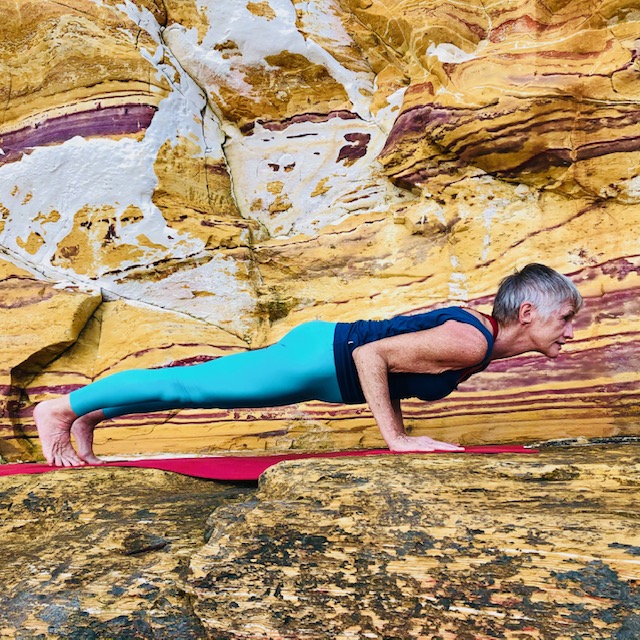
Low plank. The body stays in one line, and the front of the trunk holds it there.
In the same lab study, plank worked the trunk flexors at about 30% of their maximum, less than Boat Pose. It is a good second step because the whole front of the body shares the job and you can feel the line from head to heels. Keep the neck long and the breath moving. Hold for a short time and come down before the breath turns ragged.
5. Side plank
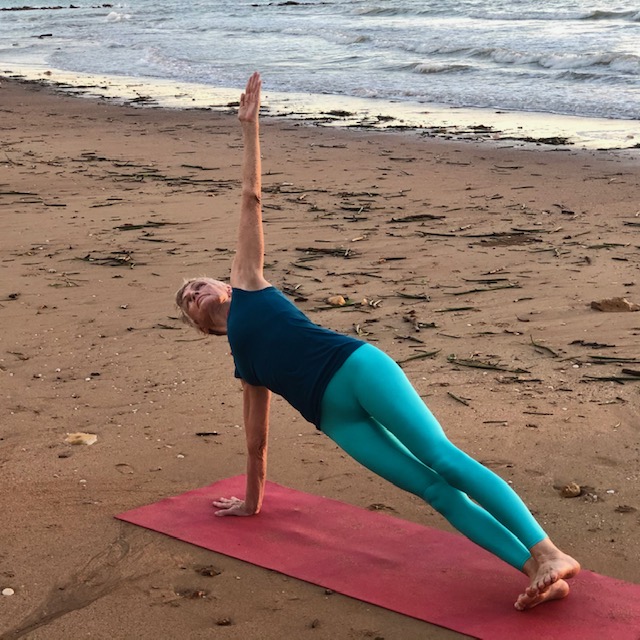
Side plank (Vasisthasana) with Senior Teacher Chris Lalor.
Side plank (Vasisthasana) asks the side of the trunk to hold you up, where plank works the front. It is a more advanced pose, so in class we build up to it with a wall or a shorter version first.
6. Supported rest

The rest at the start and end of class. A soft, slow breath teaches a clenched back to let go.
You do not need special breathing techniques to begin. Our classes start and end with lying quietly. You lie flat on your mat with a folded blanket under your head, or rest your calves on a chair seat if lying flat strains your lower back. You breathe slowly and quietly through the nose, and feel the back spread onto the floor as you breathe out.
It looks like the opposite of a core exercise. It is the other half. A deep core that can only grip is not doing its job, and this rest teaches the back to release.
One note for women in the years of hot flushes: our Cool, Calm And Strong ebook advises leaving Boat Pose and leg lifts out until the body has settled after menopause. They can bring flushes on. Standing poses and the supported rest do the work instead. See menopause belly.
Should you suck your stomach in?
No, not as the main idea. Pulling the stomach in hard is a common cue, but it is not the strongest way to steady the spine, and it tends to stiffen the breath. The aim is just enough firming, with the lower belly gently lifted and the breath moving, not as much as possible. Our teachers show you how it feels in the room, which is much easier than describing it.
Do deep core exercises fix back pain?
The research is mixed, so we do not promise it. A Cochrane review of 29 trials with 2,431 people found that exercise aimed at the deep trunk muscles was no more effective for chronic low back pain than other forms of exercise. According to PubMed, this is from Saragiotto and colleagues (DOI). What the team and the timing do for you is steadier movement and an easier breath, and that is what we teach. For a wider look, see our guides to how to reduce lower back pain and lower back stretches.
Deep core and pelvic floor
The pelvic floor is the base of the cylinder, and it moves with the breath. If that is your main interest, read our guide to pelvic floor exercises. For the question of how yoga builds strength overall, see can yoga build muscle.
Where can you learn deep core exercises in Darwin?
Flametree Yoga Studio teaches Iyengar yoga at Woolner and Coolalinga in Darwin, and live online across Australia. Beginner classes teach Boat Pose with a belt, plank and the supported rest step by step, with the props supplied. If you are new, our half price 10 class pass with 2 classes free is the easiest way in. Prefer to see times first? Look at the beginner timetable.
Get the free ebook Happy Backs New to Flametree, or away for 3 months or more? You get 2 free classes + 2 ebooks, only available via this offer. Already coming to class? You can still get the book.
Questions people ask
What are the best deep core exercises?
The best ones work the whole cylinder while you keep breathing: sitting tall on the sitting bones, Boat Pose with and without a belt, plank, side plank and a supported rest.
How do I engage my deep core?
Sit on your sitting bones, breathe out, and gently lift the lower belly without gripping or holding your breath. A teacher can show you how it feels in a few minutes.
Should I suck my stomach in?
Not hard. Just enough firming, with the breath still moving, is the aim. Gripping stiffens the spine and the breath.
Should I hold my breath in Boat Pose?
No. Mr Iyengar advised against holding the breath in Boat Pose. Use the out-breath to lift, and ease off if the breath turns strained.
Which pose works the deep core hardest?
In a lab study of 22 healthy yoga-trained adults, Boat Pose worked the front trunk muscles hardest of the 16 poses tested, above 50% of maximum, with plank at about 30%.
Do deep core exercises help back pain?
A Cochrane review of 29 trials found deep trunk muscle exercise no better than other exercise for chronic low back pain. We teach it for steadier movement and an easier breath.
Can a belt help in Boat Pose?
Yes. Chris Lalor used a belt to build core strength and hold the pose longer. The belt shares the work of the legs, so you can keep the breath easy.
Where can I learn deep core exercises in Darwin?
At Flametree Yoga Studio’s Woolner and Coolalinga classes, or live online. Beginner classes teach each move step by step, with props supplied.
Where to next
- Sore back? Read our guide to yoga for a sore back.
- Want strength? See yoga for strength.
- New to yoga? Start with the half price 10 class pass above, in Darwin or live online.
Flametree Yoga Studio, Darwin and live online. This article is general information, not medical advice.
Sources: Hodges PW et al., J Physiol 1997 (DOI); Talasz H et al., Int Urogynecol J 2011 (DOI); Dewan M et al., J Bodyw Mov Ther 2023 (DOI); Saragiotto BT et al., Cochrane Database Syst Rev 2016 (DOI); the Happy Backs ebook (Chris Lalor’s belt story, the cylinder, sitting on the tail after Leslie Howard, the rest at the start and end of class).



