
Monkey Mind: Why Your Mind Jumps Around, And How A Yoga Pose Calms It
Monkey mind: the short answer
Monkey mind is an old phrase for the busy mind that jumps from thought to thought like a monkey in a tree. You cannot order it to be still, but you can give it a job. A held yoga pose does exactly that: it hands the mind something precise to do, and the mind settles by itself.
That is the idea behind how to stop monkey mind in yoga. Mind wandering is normal, and so is a busy mind, and the body is a better door into calm than telling yourself to relax.
- What it is: a mind that hops between worries, plans and replays.
- Why it happens: the ordinary mind moves outward, towards past and future.
- What does not work: telling yourself to relax or to think of nothing.
- What works: give the mind a job, such as pressing the feet down.
- The loop: action, sensation, observation, adjustment, reflection.
- The bonus: a held pose also shows you your own mental habits.
- New students: 12 classes for $59.50 in Darwin or LIVE online.
Last updated: 25 October 2026

Holding a pose such as Warrior 2 asks a lot of the body, and the busy mind has to come along.
What is monkey mind?
Picture a monkey in a tree. It grabs one branch, lets go, grabs another, and never sits still. That is the busy mind. One thought leads to the next, then the next. You are halfway through a job and suddenly planning dinner, replaying yesterday, or worrying about next week.
Monkey mind is not a problem you have, it is a thing minds do. The ordinary mind is always moving outward: remembering, planning, worrying and judging. Chris Lalor, a senior Iyengar yoga teacher and yoga therapist at Flametree, describes how this works in the notes for a Flametree masterclass on strength and the mind.
Why does the mind wander so much?
Researchers have tried to measure it. In a 2010 study, two Harvard psychologists built a phone app to ask people, at random moments, what they were doing and what they were thinking about. According to PubMed, people were thinking about what was not happening almost as often as about what was. Doing so typically made them unhappy. DOI: 10.1126/science.1192439
Most of us know where a wandering mind goes when we are stressed. Back to the argument at work. Forward to the bill that is due. Round and round the same worry.
So if your mind jumps around, you are in very good company. The useful question is not “how do I stop thinking?” but “what can I give my mind to do?”
Why does telling yourself to relax not work?
Try this. Say to yourself, “Stop thinking.” How did that go?
Yoga therapist Ann Swanson describes two ways to calm down. Top-down means using the mind to change the body: talking yourself round, naming a worry, writing a gratitude list. Bottom-up means using the body to change the mind: movement, breathing, a walk, a warm shower.
When you are very wound up, top-down is hard. The part of you giving the order is the part that is wound up.
Mr BKS Iyengar, the twentieth-century teacher who collected and passed on traditional Indian yoga, made the same point: “If I say, ‘Relax your brain,’ you cannot do it. If I put you in a certain asana (yoga pose), your brain relaxes, and you become quiet. This is the beauty of yoga.” (Light on Life)

Two doors to calm. Top-down uses the mind to change the body. Bottom-up uses the body to change the mind.
How does a yoga pose give the mind a job?
When you hold a pose carefully, the mind has a task. Take Triangle Pose (Utthita Trikonasana). Press the big-toe mound down. Notice what happens in the inner leg. Press the outer heel. Notice the outer hip. Lift the breastbone. Notice whether the breath becomes freer or more restricted.
You are not trying to quiet the mind. You are asking it to be curious about something specific, right now.
Chris describes the process as a loop:
Action, then sensation, then observation, then adjustment, then reflection.
You do something. You feel it. You notice what it did. You adjust. You think about what changed. Then you go round again.

Action gives the mind somewhere to go. Each time round the loop, the mind comes back to now.
Each time round, the mind comes back to the present moment. Instead of thinking about yesterday or tomorrow, it becomes interested in what is happening in the body now. That repeated cycle develops concentration.
This is also why the muscles matter. Working muscles send a steady stream of information back to the brain about where the body is and how it is moving. That gives the mind plenty to follow. A pose that takes all your attention leaves little room for worry.
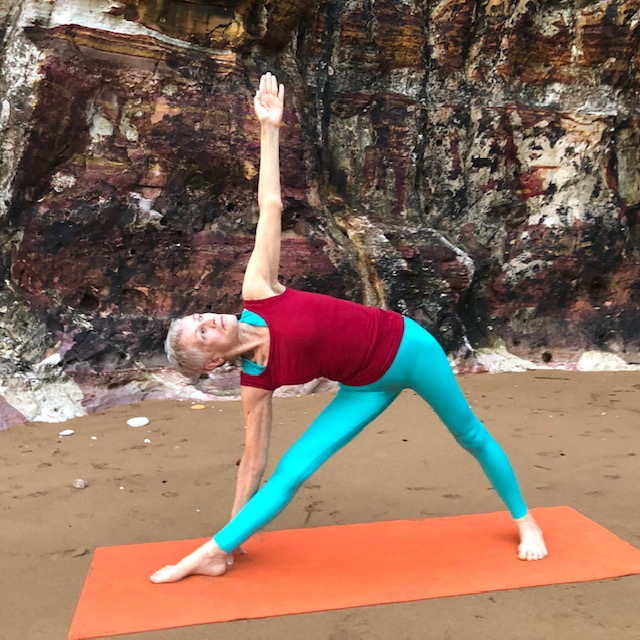
In Triangle Pose, the feet press down and the action runs up through the legs. The mind follows it.
What happens when you hold a pose for a while?
The first thing is usually the legs getting tired. And then the mind starts up.
I don’t like this. I can’t do this. When is this going to finish? Or the opposite: I must push harder. I must do it better than everyone else.
This is the interesting part. A held pose becomes a small laboratory for watching your own mind. Patanjali, the author of the old Yoga Sutras, named the habits of the mind that cause suffering as the kleshas. You can see them in a held Warrior II:
- Raga: wanting the pleasant feeling
- Dvesa: resisting the discomfort
- Asmita: thinking “I am good at this” or “I am terrible at this”
- Abhinivesha: fear when the pose feels unfamiliar or wobbly
- Avidya: not seeing clearly what is actually happening
You do not have to obey these thoughts. In a held pose, you can watch them come and go. That is a very different relationship with the busy mind from fighting it.
Does the focus grow over time?
Yes. At first, attention is narrow. Where is my foot? Is my knee straight? Can I lift my chest?
With practice, you hold several pieces of information at once: the feet pressing down, the legs lifting, the pelvis steadying, the spine lengthening, the shoulders broadening, the breath moving and the face staying quiet. You are no longer doing six separate actions. You begin to experience one pose.
The mind moves from single-pointed concentration towards whole-body awareness. A mind that is taking in the whole body has much less room to hop about.

In a wide-legged forward bend with blocks, there is a lot to feel at once. The mind gets busy in a good way.
Is effort the answer?
Not on its own. Effort alone is not yoga. If you simply tighten everything, you become rigid and the mind often gets louder.
The skill is firm and soft at the same time. The legs work strongly while the throat stays soft. The arms extend while the eyes stay quiet. The abdomen supports the spine while the breath flows.
A useful check is your face. Forehead wrinkled, jaw tight, shoulders hard, toes gripping, breath held: these tell you that effort has turned into strain. Soften them and the mind softens too.
Over time, the body begins to teach the mind. A tight jaw tells you effort is excessive. A ragged breath tells you the nervous system is getting agitated. When every part of the body is taking part, neither dull nor overworking, the mind does not have to keep jumping from place to place. It can become quiet.
Is this mindfulness?
It is close. Mindfulness means keeping your attention on what is happening now, without panic or judgement. Iyengar yoga gets there by a different door: the pose and the breath. “Yoga makes us live in the present,” Mr Iyengar said.
If you would like more on this, read our posts on how to stop overthinking, stillness in yoga and the sattvic mind (a calm, clear state of mind). For the stress side, see yoga for stress management.
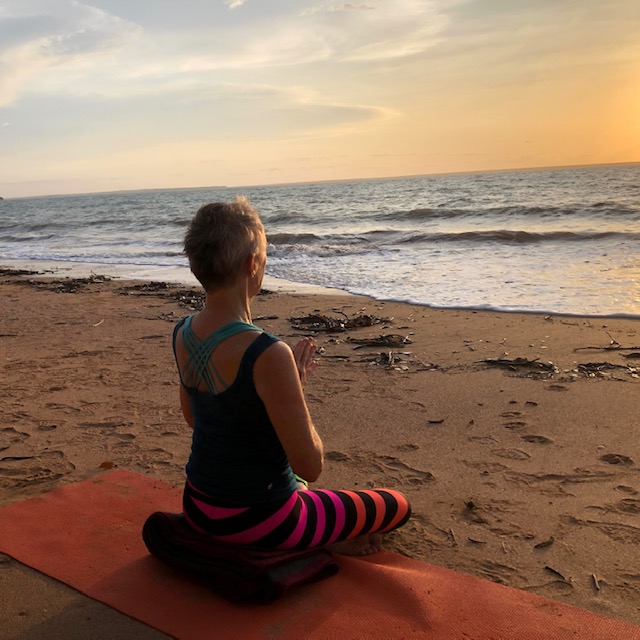
The quiet at the end. After the poses have given the mind a job, sitting still is much easier.
Start with a guided class
Reading about monkey mind will not settle it. A guided class will, because a teacher gives your mind its jobs, one at a time, and shows you what to feel. In Darwin, you can do that in the studio or LIVE online.
New to Flametree? Get 12 beginner yoga classes for $59.50 (10 at half price plus 2 free). Use them in a Darwin studio or LIVE online. You are eligible if you are new to Flametree, or away for three months or more. Props are supplied, no discount code is needed, and there is a 14-day money-back guarantee. Studio classes are for permanent NT residents, and online is open from anywhere.
See the beginner deal or look at the beginner timetable for your first class.
Monkey mind questions
What is monkey mind?
Monkey mind is an old phrase for a busy, restless mind that jumps from thought to thought like a monkey in a tree. It is normal. Almost everyone has it, especially when stressed.
How do you stop monkey mind?
Ordering the mind to be quiet rarely works. Giving it a job works better. In a held yoga pose, you press, feel, notice, adjust and reflect, and the mind settles on the task instead of the worry.
Does yoga help a busy mind?
Many students find it does. Iyengar yoga asks the mind to follow precise actions in the body, and holding a pose gives the mind something to do. A Harvard phone app study found people think about what is not happening almost as often as what is, so a practice that brings attention back is useful.
Is monkey mind the same as mind wandering?
They are close. Mind wandering is the research term for thinking about something other than what you are doing. Monkey mind is the everyday name for a mind that jumps around.
Why does my mind get louder when I try to be still?
Because sitting still gives the mind no job, and the mind fills the gap with thoughts. That is why many people find it easier to begin with a held pose, which gives the mind a task, before sitting still.
Do I need to be flexible to try this?
No. The mind work comes from the muscle action and the attention, not from how far you can bend. Props such as blocks, chairs and belts are supplied in class.
Sources
- Killingsworth MA, Gilbert DT. A wandering mind is an unhappy mind. Science 2010. PubMed, DOI
- Lalor C. Muscles, Strength And Yogic Philosophy: How Muscle Work In A Yoga Pose Quietens The Mind. Flametree Yoga Studio, Sunday Arvo Masterclass 2 notes, September 2026.
- Iyengar BKS. Light on Life. Rodale, 2005. Swanson A. Meditation for the Real World.
This post is general information about yoga. Flametree Yoga Studio, Darwin, Northern Territory.



