
Yoga For A Sore Back: The Man Told Surgery Might Paralyse Him, And What Got Him Moving
Yoga for a sore back: the short answer
Yoga for a sore back is very likely to help, and it is certainly worth trying, based on our experience at Flametree. The trials agree: yoga is one of the best studied ways to ease a long-lasting sore back, and Iyengar yoga is one of the most tested styles. The secret is how it is done. Gentle, supported poses help a bad back. Force and fast, strong yoga usually do not.
This article sums up our free ebook, Happy Backs: The Gentle Iyengar Way With A Sore Back, by Chris Lalor. Here it is in short form:
- Yoga helps sore backs, often a lot.
- Iyengar yoga has six trials behind it, all favouring yoga.
- Backs often work better before the pain fades.
- Fear and clenching keep a back sore.
- A scan rarely tells the whole story.
- Props bring the pose to you, so nothing is forced.
- The free ebook holds the stories, the science and how a class works.
A quick word on Iyengar yoga. Iyengar yoga is the style developed by Mr BKS Iyengar. In the 20th century he did more than anyone to set down traditional Indian yoga, through his books and his teaching, and he pioneered the use of props. It is sometimes called modern classical yoga, and it is the style we teach at Flametree, in Darwin and live online.

Yoga for a sore back starts gently. A chair and a belt bring the leg stretch to the body, so the back is never forced.
Is yoga good for a bad back?
Yes. In 2017 the Cochrane review (the most trusted kind of research summary) pooled 12 fair trials with 1,080 people who had long-lasting low back pain. Compared with no exercise, yoga gave real gains in how well backs worked in daily life, and pain eased.
Newer research goes further. A 2026 review of 70 exercise trials, with 3,991 people, found yoga cut back-related disability more than the other kinds of exercise it was compared with, in the short term.
Dr Timothy McCall, an American medical doctor and yoga teacher, rates back pain one of the best supported uses of yoga there is. In Does Yoga Work?, the researcher and yoga teacher Mary Flaherty even jokes that doctors might prescribe “more of the Om and less of the Oxycodone”.
Why does Iyengar yoga for back pain get such good results?
Because it has been tested directly, and it is built to be gentle. Two American trials put Iyengar yoga up against education or usual medical care.
- 2005: 60 people did 16 weeks of Iyengar yoga. They had less pain, less disability and used less pain medicine, and kept those gains three months later.
- 2009: 90 people did 24 weeks of Iyengar yoga twice a week. They had less disability, less pain and less low mood, and were still ahead six months after classes ended.
A 2015 review then found six trials of Iyengar yoga for back and neck pain, with 570 people. In all six, the yoga group did better.

Iyengar yoga for back pain is one of the best tested styles: six trials, 570 people, and yoga did better in every one.
Iyengar classes use chairs, walls, belts and bolsters so each pose meets the back where it is. As Mr Iyengar put it in Light on Life: “It is not yoga that injures, but it is the way one does yoga that leads to injury.”
Why does a sore back stay sore?
Often because it is on guard. Pain leads to fear, fear to clenching, and clenching to more stiffness and pain. Chris calls it the clench circle.
A 2017 Australian study found that people with back pain who felt stiff were no stiffer when their spines were measured. Their bodies were guarding. The researchers called that feeling “a protective feeling”, not a measurement. Australian back researchers led by physiotherapist Peter O’Sullivan add that fear and worry predict lasting back pain more than the state of the spine does.

The clench circle. Fear and gripping keep a back sore. Gentle, supported poses and a long out-breath break it.
So the answer is not force. It is showing the back, again and again, that moving is safe. Geeta Iyengar put it in one line: “You don’t protect by not doing, but by doing it properly.”
What is inside the Happy Backs ebook?
Happy Backs is about 50 pages, in three parts: the stories, the science, and how an Iyengar class actually works on a sore back. Here are some of the things you will find in it.
The stories
- Raj, the trucker who thought yoga was a myth. A lifting accident in Canada left him mostly in bed, and a doctor warned surgery could bring “likely paralysis!” He joined our Beginner Course in Darwin. One day he realised: “I can get better.” Today he runs two businesses and comes to our experienced classes.
- Chris’s own back. A former economics lecturer who then lugged pots in plant nurseries, she came to yoga in her late 30s with back pain. A simple belt was her way in.
- Mr Iyengar starting again at 60. After two scooter accidents in 1979 he had to rebuild his practice “as a raw beginner”, from the soles of his feet.
- Stuart and the 11-hour taxi ride. A day stuck in Bali traffic, after weeks of long desk days, set off his sciatic nerve. The taxi was only the occasion. The sitting had built up for years.
- Justin Langer’s three-hour cup of tea. The Australian opening batsman visited Mr Iyengar’s institute in Pune in 2004, expecting a quick chat. Mr Iyengar spotted his lopsided lower back “by the way you are sitting there”.
- Christina, Australia 1992. A surgeon was proposing a neck fusion. Mr Iyengar saw that her upper back had stopped doing its job, so her neck and lower back were doing it instead.

The job swap Mr Iyengar saw in Christina’s rounded upper back: the neck and lower back were doing its work.
The intriguing facts
- Scans of people with no pain at all show disc “wear and tear” in 37% of 20-year-olds and 96% of 80-year-olds. It is as normal as grey hair.
- 2 days against 43. In a Welsh trial of 151 hospital staff, the yoga group missed 2 working days for aches and pains in six months. The others missed 43.
- Better backs, same pain scores. In an English trial of 313 adults, the yoga group’s backs worked better for a whole year, even though pain scores ended up much the same. “The yogis functioned better.”
- More than a third of 1,170 male golfers had low back pain in the past week. When the lead hip will not turn, the lower back turns for it.
- “Ten times out of ten” the person is sitting on their tail, says Leslie Howard, an American teacher trained in the Iyengar tradition, who calls herself “a recovering mothertucker”.
- Research on yoga and back pain grew about 18 times between 2000 to 2004 and 2020 to 2024, by our own count on PubMed.

Is yoga good for a bad back at work? In a Welsh hospital, the yoga group missed 2 days for aches in six months. The others missed 43.
Get the free ebook Happy Backs. New to Flametree, or away for 3 months or more? You get 2 free classes + 2 ebooks, only available via this offer. Already coming to class? You can still get the book.
A few tips on how we do things
- Every class starts standing. Mountain Pose and the standing poses build the legs and hips, so the back no longer carries the body alone.
- Rest, then space, then strength. The order matters, and the book explains why.
- Short holds, repeated. They are kinder to a sore back than one long struggle.
- Fold from the hips, not the back. Tight hamstrings make the lower back do the bending.
- Good pain or bad pain? The book gives the simple test the Yoga Rahasya writers use.
- Backbends wait. And strong, fast yoga is not for sore backs. We have not seen it help one.
Is yoga good for sciatica and sore necks too?
Often, yes. The book has a section on sciatica, the pain from the big nerve that runs down the leg. Tight buttock muscles can press on that nerve, which is exactly what happened to Stuart in the taxi. Gentle leg stretches with a chair and a belt come into almost every back class for this reason.
Necks respond as well. A 2019 review of 10 trials, with 686 people, found yoga eased neck pain and freed up neck movement. In a German trial of 51 people, the gains were still there a year later, most of all for those who kept practising.

Pain is the brain’s alarm. A careful class works on several of the dials at once, which is why yoga for sciatica and sore backs can help even when a scan has not changed.
The pain scientist Professor Lorimer Moseley, from the University of South Australia, explains why. Pain is made by the brain, every time. It is real, but the brain decides how loud the alarm is. Fear, poor sleep and a held breath turn it up. Gentle movement, a long out-breath and good company turn it down.
How soon do people notice a difference?
Sooner than most expect. The trials used one or two classes a week for four to six months. But two of our Coolalinga students, Sharon and Rachel, told Stuart their back pain had gone by the end of their first month, coming to two classes a week. One student wrote in a Google review that after three months of beginner classes, “my back pain disappeared”.
The research has a simple message about lasting gains: keep coming. In the neck trial, the people who kept practising did best a year on.

The rest at the start and end of class. A soft, slow breath teaches a clenched back to let go.
Where can I do sore back yoga in Darwin?
Flametree runs a Yoga For Backs class on Wednesdays at 7.15pm at Woolner, in the studio only. Most of our beginner classes suit sore backs too, because every class is adjusted to the people in the room. You can join in the studio or live online, from anywhere in Australia.
If your pain is new or severe, came after a fall, or comes with numbness or weakness, tell your teacher before class so they can adapt what you do. Feel free to check with your professional advisers if you wish, but also give yoga a try.

Happy Backs, our free ebook on sore back yoga, from Darwin and online.
Your free copy of Happy Backs is waiting. New to Flametree, or away for 3 months or more? You get 2 free classes + 2 ebooks, only available via this offer. Already coming to class? You can still get the book.
We have written more on backs elsewhere too. Read Yoga For Back Pain: What The Research Says, And Raj’s Story, Yoga For Lower Back Pain and Yoga For Back Pain Over 50.
Frequently asked questions
Is yoga good for sciatica?
Often, yes, when it is gentle. Sciatica is pain from the big nerve that runs down the leg, and tight buttock muscles can press on it. Leg stretches with a chair and a belt, and standing poses that free the hips, come into almost every Flametree back class. Tell your teacher about sharp or worsening leg pain, numbness or weakness before class.
My scan shows disc degeneration. Can I still do yoga?
Usually, yes. A 2015 Mayo Clinic review of 3,110 people with no back pain found disc degeneration on scans in 37% of 20-year-olds and 96% of 80-year-olds. The researchers called these changes likely part of normal ageing. A scan on its own does not explain a sore back or decide how you will get on.
Why does my back feel stiff when it is not?
Because a sore back guards itself. A 2017 Australian study found people with back pain who felt stiff were no stiffer when measured. Their bodies were on guard. Slow, supported poses show the back that moving is safe, and the feeling of stiffness often eases.
Can yoga help neck pain from desk work?
Yes. A 2019 review of 10 trials (686 people) found yoga eased neck pain and freed up neck movement. Iyengar classes work the arms and upper back hard, which matters, because a sore desk neck usually needs strength as well as stretch.
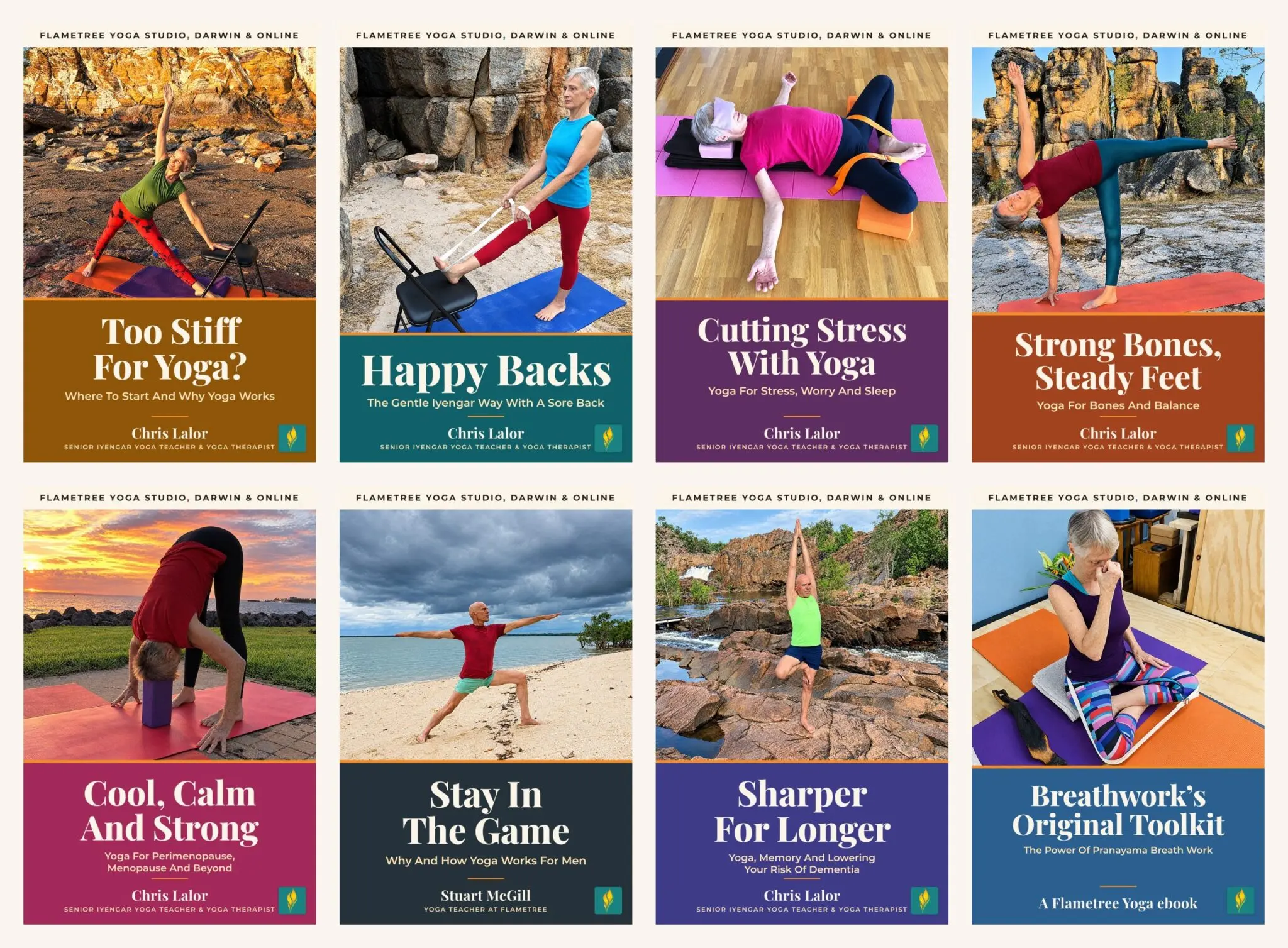
All eight free Flametree ebooks. New students choose two, with 2 free classes: Happy Backs is one of them.
Is power yoga or fast yoga good for a sore back?
In our experience at Flametree, no. We have not seen strong, fast yoga help a sore back, and it often scares people off yoga altogether. A slow, prop-based class that starts gently and builds strength steadily suits a sore back far better.
Can yoga help a golfer’s sore back?
It is well worth trying. In a 2023 survey of 1,170 male golfers, more than a third had low back pain in the past week. A golf swing twists to one side thousands of times. Iyengar classes work both sides and both hips equally, so the lower back does not have to turn for a stiff hip.
Why does Iyengar yoga use chairs and belts for back pain?
Props bring each pose to the body, so a sore back gets the benefit without strain. Mr Iyengar called the wall his guru because it taught him alignment. In a Flametree back class you will see a lot of chairs: to lengthen, to broaden the back, to twist gently and to rest.
What happens in the Yoga For Backs class in Darwin?
It runs on Wednesdays at 7.15pm at Flametree’s Woolner studio. The class starts standing, uses chairs, walls, belts and bolsters, keeps holds short and repeats them, and ends with a supported rest. Our general beginner classes, in the studio or live online, do much the same work.
Where to next
- New to yoga, or coming back? Start with our half price 10 class pass with 2 classes free, in Darwin or live online.
- For a workplace, team or group: book private yoga classes for groups, online, at a Flametree studio or at your venue.
- Want to see class times first? Look at the beginner timetable.
Flametree Yoga Studio, Darwin and live online. This article is general information, not medical advice. Feel free to check with your professional advisers if you wish, but also give yoga a try.
Sources: Cochrane review of yoga for chronic low back pain, Wieland and colleagues, 2017 (Cochrane Library); Williams and colleagues, Iyengar yoga trials, 2005 and 2009; Crow and colleagues, review of Iyengar yoga for back and neck pain, 2015; Tilbrook and colleagues, England, 2011; Hartfiel and colleagues, Wales, 2017; Brinjikji and colleagues, Mayo Clinic review of spine scans, 2015; Blanco-Heras and colleagues, review of 70 exercise trials, 2026; Mary Flaherty, Does Yoga Work? (2020); BKS Iyengar, Light on Life (2005); Leslie Howard, Pelvic Liberation (2017). Full references are in the Happy Backs ebook.



