
Benefits Of Breathwork: Today’s Hottest Breathing Tricks Are Thousands Of Years Old
The benefits of breathwork: the short answer
The benefits of breathwork are real. Trials show breathing practice lowers stress and eases anxiety and low mood, steadies the heart, can lower blood pressure, and helps the lungs. The long, slow out-breath is the stand-out. And most of today’s popular breathwork, from box breathing to humming for nitric oxide, has an older relative in pranayama, the breathing practice of yoga.
This article sums up our free ebook, Breathwork’s Original Toolkit: The Power Of Pranayama Breath Work. Here it is in short form:
- Breathing practice on its own lowers stress.
- The long out-breath beat mindfulness for mood.
- Slow breathing steadies the heart.
- Humming raises nose nitric oxide about 15 times.
- Alternate nostril breathing lowered blood pressure.
- Gentle comes first, for good reason.
- The free ebook explains all five of our breaths.
A quick word on Iyengar yoga. Iyengar yoga is the style developed by Mr BKS Iyengar. In the 20th century he did more than anyone to set down traditional Indian yoga, through his books and his teaching, and he pioneered the use of props. His Light on Pranayama (1981) is still the most detailed guide to yoga breathing in print. It is the style we teach at Flametree, in Darwin and live online. These breaths are classical and very old: every teacher, Mr Iyengar included, does them a little differently, and what he gave us was a careful, step-by-step way of learning them.

Chris Lalor has practised pranayama every day for well over twenty years. A steady breath steadies the attention.
What are the main types of breathwork, and where do they come from?
Most of them have an older relative in pranayama. Box breathing and 4-7-8 breathing are about counts: how long you breathe in, hold and breathe out. In pranayama, counts are called vrtti, and holding the breath is kumbhaka. Humming for nitric oxide is bhramari, the humming bee breath. Alternate nostril breathing is nadi shodhana. Keeping the mouth closed is how nearly every pranayama is done.

Types of breathwork: most of today’s popular methods have an older relative in pranayama.
Is box breathing the same as ujjayi, the ocean breath? No. Box breathing is about the timing. Ujjayi is about the texture: a long, smooth, even breath with a soft sound at the back of the throat. In the Iyengar way, you usually do both at once.
What pranayama adds is three things many modern methods leave out: a safe order to learn in, a set-up with blankets and props, and a teacher who watches.
What does the research say about the benefits of breathwork?
A 2023 review of 12 trials with 785 adults found breathwork lowered stress and eased anxiety and low mood. A 2022 review of 223 studies found slow breathing raised heart rate variability, a sign of a calm, adaptable nervous system, both during practice and over weeks.

Slow breathing steadies the heart, across 223 studies.
For blood pressure, a 2024 review of six trials with 525 people found alternate nostril breathing lowered it further than in the comparison groups. For the lungs, a 2019 review of 11 trials in people with COPD (long-term lung damage) found yoga improved walking distance and lung function, and the gains came from the breathing-focused programmes.
What is cyclic sighing, and why did it stand out?
Cyclic sighing is two in-breaths through the nose, one straight after the other, then a long, slow out-breath. In a 2023 Stanford University trial, 108 adults spent five minutes a day on one of four practices for a month. Every group felt better. But cyclic sighing, the long out-breath, was the one practice that clearly beat mindfulness meditation for lifting mood. The more days people practised, the bigger the lift.

Cyclic sighing stood out in the Stanford trial. A stepped breath in and a long breath out is very close to the first stage of viloma, the staircase breath.
Look closely at it. A stepped breath in, then a long, smooth breath out. That is very close to the first stage of viloma, the staircase breath. Stanford tested it in 2023. Yoga students have been doing it for generations.
Does humming really raise nitric oxide?
Yes. In 2002, Swedish researchers at the Karolinska Institute measured nitric oxide in the noses of ten healthy adults. It was about 15 times higher while they hummed than while they breathed out quietly. Other teams, measuring in different ways, have found rises of two to four times, and every study has found a rise. Nitric oxide relaxes blood vessels and helps defend the airways.

The humming bee breath, bhramari, raised nose nitric oxide about 15 times in a Swedish study.
What has not yet been studied is whether the extra nitric oxide is the reason humming helps. The long experience of practitioners is that the humming bee breath settles the mind and body.
What is inside the Breathwork’s Original Toolkit ebook?
The book has three parts: breath stories, the science of breath, and how pranayama is learnt and taught the Iyengar way. Here are some highlights.
The stories
- Treya: “My lungs became stronger”. After ten online pranayama classes, she noticed it most at stressful times, when her whole chest seemed to breathe more easily.
- “I had pranayama for breakfast.” Stuart’s students asked how much coffee he’d had. It was the early pranayama class: steady, clear energy wrapped in calm.
- A fall at Edith River. Stuart slipped on wet rocks, needed burr hole surgery, and was up and walking within about 24 hours. He credits his fast recovery partly to yoga and pranayama, as his own view, not a medical claim.
- Rob, the Queensland dive instructor who always ran low on air before his students. After about three months of yoga breathing, that fear simply went.
- Sonia, 97: “Pranayama only.” Her legs are unsteady now, but she still practises every day.
- Richard Rosen’s ton of bricks. His first full breath felt like bricks on his chest. Years later: “Whoosh, my chest exploded.”

In the Iyengar way, pranayama starts lying down, so the back is supported and nothing strains.
The intriguing facts
- Fire after the out-breath. A US Army rifle instructor taught it, and the same rule now steadies a golf putt.
- Your sinuses make nitric oxide all the time, and the store refills after about three minutes of quiet.
- In a 2023 trial, breath holds backfired for people who had unpleasant reactions to them. Slow breathing is the safe place to start.
- Most adults breathe 12 to 20 times a minute at rest. Slow pranayama brings it to about six.
- Sitali, the cooling breath, breathes in over a curled tongue. In a 2020 Chennai trial of 100 people with high blood pressure, three months of it lowered blood pressure.

A new habit takes about 66 days to feel automatic, and missing a day does not undo it.
Get the free ebook Breathwork’s Original Toolkit. New to Flametree, or away for 3 months or more? You get 2 free classes + 2 ebooks, only available via this offer. Already coming to class? You can still get the book.
A few tips on how we do things
- Body first, lying down first. “It’s a lot of lying down because the spine needs to be toned for sitting,” says Chris.
- Slow, quiet and through the nose. That is where most of the calm comes from.
- Calm practices before strong ones. Shining skull breath and breath holds come later, with a teacher.
- Half doing, half watching. The sound, the silence or the hum gives a busy mind something to hold.
- Don’t fight the breath. If it strains, stop and rest.
Why does pranayama start gently?
Because the trials agree with the old Iyengar order. A 2025 review of six trials of pranayama for mental health, with 517 people, found unwanted effects were more often linked with fast breathing than slow. Slow, gentle practices give most of the benefit with the least risk.
At Flametree we teach five main breaths: the staircase breath (viloma), the humming breath (bhramari), alternate nostril breathing (nadi shodhana), the ocean breath (ujjayi) and the shining skull breath (kapalabhati). The book explains each one. It does not teach them. That happens in class.

Then sitting, with help. Sitting backwards on a chair with belts lifts the chest without effort, so the breath can move.
A few cautions: breath holds are not for people with high blood pressure or heart problems, and in pregnancy there is no shining skull breath, fast bellows breath, uneven ratios or long holds. Keep taking any medicine as your doctor advises.
Where can I learn pranayama in Darwin?
Pranayama runs at 6.30am on Tuesdays and Thursdays, in the studio and live online, and Stuart runs breath meditation at Coolalinga. Every Flametree yoga class also opens and closes with quiet attention to the breath.
It is the build-up in Darwin right now, the hot, sticky months locals call mango madness, running on into the wet. Heat brings less energy, poor sleep and shorter tempers. Slow breathing and the cooling breaths are especially useful in these months, which is one reason they are popular in Darwin.

Breathwork’s Original Toolkit, our free ebook on pranayama, from Darwin and online.
Your free copy of Breathwork’s Original Toolkit is waiting. New to Flametree, or away for 3 months or more? You get 2 free classes + 2 ebooks, only available via this offer. Already coming to class? You can still get the book.
We have written more on this elsewhere. Read What Is Pranayama?, Bhramari Pranayama Benefits and Breathwork Classes Near Me.
Frequently asked questions
Is box breathing the same as ujjayi breathing?
No. Box breathing is about counts: breathing in, holding, breathing out and holding for the same time. Ujjayi, the ocean breath, is about the quality of the breath: long, smooth and even, with a soft sound in the throat. In the Iyengar way, counts and quality are usually practised together.
What is cyclic sighing?
Two in-breaths through the nose, one straight after the other, then a long, slow out-breath. In a 2023 Stanford trial of 108 adults, five minutes a day of cyclic sighing lifted mood more clearly than mindfulness meditation. Its pranayama relative is the first stage of viloma, the staircase breath.
What is long exhale breathing?
Any practice where the out-breath is made longer than the in-breath. It is the stand-out in the research, because a long, smooth out-breath slows the heart and tips the body towards rest. In pranayama it shows up in ujjayi with a long out-breath, viloma, uneven-count breathing and the humming breath.
Why does Iyengar pranayama start lying down?
Lying down supports the back so you can let go completely, a folded blanket under the head softens the throat, and the nerves settle before the breath is worked. Geeta Iyengar began her pranayama lessons lying down too. Sitting comes later, with blankets and a wall for support.
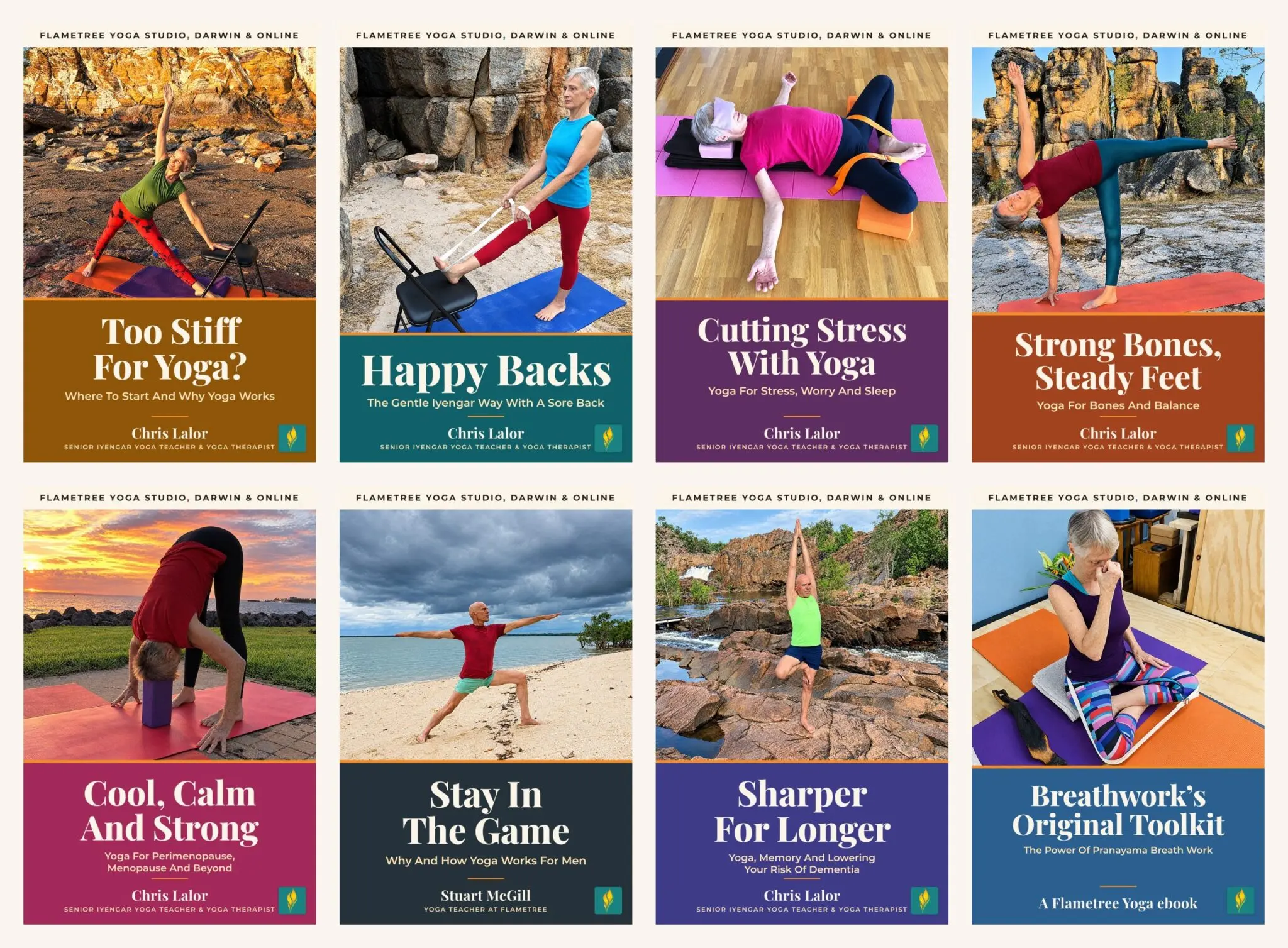
All eight free Flametree ebooks. New students choose two, with 2 free classes: Breathwork’s Original Toolkit is one of them.
Why do fast breathing and breath holds come later?
Because they carry more risk. A 2025 review of six pranayama trials found unwanted effects were more often linked with fast breathing than slow, and in a 2023 trial people who reacted badly to breath holds ended up worse off. Slow, gentle breathing gives most of the benefit with the least risk.
How long does a breathing habit take to stick?
About two months for many people. In a 2010 University College London study of 96 volunteers, the middle time for a new daily habit to feel automatic was 66 days, from 18 to 254, and missing a day did not undo the progress. A regular class keeps the practice going until it runs by itself.
What are Flametree’s five pranayama breaths?
The staircase breath (viloma), the humming breath (bhramari), alternate nostril breathing (nadi shodhana), the ocean breath (ujjayi) and the shining skull breath (kapalabhati). They are classical and very old, taught at Flametree in the careful, step-by-step Iyengar way, calm practices first.
Can breathing practice help in the Darwin build-up?
Yes, many Darwin students find it does. The build-up and wet season bring heat, poor sleep and irritability, and slow breathing with a long out-breath tips the body towards rest. The cooling breaths, sitali and sitakari, are popular in Darwin. Flametree’s pranayama classes run at 6.30am on Tuesdays and Thursdays, in the studio and online.
Where to next
- New to yoga, or coming back? Start with our half price 10 class pass with 2 classes free, in Darwin or live online.
- For a workplace, team or group: book private yoga classes for groups, online, at a Flametree studio or at your venue.
- Want to see class times first? Look at the beginner timetable.
Flametree Yoga Studio, Darwin and live online. This article is general information, not medical advice. A head injury, chest pain or breathlessness needs a doctor straight away. Choose an advisor you trust: your yoga teacher, a yoga therapist, and your doctor if you wish.
Sources: Fincham and colleagues, review of 12 breathwork trials (785 adults), 2023; Balban and colleagues, Stanford breathing trial, Cell Reports Medicine, 2023 (open access); Laborde and colleagues, review of 223 slow breathing studies, 2022; Weitzberg and Lundberg, humming and nasal nitric oxide, 2002; 2024 review of six alternate nostril breathing trials (525 people); 2019 review of 11 yoga trials in COPD; Lally and colleagues, habit formation, University College London, 2010; BKS Iyengar, Light on Pranayama (1981); Richard Rosen, The Yoga of Breath (2002). Full references are in the Breathwork’s Original Toolkit ebook.



