
Dementia Risk Factors: Yoga Works On 7 Of The 14 You Can Change, And Here Is How
Dementia risk factors: the short answer
Most dementia is not simply bad luck. In 2024 the Lancet Commission found 14 dementia risk factors we can change, and said dealing with them could prevent or delay up to 45% of dementia. Regular yoga works directly on at least seven of them: inactivity, high blood pressure, diabetes, weight, low mood, loneliness and cholesterol. In trials, yoga also improves memory and thinking in older adults.
This article sums up our free ebook, Sharper For Longer: Yoga, Memory And Lowering Your Risk Of Dementia, by Chris Lalor. Here it is in short form:
- Much of the risk is in our hands.
- Yoga works on at least seven of the 14.
- Yoga improves memory and planning in trials.
- Yoga matched gold-standard brain training.
- Women carry more of the risk, so midlife matters.
- Balance is a brain skill, and it can be trained.
- Come regularly, for months and years.
A quick word on Iyengar yoga. Iyengar yoga is the style developed by Mr BKS Iyengar. In the 20th century he did more than anyone to set down traditional Indian yoga, through his books and his teaching, and he pioneered the use of props. He wrote Light on Life at 86, still practising every day. It is the style we teach at Flametree, in Darwin and live online. Most of the brain trials below tested yoga in general: yoga is yoga, and an Iyengar class gives you the same ingredients, taught with extra care.

Tree Pose at Edith Falls. Balance is a brain skill, and the wobble is the workout.
What are the 14 dementia risk factors you can change?
The 2024 Lancet Commission, 27 experts from around the world, listed 14: physical inactivity, high blood pressure, diabetes, obesity, depression, social isolation, high LDL cholesterol, less education, hearing loss, smoking, too much alcohol, head injury, air pollution and untreated vision loss.
That does not mean any one person can cut their risk by 45%. It means nearly half of dementia is linked to things that are not fixed by our genes. And the worry is real: more than 421,000 Australians live with dementia, projected to reach about 812,500 by 2054, and 63% of Australians over 50 worry about it at least a little.
Which dementia risk factors does yoga work on?
At least seven, directly. Every class is movement. Yoga lowers blood pressure and blood sugar. It helps with weight and the calm that helps people change habits. It lifts low mood. A class is people, every week. And a 2026 review of 18 trials found yoga improved cholesterol and other blood fats.

Seven of the 14 changeable dementia risk factors are things regular yoga works on directly.
The other seven matter just as much. Get your hearing and eyes checked, don’t smoke, keep alcohol down and protect your head. Yoga does not replace any of those. It adds to them.
What does the research say about exercise and dementia?
Movement protects the brain. Finnish researchers pooled 58 long-term studies of more than 250,000 people: active people had about 20% less dementia, still there after 20 years or more. In a Swedish study that followed 191 women for 44 years, the fittest in midlife were about 88% less likely to develop dementia than women of medium fitness. A link, not proof, but a striking one.
Company counts too. A 2015 review of 19 long-term studies found lonely people had about a 58% higher risk of dementia, about as large as the risk from physical inactivity.
Does yoga improve memory?
In trials, yes. A review of 12 studies with 912 older adults found yoga improved memory, planning and focus, and attention. A bigger review of 41 studies with 3,551 people found the gains came with 12 weeks or more, 3 to 7 sessions a week.
The UCLA trials led by psychiatrist Professor Helen Lavretsky are some of the most interesting. In 2017, 81 people aged 55 and over with mild memory problems did 12 weeks of yoga or memory enhancement training, the “gold standard” brain-training programme. Both improved memory. Only the yoga group also improved in planning, focus, mood and resilience.

Five yoga trials, 215 older adults: memory and planning consistently improved.
In a 2022 brain scan trial, the memory training group lost grey matter in several areas. The yoga group did not.
What is inside the Sharper For Longer ebook?
The book has three parts: people keeping their minds sharp, what the research says, and how and why yoga works on the brain. Here are some highlights.
The stories
- Dave, the psychiatrist, “without my brain exploding”. His knees ended his marathons. In a small Flametree class he learnt to coordinate many parts of his body at once: “I found I could do it all at the same time, without my brain exploding!”
- Mr Iyengar, still learning at 86, could still stand on his head for twenty minutes. There is no retirement for a yogi, he said, only a change of role.
- Chris’s sleep routine. After two evening classes she is too wired to sleep, so it is 10 minutes of legs up the wall, then 10 minutes of supported Bridge Pose.
- Leigh’s seniors in rural Vermont, retired farm wives in their eighties and nineties, whose scattered attention became striking focus in twelve weeks.
- Tania, 92, and her chair. Still teaching in Wellington, she gets up from the floor through Downward Dog. After a broken hip she simply put a chair in front of her for balancing poses.
- Ron, tap dancing at 76, after going back to college to study oceanography.

Downward Facing Dog, one of the head-down poses in Mr Iyengar’s sequence for memory, and a part of how to reduce dementia risk through regular practice.
The intriguing facts
- Two in three people with Alzheimer’s are women, and women are about twice as likely to develop it. Dr Lisa Mosconi of Weill Cornell Medicine links part of this to falling oestrogen at menopause.
- “Dementia isn’t forgetting where you left your keys. Dementia is forgetting what keys are for,” says Dr Mosconi. Menopause brain fog is not dementia.
- Twelve minutes a day. In a 2013 UCLA pilot with 39 dementia carers, a short chanting meditation went with a rise of about 43% in telomerase, the enzyme that looks after the caps on our genes, against about 4% with relaxing music.
- Older people learn yoga’s movement skills “as quickly as in younger people,” writes the scientist and yoga author Mel Robin.
- A mistake is the brain’s last rep. The gap between what you meant to do and what happened switches rewiring on, says Dr Tommy Wood.

A small 2013 UCLA pilot: twelve minutes a day of a chanting meditation, and the enzyme that looks after the caps on our genes rose about 43%.
Get the free ebook Sharper For Longer. New to Flametree, or away for 3 months or more? You get 2 free classes + 2 ebooks, only available via this offer. Already coming to class? You can still get the book.
A few tips on how we do things
- Something new every class. A new pose, or a new step in a familiar one.
- The wobble is the workout. Try, wobble, adjust, steady: that loop is the brain learning.
- Left and right. Iyengar teaching works both sides evenly, and keeping track is part of the training.
- Head-down poses to quieten the brain. Mr Iyengar’s sequence for memory leans on supported forward bends and inversions.
- Months and years, not weeks. The trials worked at 12 weeks or more.
Can a balance test tell you about your brain?
It can tell you something. In a Brazilian study of 1,702 people aged 51 to 75, about one in five could not stand on one leg for 10 seconds, and they were about 84% more likely to die over the next seven years or so. The test does not cause anything. But balance and the brain go together, and balance can be trained at any age, starting with Tree Pose beside a wall or a chair.

The 10-second test. A sign, not a cause, and balance can be trained at any age.
Why does a yoga class do so well for the brain?
Because it works on six roads at once. It moves you, and the memory centre responds to movement. It teaches you something new, which rewires the brain at any age. It trains attention and balance. It calms stress and helps sleep. It lowers blood pressure and blood sugar. And it lifts mood and brings company, every week.

Six roads from the mat to a healthier brain. Exercise and dementia research covers the first; an ordinary class works on all six.
Where can I do yoga for memory in Darwin?
Any of Flametree’s beginner classes, the gentle classes, the 50s Plus class and the pranayama (breathing) classes all do this work, in Darwin or live online. Gentle Yoga on Fridays is the slowest class on our timetable, with every pose brought to you with chairs, walls, belts and blocks. Come regularly: the brain trials worked over months, and the benefits build over years.

Sharper For Longer, our free ebook on yoga for memory Darwin and online.
Your free copy of Sharper For Longer is waiting. New to Flametree, or away for 3 months or more? You get 2 free classes + 2 ebooks, only available via this offer. Already coming to class? You can still get the book.
We have written more on this elsewhere. Read Yoga For Brain Health: What The Studies Suggest About Memory And Ageing and Lower Blood Pressure With Iyengar Yoga.
Frequently asked questions
What are the 14 changeable risk factors for dementia?
The 2024 Lancet Commission listed physical inactivity, high blood pressure, diabetes, obesity, depression, social isolation, high LDL cholesterol, less education, hearing loss, smoking, too much alcohol, head injury, air pollution and untreated vision loss. Dealing with all of them could prevent or delay up to 45% of dementia across the population.
Which dementia risk factors can yoga help with?
Regular yoga works directly on at least seven: physical inactivity, high blood pressure, diabetes, obesity, depression, social isolation and high LDL cholesterol. It does not replace the others, such as hearing and eye checks, not smoking, moderate alcohol and protecting your head.
Why are women more at risk of Alzheimer’s?
About two-thirds of people with Alzheimer’s disease are women, and women are about twice as likely as men to develop it. Living longer is only part of it. Neuroscientist Dr Lisa Mosconi links part of the risk to falling oestrogen at menopause, which makes midlife an important time to look after the brain.
Is yoga as good as brain training for memory?
In a 2017 UCLA trial of 81 people aged 55 and over with mild memory problems, 12 weeks of yoga improved memory as much as memory enhancement training, the gold-standard programme. Only the yoga group also improved in planning and focus, mood and resilience.
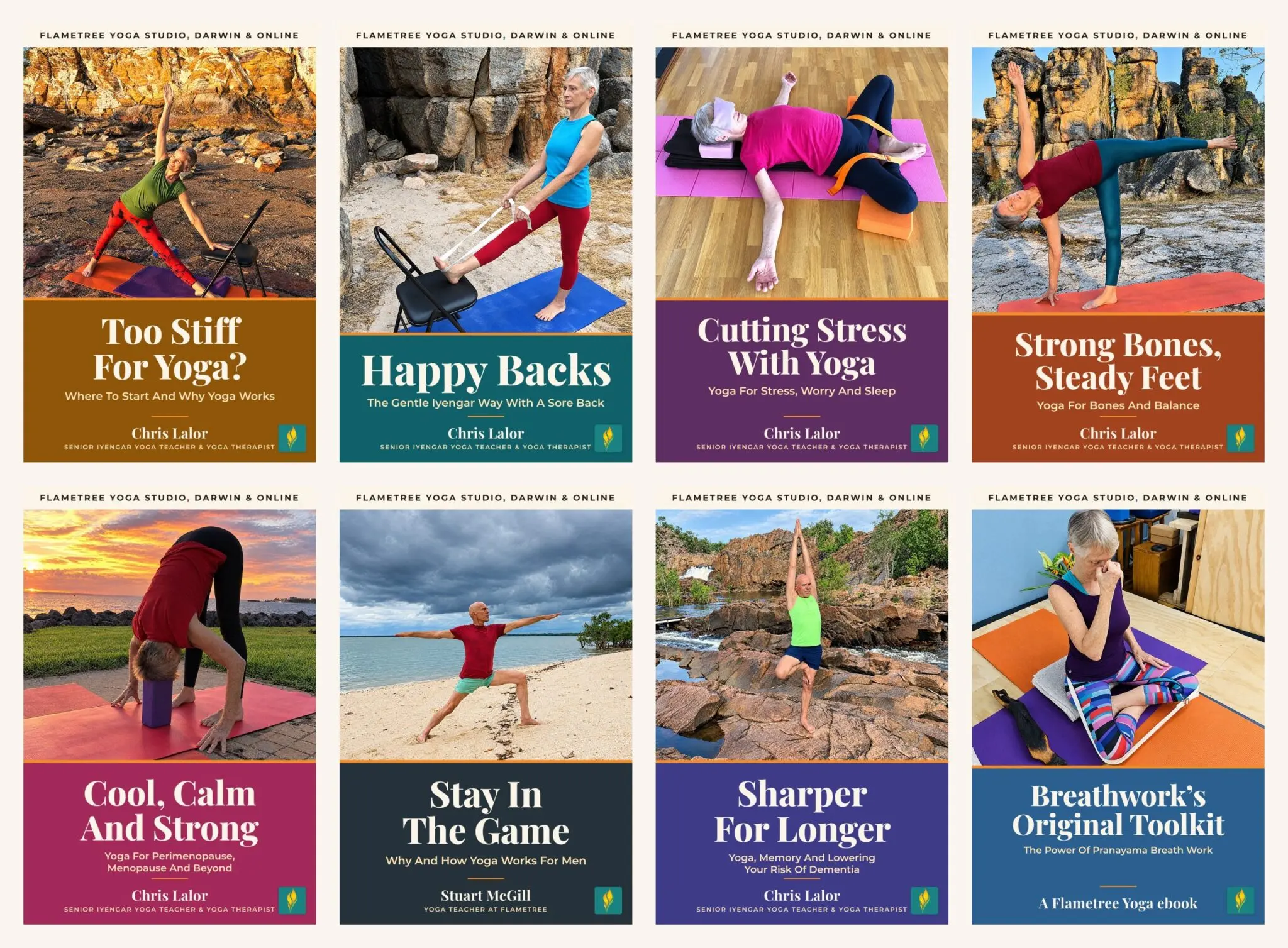
All eight free Flametree ebooks. New students choose two, with 2 free classes: Sharper For Longer is one of them.
What is the 10-second one-leg balance test?
It asks whether you can stand on one leg for 10 seconds without holding on. In a Brazilian study of 1,702 people aged 51 to 75, about one in five could not, and they were about 84% more likely to die over the next seven years or so. It is a sign, not a cause, and balance can be trained at any age.
Does loneliness raise the risk of dementia?
Yes. A 2015 review of 19 long-term studies found people with less social contact had about a 57% higher risk of dementia, and lonely people about 58% higher, about as large as the risk from physical inactivity. A weekly class with familiar faces is one simple answer.
Why does learning a new yoga pose help an ageing brain?
Learning anything changes the brain’s wiring, and older people learn yoga’s movement skills about as quickly as younger people. The gap between what you meant to do and what happened, the wobble in a new balance pose, is what switches the rewiring on. Every class brings a new pose or a new step.
Is there a 50s Plus yoga class in Darwin?
Yes. Flametree runs a 50s Plus class, along with gentle classes, pranayama classes and beginner classes, in Darwin and live online. Gentle Yoga on Fridays is the slowest class on the timetable, with chairs, walls, belts and blocks to bring every pose to you.
Where to next
- New to yoga, or coming back? Start with our half price 10 class pass with 2 classes free, in Darwin or live online.
- For a workplace, team or group: book private yoga classes for groups, online, at a Flametree studio or at your venue.
- Want to see class times first? Look at the beginner timetable.
Flametree Yoga Studio, Darwin and live online. This article is general information, not medical advice. If you notice worrying changes in memory or thinking, see a doctor promptly. Choose an advisor you trust: your yoga teacher, a yoga therapist, and your doctor if you wish.
Sources: Livingston and colleagues, the 2024 Lancet Commission on dementia (The Lancet); Dementia Australia, 2024; National Seniors Australia survey, 2024; Bhattacharyya and colleagues, review of 12 yoga studies in older adults, 2020; Chan and colleagues, review of 41 meditation and mind-body exercise studies, 2019; Eyre and colleagues, and Krause-Sorio and colleagues, UCLA yoga trials, 2017 and 2022; Lavretsky and colleagues, UCLA chanting pilot, 2013; Kuiper and colleagues, review of 19 studies on social contact, 2015; Araujo and colleagues, 10-second one-leg test, 2022; Dr Lisa Mosconi, The Menopause Brain. Full references are in the Sharper For Longer ebook.



