
Menstruation Sequence
Yoga for periods: the short answer
During a period, the Iyengar approach is to rest more: lying down, folding forward and using props, and leaving out strong standing poses, balances, backbends, twists and inversions in the first days. The poses on this page are a gentle sequence for yoga for periods, taught with bolsters, blocks, belts, chairs and a wall. They are comfort and rest poses, not a treatment. Research on exercise and period pain is encouraging but low quality, and anyone with very painful, heavy or irregular periods should see a doctor.
Every girl and woman experiences menstruation differently. Some find it a nuisance, some feel it as a time to slow down, and some have a lot of discomfort. Yoga puts you in touch with your body and your emotions, and for some women that makes the monthly cycle easier to accept and to look after.
Iyengar yoga is the style developed by Mr BKS Iyengar. In the 20th century he did more than anyone to set down traditional Indian yoga, through his books and his teaching, and he pioneered the use of props. It is sometimes called modern classical yoga, and it’s the style we teach at Flametree. This page sits in our menopause and hormone notes.
Here is the article in short form:
- Research: a 2019 Cochrane review found low-quality evidence that regular exercise may reduce period pain; a 2024 review found yoga reduced pain scores after 8 weeks.
- First days: supported lying poses and forward bends, with props, to rest.
- Standing poses: later, if energy has returned, with a wall, chair or blocks.
- Leave out: strong backbends, strong twists, balances and inversions.
- Props: bolsters, blocks, belts, chairs and a wall, so nothing is forced.
- See a doctor: for painful, heavy, irregular or changing periods.
- Next step: practise with a teacher who can adapt the sequence to you.
What does the research say about yoga and period pain?
Reviews suggest regular exercise, including yoga, may reduce period pain, though the evidence is low quality and not specific to the poses on this page.
- 2019, Cochrane review of exercise for period pain: 12 trials with 854 women. The authors found low-quality evidence that exercise, for about 45 to 60 minutes at a time, three times a week or more, may reduce period pain compared with no exercise. Yoga was among the low-intensity exercise used, with stretching and core strengthening. All the studies used exercise regularly throughout the month, and some asked women not to exercise during menstruation (Armour and colleagues, Cochrane Database of Systematic Reviews, 2019).
- 2024, network meta-analysis of 29 trials with 1,808 participants: every type of exercise, including yoga, reduced period pain after 8 weeks compared with control groups. Yoga reduced pain scores by about 2.75 points on a 10 point scale. Relaxation exercise did best in this review (Tsai and colleagues, Sports Medicine Open, 2024).
In plain words, regular movement and relaxation seem to help many women with period pain, and yoga is one way to do both. The research does not test this particular sequence, and it does not show that yoga treats period pain. What the poses below offer comes from Iyengar teaching and tradition: rest, support and calm during the days when energy is low.
What should you leave out during your period?
Leave out strong standing poses, balances, strong backbends, strong twists and inversions, at least in the first few days. This is the guidance Flametree teachers follow, and it comes from Iyengar teaching rather than from a trial.
- Standing poses: avoid them in the first few days of bleeding when energy is low. After the first few days, when your energy returns, use a wall or a chair for support.
- Balancing poses: avoid them, as balance is often affected during menstruation.
- Strong backbends and strong twists: leave them out. Supported, gentle versions are used instead.
- Inversions: strong inversions such as headstand and shoulder stand are not practised during a period in the Iyengar tradition. Supported poses are used instead, and inversions are taught again after the period. See our notes on yoga inversions and shoulder stand.
- Abdomen: in the first days use more support, so you do not compress the abdomen.
Learn to relax. Use a timer, and stay in the lying and forward poses for the length of time suggested, rather than getting up early. Props such as chairs, blocks and bolsters help you rest. If you are doing standing poses in a class, taking a foot to the wall helps with any shakiness or fatigue, and stepping out of a pose instead of jumping is a common variation. Whether you tell your teacher you are menstruating is up to you, and your teacher can offer variations if you do.
Which supported lying poses suit the first days?
Supported lying poses are the heart of the sequence, because they let you rest. They are taught with bolsters, blocks and belts so the body is held and the belly stays soft. Chris Lalor, Flametree’s Senior Iyengar Yoga Teacher, says these supine poses and forward bends settle the mind and calm the nervous system, and that, together with supported backbends, they open the chest and release tension through the back and pelvis. In her experience they also help lift a low mood. That is her teaching experience, not a trial result. Chris says her own period pain and moodiness were high, and that she always felt much better after yoga.

Reclining Bound Angle Pose (Supta Baddha Konasana), with the belt holding the legs and blocks under the knees.
A restful pose that many women find soothing in the first days. The bolster supports the back, and the belt and blocks mean the legs do not have to work. Hold about 10 minutes.

Reclining Cross Leg Pose over a bolster (Supta Swastikasana).
A simple lying pose with the legs crossed. Change the cross of the legs halfway. Hold about 3 minutes each way.

Supine Fish Pose (Supta Matsyasana), lying over a bolster with the legs crossed.
The chest opens over the bolster while the legs rest. Hold about 3 minutes with each leg crossing.

Supine Hero Pose (Supta Virasana), lying back over a bolster.
If you have knee trouble, ask your teacher for a version with more support. Hold about 5 minutes.
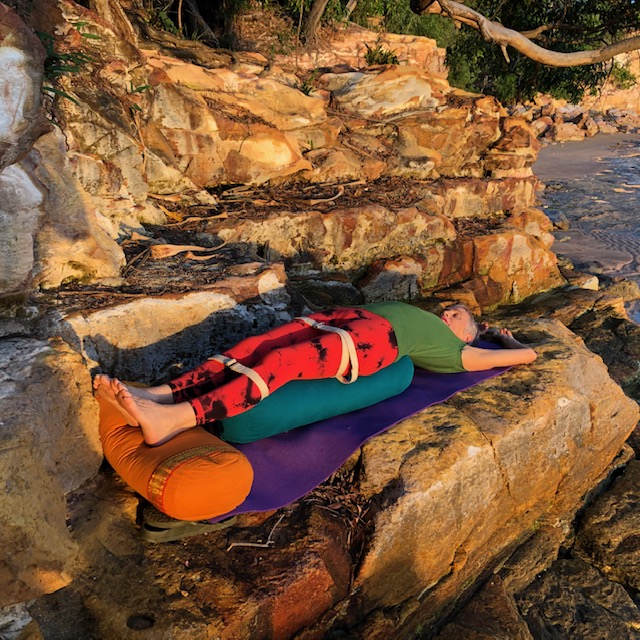
Supported Bridge Pose (Setu Bandha Sarvangasana) over bolsters.
Supported bridge is a restful pose that Iyengar teachers use instead of full inversions during a period. Lying over bolsters lets you stay for several minutes. Hold about 5 to 8 minutes.
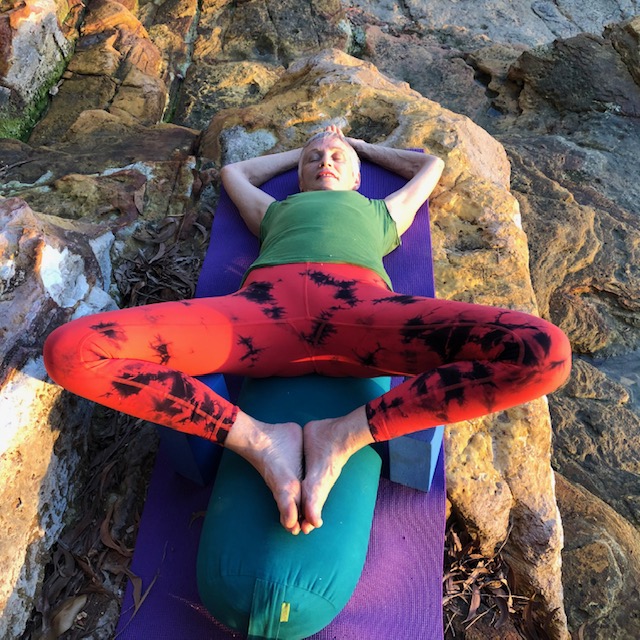
Supported Bridge Pose with the legs in Bound Angle position (Setu Bandha with Baddha Konasana).
A variation with the soles of the feet together. It is calming for many people. Hold about 5 minutes.
Which forward bends calm the mind?
Supported forward bends calm the nerves, and the bolster takes the weight of the body. In the Iyengar tradition forward bends are used to quieten the mind and the senses. Rest the trunk on a bolster so the abdomen stays soft and not compressed. In the very first days, if you feel exhausted, choose the version where the trunk is fully supported.

Forward Hero Pose (Adho Mukha Virasana).
A resting forward bend that lengthens and broadens the back. This version suits later in the cycle. Hold about 3 minutes. In the first days, ask for a version with the trunk supported on a bolster.

One Leg Hero forward bend (Triang Mukhaikapada Paschimottanasana), over a bolster.
Rest the trunk on the bolster and let the head release. Hold about 2 minutes each leg.

Head to Knee Pose with a bent knee (Janu Sirsasana), trunk resting on a bolster.
The bolster stops the belly from being squeezed. Hold about 2 minutes each side.

Cross-legged forward bend resting on a bolster.
Hold about 2 minutes each way, changing the cross of the legs.

Sage Pose I forward bend (Marichyasana I), with a bolster.
This is a forward bend only, with no twist. Hold about 2 to 3 minutes each side.

Seated Forward Bend over a bolster (Paschimottanasana).
Quietens the mind and is one of the calming poses taught for mood swings and irritability. Hold about 3 to 5 minutes.
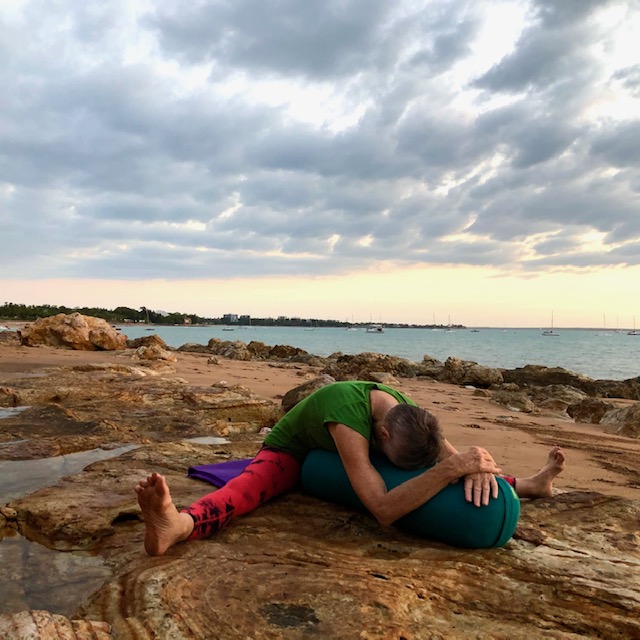
Seated Wide Angle Pose forward bend (Upavistha Konasana), over a bolster.
Widens the legs and rests the trunk. Hold about 2 to 3 minutes.
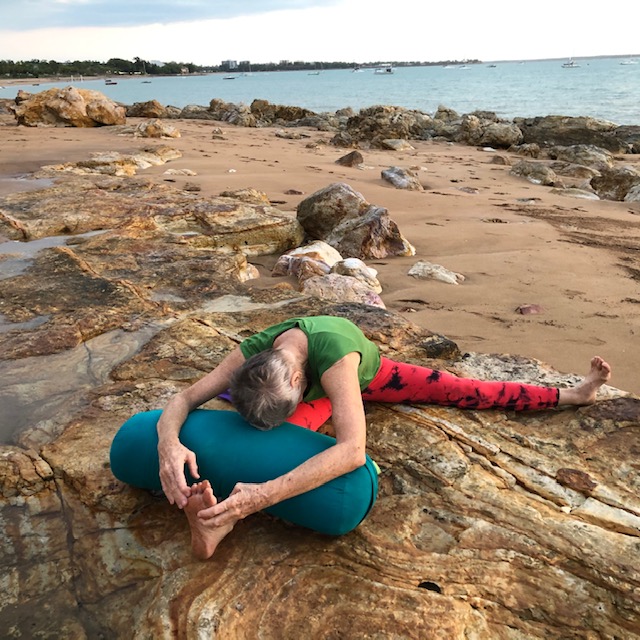
Seated Wide Angle Pose to the side (Parsva Upavistha Konasana), with a bolster.
This is a side forward bend, not a twist. Hold about 2 minutes each side.

Cross-legged forward bend with the arms resting on a chair.
The chair supports the arms and the head, so the back can relax. Hold about 2 to 3 minutes each way.
Can you do standing poses later in your period?
Yes, once your energy returns, a few supported standing poses can be added. Practise them only if you are not too fatigued. Use a wall, a chair, blocks or a rope for support. Chris shows supported versions because many women find they help with tiredness and tension. If you have access to ropes, holding a rope can help lift and open the body. Skip these poses on days when you are exhausted.
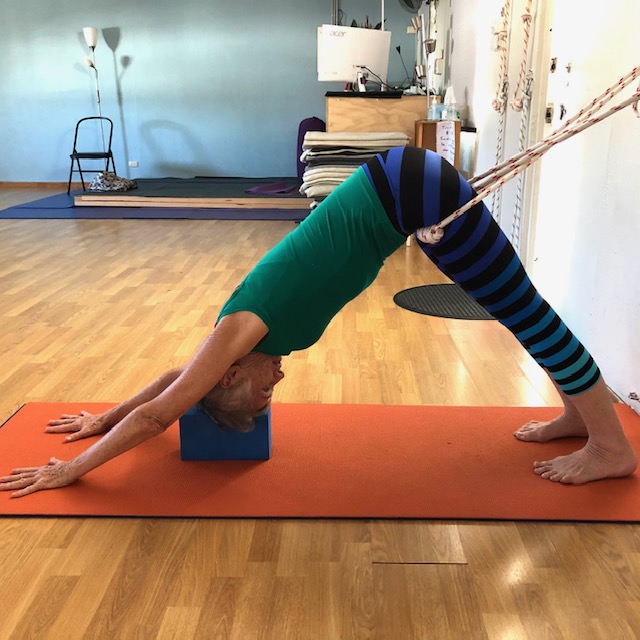
Downward Facing Dog (Adho Mukha Svanasana), with the head resting on a block and a rope around the hips.
The block under the head and the rope make this easier to hold. Hold about 2 to 3 minutes.

Intense Side Stretch (Parsvottanasana), with the hands on blocks.
Blocks keep the back long and the abdomen free. Hold briefly.

Wide Angle Standing Pose (Prasarita Padottanasana), hands on blocks with a long back.
The hands on blocks mean there is no need to fold deeply. Hold briefly.
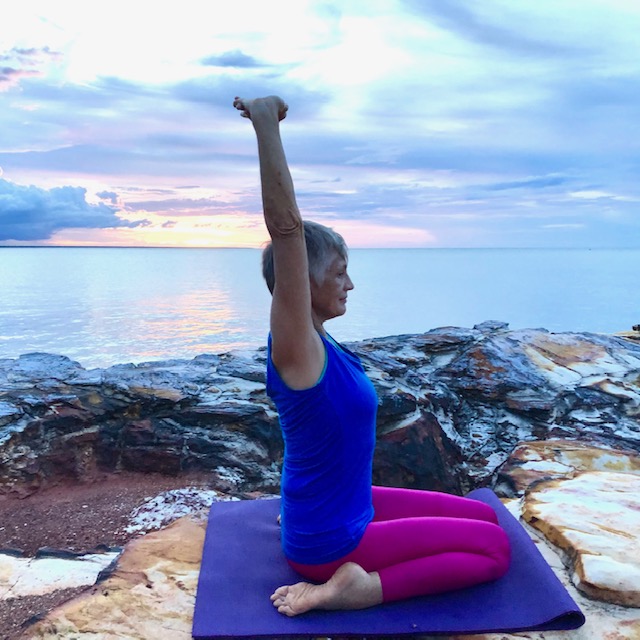
Seated Hero Pose (Virasana) with the arms stretched up.
Kneeling with the arms up can feel good if your legs are tired. Hold briefly.
Why do supported poses matter more than the poses themselves?
Props let you rest in a pose without effort, which is the point during a period. A bolster, a block, a belt or a chair means no part of the body has to hold itself up. Our note on using props in yoga explains why props are teaching tools. End a practice with a few minutes of rest in Savasana, lying on your back, for 5 to 10 minutes. When your period ends, the poses change again, and our post menstruation sequence shows what Iyengar teachers suggest after it.
When should you see a doctor about your periods?
See your doctor if your periods are very painful, unusually heavy, irregular, or have changed. Pain that stops you doing everyday things, or bleeding that soaks through protection very quickly, should be checked. Painful periods can have causes that need a diagnosis, such as endometriosis, and yoga is not a treatment for any of them. Yoga works alongside medical care, not instead of it.
For women who prefer to learn in a women-only space, our women only classes page explains how those classes work. Our menopause and hormone notes collect our other writing on hormones and the cycle.
Practise this at Flametree
Flametree Yoga Studio teaches Iyengar yoga in the studio at Woolner and Coolalinga in Darwin, and LIVE online.
- New to Flametree? Your first class is free. In the studio, just come along. Online, go to our online class list, click the class time you want and we email you the link to join.
- Beginners: new students, and anyone who has been away three months or more, can get a half price 10 class pass with 2 extra classes free, to use online, in the studio, or both. See the beginner half price pass.
- Already practising yoga? The same half price 10 class pass with 2 extra classes free, for new students and for anyone away three months or more, is also available as the non-beginner half price pass.
- See every class time, including online classes, on the timetable.
Can’t make a class? Practise at home with our video courses.
Related reading: post menstruation sequence, yoga for premenstrual lower back pain, women only classes and using props in yoga.
Yoga for periods: frequently asked questions
Which yoga poses suit your period?
Supported lying poses such as Reclining Bound Angle Pose, supported forward bends over a bolster, and Supported Bridge Pose over bolsters. These let you rest, and props mean nothing is forced. Later in the period, a few supported standing poses can be added if energy has returned.
Which yoga poses should you avoid during your period?
Iyengar teachers suggest leaving out strong standing poses, balances, strong backbends, strong twists and inversions in the first few days. This comes from teaching tradition, not from trials. Supported poses are used instead.
Why are inversions not practised during a period in Iyengar yoga?
In the Iyengar tradition, strong inversions such as headstand and shoulder stand are left out during a period, and supported poses are used instead. It is a teaching rule based on tradition, and it has not been tested in trials. Inversions are taught again after the period.
Does yoga help with period pain?
A 2019 Cochrane review found low-quality evidence that regular exercise may reduce period pain, and a 2024 review found yoga reduced pain scores after 8 weeks. Yoga is not a treatment, and painful periods should be checked by a doctor.
How long should you hold yoga poses during your period?
Supported lying and forward poses are held for several minutes, with a timer, so you can rest. Reclining Bound Angle Pose is held for about 10 minutes, and most forward bends for 2 to 5 minutes. Stop if anything hurts.
Can you do standing poses during your period?
In the first few days, when energy is low, Iyengar teachers suggest leaving them out. Once your energy returns, use a wall, chair or blocks for support, and avoid balancing poses. Skip them on days when you feel exhausted.
What props do you need for yoga during your period?
A bolster, two or three blocks, a belt, a chair and a wall cover most of the sequence on this page. At home, firm cushions and a folded blanket can stand in for some of them.
When should you see a doctor about your periods?
See a doctor if your periods are very painful, unusually heavy, irregular or have changed, or if pain stops you doing everyday things. Painful periods can have causes that need a diagnosis, such as endometriosis.
Where can I do yoga for periods in Darwin?
Flametree Yoga Studio teaches Iyengar yoga in Darwin and LIVE online, with Senior Iyengar Yoga Teacher and yoga therapist Christine (Chris) Lalor. Props are a normal part of every class, women only classes are available, and your first class is free if you are new to Flametree (in the studio, if you have lived in the NT for three months or more; online, anyone new).
This article is general information, not medical advice. The poses are comfort and rest poses, and yoga is not a treatment for period pain, heavy periods or any other condition. See your doctor about painful, heavy, irregular or changing periods. Flametree Yoga Studio, Darwin and LIVE online.
Sources (studies found through PubMed): Armour M and colleagues, Exercise for dysmenorrhoea, Cochrane Database of Systematic Reviews, 2019, doi 10.1002/14651858.CD004142.pub4. Tsai I-C and colleagues, Comparative effectiveness of different exercises for reducing pain intensity in primary dysmenorrhea: a systematic review and network meta-analysis of randomized controlled trials, Sports Medicine Open, 2024, doi 10.1186/s40798-024-00718-4. Chris Lalor’s own teaching and practice, in the Iyengar tradition.



