
GABA: The Brain’s Own Calming Chemical, And Why It Rose After An Hour Of Yoga
GABA: the short answer
GABA (gamma-aminobutyric acid) is one of the brain’s own “calm down” messengers. It works like a brake pedal inside the brain, damping down nerve cells that are firing too much. People with anxiety and low mood often have less of it, and many calming medicines work by strengthening its effect.
Brain scans at Boston University found GABA rose after an hour of yoga, and the rises went with better mood and less anxiety. Here is the article in short form:
- GABA is the brain’s brake on overactive nerve cells.
- Low GABA goes with anxiety and low mood.
- After an hour of yoga, brain GABA rose 27%.
- A quiet hour of reading did not change it.
- Iyengar yoga beat walking for mood and anxiety in Boston.
- The long out-breath and supported poses press the brake.
A quick word on Iyengar yoga. Iyengar yoga is the style developed by Mr BKS Iyengar. In the 20th century he did more than anyone to set down traditional Indian yoga, through his books and his teaching, and he pioneered the use of props. The Boston GABA trials tested Iyengar yoga. It is the style we teach at Flametree, in Darwin and live online.

A forward bend with the head resting. The body settles, and in brain scans calming chemistry follows.
What is GABA?
Your brain runs on chemical messengers. Some rev nerve cells up; GABA calms them down. When the balance tips towards too little calming, the mind races, the body stays tense and sleep comes hard. That is why GABA turns up so often in conversations about anxiety, sleep and stress.
Many people meet the word on a supplement bottle. Whether swallowed GABA reaches the brain is debated. The more interesting question is whether the brain can be helped to make and use more of its own.
How do you increase GABA naturally?
One of the best answers so far is yoga. In 2007, Dr Chris Streeter’s team at Boston University scanned the brains of experienced yoga practitioners before and after an hour of yoga, and of a group who read quietly for an hour. After yoga, GABA rose about 27%. In the reading group, it did not change.
Then they ran a proper trial. In 2010, healthy adults did 12 weeks of Iyengar yoga or walking, matched for effort, three times a week. Brain scans measured GABA in the thalamus (a relay station deep in the brain). After a yoga session, GABA rose, and bigger rises went with better mood and less anxiety. The yoga group’s mood improved more, and their anxiety fell more, than the walkers’.

Stress, worry, low mood and sleep have all been tested. Yoga moved each of them the right way.
Is low GABA linked with anxiety?
Yes. People with anxiety and low mood often have less GABA, and many calming medicines work through it. That is what makes the Boston results so interesting: a natural practice moved the same system.
The same team then took Iyengar yoga to people with major depression. In a 2017 Boston University trial, 27 of the 30 adults who finished 12 weeks of Iyengar yoga and slow breathing scored below the depression cut-off.
I know the anxious mind from the inside. My mother worried too much, and passed a lot of it on to me. If I miss my practice, I feel more anxious almost straight away. Then I get back on my mat in some of the easy, calming poses, and the anxiety goes back in its box.

The same Boston team took Iyengar yoga to people with depression. 27 of 30 who finished ended below the cut-off.
Get the free ebook Cutting Stress With Yoga. New to Flametree, or away for 3 months or more? You get 2 free classes + 2 ebooks, only available via this offer. Already coming to class? You can still get the book.
What does a yoga class do to press the brain’s brake?
Several things, in order. A class starts standing, and standing poses use up nervous energy. Then come forward bends with the forehead supported, which quieten a busy head in the Iyengar tradition. Supported inversions such as Legs Up The Wall cool and settle the system. Last comes Corpse Pose (Savasana), where you learn to let go, first in the body, then the nerves, then the mind.
The breath runs through all of it. Each breath in speeds the heart a little; each breath out slows it. “The proper rhythmic pattern of slow, deep breathing soothes the nerves, and checks emotional excitement,” Mr Iyengar said.
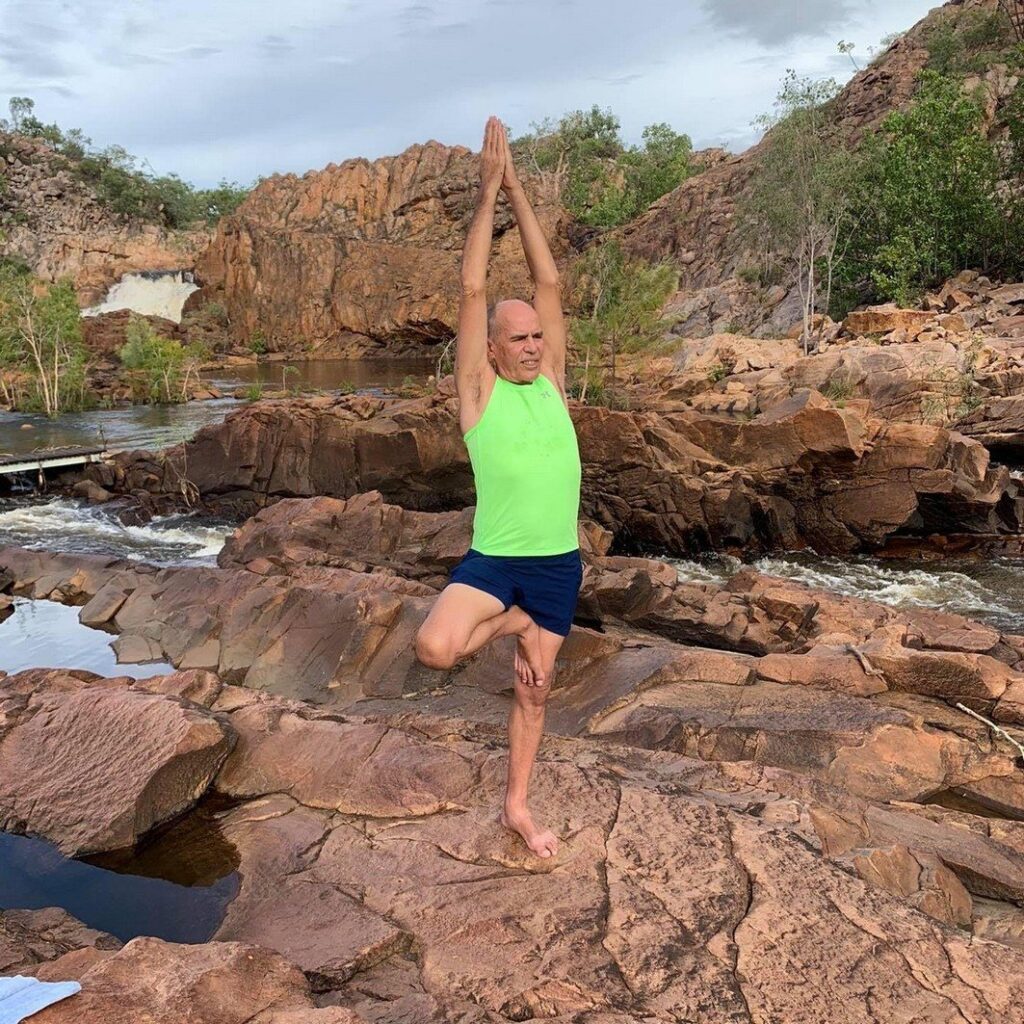
Standing poses use up nervous energy first. Then the quiet poses do their work.
Is GABA the whole story?
No, and it does not need to be. The body shows calm in many ways at once. A 2017 review of 42 studies linked yoga poses with lower cortisol, lower blood pressure and a slower resting heart rate. GABA is one more measure pointing the same way: the calm people feel after class is real and measurable in the body, not just a feeling.

Alternate nostril breathing, one of the slow pranayamas taught in our classes. The slow out-breath is the body’s brake.

Calming brain chemistry is in the still-being-studied column. The calm itself is known from long practice.
Where can I do yoga for calm in Darwin?
For a calmer brain in Darwin, come to class at Flametree’s Woolner or Coolalinga studio, or join live online from anywhere in Australia. Any beginner class works on the brake, and our pranayama, gentle and restorative classes are especially good for anxiety and sleep. Feel free to check with your professional advisers if you wish, but also give yoga a try.
See also How To Lower Cortisol, Yoga For Anxiety and How To Calm Your Nervous System.

Cutting Stress With Yoga, our free ebook on stress, worry and sleep.
Your free copy of Cutting Stress With Yoga is waiting. New to Flametree, or away for 3 months or more? You get 2 free classes + 2 ebooks, only available via this offer. Already coming to class? You can still get the book.
Frequently asked questions
What does GABA do in the brain?
GABA is one of the brain’s main calming messengers. It damps down nerve cells that are firing too much, a little like a brake pedal. Too little calming goes with a racing mind, tension and trouble sleeping.
Can yoga increase GABA?
In Boston University brain scans, GABA rose about 27% after an hour of yoga, and did not change after an hour of reading. In a 12-week trial, GABA rose after Iyengar yoga sessions, and bigger rises went with better mood and less anxiety.
Is yoga better than walking for GABA and mood?
In the 2010 Boston trial, healthy adults did 12 weeks of Iyengar yoga or walking, matched for effort. The yoga group’s mood improved more and their anxiety fell more, and their brain GABA rose after sessions.
Do GABA supplements work?
Whether swallowed GABA reaches the brain is still debated. Yoga works the other way round: it helps the brain’s own calming system, and in Boston brain scans GABA rose after yoga sessions.
What foods or habits raise GABA naturally?
The best studied habit is practice that calms the body: in brain scans, yoga raised GABA after sessions. Slow breathing, good sleep and regular rest all support the same calming side of the nervous system.
How long after yoga does GABA rise?
In the Boston studies, GABA was measured straight after a yoga session and was already higher. Over 12 weeks of regular classes, mood and anxiety improved along with those rises.
Does low GABA cause anxiety?
Low GABA goes with anxiety and low mood, and many calming medicines work through it. It is one part of a bigger picture that also includes stress hormones, sleep and the breath, all of which yoga works on.
Where can I do yoga for a calmer mind in Darwin?
Flametree Yoga Studio teaches Iyengar yoga at Woolner and Coolalinga in Darwin and live online. Any beginner class works on the body’s brake, and our pranayama, gentle and restorative classes are especially good for anxiety.
Where to next
- New to yoga, or coming back? Start with our half price 10 class pass with 2 classes free, in Darwin or live online.
- For a workplace, team or group: book private yoga classes for groups, online, at a Flametree studio or at your venue.
- Want to see class times first? Look at the beginner timetable.
Flametree Yoga Studio, Darwin and live online. This article is general information, not medical advice. Feel free to check with your professional advisers if you wish, but also give yoga a try.
Sources: Streeter CC and colleagues, Yoga asana sessions increase brain GABA levels: a pilot study, Journal of Alternative and Complementary Medicine, 2007; Streeter CC and colleagues, Effects of yoga versus walking on mood, anxiety, and brain GABA levels (34 adults), Journal of Alternative and Complementary Medicine, 2010; Streeter CC and colleagues, Treatment of major depressive disorder with Iyengar yoga and coherent breathing, Journal of Alternative and Complementary Medicine, 2017; Pascoe MC and colleagues, 42-study review of yoga and stress measures, Psychoneuroendocrinology, 2017; BKS Iyengar, Light on Pranayama. Further reading: Streeter and colleagues, 2010. Full references are in the Cutting Stress With Yoga ebook.



