
“Fuzzy Thinking” From Menopause Is A Good Reason To Consider An In-Studio Or Online Course For Yoga
Online course for yoga: the short answer
Men and women have the same brains. In other words, there’s no such thing as a “gendered brain”. But at certain stages of life, women’s brains do differ from men’s in some respects. Neuroscientist Dr Lisa Mosconi and her team studied how the brain changes across menopause, and some women notice what they call “fuzzy thinking” along the way. It is one reason some women look at an online course for yoga, or a studio class, as a steady, kind routine. Here is what that research found, what is not yet known, and what a yoga course can and cannot offer.
Iyengar yoga is the style developed by Mr BKS Iyengar. In the 20th century he did more than anyone to set down traditional Indian yoga, through his books and his teaching, and he pioneered the use of props. It is sometimes called modern classical yoga, and it’s the style we teach at Flametree. This page sits in our brain and ageing notes.
Online course for yoga: this article in short form
- The research: a 2021 brain imaging study found differences across menopause stages.
- The good news: after menopause, brain measures largely settled, and some grey matter recovered.
- What yoga did in trials: 12 studies, 912 older adults: better memory, planning, focus and attention.
- Fuzzy thinking: common in menopause, and for most women temporary.
- What yoga offers: a regular, calming practice, which many students say helps sleep and stress.
- The course idea: a pass of classes, online, in the studio, or both.
- Next step: your first class is free if you’re new to Flametree.
For a wider look at the brain, see our note on yoga for brain health, and for the symptoms women ask about most, yoga poses for menopause hot flashes.

A forward bend with support lengthens the back of the legs.
Free ebook: Sharper For Longer. Why two in three people with Alzheimer’s are women, why midlife is the time to act, and what yoga works on.
New to Flametree, or away 3 months or more? 2 free classes + 2 ebooks, only available via this offer. Already a student? You can still get this book. Get your free copy of Sharper For Longer
Men and women’s brains age differently
In her TED Talk, Dr Mosconi described how the reproductive hormones and the brain are linked. As women enter menopause, estrogen falls. Estrogen is important for reproduction, and it also plays a part in how the brain uses energy.
Menopause brings symptoms such as hot flushes, night sweats, poor sleep, memory lapses, low mood and anxiety. In her view, the brain and the ovaries “talk to one another” every day, so many of these symptoms involve the brain.
What did the 2021 study find?
Mosconi and colleagues published a brain imaging study in Scientific Reports in 2021, “Menopause impacts human brain structure, connectivity, energy metabolism, and amyloid-beta deposition”. They found differences in brain structure, connectivity and energy metabolism across the stages of menopause.
They also found that brain measures largely stabilised after menopause. Grey matter volume recovered in key regions, and this was linked with preserved cognitive performance. Amyloid-beta deposition, a marker linked to Alzheimer’s disease, was more pronounced in women who carry the APOE-4 gene variant.
In plain terms, the brain changes during the menopause transition, and then, on average, settles. That may be why “fuzzy thinking” is often described as temporary. The study is a good reason to look after yourself through the transition, not a reason to be afraid.
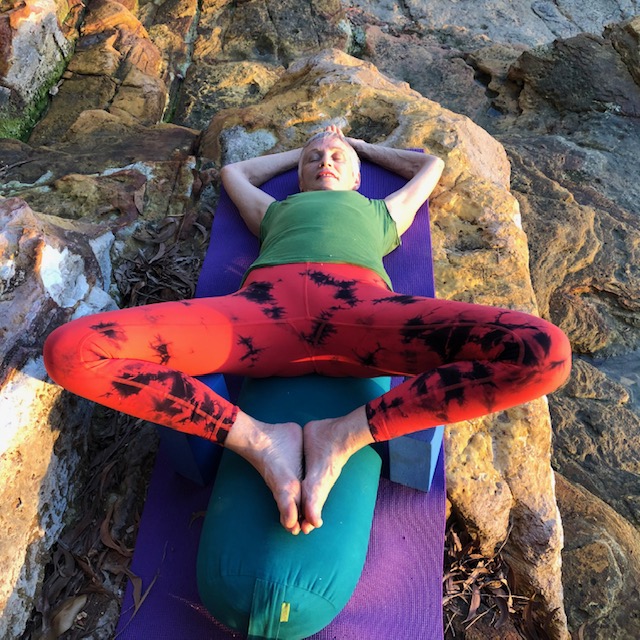
Bound angle pose with support opens the hips without strain.
Impact of male and female hormones
For men, testosterone declines more slowly over a lifetime. Dr Mosconi’s talk made the point that midlife is often a bigger shift for women, with a rapid change in hormones over a few years. We can’t say from this study how it compares with men’s brains, because it studied women.
Women have a higher rate of Alzheimer’s disease
Dr Mosconi has said that women make up a larger share of Alzheimer’s cases than men, and that the conditions for it may begin to form in midlife. Having menopause does not mean you will get dementia.
She also says that lifestyle matters, such as exercise, rest and reducing stress, and that women are attentive to their own wellness. Those are things anyone can work on, with support.

A chair and bolster take the effort out of resting.
Using lifestyle for better brain health
Dr Mosconi gives a number of tips on how women can use lifestyle to support their brain health. These include:
- eating a diet rich in phytoestrogens (compounds that occur naturally in plants), such as the Mediterranean diet;
- exercising;
- getting plenty of sleep;
- reducing stress.
How can an in-studio or online course for yoga support brain health?
By helping you do some of those things, regularly. Yoga covers most of that list in one practice. And it works on thinking directly: in a 2020 review of 12 studies in 912 older adults, yoga improved memory, planning and focus, and attention. Look at the list above:
- Exercise: yoga is exercise, and it can be adapted for women before, during and after menopause;
- Sleep: many students tell us they sleep better. Our post on yoga for improved sleep has more;
- Stress: slow, supported poses and breathing are a way to settle, as in how to calm your nervous system;
- Mindfulness: paying attention to your body and breath can make it easier to notice how you eat, and when;
- Routine: yoga can be done in-studio or with an online course, or both, at home, in lunch hours or out-of-work time.
On the wider menopause research, a 2024 review of 24 randomised trials (Wang and colleagues) found yoga improved menopausal symptoms, sleep quality, anxiety and low mood.
Other ways yoga may help
Students and teachers describe benefits like these:
- A yoga practice grounds the body and mind in the present.
- It can give a way to see brain fog as a phase you are passing through, not a fixed state.
- It can help you meet mood swings with more patience.
- It makes us more mindful of the way we live and how our choices feel in the body.
- Through practice we see that change is possible. Even small changes add up.

Standing balance builds leg strength and focus.
Brain fog and memory: what is known
“Fuzzy thinking” in menopause is common, and often temporary. The 2021 study suggests why it may settle. But it is not the only possible cause of foggy thinking. Poor sleep, stress and low mood can also play a part.
Yoga works on all three, and on attention itself. Read more in how to improve concentration and how to improve memory after 50. Tell your teacher before class so they can adapt the poses for you. Feel free to check with your professional advisers if you wish, but also give yoga a try.
Choosing yoga that balances your two nervous systems
If you’re not yet doing yoga, consider in-studio yoga, or an online course for yoga. Many students find it calming.
Some poses are energising and work through the sympathetic, or “fight or flight”, nervous system. Others, such as the supported poses we do towards the end of an Iyengar class, are quietening, and many people feel the “rest and digest” side of the nervous system come forward.

Support lets the back release without any strain.
The importance of good quality yoga
One reason to choose Iyengar yoga is that it includes many restful poses with props, and places a lot of emphasis on getting into each pose well, so you get the full effect of the pose. Lying-down poses, forward bends and supported shoulder stands are often taught towards the end of class, and many students say they sleep better afterwards.
Whatever style you choose, tell the teacher about your health conditions and any injuries. For menopause, you can read more in our menopause post and in yoga for pelvic floor.
Poses for “fuzzy thinking” are part of in-studio or an online course for yoga
Many students find supported forward bends and gentle inversions clear the head and calm the mind. Inversions are not for everyone, so tell your teacher before class.
Dr Mosconi says many women feel they are going slightly “crazy” during menopause. A regular practice can help women see this as a phase they are going through, and find a way to deal with stress, which is important for brain health.

The “Downward Dog” pose is a simple inversion, with head below heart.
What is an online course for yoga?
An online course for yoga is a set of classes you take on a regular schedule over some weeks, so you build skill step by step. At Flametree, online classes are taught LIVE in real time from the Darwin studio, so the teacher can see you and help you. You can take them from home, with a few simple props, and a pass covers online classes, studio classes, or both.
If you have no props, a firm chair, a folded blanket and a belt will do to start. Flametree also has a home props pack.

Chairs take the strain out of difficult poses.
Practise this at Flametree
Flametree Yoga Studio teaches Iyengar yoga in Darwin and LIVE online, with Christine (Chris) Lalor, Senior Iyengar Yoga Teacher. Newcomers get a free first class (for the studio, you need to be an NT resident of three months or more; online, anyone new). New students, and students who have been away three months or more, can also get a half price 10 class pass with 2 extra classes free, to use online, in the studio, or both. To join an online class, click the class time you want on the class list and we email you the link to join.
- New to yoga? See the beginner half price 10 class pass, for new and lapsed students.
- Already practise? See the half price 10 class pass for non-beginners, for new and lapsed students.
- Want to see class times? Open the timetable, including online classes.
Read more in our free ebook, Cool, Calm And Strong. Yoga for perimenopause, menopause and beyond: flushes, sleep, leaks and bones.
2 free classes + 2 ebooks, only available via this offer, for new students or anyone away 3 months or more. Current students can still get the book. See what’s inside and get your copy
Online course for yoga: frequently asked questions
What is an online course for yoga?
It is a set of yoga classes taken online on a regular schedule, so you build skill step by step. At Flametree the online classes are taught live in real time from the Darwin studio, so the teacher can see you and help you.
Can a beginner start an online course for yoga?
Yes. Flametree’s beginner classes are for any age, size or fitness level, and you can start at any time. Tell your teacher about any injuries or health conditions.
Do I need props for an online yoga course?
Not to start. A firm chair, a folded blanket and a belt will do, and your teacher can show you how to use what you have. Flametree also has a home props pack if you want to buy a set.
Where can I do an in-studio yoga course in Darwin?
Flametree Yoga Studio teaches Iyengar yoga in Darwin at Woolner and Coolalinga, and live online. Your first class is free if you are new to Flametree.
Is brain fog in menopause real?
Many women report foggy thinking or memory lapses in the menopause transition. A 2021 brain imaging study by Mosconi and colleagues found differences in brain structure, connectivity and energy metabolism across menopause stages, and that measures largely stabilised after menopause.
Is menopausal brain fog permanent?
For many women it seems to settle. In the 2021 Mosconi study, grey matter volume recovered in key regions after menopause, and this was linked with preserved cognitive performance.
Can yoga help with brain fog?
Yes. In a 2020 review of 12 studies in 912 older adults, yoga improved memory, planning, focus and attention. Many students say a regular practice also helps them feel calmer and sleep better, which makes thinking feel clearer.
Which yoga poses suit women in menopause?
Gentle, supported poses with props, such as forward bends over a chair and restful lying-down poses, suit many women. Tell your teacher about your health conditions, and ask before trying inversions.



