
Yoga For Pressure Sores: What Mr Iyengar, The Yoga Doctors And The Research Say
By Chris Lalor, Certified Senior Iyengar Yoga Teacher and Certified Yoga Therapist, and Dr Stuart McGill, Yoga Teacher, Flametree Yoga Darwin
Changing position, padding bony points and sitting well are the everyday basics of pressure care, and they are skills Iyengar yoga practises in every class. Whether you spend long hours in bed or a wheelchair, are recovering from surgery, or care for someone who does, this guide brings together what Mr BKS Iyengar, Dr Timothy McCall and the research say about yoga for pressure sores (also called pressure injuries, pressure ulcers or bed sores), including pranayama (yogic breathing), meditation and mindfulness. Last updated: 8 November 2026.
Get 2 Free Yoga Classes And 2 Free Ebooks
Yoga for pressure sores: the short answer
No trial has yet tested yoga for pressure sores. What we have is one Iyengar case report, and it is a striking one: props were used to reposition a woman who could not be moved off two painful sores, her pain eased, and both sores closed within three weeks. Around it sits a larger body of research that is not about yoga: changing position is standard pressure care, wheelchair users who move more in the seat are more often free of sores, and in trials on other wounds, relaxation and guided imagery went with better wound repair. Yoga for pressure sores works on those same things: movement, supported positions with padding, sitting well, skin awareness and a calmer body. It sits alongside nursing and medical care, never in place of it.

Supported lying in an Iyengar class: a bolster under the knees, a blanket under the head. Props spread the body’s weight over a wider area.
Overall evidence: Not yet tested
No yoga, pranayama or meditation trial has been done yet for pressure sores. What this guide sets out is known from practice, with one case report. Not yet tested is not the same as does not work.
Nearest study (case report): Ribeiro 2015, an Iyengar yoga therapy case report: a woman with motor neurone disease (ALS) had two painful pressure sores on her sitting bones, and could not be moved off them because lying down made her breathless. Props were used to change how she sat so the sores no longer took her weight. Her pain eased and both sores closed within three weeks. One person, not a trial.
That case report is Iyengar yoga therapy, given by a trained teacher, and it is the only yoga paper on pressure sores we have found. The other yoga studies mentioned below tested yoga in general, not Iyengar yoga. In our view as certified Iyengar teachers, the precise use of props to place and support the body is exactly what pressure care asks for. Why the kind of yoga matters.
The bottom line: five key moves for yoga with pressure sores
- Move often. Change position, or shift your weight, through the day. Pressure relief lasts only while you are off the spot.
- Pad and support. Bolsters, folded blankets and cushions spread the weight, and keep heels, the tailbone and the sitting bones free.
- Sit tall and even. Weight across both sitting bones, the spine long, so no one spot takes the load.
- Breathe slowly and notice your skin. A calm breath settles the body, and awareness helps you feel when it is time to move.
- Start now. New to Flametree, or away 3 months or more? 2 free classes, then 10 at half price, in Darwin or LIVE online.
Five Key Moves For Yoga With Pressure Sores
1. Move often
Shift your weight through the day.
2. Pad and support
Bolsters and blankets spread the load.
3. Sit tall and even
Both sitting bones, spine long.
4. Breathe and notice
A calm breath, an aware skin.
5. Start now
2 free classes, then 10 at half price.
Yoga for pressure sores in five moves: movement, padding, posture, breath and a start.
Who was Mr BKS Iyengar? Iyengar yoga is the style we teach at Flametree. During the 20th century, Mr BKS Iyengar was the major teacher who codified traditional Indian yoga, through his seminal books and widespread teaching. He also pioneered the use of props, so poses can be adapted to almost any body, including a body that cannot move much on its own. His style is sometimes called modern classical yoga. This guide is part of our encyclopaedia of yoga for health conditions.

Seated on a chair, a belt around the back helps the student sit tall, weight even across both sitting bones.
This guide in short
- Overall evidence: Not yet tested. Nearest study (case report): Ribeiro 2015, an Iyengar yoga therapy case report: a woman with motor neurone disease (ALS) had two painful pressure sores on her sitting bones, and could not be moved off them because lying down made her breathless. Props were used to change how she sat so the sores no longer took her weight. Her pain eased and both sores closed within three weeks. One person, not a trial.
- Mr BKS Iyengar: we have found nothing he wrote on pressure sores themselves. He built props into yoga so the body is placed and supported with care, and taught close attention to the skin.
- Dr Timothy McCall, an American medical doctor and yoga therapist who studied with Mr BKS Iyengar, author of Yoga as Medicine: Pressure Ulcers (no. 92) are on his list of conditions helped by yoga, resting on the Iyengar case report above.
- The research that is not yoga: repositioning is standard care, though trials comparing schedules are uncertain; wheelchair users who move more in the seat are more often free of sores; relaxation and mindfulness went with better wound repair in other wounds.
- For carers: yoga lowered anxiety, low mood and stress in carers across 12 studies.
- Take it further: our free ebook Too Stiff For Yoga?, the 2027 masterclass on rest that actually restores, and classes in Darwin and online.
Yoga For Pressure Sores On One Page
Mr BKS Iyengar
Props place and support the body.
Dr Timothy McCall
No. 92 on his list.
Iyengar case report
Props eased pain; two sores closed.
Not yoga
Movement and position changes matter.
Yoga for pressure sores at a glance. Each source is set out in full below.
What is a pressure sore?
A pressure sore is damage to the skin, and the tissue under it, from pressure, or pressure with a dragging force (shear), that goes on too long in one place. It usually forms over a bony point. A Cochrane review names the known risks: not being able to move, poor nutrition, and reduced feeling in the skin. The names change from place to place: pressure injury is the term Australian hospitals use, pressure ulcer is common in research, and bed sore is the everyday word.
Where it forms depends on how you lie or sit. In an Australian study of 388 people with severe pressure injuries from four hospitals, the heels were the most common site, in more than half. Lying on the back loads the heels, the tailbone and the shoulder blades. Sitting loads the sitting bones and the tailbone. Lying on the side loads the hip, the knees and the ankles.
Where pressure falls
Where Pressure Falls In Each Position
Lying on your back
Heels, tailbone, shoulder blades.
Sitting
Sitting bones and tailbone.
Lying on your side
Hip, knees and ankles.
Common pressure points for pressure sores. In one Australian study, heels were the most common site.
Pressure sores in Australia
The Australian Commission on Safety and Quality in Health Care counted 4,313 pressure injuries that began in Australian public hospitals in 2015-16, about 9.7 for every 10,000 hospital stays. That counts only injuries that started in a public hospital, so it leaves out aged care, home and private hospitals. A 2022 Australian cost study worked from an estimate that 12.9% of public hospital patients have a pressure injury, and put the cost at $9.11 billion a year. In the four-hospital study above, people with severe pressure injuries stayed in hospital for 56 days on average.
Pressure Injuries In Australian Hospitals
4,313
pressure injuries began in Australian public hospitals in 2015-16.
Australian Commission on Safety and Quality in Health Care. Hospital only, so the true number is higher.
How a pressure sore starts
Pressure, Blood Flow And Skin
One position
Weight stays on a bony point.
Pressure
Blood vessels are squeezed.
Less blood flow
Skin and tissue go short.
Breakdown
The skin starts to give way.
↻ Moving, padding and supported positions take the pressure off, so blood can return.
A simplified picture of how a pressure sore starts, drawn from the wheelchair studies below.
Who is at risk, and where yoga fits
Pressure sores come with anything that keeps a person still or dulls the feeling in the skin: spinal cord injury, motor neurone disease, muscular dystrophy, post-polio syndrome, stroke, multiple sclerosis, diabetes with numb feet, a long stay in hospital, or the weeks after surgery. Older age, fractures and other illness were linked with more severe injuries in the Australian study.
Yoga cannot take the place of nursing care, a good mattress or cushion, or medical care for a sore. What it can do is teach the skills that pressure care relies on: moving often and with less effort, placing the body with props, sitting tall and even, noticing the skin, and calming the body and mind. For carers, it is time to look after their own back, breath and stress.
What Yoga Can And Cannot Do For Pressure Sores
Yoga can
Teach regular, easier movement.
Pad and support with props.
Help you sit tall and even.
Build skin awareness and a calm breath.
Support carers.
Yoga cannot
Replace nursing care.
Replace a pressure-relieving mattress or cushion.
Replace medical care for a sore.
Yoga for pressure sores works alongside pressure care, never in place of it.
“Take each pore of the skin for a conscious eye.”
Mr BKS Iyengar
In short: we have found nothing Mr Iyengar wrote about pressure sores themselves. Two parts of his teaching go to the heart of them. The first is props: blankets, bolsters, belts, blocks, chairs and the wall, used to place the body exactly and to support it, so even a person who cannot hold a pose can rest in one. The second is attention to the skin. He taught students to feel the skin as a sense in its own right, everywhere in the body, and to notice where weight falls.
Both came together in the one yoga paper on pressure sores. Subbappa Ribeiro, of the BKS Iyengar Yoga Center of the Willamette Valley in Oregon, USA, worked with a woman with motor neurone disease whose sores sat right where she sat. She could not be moved to lie down, because lying made her breathless. So props were used to change how she sat, until the sores no longer took her weight. That is Iyengar yoga therapy: the pose, and the support, shaped to the person.
“Do you teach a child to run as soon as it is born? You allow the child to have support whether it can stand or not.”
Dr Timothy McCall
In short: Pressure Ulcers are no. 92 on Dr McCall’s June 2019 list of 117 health conditions helped by yoga. The study behind that line is the Iyengar case report above (Ribeiro 2015), a single case. In the introduction to that list he explains that yoga therapists work with the person, not the diagnosis: they help people de-stress, breathe more efficiently, calm the nervous system and sleep better. The pressure sore case shows the same idea: the support was shaped to the woman in front of the teacher.

Supported lying with the calves on a chair. The heels hang free, so they take no weight.
“Props benefit in two ways; one is extension and the other is relaxation, taking place at the same time.”
What the research shows on yoga for pressure sores
The research is set out in groups: Iyengar yoga, yoga in general, breathing and pranayama, meditation and relaxation, and then the research on movement and sitting that is not yoga, labelled as such. Studies of yoga in general are not studies of Iyengar yoga. Why the kind of yoga matters.
The research at a glance
Yoga For Pressure Sores: The Research At A Glance
Iyengar yoga
One case report: pain eased, two sores closed.
Yoga in general
No pressure sore trial. Chair yoga was safe.
Breathing
No trial yet.
Relaxation and mindfulness
Better repair in other wounds.
Yoga for pressure sores is not yet tested. Not yet tested is not the same as does not work.
Iyengar yoga
One case report, Iyengar yoga therapy given by a trained teacher.
- Props used to reposition a woman with motor neurone disease eased the pain of two pressure sores, and both closed within three weeks. Ribeiro 2015, a case report. She had become immobile for a year, and the sores were on her sitting bones, where she sat. Ointment and morphine had not controlled the pain, and moving her to lie down or on her side worsened her breathlessness. A new way of aligning her with props took the weight off the sores. The authors call for more study. The study on Dr McCall’s list. Read the study.
Yoga in general
No trial has tested yoga for pressure sores. Two studies of yoga in people with limited movement show it can be adapted and done safely. These were yoga in general, not Iyengar yoga.
- Chair-based yoga was safe for older adults with several long-term conditions, and pain scores were better, though overall quality of life did not differ. Tew and others, 2024, a randomised trial of 454 people aged 65 and over in England and Wales, 12 weeks of a gentle chair-based programme. No serious related problems. Read the study.
- A man with a spinal cord injury in the neck improved his balance, flexibility, posture and strength with adapted yoga. Moriello and others, 2015, a case report: 60-minute sessions twice a week for 12 weeks, poses modified to suit him. Read the study.

Kim in a supported seated forward bend, the chest resting on a bolster on a chair. Leaning forward also lifts weight off the tailbone.
Breathing and pranayama
No trial has tested pranayama or breathing practice for pressure sores. Not yet studied is not the same as not working. Breathing comes into pressure care through rest, pain and stress, which the next group covers.

Sitting on a bolster with the attention on the breath. The bolster raises the hips and spreads the weight.
Meditation, mindfulness and relaxation: other wounds, not pressure sores
Stress is known to slow wound repair. These trials asked whether calming the mind changes that. They tested relaxation, guided imagery and a mindfulness course, not yoga, and none looked at pressure sores. They still count for our classes, because a good yoga and pranayama class builds the same calm.
- Across 19 randomised trials, psychological approaches favoured better wound repair, especially relaxation. Robinson and others, 2017, a review of trials in experimental, surgical, burn, fracture and ulcer wounds. The results were too mixed to pool, and some negative studies may not have been published. Read the study.
- A short relaxation and guided imagery session lowered stress and increased healthy new tissue in surgical wounds. Broadbent and others, 2012, a randomised trial of 60 people having gallbladder surgery: one 45-minute session, then recordings for 3 days before and 7 days after. Read the study.
Calm And Wound Repair
19 trials
of relaxation and other calming approaches favoured better wound repair.
Robinson 2017. Other wounds, not pressure sores, and not yoga: a lead worth following.
- Relaxation sessions went with more healing of diabetic foot ulcers than no sessions. Pereira and others, 2025, a pilot randomised trial of 69 distressed people with chronic diabetic foot ulcers: muscle relaxation, hypnosis, neutral sessions or no sessions. Read the study.
- An 8-week mindfulness course did not change overall wound repair, but people whose mindfulness rose most had faster skin barrier recovery. Meesters and others, 2018, a randomised preliminary study of 49 adults with standard skin blisters made on the forearm. Read the study.
- Relaxation with guided imagery was workable and well liked by people with diabetic foot ulcers, and lowered stress. Ferreira and others, 2023, a pilot randomised trial of 54 distressed people. Read the study.
“Nothing pertaining to pranayama can be forced. That is why it teaches humility.”
Movement, repositioning and sitting: not yoga
This is the research behind everyday pressure care. It is not about yoga, but it shows why the skills yoga practises matter.
- Changing position is standard pressure care, but trials comparing how often to turn people are very uncertain. Latimer and others, 2026, a Cochrane review. Turning every 2 hours or every 4 hours made no clear difference (4 trials, 1,104 people, very low certainty). In 1,226 intensive care patients, wearable sensors that reminded staff to turn people cut pressure injuries (moderate certainty). Most evidence was low or very low certainty. Read the study.
- Wheelchair users who moved more in the seat were more often free of pressure sores. Sonenblum and others, 2024, an observational study of 50 wheelchair users with spinal cord injury or disease. The share of seated time spent moving was the one predictor a person could change. Read the study.

A seated forward bend with the head resting on a support. Leaning forward moves weight off the tailbone.
- Pressure relief works only while it lasts, so it needs to be frequent and long enough for blood flow to return. Oette and others, 2023, seat pressure measured in 34 wheelchair users with spinal cord injury over 90 minutes. Read the study.
- In wheelchair users who could not shift their own weight, the area of highest pressure grew over 90 minutes; in those who could, it did not. Müller and others, 2024, 33 wheelchair users with spinal cord injury. Read the study.
- How a person is positioned and repositioned matters, but studies are too varied to give firm rules, and skin may respond differently after spinal cord injury. Groah and others, 2015, a systematic review of 49 studies. Read the study.
- Air-cell wheelchair cushions gave the best pressure relief in a review of cushion studies. Damiao and others, 2024, a systematic review. Read the study.
A Cochrane review of bed rest for healing pressure sores in wheelchair users found no trials at all (Moore 2016). Much of pressure care rests on practice and good sense, not trials, just as much of yoga does.
What The Movement Research Says
Change position
Standard care, from Cochrane.
Move in the seat
More movement, fewer sores.
Relief lasts only while you move
So move often.
Good cushions
Air-cell cushions spread the load.
Research that is not yoga, and why yoga for pressure sores focuses on movement and support.
Carers
- Yoga lowered anxiety, low mood and stress in carers, and lifted their quality of life. Muz and others, 2026, a review and meta-analysis of 12 studies of yoga-based programmes for carers. It did not change the sense of burden. Read the study.
Yoga For Carers: How Much It Helped
Size of the improvement (standardised mean difference), 12 studies
Muz 2026. Bars drawn to scale from zero; a larger number means more improvement.
Props, padding and supported positions
This is where Iyengar yoga and pressure care meet. In class, props are used to place the body so it is supported over a wide area rather than resting on one hard point. What follows is known from practice, not tested in a trial, and is shaped by the teacher to each person.
- Lying on the back: a bolster or rolled blanket under the calves or knees, so the heels hang free; a folded blanket under the head and upper back.
- Lying on the side: a bolster or folded blanket between the knees and ankles, and a cushion in front to rest the top arm, so bone does not press on bone.
- Sitting: a firm, even seat, weight spread across both sitting bones, a belt or the chair back for support, and the feet flat.
- Resting poses: leaning forward over a bolster, or lying with the legs on a chair, take weight off the tailbone and heels in turn.
Hard Point Or Wide Support
Flat on a hard surface
Weight sits on a few bony points.
Heels and tailbone take the load.
Supported with props
Bolster under the calves, heels free.
Blanket under the head and back.
Weight spread wide.
Yoga for pressure sores uses props to spread the load. Known from practice.

Legs up the wall with a bolster under the hips. A resting pose that changes where the weight falls.
Sitting well, and moving in the seat
Sitting for long hours is where many pressure sores begin, and the wheelchair studies show that moving in the seat matters. In class we teach sitting tall with the weight even, then simple shifts that move the load: leaning forward over the thighs, leaning to one side then the other, and, where it suits the person, a twist with the hand on the chair back. Each one takes the weight off a different spot. Done often through the day, they become habit.
Four Seat Shifts To Practise
1. Sit tall
Weight even on both sitting bones.
2. Lean forward
Chest towards the thighs, spine long.
3. Lean to each side
One sitting bone lifts, then the other.
4. Turn
A gentle twist, hand on the chair back.
Seat shifts for yoga with pressure sores, known from practice. Your teacher adapts them to you.

Kim stretches forward to a chair, spine long. Standing work, where possible, changes the load completely.
“My props became my guru and taught me how to use the body.”
Skin awareness, the breath and a calm mind
Iyengar yoga trains attention to the whole surface of the body: where the skin touches the floor, how weight spreads, where it presses. That awareness is the beginning of noticing when it is time to move. Where feeling is reduced, as after a spinal cord injury or with numb feet, the eyes and a regular routine take over, and a carer can check the skin.
The breath comes in through rest and calm. Pressure sores hurt, and pain and worry tighten the body. A slow, quiet out-breath, taught step by step in pranayama, settles the body, and the wound studies above suggest calm may matter for repair too. Humming breath (Bhramari) is gentle and can be done lying or sitting.
A Calm Breath, Lying Or Sitting
1. Get comfortable
Supported, weight spread wide.
2. Slow the out-breath
Let each breath out grow long.
3. Hum softly
If you like, a gentle humming breath.
4. Rest
Back to normal breathing any time.
A calm breath for yoga with pressure sores, known from practice: gentle, never forced.

Seated humming breath (Bhramari), slow and soothing. It can be done from a chair or lying supported.
For carers
If you turn, lift or reposition someone through the day and night, pressure care is your work too, and it is hard on the body and the mind. Two things from yoga help. Your own back: bending from the hips with a long spine, knees soft, and the person close to you, rather than reaching and twisting. Your own stress: in a review of 12 studies, yoga lowered carers’ anxiety, low mood and stress. The trials for stress and worry in general are in our guides to stress and burnout and back pain. A class is an hour that is yours.
An Hour For The Carer
A carer’s day
Turning and lifting.
Broken sleep.
A breath held high.
An hour of class
A long spine, strong legs.
A slow out-breath.
An hour that is yours.
Yoga for carers of people with pressure sores: an hour for your own back and breath.
Yoga, pranayama and mindfulness: how they work together
Some of the wound studies above tested relaxation, guided imagery or a mindfulness course, not yoga. That still counts for our classes. Mindfulness is steady, present attention, and yoga poses and pranayama (yogic breathing) are old routes to that same state. So those studies also show what a good yoga and pranayama class can build, alongside the Iyengar case report on pressure sores. No trial separates which part does the work.
Two routes to one steady mind
A steady body, with attention held on the pose.
A steady breath, with attention held on the breath.
Mindfulness: steady, present attention. Each makes the other easier.
A simplified picture, known from practice. No trial separates which part does the work.
We suggest coming to both a yoga class and a pranayama class. Mr Iyengar taught that asana (poses), pranayama and meditation are not divided, and in our experience the two together do more than either alone. See every class time. We trace the history and the links in Yoga And Mindfulness: Why The Mindfulness Research Points Back To Yoga And The Breath.
“It is never too late in life to practise yoga.”
How this comes together in a Flametree class
Everything above points the same way, and it is how we teach yoga in Darwin and online. Flametree classes adapt poses with chairs and props, so people who cannot move much, sit for long hours or are recovering can take part. If you have an open sore, or a red or darker patch of skin that does not fade, never lie, sit or lean on it, and let your teacher know so the pose can be set up to keep weight off it. Always follow the directions of any doctor you are consulting.
- Tell your teacher about your condition. Where you have, or have had, a sore; how long you sit or lie each day; and how you are on the day.
- Padding everywhere: mats, folded blankets and bolsters under heels, the tailbone and the sitting bones, so no hard point takes the load.
- Short holds, then change: poses are held as long as is comfortable, then the position changes.
- Seated options: much of a class can be done on a chair, with seat shifts built in.
- A gentle breath: no forced breathing or hard breath-holds. Our pranayama classes teach the slow breath step by step.
- Online from home: LIVE online classes can be done from your own bed, chair or wheelchair, with your own cushions and props.

Lying back over a bolster at home, with a LIVE online class on the screen. Your own props and cushions, at your own pace.
See the timetable and book a class. Online classes save the effort of travel and let you practise on your own supports.
Practising Well With Pressure Sores
A sore or a red patch?
Never put weight on it. Tell your teacher.
Numb skin?
Check it by eye, or with a carer, after class.
Sitting a long time?
Shift your weight often.
Breathing feels strained?
Go back to normal breathing.
Yoga for pressure sores is padded, supported and moving often.
Read more on related conditions
- Spinal cord injury: yoga, the breath and the mind after a spinal cord injury, including wheelchair users
- Motor neurone disease (ALS): where the Iyengar pressure sore case report comes from
- Post-polio syndrome and muscular dystrophy: paced, supported yoga with weak muscles
- Diabetes: blood sugar, circulation and care of the feet
- Recovery before and after surgery: moving again after an operation
- Nearby guides: circulation, healthy ageing, stroke recovery and stress and burnout
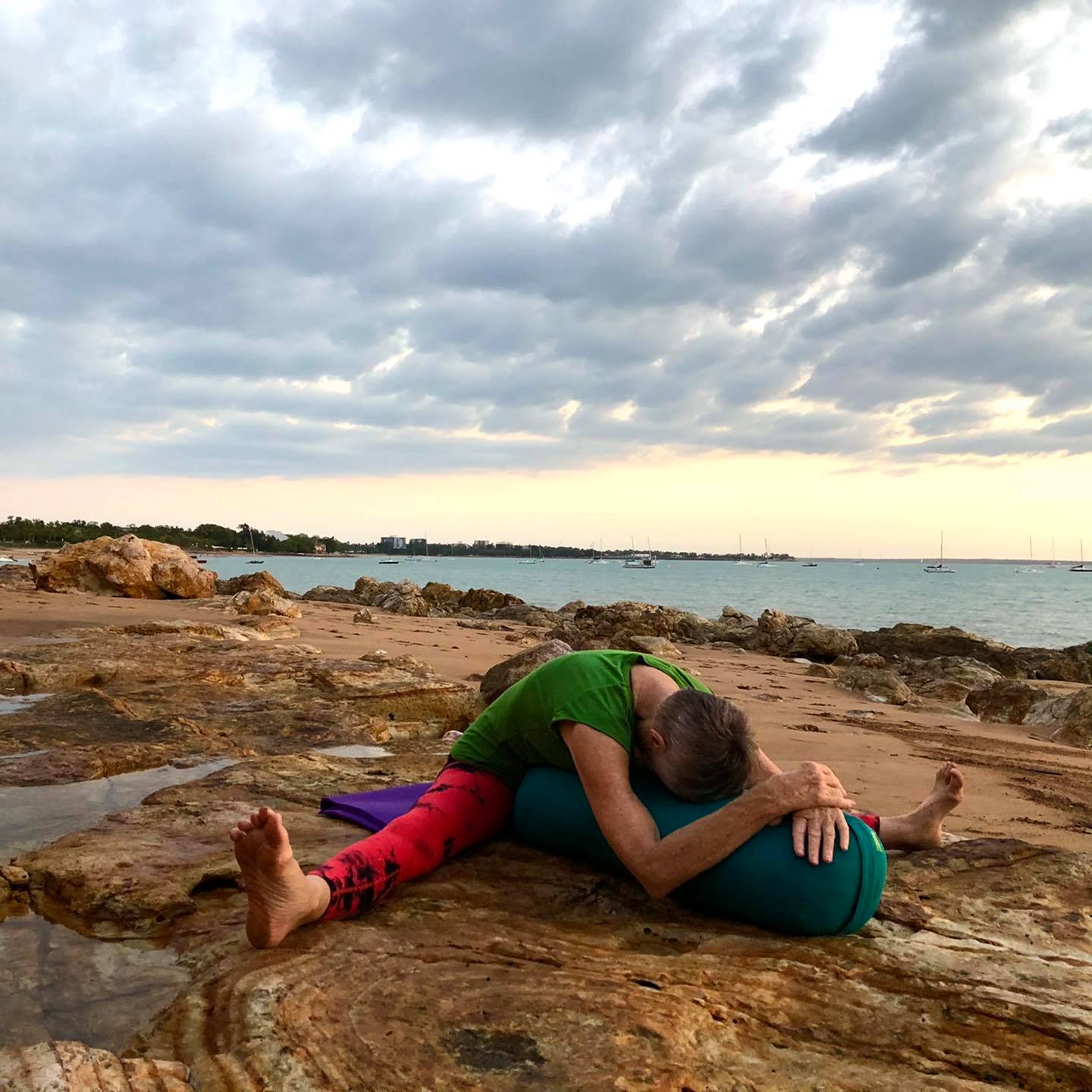
A seated forward bend resting over a bolster, by the sea in Darwin. Leaning forward takes weight off the tailbone.
Take it further
Free ebook: Too Stiff For Yoga? Pressure care depends on being able to move and change position, and stiffness makes that harder. This book has all the material on why stiffness is one of the things yoga changes most, with the stories of how it has helped people. Then do the free classes, see what you think, and buy a pass that puts it all into action.
New to Flametree, or away 3 months or more? 2 free classes + 2 ebooks, only available via this offer. Already a student? You can still get this book. Get your free copy of Too Stiff For Yoga?
- Classes, in Darwin or LIVE online: new, or away 3 months or more? 2 free classes, then 10 at half price. Already practising yoga? See the non-beginner half price pass. See the timetable and book.
- Masterclasses: Yoga for sleep and energy: rest that actually restores, Sunday 10 January 2027, one of our 2027 masterclasses with Chris Lalor, where you learn the supported, padded lying and resting positions with bolsters and blankets that sit at the heart of yoga for pressure sores. For sitting tall, Yoga for backs, Sunday 21 February 2027. See the 2027 masterclasses.
2027 Masterclasses From 28 December
Over four months, learn the poses and breath practices that make the biggest difference for a range of key health conditions: arthritis, sleep and energy, pelvic floors, backs, wisdom, and anxiety, upsets and anger. In Darwin or LIVE online.
Other conditions are in our encyclopaedia of yoga for health conditions.
Yoga for pressure sores: questions people ask
Can yoga help pressure sores?
Yoga has not yet been tested in a trial for pressure sores. In one Iyengar yoga therapy case report, props were used to reposition a woman who could not be moved off two painful sores; her pain eased and both sores closed within three weeks. Yoga practises the basics of pressure care: moving often, padding and supporting the body, sitting well and a calm breath.
Can yoga cure pressure sores?
No. Yoga does not close a pressure sore on its own, and it never replaces nursing or medical care. It works alongside that care, on movement, supported positions, sitting well and calm.

Chris Lalor in a supported reclining pose. The bolster carries the back, so the weight is spread wide.
What are bed sores and pressure injuries?
They are the same thing as pressure sores and pressure ulcers: damage to the skin and the tissue beneath it from pressure, or pressure with shear, that goes on too long in one place, usually over a bony point such as the heels, tailbone or sitting bones. Pressure injury is the term Australian hospitals use.
Can I do yoga if I have a pressure sore?
Yes, with care. Never lie, sit or lean on the sore or on a red or darker patch that does not fade, and tell your teacher so poses can be set up to keep weight off it. Seated and supported poses with padding suit most people. Always follow the directions of any doctor you are consulting.
“With problems, go down, stretch, but don’t strain.”
How does moving help with pressure sores?
Pressure squeezes the blood vessels under the skin, and relief lasts only while you are off the spot. Changing position is standard pressure care, and in a study of 50 wheelchair users, those who moved more in the seat were more often free of pressure sores. These studies were not about yoga, but yoga practises regular, easier movement. Read the spinal cord injury guide.
Which yoga positions take pressure off the heels and tailbone?
Lying on the back with a bolster or rolled blanket under the calves lets the heels hang free. Leaning forward over a bolster, or lying with the legs resting on a chair, takes weight off the tailbone. These set-ups are known from practice, and your teacher adapts them to you.
A Padded Lying Set-Up
1. Pad the floor
A mat and a folded blanket under the back.
2. Support the head
A folded blanket under the head.
3. Free the heels
A bolster under the calves.
4. Rest, then change
Move on when it is time.
A padded lying set-up for yoga with pressure sores, known from practice.

Lying back over bolsters, eyes covered. The body is held along its length, so no one point takes the weight.
Can relaxation or mindfulness help wound repair?
In trials on other wounds, not pressure sores, relaxation and guided imagery went with better wound repair: a review of 19 trials favoured it, especially relaxation. A mindfulness course gave mixed results. These tested relaxation and mindfulness, not yoga, and they still count for the calm that a yoga and pranayama class builds.
Can yoga help carers of someone with pressure sores?
Yes. In a review of 12 studies, yoga-based programmes lowered carers’ anxiety, low mood and stress and lifted their quality of life. Yoga also teaches how to bend from the hips with a long spine, which helps when turning or lifting someone. Read the stress and burnout guide.

Chris Lalor seated on a bolster, ready for breathing practice. An hour for the carer’s own breath.
Can I do yoga for pressure sores in Darwin or online?
Yes. Flametree Yoga teaches Iyengar yoga in Woolner and Coolalinga in Darwin, and LIVE online, so you can practise from your own bed, chair or wheelchair with your own cushions and props. Flametree classes adapt poses with chairs and props. New students can begin with 2 free classes, then 10 at half price. Book a class
Where this comes from: BKS Iyengar, Sparks of Divinity, The Tree of Yoga, Astadala Yogamala (volumes 4 and 6), Yoga Wisdom and Practice and Light on Life (Kindle edition); Geeta S Iyengar, women’s class questions in Sydney, 1996. Timothy McCall MD, his June 2019 list of 117 health conditions helped by yoga and its reference list, and Yoga as Medicine (Bantam). Australian figures: Australian Commission on Safety and Quality in Health Care, Hospital-Acquired Complication 1: Pressure Injury (2018); Nghiem 2022 (International Journal of Nursing Studies); Barakat-Johnson 2026 (Journal of Tissue Viability). Ribeiro 2015, Latimer 2026 (Cochrane), Moore 2016 (Cochrane) and the other studies as linked above, each looked up in PubMed in November 2026. Everything is summarised in our own words.
This page is general information, not medical advice. Flametree Yoga Studio, Darwin and LIVE online.
