
Yoga For Cricketers: The Test Opener Who Found It Hurt At First, And Kept Going
Last updated: 4 November 2026
It hurt. That was the first thing yoga gave Justin Langer, Australia’s Test opening batsman. He found it a bit demotivating, and he was not sure the benefits would be worth the discomfort. He kept going anyway. In time he was practising daily on tour, wherever he could, and recommending yoga for cricketers who believed it could make them a better player and a better person.
Yoga for cricketers: the short answer
Yoga for cricketers works best as an add-on to nets, gym and matches, not a replacement. Cricket is a one-sided game. Fast bowlers load one side of the lower back, batters stand side-on for hours, and keepers crouch all day. Yoga works both sides evenly, frees the hips, hamstrings and shoulders, and trains the steady attention a batter needs at the crease.
The cricket stretches below come from Iyengar yoga, the prop-based style we teach in Darwin and live online. Here is the article in short form:
- Langer found yoga hurt at first, then made it daily on tour.
- Cricket loads one side of the body, again and again.
- Fast bowlers’ backs carry the most strain in the game.
- In 82 first-class cricketers, yoga gains lasted six months.
- Six cricket stretches from yoga, done slowly and evenly.
- A calm breath between balls steadies attention.
- Classes in Darwin and live online, beside your cricket.
A quick word on Iyengar yoga. Iyengar yoga is the style developed by Mr BKS Iyengar. In the 20th century he did more than anyone to set down traditional Indian yoga, through his books and his teaching, and he pioneered the use of props. He also taught cricketers, and wrote a whole book on yoga and sport. It is the style we teach at Flametree, in Darwin and live online.
Yoga for cricketers starts with the legs

Stuart McGill, yoga teacher, Flametree Yoga Darwin, balancing on one leg with the other raised. Long hamstrings and a steady standing leg are what a bowler’s front leg needs.
What did Justin Langer say about yoga?
He said it hurt at first, then became very important to him. Langer answered a short set of questions about cricket and yoga for Yoga Rahasya (the Iyengar yoga journal, published quarterly in Pune by Mr Iyengar’s institute) in 2006. The questions were put by Rajvi H. Mehta. Yoga Vaani, the magazine of Iyengar Yoga Australia, reprinted the interview in issue 85, March 2006, pages 26 and 27. That issue is held in Iyengar Yoga Australia’s online library of past issues, which needs a log-in.
At the time, Langer was Australia’s opening batsman. By the time he retired in 2007 he had played 105 Tests and made 7,696 Test runs, batting left-handed. He later coached Australia. The interview’s introduction says that while Australia toured India, he took the chance to meet Mr Iyengar in Pune. Mr Iyengar gave him tips on getting over back strain and on his performance.
Here is what he said, in short. We have kept his own words to two short phrases and summed up the rest.
It hurt at first
His first experience of yoga was not fun. He said it “hurt my body”, and he was not sure the benefits would outweigh the discomfort. Plenty of men we teach say the same in their first few weeks. It is normal, and it passes, especially when a teacher sets each pose to suit a stiff body.
He learnt with teachers in Western Australia first
Langer started with various teachers around Western Australia. He was drawn to the physical side first, because he believed it would help him improve as a cricketer.
Daily on tour, where he could
By the time of the interview, yoga was very important to him. He practised daily on tour if time and circumstances allowed. He said he had come to respect how much regular practice did for his body and his mind, and that practice had become a higher priority.
Modest about the scorecard, sure about himself
Asked whether yoga had helped his game, he said it was hard to give a definite answer. He thought it probably had, because he felt so much better in himself. That is a careful answer from a careful cricketer, and it is the one most of our students give too: they feel better, and their sport follows.
Flexibility, awareness and state of mind
He believed better flexibility and body awareness improve performance, longevity and your state of mind. And he tied it all to the mind: in his words, “a sound, happy frame of mind results in improved performance” in everything you do, his cricket included.
Who he would recommend it to
Would he recommend yoga as part of cricket training? Yes, he said, if a player believes in their heart it will help them become a better player and person. He also said meeting Mr Iyengar was a chance to meet a master, which he enjoyed immensely, and that he was inspired by how many people around the world practise yoga.
Chris Lalor, Certified Senior Iyengar Yoga Teacher and certified Yoga Therapist, Flametree Yoga Darwin, just missed him. On one of her study visits to Pune, she arrived soon after Langer’s visit, and the institute was still buzzing about it. We have written before about what Mr Iyengar noticed in Langer’s lower back and shoulder: see Uneven Shoulders and Sacroiliac Joint Pain.
He was not the first cricketer to make that trip. Sachin Tendulkar first went to Mr Iyengar in 1999 with a backache that was giving him a lot of trouble. He spent a week under Mr Iyengar’s care and later said the poses he learnt helped him throughout his career (Gulf News, 2014). It was the Indian wicket-keeper Kiran More who introduced them. In his writing on yoga and sport, Mr Iyengar tells how More, after working with him, seemed taller. A keeper spends most of the day bent over, watching the ball.
Why does cricket make you stiff and lopsided?
Because it asks the same movement of the same side, thousands of times a season. A right-arm bowler lands on the same front leg and bends the same way at every delivery. A batter stands side-on, head turned one way, for hours. A keeper squats all day. Fielders sprint, dive and throw with one arm.
The body follows what it does most. One hip turns in more than the other. One side of the lower back gets tighter and stronger than the other. Hamstrings shorten after hours of standing and crouching. Over years, a cricketer can end up fit and strong but uneven, with good range on one side and not the other.
Yoga is the opposite habit. Every pose is done on both sides, slowly, with attention to where the weight falls. That is why Iyengar teachers watch the feet first, then the knees, hips and spine.

Yoga for cricketers by role: each part of the game takes something, and yoga gives it back on both sides.
Standing poses for a one-sided game

A Flametree student in Triangle Pose on a ute tray in the Top End. Standing poses work each side in turn, which a one-sided sport needs.
Is yoga good for fast bowlers’ backs?
Yes, it is well worth adding, and fast bowlers are the cricketers with the most to gain. A 2026 review of cricket injuries found fast bowlers have the highest injury rate in the game, most often lumbar stress injuries (small cracks from overload in the bones of the lower back) and hamstring strains (Nawabi and Pandya, Current Reviews in Musculoskeletal Medicine).
Young bowlers are hit hardest. In a 2026 study of 98 youth bowlers aged 10 to 20, 16.3% had a lumbar bone stress injury in a single season, and 28.6% had had one at some stage (Daniels and colleagues, Journal of Science and Medicine in Sport). An earlier study of 38 adolescent fast bowlers found 21% developed one during the season (Kountouris and colleagues, 2012).
Bowling workloads are for the coach and the club. What yoga adds is the body around the bowling action:
- Even both sides. Standing poses and twists are done to the left and the right.
- Free the hips and hamstrings, so the lower back is not left to make up the range.
- Strong legs and trunk, working while they lengthen, in poses held for some time.
- Know your own body. Langer called it body awareness. A bowler who can feel when one side is tight can tell the coach early.
In the Iyengar tradition, twists and back bends are taught with care, in stages, with props, and adjusted to the person. Known from long practice, a back that is moved evenly and sensibly every week tends to stay happier. No trial has yet tested yoga on bowlers’ stress injuries, so we say what practice shows and leave the rest to research still to come.
For more on sore backs, see our Back Pain And Yoga guide, and for pain that runs down the leg, our Sciatica And Yoga guide.
Long hamstrings protect a fast bowler’s back

Chris Lalor in Reclining Big Toe Pose with a belt and a chair. Lying down, the hamstrings lengthen without the lower back taking any load.
What do the cricket trials show?
They show cricketers move better with yoga, and the gains last. Two Indian trials are the best we have.
First-class cricketers. 82 male first-class players, aged 18 to 35, were split into a yoga group of 42 and a waiting group of 40. The yoga group did a yoga programme five days a week for six weeks. Core stability, flexibility, range of motion, balance and ankle control all improved, and the gains were still there six months later (Rao and colleagues, Journal of Bodywork and Movement Therapies, 2021).
Club bowlers. 60 male club cricketers aged 13 to 25 did 45 minutes, three times a week, for 12 weeks, as well as their bowling practice. Half did yoga (breathing practice plus standing and lying poses). Half did standard conditioning. Bowling speed rose 6.5% in the yoga group and 5.2% with conditioning. Accuracy rose 35.4% with yoga and 31.3% with conditioning (Vaidya and colleagues, International Journal of Yoga Therapy, 2021). The researchers called the gains comparable. Yoga did the job of standard conditioning.

Stretches for fast bowlers that also build pace: young bowlers gained as much speed and accuracy with yoga as with standard conditioning.
Core strength from your own weight

Chris Lalor in Boat Pose with a belt. Core stability was one of the gains the first-class cricketers kept six months later.
Cricket stretches: six yoga poses that suit the game
These six cricket stretches come straight from an ordinary Iyengar class. Each one is done on both sides, held long enough to feel it change, and set up with props so a stiff body can do it well. We describe them so you know what to expect. In class, the teacher sets each one to suit you.

Six cricket stretches from Iyengar yoga, each worked on both sides.
1. Reclining Big Toe Pose (Supta Padangusthasana), with a belt
Lying on your back, you take one straight leg up with a belt around the foot. The hamstrings lengthen while the floor supports the back. It suits bowlers, batters who run hard between wickets, and anyone who strains a hamstring. Our post on tight hamstrings covers how long to hold.
2. Triangle Pose (Utthita Trikonasana)
Both legs straight, feet wide, one arm reaching down and one up. The front hip and the back hip each get their own work, so the side that is always loaded gets stretched and the lazy side gets strengthened.
3. Half Moon Pose (Ardha Chandrasana)
You balance on one straight leg with the other lifted level and the chest turned open. A fast bowler’s front leg takes a huge jolt at landing. Half Moon trains that leg to be straight, strong and steady, with the hip in line.
Half Moon: balance on the landing leg

Chris Lalor in Half Moon Pose. One straight, steady standing leg, with the hip and chest turned open.
4. A seated twist (Bharadvajasana)
Sitting tall, you turn the trunk one way, then the other. Batters spend all day turned one way to face the bowler. Bowlers whip the trunk one way at every ball. A twist taken slowly to both sides gives back the turn you never use.
Turning both ways, not just one
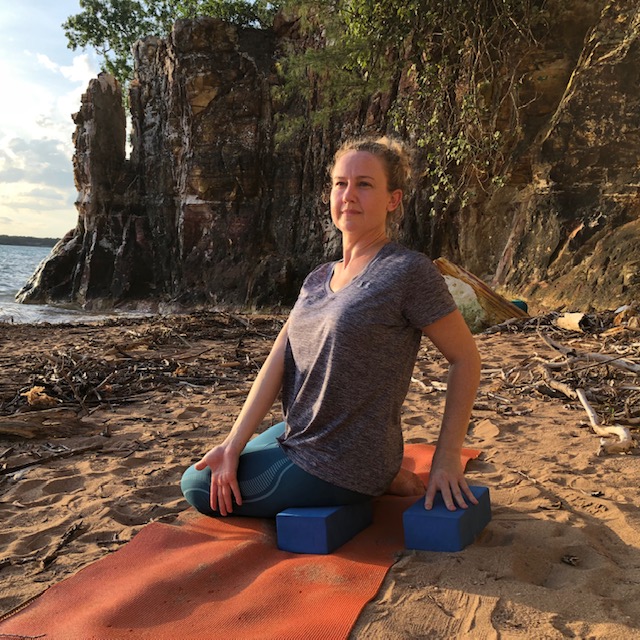
A seated twist on blocks. Sitting up on height lets the spine turn without slumping.
5. Cow Face arms (Gomukhasana), with a belt
One hand reaches up and back, the other comes up from below, and a belt joins them if the hands do not meet. It opens the front of the shoulder and the chest. Bowlers and fielders throw thousands of times a season with one arm. This pose shows you, quickly, how different your two shoulders have become. See also shoulder mobility and our shoulder pain guide.
Cricket stretches for the throwing shoulder
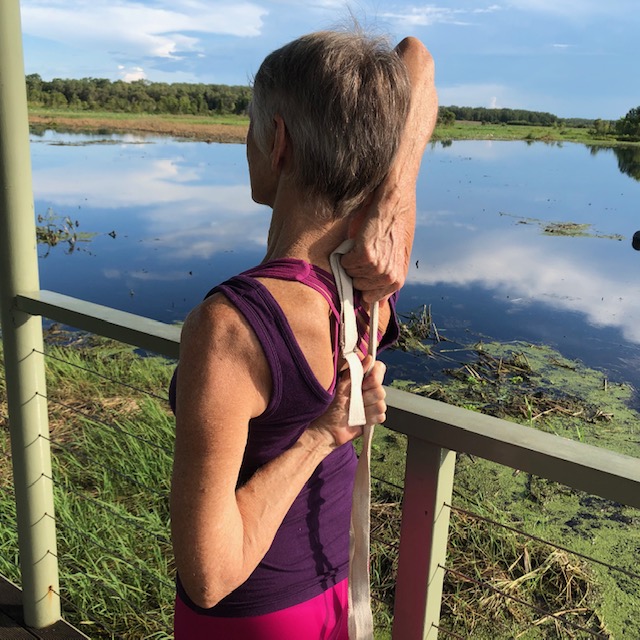
Chris Lalor in Cow Face arms with a belt. Do both sides and the difference between a bowling arm and the other arm shows straight away.
6. Forward bend to a chair, or the rope wall
You stand, hinge at the hips and take the hands to a chair, with the legs straight and the back long. At Flametree we also use the wall ropes around the hips, which hold you back while you lengthen forward. After a day in the field, it lets the lower back lengthen while the legs stay working.
A long back after a long day in the field

Stuart McGill with the wall ropes at his hips, reaching to a chair. The ropes take him back while his arms take him forward, so the whole back lengthens.
Will yoga make a fast bowler too flexible?
No. This worry comes up a lot, and it is a misunderstanding of what a yoga pose does. Iyengar yoga is not floppy stretching. In a standing pose the legs work hard while they lengthen, so the range you gain is range you can control. That is strength and length together, which is what a bowler’s landing leg and a batter’s lunge need. For more, see Can Yoga Build Muscle? Our knee and hip pain guide and stiff joints guide cover the joints cricket wears.
Does yoga help concentration at the crease?
Yes. A batter has to stay calm and switched on for hours, then react in a split second. Langer tied his whole view of yoga to a sound, happy frame of mind. In the yoga tradition, a held pose and a slow breath train exactly that: attention that stays on the thing in front of you.
Students commonly find that a slow breath through the nose, with the out-breath a little longer than the in-breath, settles them under pressure. Between balls is a natural place to use it. At Flametree we suggest starting with some yoga poses first. They quieten the mind, which makes the breathing work far easier to feel and use.

Calm at the crease: a breath between balls. Steady breath, steady attention.
Breath work at Flametree

A Flametree student in a breath practice class, sitting backwards on a chair to keep the chest lifted.
When should a cricketer do yoga in the season?
All year, with a different emphasis each part of it. Both cricket trials above ran classes several times a week for six to twelve weeks, and the first-class players kept their gains for six months.
- Off-season: the best time to start. Even out both sides and build range before the bowling load returns.
- Pre-season: keep the range you have built while training picks up.
- In season: one or two classes a week. Lean on the slower, supported poses the day after a long spell or a long innings.
In Darwin, club cricket is played through the Dry, so the Wet is a natural off-season to start yoga.
Get the free ebook Stay In The Game, our book on why and how yoga works for men who want to keep playing sport, by Stuart McGill. It covers the cricket trials, golf, rugby and life after 40. New to Flametree, or away for 3 months or more? You get 2 free classes + 2 ebooks, only available via this offer. Already coming to class? You can still get the book.
Where can cricketers do yoga in Darwin?
At Flametree Yoga Studio, in Woolner and Coolalinga, and live online anywhere in Australia. Stuart McGill teaches beginner classes every week, and about a third of our students are men. Our men’s health guide sets out what yoga offers men. Every class is adjusted to the people in it, so a stiff fast bowler and a supple keeper can work side by side. Props mean nobody is too stiff to start.
You do not need a special cricket class. Any good Iyengar class gives a cricketer what the game takes away. For more on men and sport, read Yoga For Men, yoga for golfers and stretches for runners, or see every article in one place on our yoga for athletes page.
Frequently asked questions
Is yoga good for cricketers?
Yes. Cricket loads one side of the body again and again, and yoga works both sides evenly. In a trial of 82 first-class cricketers, six weeks of yoga improved core stability, flexibility and balance, and the gains were still there six months later.
Can yoga help a fast bowler’s back?
It is well worth adding. Fast bowlers have the highest injury rate in cricket, mostly lower back stress injuries and hamstring strains. Yoga evens out both sides and frees the hips and hamstrings, so the lower back is not left to do all the work. Bowling workloads stay with the coach.
What are the best cricket stretches?
Six that suit the game: Reclining Big Toe Pose with a belt for the hamstrings, Triangle Pose for the hips, Half Moon for the landing leg, a seated twist to turn both ways, Cow Face arms for the shoulders, and a forward bend to a chair for a long back. Do each one on both sides.
Did Justin Langer do yoga?
Yes. In a 2006 interview for the Iyengar journal Yoga Rahasya, reprinted in Yoga Vaani 85, he said yoga hurt at first, became very important to him, and was part of his day on tour when time allowed. He met Mr BKS Iyengar in Pune while Australia toured India.
Will yoga make me too flexible to bowl fast?
No. Iyengar yoga builds strength and length together. In standing poses the legs work hard while they lengthen, so the range you gain is range you control. In 60 club cricketers, yoga raised bowling speed and accuracy as much as standard conditioning did.
Does yoga help batting concentration?
Yes. Held poses and a slow breath through the nose train attention that stays on what is in front of you. Justin Langer linked a sound, happy frame of mind to better performance in everything, his cricket included.
How often should cricketers do yoga?
Once or twice a week through the season, more in the off-season. The cricket trials used classes several times a week for six to twelve weeks. Start in the off-season if you can, and keep going once matches begin.
Where can I do yoga for cricket in Darwin?
At Flametree Yoga Studio in Woolner and Coolalinga, and live online. Any Flametree beginner class suits cricketers, whether you bowl, bat or keep. New students get 2 free classes and half price passes.
Where to next
- New to yoga? Start with our half price beginner yoga deal with 2 classes free, in Darwin or live online.
- Done yoga before, new or back after a break? Take the non-beginner starter deal: 2 classes free, then 10 at half price.
- Want to see class times first? Look at the beginner timetable.
Flametree Yoga Studio, Darwin and live online. This article is general information, not medical advice. Feel free to check with your professional advisers if you wish, but also give yoga a try. Justin Langer and Sachin Tendulkar are quoted or described from published sources; neither is connected with Flametree. Find us on Facebook.
Sources: Rajvi H. Mehta (questions), “Cricket and Yoga: Quick Responses from Justin Langer”, Yoga Rahasya 2006, reprinted in Yoga Vaani 85, March 2006, pp. 26 to 27, Iyengar Yoga Australia; Rao and colleagues, yoga in 82 first-class cricketers, Journal of Bodywork and Movement Therapies, 2021 (doi 10.1016/j.jbmt.2021.02.022); Vaidya and colleagues, yoga in 60 cricket bowlers, International Journal of Yoga Therapy, 2021 (doi 10.17761/2021-D-20-00060); Nawabi and Pandya, Injuries in Cricket: A Review, Current Reviews in Musculoskeletal Medicine, 2026 (doi 10.1007/s12178-026-10029-8); Daniels and colleagues, lumbar bone stress injury in 98 youth bowlers, Journal of Science and Medicine in Sport, 2026 (doi 10.1016/j.jsams.2026.06.017); Kountouris and colleagues, 38 adolescent fast bowlers, Journal of Science and Medicine in Sport, 2012 (doi 10.1016/j.jsams.2012.03.012); Gulf News, Tendulkar pays tribute to BKS Iyengar, 2014; BKS Iyengar, Astadala Yogamala volume 3, Yoga and Sports (Kiran More); Justin Langer’s Test record, Wikipedia.



