
Yoga And Anxiety, Upsets And Anger: What Mr Iyengar, The Yoga Doctors And The Research Say
Wound up, on edge, or quick to snap? Anxiety, upsets and anger feel different, but they grow from the same place: a nervous system stuck on alert. Mr BKS Iyengar and the medical doctors who worked with him give the same answer: calm the body and the breath, and the mind follows. This guide brings together what each of them says about anxiety, panic and anger, and what modern research has found. Last updated: 31 October 2026.
Get 2 Free Yoga Classes And 2 Free Ebooks
Yoga and anxiety, upsets and anger: the short answer
Does yoga help anxiety and anger? Yes. Yoga and anxiety have been studied together for decades, and yoga eases anxiety and stress. Reviews of many trials found less anxiety after yoga, and an Iyengar yoga trial in Berlin found less stress, anxiety and low mood after three months. For anger, the biggest review of all, 154 studies, found that calming practices such as slow breathing and meditation brought anger down, while “letting off steam” did nothing useful. Trials of yoga on its own for anger are few, so here we lean on what is known from practice: quieten the mind, and the flare-ups come less often.
One thing to keep in mind as you read: most trials tested “yoga” of many styles, taught by teachers with very different training. The trials that tested Iyengar yoga specifically, taught by trained Iyengar teachers, found it helped too, and in our view well-taught Iyengar yoga is likely to go further than the average. Why the kind of yoga matters.
The bottom line: five key moves for anxiety, upsets and anger
- Go to a yoga class at your level, several times a week. Two or three a week is a good start. In the Berlin Iyengar trial, even once a week helped. Give it 8 to 12 weeks.
- Add breath work (pranayama). A slow, smooth breath with a long out-breath is the body’s brake. It is how to calm anxiety from the inside, and it takes the heat out of anger.
- Calm down, don’t let off steam. Hitting a bag or a hard run does not lower anger. Calming does. Choose the quiet option when you are upset.
- Active first, then quiet. Standing poses burn off nervous energy. Then forward bends with the head resting, and supported poses, let the mind settle.
- Start now. New to Flametree, or away 3 months or more? 2 free classes, then 10 at half price, in Darwin or LIVE online.
Iyengar yoga is the style we teach at Flametree. During the 20th century, Mr BKS Iyengar was the major person who codified traditional Indian yoga, through his seminal books and widespread teaching. He also pioneered the use of props, so poses can be adapted to almost any body. His style is sometimes called modern classical yoga. This guide is part of our encyclopaedia of yoga for health conditions.
This guide in short
- Mr BKS Iyengar: a yoga approach for anxiety, irritability and over-breathing, built on supported forward bends, supported inversions, rest and breath.
- Dr Timothy McCall: anxious breathing is fast, choppy and high in the chest. Change the breath and the anxiety changes with it.
- Dr Krishna Raman: balance the practice. Too many backbends bring irritability; too many forward bends bring dullness.
- Other yoga voices: Geeta Iyengar on fear and the back, and Chris Lalor on meeting her own anger in a yoga room.
- The research: 23 studies listed below, from small Iyengar trials to a review of 154 studies on anger.
- Take it further: a free ebook, our 2027 masterclass on anxiety, upsets and anger, and classes in Darwin and online.
Anxiety, Upsets And Anger On One Page
Five sources, one answer: calm the body and the breath, and the mind follows.
Rest the head, support the body, steady the breath. Rest alone is not enough.
Change the anxious breath: slower, lower, with a longer out-breath.
Balance the practice. Restful, propped poses suit stress.
Fear sits in the back, courage in the chest. Anger can surface on the mat, then let go.
Yoga eased anxiety and stress across many trials. Calming practices lowered anger across 154 studies.
Each source is set out in full below. Research: Cramer 2018, Michalsen 2012, Kjaervik and Bushman 2024.
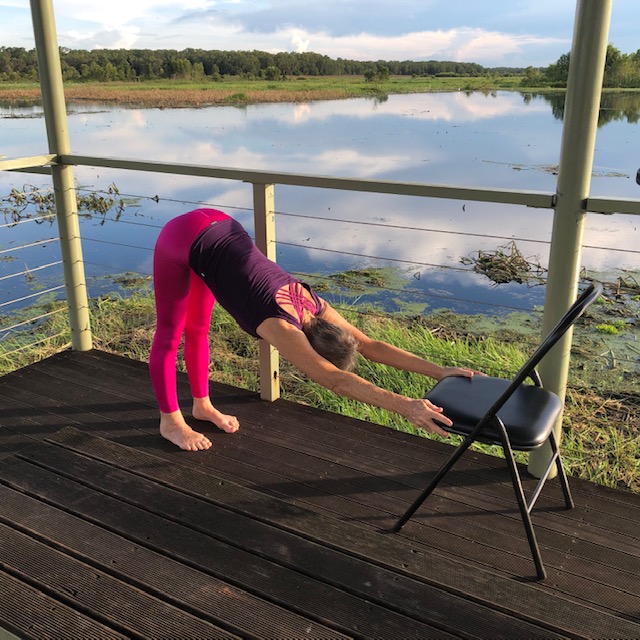
A standing forward bend with the hands on a chair. Bending forward with support is one of the classic Iyengar ways to quieten a busy head.
“Constantly plagued by doubt and fear, the scattered mind alternates between decisiveness and lack of confidence.”
What anxiety, panic and anger are
Anxiety is worry or fear that hangs on, often with a racing heart, a tight chest, shaky hands, a knotted stomach and broken sleep. About 1 in 6 Australians aged 16 to 85 had an anxiety disorder in the past year. Dr McCall’s list of conditions helped by yoga includes three in this family:
- Anxiety (no. 4): worry that runs on, in the mind and in the body.
- Panic disorder (no. 72): sudden waves of fear, with a pounding heart, breathlessness, dizziness or chest pain, which can feel like a heart attack.
- Performance anxiety (no. 76): stage fright, nerves before a talk, an exam, a game or a job interview.
Mr Iyengar adds irritability and anger (short bursts of impatience and temper) and hyperventilation (over-breathing, which brings dizziness and tingling). Upsets and anger are not illnesses. They are the same alarm system firing, outward instead of inward.
“The main causes of negative stress are anger, fear, speed, greed, unhealthy ambition, and competition.”
What Mr BKS Iyengar taught about anxiety, irritability and anger
In short: rest the head, support the body, steady the breath, and pair rest with active practice.
In Yoga: The Path to Holistic Health, Mr Iyengar sets out a yoga approach for 72 health conditions. His section on the mind and emotions includes anxiety, irritability and hyperventilation. In our words:
- Anxiety (pp. 364 to 365). He lists the signs: nausea, hot flushes, dizziness, trembling, tight muscles, headaches, backache and a tight chest. His course combines supported forward bends, reclining poses, standing poses and supported inversions (upside-down poses held with props), with a staircase breath (Viloma) and a final rest.
- Irritability (p. 359). Short bursts of impatience that follow life changes, lost sleep, worry at work or allergies. His course leans on forward bends with the head supported, and supported inversions, to calm the front of the brain.
- Hyperventilation (p. 367). Over-breathing set off by stress, with dizziness and tingling. A short course of reclining poses, standing forward bends and supported inversions.
- The scattered mind (pp. 50 to 51). He describes five states of mind, from dull to still. The scattered state, full of doubt and fear, is the most common. In his words, “The mind can be a secret enemy and a treacherous friend” (p. 50).
- Anger needs looking inward (pp. 52 to 53). He sees anger as a form of violence that sits below the surface, and contentment as one of its antidotes (his claim).
Where Tension Hides
Mr Iyengar placed stored tension in three places. Yoga works on each one.
Tight shoulders, jaw and back. Standing poses use up the nervous energy, then supported poses let the muscles let go.
A held, shallow breath. Chest-opening poses and pranayama free the breathing muscle so the breath can slow and deepen.
A system stuck on alert. Forward bends with the head resting, supported inversions and rest turn it down.
“Mere relaxation is not sufficient.” Mr Iyengar pairs rest with active practice. Too much passive practice, he warns, can leave a person restless and irritable.
Mr BKS Iyengar, Yoga: The Path to Holistic Health, stress chapter (pp. 180 to 181). A simplified picture.
He also uses props whenever a person is stressed (p. 181), so the body is held and the mind can let go. Of single poses, he says the standing forward bend (Uttanasana) helps anxiety, and sitting upright with the legs straight (Dandasana) builds “will power and emotional stability” (pp. 92 and 102, his claims). He calls the diaphragm the “seat of the intelligence of the heart” (pp. 41 to 42).
We do not publish his sequences. A sequence needs a teacher who can see how you respond and adapt each pose, which is what a class is for.
“If any emotional or intellectual upheavals take place, the first reaction is on the diaphragm.”
What Dr Timothy McCall says
In short: anxiety lives in the breath, so change the breath first.
Dr McCall is a US medical doctor and yoga therapist, author of Yoga as Medicine and former medical editor of Yoga Journal. His June 2019 list of conditions helped by yoga includes anxiety (no. 4), panic disorder (no. 72) and performance anxiety (no. 76). His book gives anxiety and panic attacks a full chapter (chapter 8), built around Rolf Sovik of the Himalayan Institute, who holds a doctorate in clinical psychology. His points, in our words:
- A story to start. A woman he calls Graciella had panic attacks every couple of days, with chest pain she took for a heart attack. Her heart tests were clear. She credits yoga with ending both her panic and her long-standing asthma (her claim).
- The anxious breath. Anxious breathing is quick, choppy and high in the chest. Calm breathing is smooth and low, moving the diaphragm, through the nose, with a longer out-breath.
- Breath and poses work best together. He reports a study where poses without attention to the breath did little, breathing alone helped, and the two together did best.
- Head supported. He suggests the wide-legged standing forward bend (Prasarita Padottanasana) with the head resting on a support, a calming Iyengar choice.
- Go gently. Backbends can stir up an anxious person, and gentle inversions are a better way in. Too strenuous a practice can deepen a worn-out feeling.
- For people who cannot lie still, a guided deep relaxation (Yoga Nidra) can be easier than silent rest.
- Mind or body worry. He notes Jon Kabat-Zinn’s observation: people whose worry is mostly in the head often take well to active yoga, while those whose worry sits in the body may prefer quieter meditation.
He also describes the 2005 Iyengar study of distressed women in Germany, listed below with the research.
The Anxious Breath And The Calm Breath
The breath both shows the alarm and switches it off.
- Fast and choppy
- High in the chest
- Often through the mouth
- Short out-breath
- Keeps the alarm ringing
- Slow and smooth
- Low, moving the diaphragm
- Through the nose
- Long, soft out-breath
- Presses the body’s brake
Every slow breath out slows the heart a little. That is why pranayama, taught step by step, is at the centre of yoga for anxiety and anger.
Based on Dr Timothy McCall, Yoga as Medicine, chapter 8, Anxiety and Panic Attacks. A simplified picture.
“You can never do pranayama with an upset mind.”
What Dr Krishna Raman says
In short: balance the practice, rest with props when stressed, and learn pranayama properly.
Dr Raman is a Chennai physician who trained in yoga under Mr Iyengar. His question-and-answer book on yoga and medical science covers stress, the agitated mind, anger flare-ups and panic. His views, in our words:
- Balance the poses. Too many backbends can bring irritability, and too many forward bends can bring dullness. A good practice balances the two.
- Restful, propped poses suit stress. When life is heavy, supported poses do more than strong ones.
- Pranayama must be learnt properly. In his view, badly done breathing practice can leave a person breathless and irritable, which is why it is taught step by step.
- Go easy at first. He does not advise the internal locks of advanced breathing (bandhas) at first for people under heavy stress.
- Routine matters. For stress that cannot be avoided, he suggests a steady daily routine and an early night, around 9.30 pm.
- Children’s tempers, in his view, mostly reflect how they are brought up.
Balance The Practice
Too much of any one thing tips the mind off balance. The aim is the middle.
Too stirring
Too many backbends, or forceful breathing: irritable and wound up
Balanced
Active first, then quiet, with slow pranayama: alert and calm
Too passive
Too many forward bends, or rest alone: dull, or restless
After Dr Krishna Raman (Yoga and Medical Science: FAQ) and Mr BKS Iyengar (Yoga: The Path to Holistic Health, p. 181). A simplified picture.
“Fear and fatigue block the mind. Face both, then courage and confidence flow into you.”
Other yoga voices on anxiety and anger
- Fear lives in the back, and courage in the chest. That is the teaching of Geeta Iyengar, Mr Iyengar’s daughter, in substance. A hard upper back in a forward bend is often fear, and a long, soft out-breath with a pause helps it let go. She also taught resting the forehead in forward bends to quieten the mind. This is known from practice, not research.
- Anger can surface on the mat, and then let go. Chris Lalor, Certified Senior Iyengar Yoga Teacher and certified Yoga Therapist, first met her own anger in a yoga room, after a class of twists. She tells the story in does yoga help with anger? In her experience, people who have done yoga or pranayama for a while already know it leaves them calmer and slower to anger.
- A pearling boat captain with two settings, fine or angry, found yoga gave him another one. His story, in his words: anger management and yoga.
- Yoga in prisons earns three stars for impulsivity, aggression and re-offending, and workplace yoga lowered stress and improved sleep. Mary Flaherty, Does Yoga Work?, a careful review of the yoga research.

A supported reclining pose on two bolsters. The props do the holding, so the breath and the mind can let go.
“Contentment helps to curb desire, anger, ambition, and greed.”
What the research shows
In short: anxiety and stress have plenty of trials, and they show yoga helps. Panic has a few small trials. Anger has the big reviews of calming practices, and only small trials of yoga alone, so for anger we lean on what is known from practice. Most of these studies tested yoga in general, of many styles. The Iyengar yoga trials are listed on their own below. Why the difference matters.
The Research At A Glance
Four studies that sum up the evidence. All of them, with links, are listed below.
Iyengar yoga lowered stress, anxiety and low mood, and once a week worked as well as twice. Michalsen 2012: 72 distressed women in Berlin, 3 months.
Yoga eased anxiety, more than other active programmes did. Cramer 2018: 8 trials, 319 people with high anxiety, yoga of many styles.
A mindfulness course matched a common anti-anxiety medicine, with far fewer side effects. Hoge 2023: 276 adults with anxiety disorders.
Calming lowered anger. Letting off steam did not. Kjaervik and Bushman 2024: 154 studies, over 10,000 people.
Every study is listed in full in this section, with a link to read it.
Yoga for anxiety and stress
- Yoga eased anxiety in people with high anxiety, with a large effect against other active programmes and a smaller one against no programme. No extra injuries were reported. Cramer 2018, a review of 8 trials and 319 people. Read the study.
- Yoga lowered anxiety more than control groups in people with anxiety disorders. Martinez-Calderon 2023, a review of 23 studies and 1,420 people. Read the study.
- Yoga lifted mood and lowered anxiety more than walking, and the gains tracked a rise in GABA, the brain’s own calming chemical. 60 minutes, three times a week, for 12 weeks. Streeter 2010, a trial of 34 healthy adults. Read the study.
- Over half the yoga group with generalised anxiety disorder responded (54%), against a third with stress education (33%). 12 weeks. Simon 2021, a trial of 226 adults. Read the study. Note: this trial tested yoga in general, not Iyengar yoga taught by teachers with six or more years of training. Why it matters.
Iyengar yoga studies
These trials tested Iyengar yoga specifically, taught by trained Iyengar teachers, with props and adapted poses.
- Iyengar yoga lowered stress, anxiety and depression, and improved mood, wellbeing and bodily complaints. Once a week worked as well as twice. Twelve or 24 classes of 90 minutes over 3 months, against a waiting list. Michalsen 2012, a randomised trial of 72 distressed women in Berlin. Read the study.
- Iyengar yoga cut stress as much as a mindfulness course, and the gain lasted to 24 weeks. All three programmes (two kinds of yoga and mindfulness) lowered stress by a large amount. Fischer 2022, the RELAX trial, 102 stressed adults. Read the study.
- Iyengar yoga lowered stress, anxiety and fatigue and lifted wellbeing and vigour, and the stress hormone cortisol fell after a class. Two 90-minute classes a week for 3 months. Michalsen 2005, a controlled study of 24 distressed women. Read the study.
- Iyengar yoga with slow breathing (five breaths a minute) lowered depression scores, and the calming chemical GABA rose. 12 weeks, two or three classes a week. Streeter 2020, a trial in people with major depression. Read the study.
Panic attacks and over-breathing
- Yoga added to usual care lowered anxiety more than usual care alone, and quality of life improved. One hour, five days a week, for 12 weeks. Yadla 2024, a trial of 64 people with panic disorder. Read the study.
- Anxiety, panic beliefs and frightening body sensations fell with yoga, and fell further when yoga was combined with talk therapy. Weekly 100-minute sessions for 2 months. Vorkapic and Range 2014, a trial of 20 people with panic disorder. Read the study.
- Six weeks of breathing retraining cut over-breathing symptoms by 11.6 points and eased anxiety, with the gains still there at 3 months. Not a yoga study. Beaumont 2025, 42 people with hyperventilation syndrome. Read the study.
No trial has yet tested pranayama on its own for panic or over-breathing. Not yet studied is not the same as not working.
Anger and aggression
- Calming activities (slow breathing, mindfulness, meditation) lowered anger and aggression. Arousing ones (hitting a bag, jogging, cycling) did nothing useful. Kjaervik and Bushman 2024, a review of 154 studies and 10,189 people. Read the study.
- Mindfulness programmes lowered anger and aggression, and people who are naturally more mindful are less angry. O’Dean 2025, four reviews across 118 studies. Read the study.
- Yoga eased distress, including suspicious and fearful thoughts, more than free-choice exercise. One 90-minute class a week for 10 weeks. Sfendla 2018, a trial of 152 Swedish prisoners. Read the study.
- Yoga and meditation in prisons improved wellbeing and behaviour, and longer, gentler programmes did best. Auty 2015, a review of yoga and meditation in prisons. Read the study.
- Anger, depression and anxiety tended to fall after 10 weeks of yoga. Uebelacker 2024, a pilot trial of 40 people in prison with high anger. Read the study.
- Teenagers in a yoga programme had lower anger scores than those without one. Alaka Mani 2021, a pilot of 50 adolescents. Read the study.
No large trial has yet tested yoga on its own for anger. Not yet studied is not the same as not working. What people who practise know is that a quieter mind flares up less, and the reviews above show calming practices do exactly that.
Venting Or Calming?
How much each kind of activity lowered anger and aggression, across 154 studies.
Calming: slow breathing, mindfulness, meditation, gentle movement. A medium-to-large drop.
Letting off steam: hitting a bag, jogging, cycling. Almost no change.
Calming down works. Letting off steam does not. A yoga class ends in quiet for exactly this reason.
Kjaervik and Bushman 2024, Clinical Psychology Review. Bar length shows effect size (calming g = 0.63, arousing g = 0.02). A simplified picture.
Meditation and mindfulness
These trials tested mindfulness courses, not yoga or pranayama. In our view the three overlap: you cannot do a yoga pose or pranayama well without being mindful.
- Eight weeks of mindfulness worked as well as a common anti-anxiety medicine, with far fewer side effects (15% against 79%). Hoge 2023, a trial of 276 adults with anxiety disorders. Read the study.
- Mindfulness training lowered brooding thoughts, anxiety and depression, and raised self-compassion, with gains still there at follow-up. Wei 2025, a review of 29 trials and 2,535 people. Read the study.
Breathing practice (pranayama)
“Breathwork” is a loose word. It can mean slow, nasal pranayama taught step by step, or fast, forceful breathing with long holds. Look closely at what was taught. The pranayama we teach (staircase, ocean, alternate nostril, humming and a gentle shining skull breath) is slow, nasal and taught step by step. Why the kind of breathing matters.
- Breathing practice lowered stress, anxiety and low mood. Fincham 2023, a review of 12 trials and 785 adults for stress, and 20 trials for anxiety. Read the study.
- A breath with a long out-breath (cyclic sighing) lifted mood more than mindfulness, in just 5 minutes a day. Balban 2023, a one-month trial at Stanford. Read the study.
- Pranayama lowered symptoms in people with mental health conditions, about as much as usual care, and slow breathing caused fewer side effects than fast. Mütze 2025, a review of 6 trials and 517 people. Read the study.
- Slow breathing switched on the body’s calming nerve, during practice and after programmes of several weeks. Laborde 2022, a review of 223 studies of heart rate variability. Read the study.
“Suppression does not work.”
How this comes together in a Flametree class
Everything above points the same way, and it is how we teach in Darwin and LIVE online.
- Active first, then quiet. Standing poses use up nervous energy. Then forward bends with the head resting, supported inversions and rest let the system settle.
- Props in every class: bolsters, blankets, chairs and the wall, so the body is held and the mind can let go.
- Classes adapted to the people in them. No one-size-fits-all. Tell your teacher if you are anxious or wound up, and the practice is shaped for you.
- Breath at the centre: every class ends in rest, and our pranayama classes teach the slow, smooth breath step by step.
- A practice for every kind of day: our gentle yoga and restorative yoga classes suit the days when everything feels too much.
Read more on anxiety, stress and anger
- Yoga for anxiety, and breathing exercises for anxiety that help
- Yoga for stress relief: what the research says and yoga for stress management
- Does yoga help with anger? Chris’s story
- Anger management and yoga: one man’s story and yoga for anger management and stress
- How to stop overthinking and monkey mind
- How to calm your nervous system, cyclic sighing and GABA, the brain’s calming chemical
- Yoga for depression and low mood
- Iyengar quotes on stress and on fear and courage
Take it further
Free ebook: Cutting Stress With Yoga. All the material on stress, worry and sleep, with the stories of how it has helped people: Chris’s own anxiety, the newsreader who froze on live TV, and why the out-breath is the brake.
New to Flametree, or away 3 months or more? 2 free classes + 2 ebooks, only available via this offer. Already a student? You can still get this book. Get your free copy of Cutting Stress With Yoga
- Classes, in Darwin or LIVE online: new, or away 3 months or more? 2 free classes, then 10 at half price. Already practising yoga? See the non-beginner half price pass. See every class time.
- Masterclass: anxiety, upsets and anger is one of our 2027 Sunday Arvo Masterclasses with Chris Lalor. Come for the poses, the sequences and the pranayama that put all of this into action. Bookings open soon.
- Retreats: a week of daily yoga and pranayama in Bali, away from the things that wind you up. See the retreats.
Other conditions are in our encyclopaedia of yoga for health conditions.
Yoga and anxiety, panic and anger: questions people ask
Does letting off steam calm anger?
No. A 2024 review of 154 studies found that hitting a bag, jogging or cycling did almost nothing for anger, while calming activities such as slow breathing, mindfulness and meditation brought it down. If you want to know how to control anger, calm the body first. Yoga and pranayama train exactly that.
Can yoga help irritability and a short temper?
Yes, in our experience and in Mr Iyengar’s teaching. He set out a yoga approach for irritability in Yoga: The Path to Holistic Health, built on forward bends with the head supported and supported inversions. Dr Raman adds that too many backbends can make a person irritable, so balance matters. Yoga for irritability has not yet been studied in trials, but it is well known from practice.
What is the difference between anxiety and a panic attack, and what slows the breath?
Anxiety is worry that runs on. A panic attack is a sudden wave of fear, often with a pounding heart, dizziness and chest pain. Both speed up the breath. If you are wondering how to stop a panic attack, start with the breath. Dr McCall points to a smooth, low breath through the nose with a longer out-breath, which slows the heart. Two small trials found yoga lowered anxiety in people with panic disorder.
Why does over-breathing cause dizziness and tingling?
Breathing too fast and too hard blows off more carbon dioxide than the body needs, which can bring dizziness, tingling and chest tightness. Mr Iyengar gave a short course for hyperventilation built on reclining poses, standing forward bends and supported inversions. A 2025 study found six weeks of breathing retraining cut over-breathing symptoms and eased anxiety.
Why does the mind feel so scattered when I am upset?
Mr Iyengar described five states of mind, and called the scattered one, full of doubt and fear, the most common. A yoga pose gives the mind one job, and a slow breath gives it a steady rhythm, so the scattered mind starts to gather. Dr Raman also writes on quietening the agitated mind through the breath.
Do forward bends with the head supported calm the mind?
That is the Iyengar teaching. Mr Iyengar uses forward bends with the head resting in his courses for anxiety and irritability, and Dr McCall suggests the wide-legged forward bend with the head supported. Geeta Iyengar taught resting the forehead to quieten the mind. Many people find these poses calming from the first class.
Why does lying still make some people more anxious?
For a wound-up body, stillness can feel like pressure. Mr Iyengar said mere relaxation is not enough, and paired rest with active practice. Dr McCall suggests guided deep relaxation (Yoga Nidra) for people who cannot lie still. In class, standing poses come first, so the body is ready to rest.
Is yoga as good as mindfulness for anxiety or anger?
For stress, yes. The RELAX trial found Iyengar yoga cut stress as much as a mindfulness course, and the gain lasted 24 weeks. Mindfulness has the biggest anger reviews, and in our view yoga and mindfulness overlap: you cannot do a pose or pranayama well without being mindful.
Where this comes from: BKS Iyengar, Yoga: The Path to Holistic Health (Dorling Kindersley), the philosophy and stress chapters and the mind and emotions courses. Timothy McCall MD, Yoga as Medicine (Bantam), chapter 8, Anxiety and Panic Attacks, and his June 2019 list of health conditions helped by yoga. Krishna Raman MD and S. Suresh MD, Yoga and Medical Science: FAQ. Geeta S Iyengar’s teaching on fear, as passed on in the Iyengar tradition. Mary Flaherty, Does Yoga Work?. Chris Lalor’s own story, from her emails and posts. Australian Bureau of Statistics, National Study of Mental Health and Wellbeing 2020 to 2022. Studies as linked above. Everything is summarised in our own words.
This page is general information, not medical advice. Flametree Yoga Studio, Darwin and LIVE online.
