
Yoga For Darwin’s Build-Up: How To Stay Steady In The Heat Before The Wet
Build-up season Darwin: the short version
The frogs start up at night, the mangoes ripen, and half of Darwin snaps at the other half. That is the build-up, the hot, sticky weeks before the wet. Many of us feel flat, short-tempered and tired in it. Locals call it mango madness, or going troppo. Yoga can help you stay steady through the build-up season in Darwin if you change how you practise: more resting poses, more props, slower breathing and gentler forward bends. Here is what we teach, in plain steps.
This note in short form
- Start with rest: five to eight minutes in a resting pose before anything else.
- Go slowly on your feet: short standing holds, repeated, with props to save effort.
- Lift the chest: a supported backbend most days can lift a flat mood.
- Keep forward bends and inversions gentle: head supported, nothing intense.
- Breathe slowly: if you are panting, back off.
- Cooling breaths: sitali and sitkari are taught in class. Learn them from a teacher.
- Next step: try it in a class, in the studio or LIVE online. Your first class is free if you’re new.
Back to our Stress And Sleep notes.
Why does the build-up feel so hard?
Heat and humidity make everything take more effort, and the nights stay warm. Angus Konta, writing for Weatherzone, describes the build-up as the time when the dry winds weaken, humidity builds, and storm clouds form but rarely bring rain. Many people feel dull, irritable and worn out in those weeks.
In our teaching, heat and humidity are taxing on the nervous system (the wiring that runs your stress and rest responses). Air-conditioning alone is not enough. A yoga practice lets you see how well you are coping, and gives you a way to change it.
Iyengar yoga is the style developed by Mr BKS Iyengar. In the 20th century he did more than anyone to set down traditional Indian yoga, through his books and his teaching, and he pioneered the use of props. It is sometimes called modern classical yoga, and it’s the style we teach at Flametree.
In the Iyengar tradition, a practice changes with the season. Ayurveda (India’s older system of health, a sister of yoga) treats hot weather as a drying time, and the traditional advice is storing your energy and not overexerting yourself in the heat of the day. Drinking more water is part of common sense too. This is teaching from practice, not research.
What should you do first?
Start your practice with a resting pose and stay five to eight minutes. A resting pose settles your nerves and slows your mind. It also gives you a moment to notice how the weather is affecting you. Many of us go through the day on automatic pilot, and we only feel it when we stop.
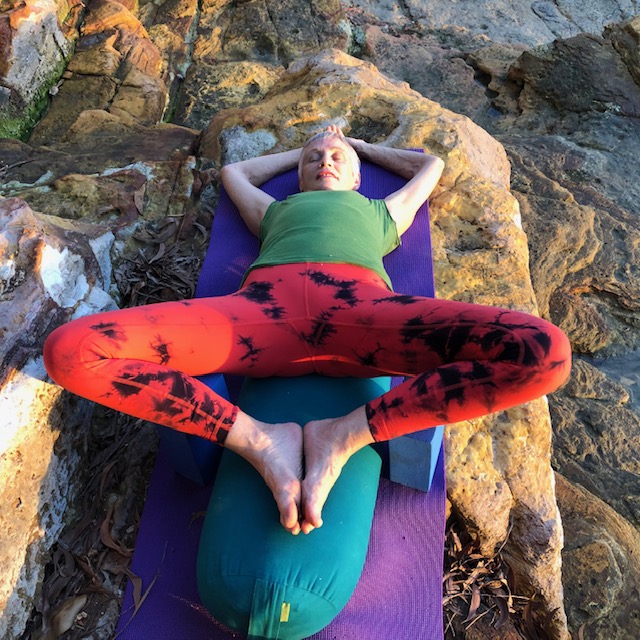
Good choices are Legs Up The Wall (Viparita Karani), Reclining Hero Pose (Supta Virasana), and Reclining Bound Angle Pose (Supta Baddha Konasana), all done with props. Our note on legs up the wall shows the set-up. Aim for a couple of these a day, and stay up to five minutes in the lying poses.

Chris in Reclining Bound Angle Pose (Supta Baddha Konasana) over bolsters. A resting pose to begin a build-up practice.
We also teach a supported bridge with the legs in Bound Angle (Baddha Konasana). The bolster sits just below the shoulder blades so the heart is higher than the head, with a support under each knee. Many students find it calming, and find that it opens the chest so the breath comes more easily.
Supported Bridge Pose with the legs in Bound Angle (Baddha Konasana). Ask your teacher to set up the supports.
What about standing poses and props?
Do standing poses slowly and avoid doing them mechanically. Stay for short periods, rest, and repeat. In the build-up our calves get tight, so Downward Facing Dog (Adho Mukha Svanasana) is a good one, with a rest in Forward Hero Pose (Virasana) in between. See our note on Downward Facing Dog.
Props let you stay longer and spend less effort. Belts, blocks, chairs and ropes help you move blood around the body, and they can bring back a light, playful feel to practice. A prop does not make a pose easy. Your muscles still do the work. There is nothing weak about props, and we say more in using props in yoga.
Which forward bends and inversions suit the heat?
Keep them gentle, with the head supported. Forward bends that are not too intense, with props so you can stay a while, cool the body and settle the mind. Resting the head also helps. We teach that stronger inversions and intense forward bends can wait for the wetter, cooler weeks, when you have more energy. If you are new, the stronger inversions are not for you yet anyway.
Work steadily with the forward bends now, and you will be in good shape to play with the deeper ones later.
Why are backbends so good for flat moods?
Many students find a backbend lifts a flat mood. A backbend in every practice is a good strategy for the build-up, for the irritability and flatness that can creep in when the rain does not come. Chris has said she does some form of backbend every day. When she has energy it is active, and when she does not it is supported, with blocks or from a chair.
Use props so you save energy and do not overload your nervous system. Chest-opening poses over a bolster, or over a barrel prop, help too. End with poses that quieten you, such as a supported Plough Pose, a supported bridge and Relaxation Pose (Savasana).

Chris in a supported backbend over a chair. The chair does some of the work, so it takes less effort. Learn this one in class.
Should you practise in the morning or the evening?
Both work, but they feel different. In the cool morning, Chris often starts with breath practice and then moves into her asana, including active poses. After the heat of the day, the evening practice is gentler.
On an evening after a hot day, a cool-down like this works well:
- Legs Up The Wall for 5 to 10 minutes.
- A few lying poses over a bolster for 5 to 8 minutes.
- Standing poses, and Downward Facing Dog with the head supported.
- Backbends with props, such as a chair, because they take less effort.
- Forward bends with the head supported, to quieten the mind and help you unwind.
- A long Savasana to finish.
Some students already do headstand and shoulderstand, and Chris includes them in her own practice. They are advanced, and they come with a teacher, so skip them if you are new. Our note on why the order of poses matters explains why this order works. Late in the day, a cool-down can also help you sleep. See yoga for sleep.

Lying back over cross bolsters, late in the day. Chris finds it recovers energy and opens the chest.
Which breathing helps in the heat?
Breathe slowly and stay aware of each breath. If you are panting, you are overdoing it, so back off. Practise breath work early in the day, or late after the sun goes down.
Sitali and Sitkari are cooling breath practices. In Sitali, the tongue is curled. In Sitkari, it lies flat and the breath makes a hissing sound between the lips. They breathe in through the mouth on purpose, as taught techniques, which is not the same as the habit of mouth breathing in our note on mouth breathing. Learn them from a teacher, and read is pranayama safe first. Stop if you feel dizzy.
What about windy days?
On windy days, go for poses that ground you. When the wind blows, some people feel scattered, irritable and anxious. In the Indian tradition, wind is linked with the air element, and the answer is to connect with the earth element: standing poses, seated poses and forward bends.
Press down through the feet, spread the toes and make your base broad and steady. A foot against the wall, or belts around the legs, help if you feel wobbly. In seated poses and forward bends, rest the head on a bolster or chair.
What should you watch for?
Learn to watch yourself. Going troppo happens to all of us at some point, even if it is only snapping at someone. Yoga gives you a bit of space to see yourself, and to sit with strong feelings in the body without acting on them. If you feel faint, confused or very unwell in the heat, stop, cool down and get medical help.
If your mood stays low or you are very anxious, talk to your yoga teacher, your yoga therapist, and your doctor if you wish. Our posts on yoga for anxiety and on how to calm your nervous system have more.
Practise this at Flametree
Your first class is free if you’re new to Flametree. New students, and anyone who has been away three months or more, can also get a half price 10 class pass with 2 extra classes free, to use online, in the studio, or both. We teach in the studio at Woolner and Coolalinga in Darwin and LIVE online. For the studio, just come along. For an online class, click the class time you want and we email you the link to join.
- Beginners: see the half price 10 class pass for new and lapsed students
- Not a beginner: see the half price 10 class pass for new and lapsed students
- The timetable, including online classes
Can’t make a class? Practise at home with our video courses.
Questions people ask about Darwin’s build-up season
What is the build-up season in Darwin?
The build-up is the hot, humid stretch before the wet season starts, when the dry winds weaken, humidity rises and storm clouds form but rarely bring rain. Many people feel tired, irritable and sleep poorly in it. Locals call it mango madness or going troppo.
Why do I feel so tired and irritable in the build-up?
Heat and humidity make everything take more effort, and the nights stay warm, so rest is poorer. In our teaching, practice that includes rest, props and slow breathing helps people stay steady. If your mood stays low, talk to your yoga teacher, your yoga therapist, and your doctor if you wish.
What yoga poses are best for the build-up season?
Resting poses over bolsters, such as Legs Up The Wall and Reclining Bound Angle Pose, come first. Then short, supported standing poses, gentle forward bends with the head supported, and a supported backbend. Save strong inversions and intense forward bends for cooler weeks.
Should I do yoga in the morning or the evening in the build-up?
Either. In the cool morning you can do a more active practice and breath work. After a hot day, an evening cool-down of resting poses, supported backbends, gentle forward bends and a long Savasana works well.
What is cooling yoga?
Cooling yoga is practice done to calm and soothe the nervous system, with less effort and more support. It includes standing poses done in a cooling way, a quieter intention, and attention to how air moves over the body. It is not only restorative yoga.
Can yoga help me sleep in the build-up?
Many students find a cool-down before bed helps. Legs Up The Wall, lying poses over a bolster and a long Savasana are good places to start, and our yoga for sleep post gives a full sequence. We cannot promise sleep, and poor sleep that continues is worth raising with your doctor.
Are cooling breaths like sitali and sitkari safe?
They are taught techniques, so learn them from a teacher and read our post on whether pranayama is safe first. Breathe slowly, and stop if you feel dizzy. Sitali and Sitkari are different from the habit of mouth breathing.
Where can I do yoga for the build-up in Darwin?
Flametree Yoga Studio teaches Iyengar yoga in the studio at Woolner and Coolalinga in Darwin and LIVE online, so you can practise from home on the worst days. Your first class is free if you’re new to Flametree.
Flametree Yoga Studio, Darwin NT, teaching Iyengar yoga in the studio and LIVE online. This note is general information, not medical advice.
Sources
- Weatherzone: Angus Konta, Top End in the midst of the build-up, 2025 (description of the build-up weather).
- Flametree teaching notes by Chris Lalor, Senior Iyengar Yoga Teacher, on practising in Darwin’s build-up (Flametree Facebook page, 2018 to 2024).
- Teaching on practising in windy weather, as shared by Flametree Yoga Studio (2022).



