
Yoga And Chronic Pain: What The Research Suggests About The Brain And Pain
Yoga and chronic pain: the short version
Pain that has lasted for months can make you feel on guard, and afraid to move. Researchers have asked whether yoga changes how the brain and body handle pain. The honest answer so far is modest. Reviews of trials find small improvements, scans show differences in long-term practitioners, and none of it shows that yoga is a treatment for chronic pain. Here is what the research says, with its limits, and how an Iyengar class can be adapted when pain is part of your life.
This note in short form
- Reviews of trials: exercise, including yoga, may give small improvements in chronic pain and movement, but the evidence is low quality.
- Brain scan study: experienced practitioners tolerated pain more than twice as long as matched controls, but a comparison cannot show that yoga caused it.
- Not shown: that yoga is a treatment for chronic pain, or that it changes the brain’s pain circuits.
- Pain is real: the brain is part of how every pain is made, which does not mean it is imagined.
- Safety: go gently, use props, and see a doctor first for new or changing pain.
- Next step: try a class in the studio or LIVE online. Your first class is free if you’re new.
Back to our Back Care notes.
What is chronic pain, and why does the brain come into it?
Chronic pain is usually defined as pain that lasts beyond the normal time for healing, generally taken to be 12 weeks. A Cochrane overview (Geneen and colleagues, 2017) puts the average rate in adults at about 20 percent. It is a very common problem, and it can affect sleep, mood and daily life.
Pain is always real. It is also always produced by the brain and nervous system, which weigh up signals from the body along with attention, emotion and memory. A 2013 review in Nature Reviews Neuroscience (Bushnell, Ceko and Low) looked at how the brain controls pain through attention and emotion. It also described evidence that chronic pain itself alters brain circuits involved in controlling pain, which may be why controlling pain becomes harder as it becomes chronic.
In her book Yoga for Pain Relief, Kelly McGonigal describes some chronic pain as a learned, overprotective response: a nervous system that stays on guard and treats harmless sensations as threats. That is her explanation, drawn from the research she reviews, and it is an idea rather than a proven mechanism. It does explain why yoga researchers have been interested in attention, breathing and relaxation.

Supported rest over a bolster. Props let the body be held while the breath slows.
What did the brain scan study find?
The study people quote most is a small one by Villemure and colleagues, in Cerebral Cortex in 2013. It compared a small group of experienced yoga practitioners with individually matched people who did not practise. The practitioners tolerated pain for more than twice as long. They also had more grey matter (brain tissue) in several brain regions, and in a region called the insula, the amount of grey matter went with pain tolerance. Among the practitioners, more insula grey matter went with more years of yoga.
The authors also found that the practitioners used different mental strategies to cope with pain, involving the body’s calming side (parasympathetic activation) and attention to inner sensations (interoceptive awareness). They suggest this may explain the brain differences.
That is the research rung of the ladder, and it has limits. It compared two groups at one point in time, so it cannot show that yoga caused the differences. People who choose yoga may differ in other ways. The published summary also describes practitioners and controls, not people living with chronic pain, so it does not tell us that yoga reduces chronic pain.
What do reviews of trials say?
The Cochrane overview mentioned above (Geneen and colleagues, 2017) gathered 21 reviews, covering 381 studies and 37,143 people, of physical activity and exercise for chronic pain. Yoga, Pilates and tai chi were among the types of exercise included, with walking, strength and stretching. The authors said the quality of the evidence was low, mostly because the studies were small and short. Several reviews found favourable results for pain, but the results were not consistent. Physical function improved in 14 reviews, mostly by small to moderate amounts. Few adverse events were reported, and most were extra muscle soreness that settled after a few weeks.
For back pain, the best studied type of chronic pain in yoga research, a Cochrane review of yoga (Wieland and colleagues, 2022) included 21 trials. Compared with no exercise, yoga gave small improvements in pain and back function, which the authors judged not clinically important. It made little or no difference compared with other back exercise for function. The review also found more adverse events with yoga than with no exercise, mostly more back pain, which is a good reason to go gently. Our notes on yoga for lower back pain and back pain over 50 go through that research in detail.
Why might yoga help? (still being studied)
Three ideas keep coming up, and all three are still being studied. The first is attention: learning to notice your body and breath, rather than bracing against pain. The second is the body’s calming side, which our note on how to calm your nervous system explains. The third is moving safely again, because exercise of many kinds is associated with better movement in people with chronic pain.
Not yet tested is not the same as wrong, but it is not proven either. If yoga helps, it may be one useful part of looking after yourself, alongside whatever your doctor or physiotherapist advises.
Iyengar yoga is the style developed by Mr BKS Iyengar. In the 20th century he did more than anyone to set down traditional Indian yoga, through his books and his teaching, and he pioneered the use of props. It is sometimes called modern classical yoga, and it’s the style we teach at Flametree.
How can an Iyengar class be adapted when you have pain?
This is where props earn their place. A bolster lets you lie and breathe without strain, a chair can take the weight in a forward bend, a wall helps with balance, and a belt lets you reach a leg without pulling your back. The pose is brought to you, rather than you having to reach the pose. A class can also be slow, with pauses to rest, and you can take a restorative class when a day is hard.
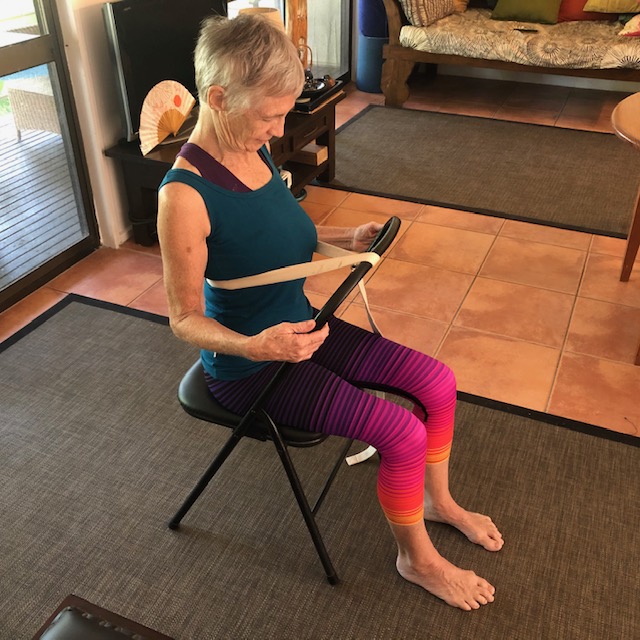
Chris sitting on a chair with a belt, so she can sit tall and breathe without effort. A class can be adapted like this on a hard day.
You are never asked to push through pain. Aim for a stretch or a mild effort that you can breathe through, and come out of a pose if it feels sharp. Tell your teacher before class about where your pain is and what makes it worse, so they can change the poses.

A standing forward bend with a chair taking the weight of the arms.
Who should check first?
New pain, or pain that is changing, deserves a proper check. Talk to your yoga teacher, yoga therapist, and your doctor if you wish, before you start. Some signs need a doctor straight away: numbness around the saddle area, a change in bladder or bowel control, leg weakness that is getting worse, pain after a fall, fever, or night pain that does not ease. Yoga does not replace medical care, and it is not a reason to stop your medication or physiotherapy.
Practise this at Flametree
Your first class is free if you’re new to Flametree. New students, and anyone who has been away three months or more, can also get a half price 10 class pass with 2 extra classes free, to use online, in the studio, or both. We teach in the studio at Woolner in Darwin and LIVE online. For the studio, just come along. For an online class, click the class time you want and we email you the link to join.
- Beginners: see the half price 10 class pass for new and lapsed students
- Not a beginner: see the half price 10 class pass for new and lapsed students
- The timetable, including online classes
Can’t make a class? Practise at home with our video courses.
Questions people ask about yoga and chronic pain
Can yoga help with chronic pain?
It may help some people a little. Reviews of exercise for chronic pain, which include yoga, found small improvements in pain and movement, but the evidence is low quality. Yoga is not a replacement for medical treatment of chronic pain, and it works best alongside your doctor’s advice.
Is it safe to do yoga with chronic pain?
Usually, if you go gently and use props. A Cochrane review of yoga for back pain found more adverse events than no exercise, mostly more back pain, so tell your teacher about your pain and never push through it. See a doctor first for new or changing pain.
Does yoga change how the brain handles pain?
A 2013 scan study found experienced practitioners tolerated pain longer than matched controls and had more grey matter in some regions. It compared groups at one point in time, so it cannot show that yoga caused the difference.
Is chronic pain all in your head?
No. Pain is real, and the brain is part of how every pain is made. Research shows that attention, emotion and memory affect how pain is felt, which is not the same as saying it is imagined.
What type of yoga is best for chronic pain?
The research does not settle it. Most of the back pain trials used Iyengar, hatha or viniyoga. We teach Iyengar yoga, which uses props, so poses can be changed to suit your body.
How long before yoga helps with pain?
Nobody can promise a timeline. The back pain trials usually measured results at about three months. Practising regularly and gently, with a teacher, is what the research tested.
Can I do yoga instead of other pain treatment?
No. Yoga has been studied as an addition to usual care, or compared with other exercise, not as a replacement. Talk to your yoga teacher, yoga therapist, and your doctor if you wish, before changing any treatment.
Where can I learn yoga for chronic pain in Darwin?
Flametree Yoga Studio teaches Iyengar yoga in the studio at Woolner in Darwin and LIVE online, with props and a chair. Tell your teacher about your pain before class. Your first class is free if you’re new to Flametree.
Flametree Yoga Studio, Darwin NT, teaching Iyengar yoga in the studio and LIVE online. This note is general information, not medical advice.
Sources
- Villemure C, Ceko M, Cotton VA, Bushnell MC. Insular cortex mediates increased pain tolerance in yoga practitioners. Cerebral Cortex, 2013. doi:10.1093/cercor/bht124
- Bushnell MC, Ceko M, Low LA. Cognitive and emotional control of pain and its disruption in chronic pain. Nature Reviews Neuroscience, 2013. doi:10.1038/nrn3516
- Geneen LJ, Moore RA, Clarke C, Martin D, Colvin LA, Smith BH. Physical activity and exercise for chronic pain in adults: an overview of Cochrane Reviews. Cochrane Database of Systematic Reviews, 2017. doi:10.1002/14651858.CD011279.pub2
- Wieland LS, Skoetz N, Pilkington K, Harbin S, Vempati R, Berman BM. Yoga for chronic non-specific low back pain. Cochrane Database of Systematic Reviews, 2022. doi:10.1002/14651858.CD010671.pub3
- McGonigal K. Yoga for Pain Relief. New Harbinger Publications.



