How Many Calories Does Walking 1 km Burn? The Chocolate Test
Short answer: an average adult of about 70 to 75 kg burns roughly 50 to 65 calories for every kilometre walked, so burning off a 200g block of milk chocolate (about 1,100 calories) takes a walk of around 20 km. Running burns calories faster, but not much more per kilometre, so it still takes roughly 16 to 22 km depending on your weight and the estimate used. Exercise is good for you in many ways, but for most people it is much easier to eat a little less than to burn it off, which is why Flametree teaches mindful eating alongside yoga.
- Walking: about 50 to 65 calories per km for a 70 to 75 kg adult.
- Running: roughly 1 calorie per kg of body weight per km (about 70 calories per km at 70 kg).
- 200g block of milk chocolate: about 1,070 to 1,100 calories (about 4,500 kJ).
Calories in a typical block of chocolate
Senior Iyengar teacher Chris Lalor suggests mindful eating instead.
Burning off calories after the event is hard work for most people. See why below, and why Flametree suggests mindful eating, supported by yoga and pranayama (breath meditation), instead.
A standard chocolate block (200g) contains approximately 1,100 calories (or about 4,460 kJ)[1][2].
This figure is based on common brands such as Cadbury Dairy Milk, which averages around 525 to 540 calories per 100g, making a 200g block roughly 1,050 to 1,100 calories[1][2][3].
How Far You Need to Walk to Burn Off a 200g Chocolate Block
The number of calories burned while walking depends on your weight, walking speed, and terrain.
For an average adult (around 70 to 75 kg), walking burns about 50 to 65 calories per kilometer at a moderate pace[4][5]. Some sources round this up to about 100 calories per mile (1.6 km)[6][5].
Calculation
- Calories in 200g chocolate block: ~1,100 calories[1][2]
- Calories burned per kilometer (average adult): ~50 calories[4][5]
Distance required to burn 1,100 calories:
So, you would need to walk about 22 kilometers (approximately 13.7 miles) at a moderate pace to burn off the calories from a typical 200g block of chocolate.
Even half the block needs an 11 kilometre walk to get back to where you were before you ate it.
It is one reason why weight can so easily creep up on us.
Summary Table
|
Item |
Calories |
Distance to Walk (average adult) |
|
200g chocolate block |
~1,100 |
~22 km (13.7 miles) |
Additional Notes on the table
- Heavier individuals burn more calories per kilometer, so the distance may be slightly less if you weigh more, and slightly more if you weigh less[6][4][5].
- Walking faster, uphill, or with added weight will increase calorie burn per kilometer, reducing the total distance needed[6][5].
Short summary about burning off chocolate
Eating a whole 200g block of chocolate means you’d need to walk about 22 kilometers to burn it off, for an average adult walking at a moderate pace[1][5].
What is the average calorie content of milk chocolate blocks
The average calorie content of milk chocolate blocks is approximately 530 to 540 calories per 100 grams[7][8]. This is consistent across major brands, including Cadbury Dairy Milk, Woolworths, Haigh’s, and Koko Black, which all list values in this range per 100g serving[7][9][10]. For example:
- Cadbury Dairy Milk: 525 to 535 kcal per 100g[7][8]
- Haigh’s Milk Chocolate: 533 kcal per 100g (2230 kJ)[9]
- Koko Black Intense Milk: 554 kcal per 100g (2320 kJ)[10]
In summary of chocolate calories:
A typical 100g block of milk chocolate contains about 535 calories. Larger blocks (e.g., 180g or 200g) will contain proportionally more calories, so a 200g block would average around 1,070 calories[7][8].
Why does burning 1100 calories require about 22 km of walking
Burning 1,100 calories requires about 22 km of walking because the number of calories you burn while walking is closely tied to your body weight and the distance you cover. A commonly used estimate is that an average adult burns about 50 to 60 calories per kilometer walked at a moderate pace[11][12].
Here’s the breakdown:
- Calorie burn per kilometer: For a person weighing around 70 to 80 kg, walking 1 km typically burns about 50 to 80 calories[11][12].
- Total calories to burn: 1,100 calories (the amount in a typical 200g block of milk chocolate).
- Distance required: 1,100 calories divided by about 50 calories per km is about 22 km.
This estimate matches real-world tracking data: for example, a person walking about 16.5 km (20 to 22,000 steps) reports burning around 1,100 calories, according to fitness trackers and calculators[13][12].
Why so far to run or walk?
Walking is a moderate-intensity, weight-supported activity, so it doesn’t burn calories as rapidly as running or other vigorous exercise. The energy expenditure per kilometer is relatively low, so covering a large distance is required to burn off a high-calorie food like a block of chocolate.
Key factors in the distance needed:
- Heavier individuals burn more calories per kilometer, so the distance may be slightly less for them, and vice versa for lighter individuals[11][12].
- Walking speed and terrain can also affect calorie burn, but distance is the primary factor for most people at moderate paces[11].
You need to walk about 22 km to burn 1,100 calories because each kilometer of walking burns a modest number of calories, and the total adds up over a long distance[11][12][13].
Running: how far would you need to run to burn off 1,100 calories?
A common rule of thumb is that running burns roughly 1 calorie per kilogram of body weight per kilometre, whatever your speed. By that rule, a 70 kg person burns about 70 calories per km and would need to run about 16 kilometres to burn 1,100 calories, and a 90 kg person about 12 km. Online calculators that use lower figures give 18 to 22 km for an average adult.
How This Is Calculated
- General Rule: The average person burns about 60 calories per kilometer run, or about 100 calories per mile[14][15].
- Body Weight Factor: Heavier individuals burn more calories per kilometer. For example, a person weighing 70 kg (about 154 lbs) burns around 50 to 65 calories per kilometer, while someone weighing 80 to 90 kg will burn slightly more[16][17].
- Calculation: at the lower end of 50 to 60 calories per km, 1,100 calories takes about 18 to 22 km.
- Typical Range:
Key Points about running to achieve burn off
- Running speed has little effect on total calories burned per kilometer; calorie burn is primarily determined by distance and your weight[18][14].
- Running on an incline or at a higher intensity can increase the calories burned per kilometer[18][16].
- These numbers are estimates and can vary based on individual metabolism, running efficiency, and terrain.
To burn 1,100 calories, you would need to run about 18 to 22 kilometers (11 to 13.7 miles), with the exact distance depending on your weight and running conditions.
Can a treadmill or outdoor running alter how far I must go to burn that many calories
The distance you need to run to burn 1,100 calories is only slightly affected by whether you run on a treadmill or outdoors. The main reason: calorie burn per kilometer (or mile) is very similar for both, provided you adjust for certain factors.
Key Differences
- Outdoor Running: You typically burn a bit more calories outdoors because you face wind resistance and potentially varied terrain[19][20]. Studies estimate this difference to be about 5% more calories burned outdoors compared to a treadmill at the same speed and incline[19].
- Treadmill Running: Running on a flat treadmill is slightly easier because there’s no wind resistance and the belt assists your stride slightly. However, setting the treadmill to a 1% incline compensates for this and makes the calorie burn nearly identical to outdoor running[21][22][19].
Practical Impact
- If you run outdoors: You might burn 5% more calories per kilometer, so you could cover a slightly shorter distance to burn 1,100 calories.
- If you run on a treadmill (flat): You’ll need to run a bit farther to burn the same calories.
- If you run on a treadmill (1% incline): The calorie burn per kilometer is virtually the same as running outdoors, so the distance required to burn 1,100 calories is about the same[21][22][19].
Example Calculation
- Average calorie burn: ~60 calories per kilometer running (varies with weight and speed)
- Distance to burn 1,100 calories:
Summary Table of outdoor versus treadmill
|
Running Type |
Distance to Burn 1,100 Calories |
|
Outdoor |
18 to 22 km |
|
Treadmill (1% incline) |
18 to 22 km |
|
Treadmill (flat) |
Slightly more than 18 to 22 km |
There’s little practical difference in the distance you need to run to burn 1,100 calories on a treadmill (with a 1% incline) versus outdoors. Outdoor running burns slightly more calories due to wind and terrain, but this can be matched on a treadmill by using a small incline[22][19][20].
Mindful eating, yoga and weight
Yoga itself burns a modest number of calories. Where many students find it helps with weight is through mindfulness: noticing hunger and fullness, and eating less without feeling deprived. See mindful eating and weight and Chris on intermittent fasting.
Iyengar yoga beginner classes in Darwin and online
Do beginner yoga classes at Woolner or Coolalinga, live online, or any mix. See the beginner timetable.
In the yoga tradition, yoga and pranayama meditation build the mindfulness that supports mindful eating, so it is easier not to eat too much in the first place.
If you are new, your first class is free. Then beginners, new or away three months or more, get the beginner deal: 10 classes at half price plus 2 free, $59.50 in total, with no code and a 14-day money-back guarantee. Already practising yoga? The non-beginner deal is $104.50 for 12 classes.
Chris Lalor, Flametree Iyengar Yoga Darwin NT Senior Yoga Teacher
Yoga Class online or studio get your link to join
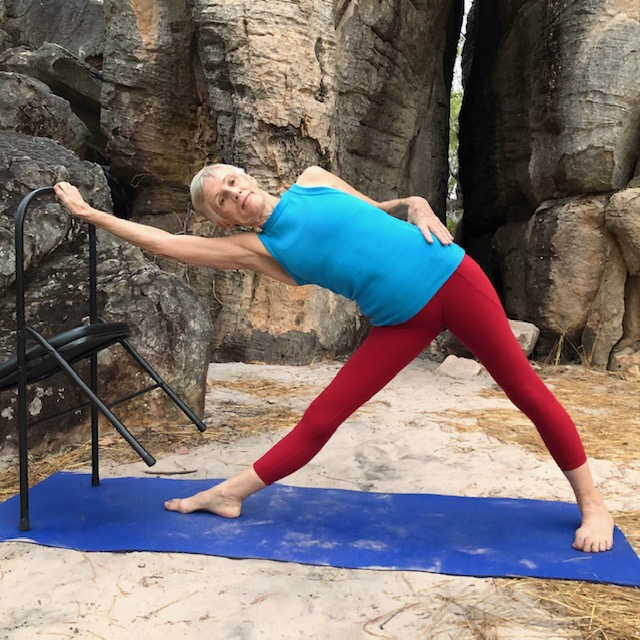
Triangle pose. Flametree teaches Iyengar yoga for all ages, sizes and genders, at Woolner, Coolalinga and online.
Walking and yoga both have plenty of benefits, and are well worth doing, separately or together. But it is important to manage what you eat as well.
So, make mindful eating part of your yoga driven practices.
Flametree Iyengar yoga class deals
Casual beginner yoga class, $14
Newcomer & lapsed: 10 at HALF price plus 2 FREE, $59.50
Non-beginners: 10 at HALF price plus 2 FREE, $104.50
Burning calories: common questions
How many calories do you burn walking 1 km?
About 50 to 65 calories for an average adult of 70 to 75 kg at a moderate pace. Heavier people burn more per kilometre, lighter people less, and hills or a faster pace add a little more.
How far do you have to walk to burn off a block of chocolate?
A 200g block of milk chocolate has about 1,100 calories, so an average adult would need to walk around 20 km to burn it off. Even half a block is a walk of about 10 km.
How many calories do you burn running 1 km?
Roughly 1 calorie per kilogram of body weight per kilometre, whatever your speed. A 70 kg person burns about 70 calories per km; a 90 kg person about 90.
How many calories are in a 200g block of milk chocolate?
About 1,070 to 1,100 calories (around 4,500 kJ). Most milk chocolate brands in Australia have about 530 to 540 calories per 100g.
Does running on a treadmill burn fewer calories than running outside?
Slightly. Running outdoors burns a little more because of wind and uneven ground. Setting the treadmill to a 1% incline roughly makes up the difference.
Is it easier to eat less than to burn calories off?
For most people, yes. Burning off a single treat can take hours of walking, while eating a little less takes no time at all. That is why mindful eating matters as much as exercise for managing weight.
Can yoga help with mindful eating?
Many students find it does. Yoga and breath meditation train you to notice sensations in the body, which can make it easier to notice hunger and fullness. See Flametree’s mindful eating and weight page.
Where can I do yoga for mindful eating in Darwin or online?
Flametree teaches beginner Iyengar yoga at Woolner and Coolalinga in Darwin, and live online. If you are new, your first class is free. See the beginner timetable.
Flametree acknowledges the traditional custodians of the lands on which we teach yoga, as well as all First Australians.
Sources
- https://www.haighschocolates.com.au/milk-chocolate-block-200g
- https://www.nutracheck.co.uk/calories/calories_in_snacks_and_confectionary/calories_in_chocolate
- https://www.whitakerschocolates.com/blogs/blog/how-many-calories-in-a-chocolate-bar-uk
- https://novi-health.com/library/calories-walking-burn
- https://www.parashospitals.com/blogs/walking-and-caloric-burning
- https://www.goodhousekeeping.com/health/fitness/a47008/calories-burned-from-walking/
- https://cadbury.com.au/products/cadburydairymilkmilkchocolateblock180g/
- https://www.nutracheck.co.uk/calories/calories_in_snacks_and_confectionary/calories_in_chocolate
- https://www.haighschocolates.com.au/milk-chocolate-block-200g
- https://www.kokoblack.com/products/no-41-intense-milk
- https://www.parashospitals.com/blogs/walking-and-caloric-burning
- https://www.omnicalculator.com/sports/steps-to-calories
- https://www.reddit.com/r/CICO/comments/1f4q1vo/how_good_is_walking_for_burning_calories/
- https://www.runnersworld.com/uk/health/weight-loss/a763166/running-calorie-calculator/
- https://www.verywellfit.com/how-many-calories-does-running-burn-2911108
- https://www.vinmec.com/eng/blog/how-many-calories-does-running-1km-reduce-en
- https://www.reddit.com/r/Fitness/comments/4a9yev/how_many_calories_does_runningjogging_really_burn/
- https://www.omnicalculator.com/sports/running-calorie
- https://www.bbc.co.uk/programmes/articles/ysr7Wh1vMSgrrf8zBnnRHw/which-is-better-running-on-a-treadmill-or-outdoors
- https://www.bexleypools.com.au/running-on-a-treadmill-vs-outside-which-one-is-better-for-you/
- https://www.reddit.com/r/Fitness/comments/au10q6/is_there_a_significant_difference_between_running/
- https://www.livestrong.com/article/388802-treadmill-vs-running-outside/