
Weight Bearing Exercises For Osteoporosis: The Four Bones To Reach, And The Yoga Poses That Reach Them
Weight bearing exercises for osteoporosis: the short answer
A weight bearing exercise is any movement where your bones carry your weight against gravity. For osteoporosis, the useful question is not “am I weight bearing?” but “which bone is carrying the load?” Walking loads the legs. It does almost nothing for the wrist, the shoulder or the spine, and those are common places to break.
In an Iyengar class, one practice can reach all four. Standing and single-leg poses load the hip. Weight on the hands loads the wrist and shoulder. A long, lifted spine loads the back.
- Hip: standing poses, held, and poses on one leg.
- Wrist and shoulder: Downward Dog and Plank, built up gradually on a ladder from the wall.
- Spine: gentle backbends and a long, tall spine. Avoid loaded forward rounding.
- How often: short, regular bouts beat one long session.
- The limit: the loading logic is solid. Whether yoga changes a bone scan is still being studied.
- New students: 12 classes for $59.50, in Darwin or LIVE online.
Last updated: 25 October 2026

Half Moon Pose. The standing leg carries the body, and the hip is loaded from the side.
What makes an exercise “weight bearing”?
Standing is weight bearing, because your leg bones carry you. In a pool or on a bike seat, the water or the seat holds you up, so the bones carry much less.
Bone only grows where it is loaded, and only when the load is more than it is used to. That is the idea behind Wolff’s law, which we explain in our post on Wolff’s law. It leads to a simple plan: find the bones you want to protect, then find a load for each one.
Why is walking not enough for osteoporosis?
Walking is good, but our legs already do it all day, so it is no longer a new signal. It also loads the thigh bone front to back. Almost nothing in an ordinary day loads it from the side. And walking puts close to nothing through the arms. The wrist, in particular, carries almost no weight in daily life.
So walking alone leaves gaps. For the full story, see our post on how to increase bone density.
Which four bones does a good practice need to reach?
Think of four places: the wrist, the upper arm at the shoulder, the hip and the spine. They are common places for an osteoporotic break, and each needs a different kind of load.

Four bones, four kinds of load. Walking reaches only the legs.
Here is how the poses sort out.
Which poses load the hip?
Standing poses do most of the work. Warrior 2, Triangle, Side Angle and Half Moon hold the legs under load for long enough for the bone to notice. They also push the hip sideways, a direction walking never uses. Bone answers an unfamiliar direction better than a familiar one.
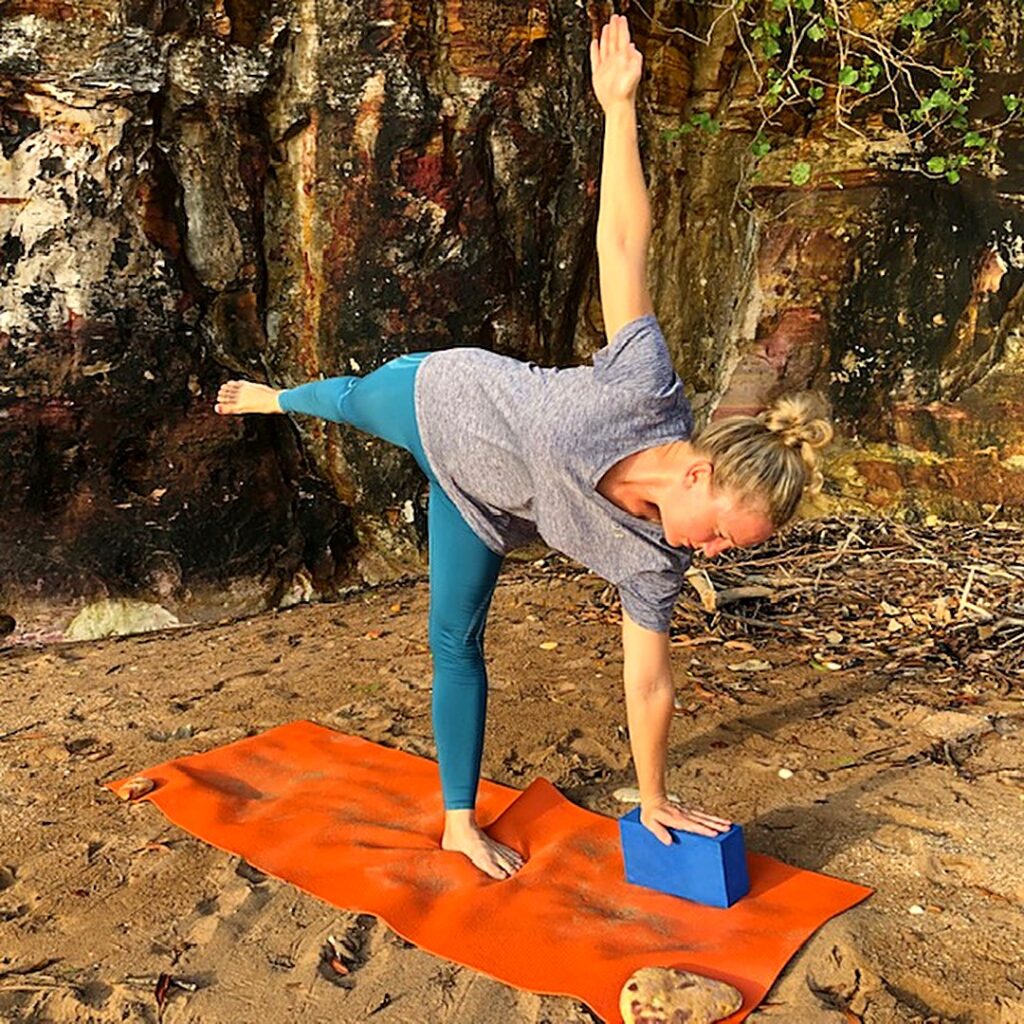
Half Moon with a block. The block brings the floor up to you, so the pose can be held with a long spine.
Single-leg poses add more. When you lift one foot, the standing leg and hip carry the whole body. Half Moon and Warrior 3 go further, because the lifted leg and the trunk reach out like a long lever.

Warrior 3 with a chair. The hand rests on the chair so you can hold the pose with a straight standing leg.
There is real evidence on one-leg standing and falls. A 2012 Japanese trial followed 865 people aged 75 or older who could stand on one leg for 15 seconds or less. Half did one minute on each leg, three times a day, holding on to something if needed. After six months, the women in the exercise group fell less. The trial did not show a clear difference in fractures. So single-leg work is a good tool for falls. For bone density itself, it is not yet shown.
You cannot break a hip you do not fall on. Our post on how to improve balance goes into this.
Which poses load the wrist and shoulder?
This is the biggest chance most of us have. Your arms carry almost nothing in a normal day, so the bar is set very low. Almost any real weight through the hands is a big step up.
Downward Dog, Plank and Side Plank all send weight through the wrist and up into the shoulder. Side Plank puts the load on one arm at a time.

Side Plank. One hand carries the load, so the wrist and shoulder have to do real work.
A caution: wrists need to come up slowly. A sore wrist is a wrist that stops practising, and regular practice is the thing we cannot afford to lose. So we build in steps, on a ladder.

The hands ladder. Start on the rung that feels easy and move up only when it does.
On the first rung, you lean your hands into a wall. On the next, you put your hands on a chair. Then a raised surface like a sturdy table. Finally the floor. If a wrist is sore, step back down a rung and tell your teacher, who will set the rung for you.

Half Downward Dog with the hands on a chair. The hands carry weight, and the angle is kind to the wrists.
What about the spine?
Here the direction matters. Backbends such as Locust, Bridge and Cobra work the muscles along the spine and keep it long and tall. They are a good fit for a spine that is losing density.
Forward rounding under load needs care. In a small 1984 study of 59 women with spinal osteoporosis and back pain, new compression fractures of the spine were more common in women who did flexion (forward bending) exercises than in those who did extension exercises. That study was small and not randomised, so treat it as a caution and not a verdict. The practical rule is simple: keep the spine long in forward bends, and tell your teacher about your diagnosis so they can shape the pose for you. A prop under the hands or a chair in front of you does the job.
How often, and how much?
Short, regular bouts beat one long session. In the classic bird-bone experiment, 36 loads a day built new bone and 1,800 added nothing more. That was a laboratory experiment on a bird, so the numbers are not for us. The idea is: a small dose, often, is the plan.
So two or three classes a week, with a few minutes of practice at home on the other days, makes more sense than one big session. And the class itself must contain the loading. A class with no weight on the hands, no single-leg work and no standing poses held long will help balance and strength. It will not reach the bones described above.
What does the research say so far?
The research is still young. A 2026 review pooled 74 trials of exercise in 5,331 women after menopause. It found that mind-body exercise, which includes yoga, Tai Chi and Pilates, combined with strength work was the best for bone density at the spine and the neck of the thigh bone. Programmes of a year or longer gave the more consistent gains.
Dr Loren Fishman’s team looked at 227 volunteers who kept up a 12-minute daily yoga routine. Their spine and thigh bone density rose, and no yoga-related serious injuries were reported. There was no separate comparison group, so it is a signal and not proof. The routine also put little weight through the hands.
No study has yet tested a full Iyengar practice, with weight on the hands, for bone density. Not yet tested is not the same as wrong. In yoga we call this the three ways of knowing: known from practice, supported by research, and still being studied. The loading logic sits in the first two. How much a class adds to a scan sits in the third.
Where to start
You do not need to be strong or flexible. Props, walls and chairs bring the pose to you. Chris Lalor’s free ebook, Strong Bones, Steady Feet, explains it in plain words. It explains yoga. It does not teach it, because classes do that.
Get the free ebook Strong Bones, Steady Feet. New to Flametree, or away for 3 months or more? You get 2 free classes + 2 ebooks, only available via this offer. Already coming to class? You can still get the book.
New to Flametree, or away for three months or more? The Yoga For Bones And Balance pass gives you 12 classes for $59.50 (10 at half price plus 2 free). Use them at our Woolner and Coolalinga studios or LIVE online. Props are supplied, and there is a money-back guarantee on your first class. Studio classes are for permanent NT residents, and online is open from anywhere.
Read more in our posts on yoga for osteoporosis, whether osteoporosis can be reversed and osteopenia.
Weight bearing questions
What are the best weight bearing exercises for osteoporosis?
The best ones load the bones that tend to break: the hip, the wrist, the shoulder and the spine. Held standing poses and single-leg poses load the hip. Weight through the hands loads the wrist and shoulder. A long, lifted spine and gentle backbends suit the back.
Does swimming or cycling count as weight bearing?
Not much. In water or on a seat your body is held up, so the bones carry less. For bone, the load has to travel through the bone you want to protect.
How often should I do weight bearing exercise for osteoporosis?
Short, regular bouts are better than one long session. Bone responds to a small dose of the right kind of load, then needs rest before it listens again. Two or three classes a week plus a few minutes at home is a sensible plan.
Are weight bearing exercises safe if I have thin bones?
Most people can find a safe way in if the pose is adjusted. Tell your teacher about your diagnosis. Props bring the pose to you, and a wall or chair stays as long as you want it.
How can I put weight through my wrists without hurting them?
Use the hands ladder. Start with your hands on a wall, then a chair, then a raised surface, then the floor. Move up a rung only when the one you are on feels easy.
Which forward bends should I avoid with osteoporosis?
Avoid loaded forward rounding of the spine. Keep the spine long, put a prop under your hands, and ask your teacher to shape forward bends for you.
Sources
- Sakamoto K, Endo N, Harada A, et al. Why not use your own body weight to prevent falls? A randomized, controlled trial of balance therapy to prevent falls and fractures for elderly people who can stand on one leg for 15 s or less. J Orthop Sci 2013. PubMed, DOI
- Sinaki M, Mikkelsen BA. Postmenopausal spinal osteoporosis: flexion versus extension exercises. Arch Phys Med Rehabil 1984. PubMed
- Rubin CT, Lanyon LE. Regulation of bone formation by applied dynamic loads. J Bone Joint Surg Am 1984. PubMed
- Zhou Z, Wei X, Zhang X, et al. Effects of different types of exercise over 24 weeks on bone mineral density in postmenopausal women: a systematic review with pairwise and network meta-analysis. J Sport Health Sci 2026. PubMed, DOI
- Lu YH, Rosner B, Chang G, Fishman LM. Twelve-minute daily yoga regimen reverses osteoporotic bone loss. Top Geriatr Rehabil 2016. PubMed, DOI
- Lalor C. Yoga For Bones: What, Why And How. Flametree Sunday Arvo Masterclass paper, 2026.
This post is general information about yoga. Flametree Yoga Studio, Darwin, Northern Territory.



