Intermittent Fasting And Yoga
Last updated: 25 October 2026.
Intermittent fasting and yoga: the short answer
Many people do yoga while intermittent fasting, but fasting is not right for everyone, and the research on it is still mixed. Chris Lalor, Flametree’s Senior Iyengar Yoga Teacher and certified yoga therapist, has practised intermittent fasting for some years. This page is her story of how yoga and fasting fitted together for her, alongside what an up to date review of the research says, who should not fast, and where to learn yoga in Darwin or online. It is one person’s experience, not advice to fast.
Iyengar yoga is the style developed by Mr BKS Iyengar. In the 20th century he did more than anyone to set down traditional Indian yoga, through his books and his teaching, and he pioneered the use of props. It is sometimes called modern classical yoga, and it’s the style we teach at Flametree. This page sits in our food and habits notes.
Here is the article in short form:
- Yoga and fasting: many people practise both; listen to your body and ease off if you feel weak.
- The terms: 16/8 means 16 hours without food and an 8 hour eating window; 18/6 means 18 and 6.
- Chris’s route: she built up in stages, from 12 hours, over months and years.
- Research: a 2024 review found good evidence for weight and metabolic markers in overweight adults, and calls for more long-term research.
- How yoga helped her: stress, mindfulness and self-discipline made eating habits easier to change.
- Who should not fast: anyone with an eating disorder history, and fasting does not suit everyone.
- Next step: feel free to check with your professional advisers if you wish, but also give yoga a try, starting with a gentle class.
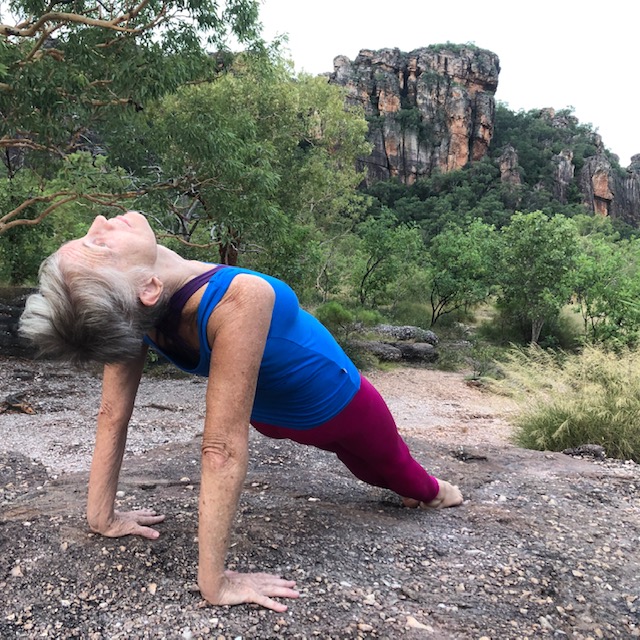
Chris Lalor in Upward Plank Pose (Purvottanasana). Chris says her yoga has kept developing as her eating habits changed.
Can you do yoga while intermittent fasting?
Many people do, and Chris does. There is no rule that says fasting and yoga cannot go together. The sensible approach is to listen to your body. If you feel light-headed or weak, stop, rest and eat, and choose a gentler practice. If you are new to yoga, Chris suggests building slowly in stages, and being careful about strong flowing classes before you are ready for them.
Chris describes her experience as “fairly easy” once she built up gradually, and says her capacity for it grew over months and years. She also says yoga had already built her self-discipline and mindfulness, which she thinks made fasting easier. That is her account, and your experience may be different.

Bound angle pose with support opens the hips without strain.
What do 16/8, 18/6 and 186 intermittent fasting mean?
They describe how many hours you go without food each day, and how many you eat in. Intermittent fasting 16/8 means 16 hours of fasting and an 8 hour eating window. Intermittent fasting 18/6, sometimes written 186, means 18 hours of fasting and a 6 hour window. A 12 hour overnight fast is a gentler version, and seven to nine of those hours are spent asleep.
Chris built up in stages. She began with 12 hours of fasting a day, then moved to 14, 16 and 18 hours. She also describes starting with an 8 hour eating window and shortening it over at least 12 months. Because she teaches in the evening, she skips dinner, while many other people skip breakfast. Her own aim was never a smaller size. She says she was small anyway, and that she enjoyed ice cream. She kept going because of other effects she noticed.

A strap and bolster let the legs open without effort.
What does the research say about intermittent fasting?
A 2024 umbrella review found good evidence of benefit for weight and metabolic markers in overweight adults, and said more long-term research is needed. An umbrella review pulls together many reviews. This one covered 12 meta-analyses and 122 health outcome associations (Hua and colleagues, Diabetes, Obesity and Metabolism, 2024).
- Time-restricted eating (eating within a set window each day) was linked with weight loss, less fat mass, and lower fasting insulin and HbA1c in overweight or obese adults. This was rated high-quality evidence.
- The 5:2 diet was linked with lower LDL cholesterol, also rated high quality.
- Alternate-day fasting (modified) was linked with better body weight, blood fats and blood pressure, but the evidence was moderate to low quality.
- Limits: the authors call for more research on long-term effects, individual plans and possible side effects in different groups of people.
None of this research is about yoga, and most of it is in people who are overweight or obese. It does not show that fasting suits everyone. Chris also points to Dr Jason Fung, a Canadian kidney specialist who writes about intermittent fasting, as one author she found helpful. Like any single author, he gives one view, and you should weigh it against other sources.

A chair makes many poses safe and easy to reach.
How did yoga make fasting easier for Chris?
She says yoga reduced her stress and built mindfulness and self-discipline, and these made her eating habits easier to change. In her account, yoga first helped her manage stress. Reducing stress then reduced her stress-based eating. Bit by bit, yoga also made her more mindful and intentional, partly through holding poses and partly through breath meditation (pranayama). She applied those skills to what she ate, first by cutting sugar, then through fasting. Chris cites Dr Tim McCall, a medical doctor who has reviewed studies for decades, as saying that mindfulness helps with eating habits. Her own words are that it is “not a once only magic bullet” but a day by day process.
She notes that all yoga poses can help reduce stress, and some do it more than others. Simple restful poses such as Legs Up The Wall and supported Bridge Pose, with the feet on a wall and the back on bolsters or blocks, are examples. Our note on how to quit sugar cravings looks at that habit more closely.

A gentle, restful pose with props. Gentle and restorative classes are taught in easy, preparatory stages, so you can work at a pace you can manage.
What changed for Chris, and why does it not prove anything?
Chris reports a smaller waist, steadier energy and stronger yoga, but this is one person’s account, with no measurements in this post. She says her weight stayed steady while her middle became more trim, which she puts down to losing some fat and building some muscle. She says twists became easier, because her arms reach around her body more easily, and that she can feel poses more clearly. Some students noticed the change and worried she was ill. In her words, her health, yoga practice and mind are the best they have been.
These are her observations. They are not a controlled test, and they do not show that fasting caused them. People of all sizes and ages can do yoga very well. Chris says she has also seen other students who fast say similar things, which is again an observation, not a study.

Lying down lets the body rest while it stretches.
Who should not do intermittent fasting?
Anyone with an eating disorder, or a history of one, should not fast. This is a caution Chris states plainly. Fasting may not suit you if any of these apply:
- you have diabetes, or take any regular medicine;
- you are pregnant or breastfeeding;
- you are underweight, or recovering from illness;
- you are under 18.
Do not change or stop any medicine because of something you read here. Yoga works alongside medical care, not instead of it.
Where do inflammation and yoga come in?
Some researchers are looking at whether fasting may affect inflammation, and Chris has written a separate post on yoga for inflammation, which covers Dr Merad’s research. That research is early, so we treat it as an open question. For the weight angle, see our post on Iyengar yoga and weight loss.
Which yoga classes suit someone who is fasting?
A gentle or restorative class is a sensible place to start. These classes teach poses in easy stages, with props, at a pace you can manage. Resting poses such as a forward fold with support, or Child’s Pose, give a break between more active poses. Our notes on gentle yoga for beginners and what restorative yoga is explain what to expect. If you have special issues, or are not sure about yoga, a private class is another way to begin.

Wall ropes help the leg lift and the chest turn.
Practise this at Flametree
Flametree Yoga Studio teaches Iyengar yoga in the studio at Woolner and Coolalinga in Darwin, and LIVE online.
- New to Flametree? Your first class is free. In the studio, just come along. Online, go to our online class list, click the class time you want and we email you the link to join.
- Beginners: new students, and anyone who has been away three months or more, can get a half price 10 class pass with 2 extra classes free, to use online, in the studio, or both. See the beginner half price pass.
- Already practising yoga? The same half price 10 class pass with 2 extra classes free, for new students and for anyone away three months or more, is also available as the non-beginner half price pass.
- See every class time, including online classes, on the timetable.
Can’t make a class? Practise at home with our video courses.
Related reading: yoga for inflammation, Iyengar yoga and weight loss, how to quit sugar cravings and legs up the wall.
Intermittent fasting and yoga: frequently asked questions
Can you do yoga while intermittent fasting?
Many people do. Listen to your body, ease off or stop if you feel light-headed or weak, and choose a gentler class if energy is low. Fasting does not suit everyone, so take extra care if you take medicine or have a health condition.
What does intermittent fasting 16/8 mean?
It means 16 hours of fasting and an 8 hour eating window each day. Intermittent fasting 18/6, also written 186, means 18 hours of fasting and a 6 hour window. A 12 hour overnight fast is a gentler start.
How do I start intermittent fasting?
Chris built up in stages, starting with 12 hours of fasting a day, mostly overnight, and then moving to 14, 16 and 18 hours over months and years. Take extra care if you take medicine, and start gently.
Does intermittent fasting work?
A 2024 umbrella review found high-quality evidence that time-restricted eating was linked with weight loss and lower fasting insulin in overweight or obese adults, and called for more long-term research. Results vary between people.
Does yoga help with intermittent fasting?
Chris says yoga helped her manage stress and built mindfulness and self-discipline, which made her eating habits easier to change. That is one person’s experience, not a trial result.
Who should not do intermittent fasting?
Anyone with an eating disorder or a history of one should not fast. Fasting may not suit you if you have diabetes, take medicine, are pregnant or breastfeeding, are underweight, or are under 18.
Is intermittent fasting safe?
It is not safe for everyone. The 2024 umbrella review authors call for more research on long-term effects and possible side effects. Whether it suits you depends on your own health, and you should never stop a medicine because of something you read online.
What yoga class should I start with if I am fasting?
A gentle or restorative class is a sensible start, because poses are taught in easy stages with props at a pace you can manage. Avoid strong flowing classes until you are ready for them.
Where can I do yoga in Darwin if I am fasting?
Flametree Yoga Studio teaches Iyengar yoga in Darwin and LIVE online, with Senior Iyengar Yoga Teacher and yoga therapist Christine (Chris) Lalor. Gentle and restorative classes suit a quieter day, and your first class is free if you are new to Flametree (in the studio, if you have lived in the NT for three months or more; online, anyone new).
This article is general information, not medical advice. It describes one person’s experience and does not recommend fasting. Feel free to check with your professional advisers if you wish, but also give yoga a try. Flametree Yoga Studio, Darwin and LIVE online.
Sources (studies found through PubMed): Hua Z and colleagues, Intermittent fasting for weight management and metabolic health: an updated comprehensive umbrella review of health outcomes, Diabetes, Obesity and Metabolism, 2024, doi 10.1111/dom.16092. Chris Lalor’s own experience and teaching. Dr Jason Fung and Dr Tim McCall are cited as authors Chris has read and referred to; their views are theirs and are not tested here.