
How To Quiet The Mind: What Geeta Iyengar Taught About The Breath, The Pauses And The Vast Mind
How to quiet the mind: the short answer
Most of us try to quiet the mind by squeezing it: shut the eyes, grit the teeth, think of nothing. It rarely works. Geeta Iyengar taught the opposite. To quiet the mind, make it bigger, not smaller, and let the breath show you where it has gone.
In her pranayama (yogic breathing) classes in Australia in 2009, she used the breath, the small pauses at the end of each in-breath and out-breath, and a long, quiet Savasana (Corpse Pose) as the way in. Here is what she taught, in short form, and how Flametree uses it in its breath meditation classes in Darwin and LIVE online.
- Small mind, vast mind: a crowded mind has no room left to be quiet.
- Focus without shrinking: one-pointed attention, with the mind still wide.
- Witness the mind: watch it, rather than fight it.
- The mind leads the breath: where attention goes, the breath can follow.
- The pauses give clarity: the still points between breaths are where the mind settles.
- Quiet the senses: eyes and ears drawn back, so the inner quiet can be heard.
- The out-breath releases: the mind goes to a part, the breath lets it go.
- Start here: 12 classes, 10 at half price plus 2 free, Darwin or LIVE online.
Last updated: 4 November 2026
Seated pranayama at Flametree

Chris Lalor seated for pranayama. The chest is lifted and steady, so the mind has room to settle.
Who was Geeta Iyengar, and why listen to her on the mind?
Iyengar yoga is the style developed by Mr BKS Iyengar. In the 20th century he did more than anyone to set down traditional Indian yoga, through his books and his teaching, and he pioneered the use of props. It is the style we teach at Flametree.
Geeta S. Iyengar was Mr Iyengar’s eldest daughter. She was a great senior teacher in her own right, and a doctor of Ayurveda (India’s traditional system of medicine). On pranayama, Flametree follows her lead more than anyone’s, because her approach is so practical.
This article draws on recordings of her pranayama classes at the Yoga Retreat Australia in 2009, now held in the Iyengar Yoga Australia e-Library. Short quotes are hers. The rest is our own summary of what she taught.
Why can’t you just tell your mind to be quiet?
Because the part of you giving the order is the busy part. Ask a racing mind to stop, and it starts arguing about whether it has stopped.
Researchers have tried to measure how much the mind wanders. In a 2010 Harvard study published in Science, 2,250 adults were asked through a phone app, at random moments, what they were thinking about. Their minds were off somewhere else nearly half the time, and they were less happy when they were (Killingsworth and Gilbert, 2010).
So a busy mind is normal. Geeta’s answer was not to fight it but to change the way you hold it. We cover the body side of this, giving the mind a job in a held pose, in our post on monkey mind. This article is about the breath side.
A quiet seat by the water
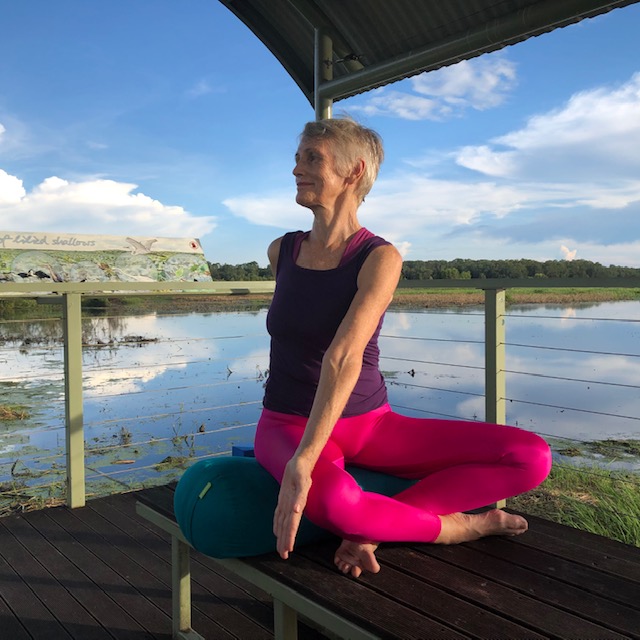
A steady seat on a bolster. The body is settled first, so the mind is not fighting the legs.
What did Geeta Iyengar mean by the small mind and the vast mind?
She meant that a crowded mind cannot be quiet, however hard it tries. Her picture was a sheet of paper already covered in writing. You want to sign it, so you hunt for a corner that is still free. That cramped corner is the small mind.
Each thought that comes in takes up more of the page. Plans, replays and worries fill it, until there is nowhere left to put anything new, including quiet.
Her answer: make the mind vast, like a clean page. She was clear that a mind with a lot in it is not the problem. The problem is a mind that has shrunk around its contents. “It’s not a small mind,” she told the class.
(Geeta S. Iyengar, Yoga Retreat Australia 2009, Iyengar Yoga Australia e-Library recording.)
Making the mind wider, not emptier

Seated at Edith Falls. Geeta Iyengar asked for a mind as wide as the view, not a mind squeezed into a corner.
How do you focus without making the mind tight?
You keep the attention on one point while the mind stays wide. Geeta drew this line sharply. One-pointed attention is part of yoga, but she warned against confusing it with clenching.
“One pointed attention doesn’t mean you have to shrink your brain,” she said.
(Geeta S. Iyengar, Yoga Retreat Australia 2009, Iyengar Yoga Australia e-Library recording.)
She showed what shrinking looks like in practice. The mind goes to the legs and loses what it was holding in the chest, so the chest drops. Or it runs off, and the abdomen puffs and the eyes bulge. She called the mind quick like mercury, landing on one place after another.
The skill is the reverse. She described the mind as stretchable, like elastic. It can reach into one area and still hold the rest. That is why the work done with half the attention is often only half done, even when you think it is finished.
What does it mean to witness the mind?
It means watching what the mind is doing, instead of being swept along by it. Geeta set this apart from ordinary concentration.
When you read, paint or play the guitar, you concentrate on the object: the page, the canvas, the music. In yoga, she said, you also witness the mind itself, its vastness and its clarity, while you work. You are both the one doing and the one watching.
This is what the West now calls mindfulness. In yoga it is built in. You cannot do a pose or a breath practice properly without being present in it, so the practice itself trains the watching.
Seated pranayama at sunset

Sitting tall on blocks, with a belt round the legs, so the body stays steady and the mind can watch.
Does the mind lead the breath, or the breath lead the mind?
In Geeta’s teaching, the mind leads. She asked students to watch what the mind does as the breath comes in. Is the mind spreading the breath, or holding it back?
“The mind shows the path for that breath movement,” she said.
(Geeta S. Iyengar, Yoga Retreat Australia 2009, Iyengar Yoga Australia e-Library recording.)
Her practical test was simple. Where the breath opens a part of the chest and then stops, the mind has stopped there too. Widen the mind on the next in-breath, and the breath can go further. A widened breath means a widened mind.
That turns the usual idea around. Most breathing advice uses the breath to calm the mind. Geeta used the breath to show you where the mind is.
Alternate nostril breathing, Flametree style

Alternate nostril breathing (Nadi Shodhana). The fingers guide the breath. The mind decides where it goes.
What are the pauses in the breath for?
They are where clarity comes. At the end of each in-breath, and the end of each out-breath, there is a natural pause. Geeta called these pauses space, not just a moment of adjustment.
She described the end of the in-breath and the end of the out-breath as the north and south poles of the breath: two stable points. In her classes the instruction was often just “watch that space.”
(Geeta S. Iyengar, Yoga Retreat Australia 2009, Iyengar Yoga Australia e-Library recording.)
If the mind slips at the top of the in-breath, she pointed out, the out-breath simply starts by itself. The skill is a fine, quiet adjustment, not control. Progress, in her words, is clarity at the end of the in-breath, clarity at the end of the out-breath, and clarity in the spaces between.
She also kept a few ordinary breaths between each round, and asked that they stay aware, not sleepy. The brain is washed in those breaths. “Exhalation, that is brain shower. Inhalation, that is a bath for the chest,” she said.
(Geeta S. Iyengar, Yoga Retreat Australia 2009, Iyengar Yoga Australia e-Library recording.)
Lying-down pranayama

Lying-down pranayama, with the chest supported and the eyes covered. Geeta’s classes moved between lying and seated pranayama.
Is pranayama safe for everyone?
The quiet breathing in this article is gentle. Some pranayama, though, uses longer pauses or holds the breath, and that needs care. Our standing cautions:
- Breath holds are not for high blood pressure or heart problems. Keep to quiet breathing without the holds.
- In pregnancy: no Kapalabhati (shining skull breath), no fast bellows breathing, no uneven ratios and no long holds.
- If something does not feel right, stop, return to normal breaths, and feel free to tell your teacher.
Our post Is Pranayama Safe? covers this in more detail.
How do you quiet the senses?
You draw them back from the outside world. Geeta was clear that closing the eyes is not only closing the eyelids. The mind often goes looking outside through the eyes, so it is the mind that has to turn back.
The ears matter just as much. She asked for ears so quiet that an outside noise would not break the inner peace. That takes training, she said, and it is trained.
When the eyes and ears go back, and the root of the tongue softens, a different kind of quiet appears. She spoke of an inner sound that comes out of inner space, a sound you do not make. You only hear it when you are quiet enough not to be making any effort at all.
Even in the nostril practices, she reminded students that the eyes and ears should not fall onto the fingers at the nose. The fingers do their job. The senses stay back.
Attention drawn inward

Head bowed, eyes and ears drawn back. The senses stop reaching out, and the mind can turn in.
How do the mind and the breath work together?
Through awareness spread everywhere at once. Geeta used two Sanskrit words here. Chitta (the whole mind, including memory and awareness) and prana (the life energy carried by the breath).
She described awareness as “the rays of the chitta,” spreading from the centre of the heart to every part of the body. Where the awareness fails, the body drops and a disturbance appears. Where it stays, the body stays firm without strain.
(Geeta S. Iyengar, Yoga Retreat Australia 2009, Iyengar Yoga Australia e-Library recording.)
The breath and the awareness have to go together, she said. The body makes the adjustments. After that, it is the mind’s job to stay there. If the mind wanders off, the body slides back into its old, wrong shape.
This is also why a chair or a pile of blankets is not cheating. Support lets the body hold its height while the mind does its work. Over months, the support can come down, as long as the tallness of the body stays.
Pranayama on a chair

Breath meditation on a chair, with a belt to keep the chest open. Support lets the mind do its work.
What does the mind do on the out-breath?
It goes to a part of the body, and the out-breath releases it. This was the heart of Geeta’s relaxation teaching.
She would take the class through the face first. A frown, she said, is a habit of the brain, and the out-breath has to reach the forehead so the frown no longer stays. Then the cheeks, like letting the air out of a tyre so the face sits down. Then the lips, throat, chest, abdomen, thighs and palms.
Her own summary was three steps: “Bring the mind there, exhale the breath, release that part.”
(Geeta S. Iyengar, Yoga Retreat Australia 2009, Iyengar Yoga Australia e-Library recording.)
She was careful that this is not a chant or a slogan repeated in the head. The meaning has to be understood and felt. No region should stay tense while another lets go. Awareness travelling everywhere, she called a distribution of energy.
Supported Savasana with Kim

Kim in supported Savasana. With each out-breath, the mind goes to one part and lets it go.
Why did Geeta Iyengar treat Savasana as pranayama?
Because for her, pranayama was never just breathing technique. “Pranayama is not just breathing exercises,” she told one class.
(Geeta S. Iyengar, Yoga Retreat Australia 2009, Iyengar Yoga Australia e-Library recording.)
She described it as bringing alive the energy already within you. Whatever happens in a deep, quiet Savasana is part of that.
So she suggested giving Savasana a session of its own, sometimes 30 to 40 minutes, rather than squeezing it into the last few minutes of a class. “In that Savasana you have to learn how to quieten yourself,” she said. She added that this is not lazy time, and that falling briefly asleep in it is nothing to worry about.
(Geeta S. Iyengar, Yoga Retreat Australia 2009, Iyengar Yoga Australia e-Library recording.)
She was also frank that Savasana does not always come. Sometimes it goes deep, and sometimes, in spite of all your effort, it does not. That is part of learning it. For the how-to, see our post on Savasana, the Iyengar way.
Savasana as its own practice

Savasana given time of its own. Geeta Iyengar suggested 30 to 40 minutes for learning to be quiet.
What research has tested so far, and what practice already knows
Research has measured the problem well: the wandering mind, and the unhappiness that goes with it, as in the Harvard study above. Trials of yoga, breath meditation and mindfulness count as evidence for the same road, and many of them point the same way. Calmer breathing, calmer mind.
Geeta’s finer points, such as the pauses as places of clarity, or the mind leading the breath, are known from practice. They come from generations of teachers and students, tested class by class. Research has not yet studied them in that detail. Not yet tested is not the same as wrong, and students tell us they feel the difference quickly.
Flametree has written about the wider benefits of pranayama elsewhere. Start with What Is Pranayama?, the benefits of breathwork and our collection of yoga and breathing notes.
Should you start with yoga poses or with breathing?
At Flametree we suggest starting with some yoga poses first. Asana (the yoga poses) quietens the mind, which makes the breathing work far easier to feel and use. That fits Geeta’s own classes, where the body was set up carefully before any breath was asked of it.
Then the breath meditation classes take it further. This article explains the ideas. It is not a home practice. The breath work itself is best learnt with a teacher watching, in the studio or LIVE online, and then taken home once you know what you are doing.
Supported reclining pose before pranayama

A supported reclining pose opens the chest and quiets the body first. The breath work is easier afterwards.
Learn to quiet the mind in Darwin and LIVE online
Flametree runs breath meditation (pranayama) classes at Woolner and Coolalinga and LIVE online, taught in the Iyengar way that Geeta set out. You can also buy a pranayama class pass directly.
New to yoga? Get 12 beginner classes for $59.50 (10 at half price plus 2 free), in a Darwin studio or LIVE online. See the beginner deal.
Done yoga before? New and lapsed non-beginners get 10 classes at half price plus 2 free, and they can be yoga or breath meditation classes, or both. See the non-beginner deal.
Both are for people new to Flametree or away for three months or more. Find a time on the timetable, including online classes.
Breath meditation in a Flametree class

Seated on blankets, with a belt to keep the legs quiet. In class, the teacher checks the set-up before any breath work.
How to quiet the mind: questions people ask
How do you quiet the mind?
Not by forcing it. Geeta Iyengar taught that a crowded, shrunken mind cannot be quiet. Widen the mind, watch it rather than fight it, and use the breath and its pauses to settle it. Many people find yoga poses first make this much easier.
What did Geeta Iyengar mean by the small mind and the vast mind?
The small mind is like a page so full of writing that only a corner is left. The vast mind is like a clean page. Thoughts take up space; a quiet mind is a mind with room in it.
How can I focus without my mind getting tight?
Keep one point of attention while the mind stays wide. Geeta Iyengar said one-pointed attention does not mean shrinking the brain. The mind can reach into one area and still hold the rest of the body.
What are the pauses at the end of the breath for?
They are the still points where clarity comes. Geeta Iyengar called the end of the in-breath and the end of the out-breath the north and south poles of the breath, and asked students to watch that space.
Does the mind lead the breath?
In Geeta Iyengar’s teaching, yes. She said the mind shows the path for the breath. Where the mind stops, the breath stops; widen the mind, and the breath can spread further.
What is chitta in yoga?
Chitta is the Sanskrit word for the whole mind, including memory and awareness. Geeta Iyengar described awareness as the rays of the chitta, reaching every part of the body, working together with prana, the energy of the breath.
Is pranayama just breathing exercises?
No. Geeta Iyengar said so directly. Pranayama works on the energy and the mind as well as the breath, which is why she counted a deep, quiet Savasana as part of it.
Why did Geeta Iyengar give Savasana a session of its own?
Because learning to quieten yourself takes time. She suggested a Savasana of 30 to 40 minutes as a practice in itself, not a rest squeezed into the end of a class.
Who should not hold the breath in pranayama?
Breath holds are not for people with high blood pressure or heart problems. In pregnancy, leave out Kapalabhati, fast bellows breathing, uneven ratios and long holds. Gentle, quiet breathing without holds is the place to start.
Should I start with yoga poses or breathing?
At Flametree we suggest starting with some yoga poses first. The poses quieten the mind, which makes the breathing work easier to feel and use.
Where can I learn to quiet the mind with pranayama in Darwin?
Flametree Yoga Studio runs breath meditation (pranayama) classes at Woolner and Coolalinga in Darwin, and LIVE online, in the Iyengar style Geeta Iyengar taught.
Sources
- Iyengar GS. Pranayama classes, Day 1, Day 4 and Day 5, Yoga Retreat Australia 2009. Iyengar Yoga Australia e-Library recording. Quotes are short, from automatic captions, lightly tidied. Iyengar Yoga Australia
- Killingsworth MA, Gilbert DT. A wandering mind is an unhappy mind. Science 2010. DOI
This post is general information about yoga and pranayama. Flametree Yoga Studio, Darwin, Northern Territory.



