
Sarvangasana, The Iyengar Way: Why Blankets, A Chair And A Wall Make Shoulderstand Kinder To The Neck
Ask an Iyengar teacher what makes Sarvangasana (Shoulderstand) kind to the neck, and the answer is not strength or flexibility. It is three folded blankets.
Sarvangasana with props: the short answer
Sarvangasana (Shoulderstand) is the upside-down pose where you balance on your shoulders with your legs straight up. Iyengar teachers teach Salamba Sarvangasana (supported Shoulderstand) with folded blankets under the shoulders, so the neck keeps its natural curve and the weight sits on the shoulders, not the neck. For stiff necks, beginners, tired days and higher blood pressure, a chair or a wall turns it into a supported shoulderstand you can stay in calmly. Iyengar teachers have used these props for decades, and Flametree teaches them in Darwin and live online.
Here is the article in short:
- Blankets protect the neck by lifting the shoulders so the neck is not squashed flat.
- A chair makes it restful, and Mr Iyengar used one for students who could not stay up.
- A wall gives the feet a guide while you learn to go up and come down.
- Sarvangasana benefits in Iyengar teaching: calm, cooling and steadying.
- Some people take care first: high blood pressure, neck problems, pregnancy, periods, eye pressure.
- It follows Headstand, and closes a practice to settle the system.
- Learn it with a teacher, in Woolner, Coolalinga or live online.
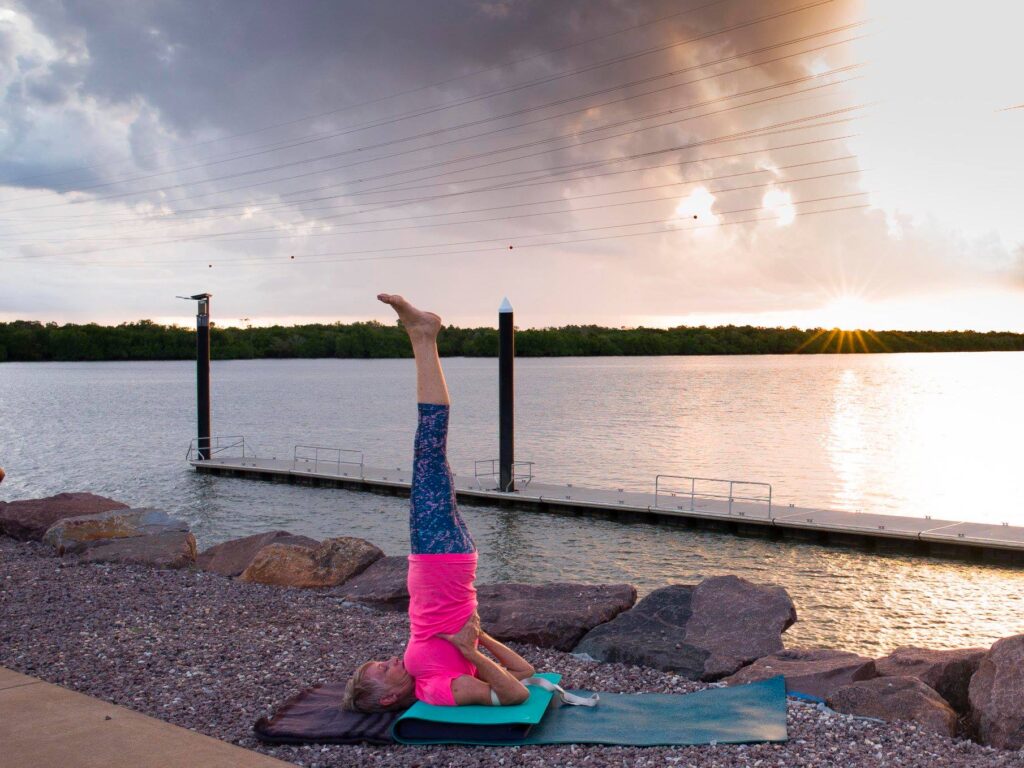
Salamba Sarvangasana, the Iyengar way: shoulders on a folded stack, a belt on the arms, the body in one straight line.
What is Iyengar yoga, and why does it use props?
Flametree teaches in the Iyengar yoga style. In the 20th century, Mr BKS Iyengar did more than anyone to set down traditional Indian yoga, through his books and his teaching, and he pioneered the use of props such as blankets, belts, blocks and chairs. His style is sometimes called modern classical yoga. Iyengar teachers train for years before they are assessed, and Shoulderstand is one of the poses they learn to teach with great care.
Props are not a crutch. They let ordinary bodies, including stiff ones and older ones, get the shape of a pose and stay in it long enough to feel what it does. Mr Iyengar said in 2008 that he had worked out prop versions of the poses in Light on Yoga, showing “how you can all do them without any pain” (Yoga Vaani 95, September 2008, pp. 9 to 10). Shoulderstand was one of the first poses he gave support to.
Why do Iyengar teachers put blankets under the shoulders?
To protect the neck. Lying flat on the floor and swinging the legs up bends the neck (the cervical spine, the seven small bones of the neck) hard forward, with the body’s weight pressing down on it. However, a neat stack of folded blankets lifts the shoulders. As a result, the head rests on the floor beyond the stack, so the neck keeps a little space and its natural curve.
The blankets do three jobs at once:
- They take the load off the neck. The weight sits on the tops of the shoulders and the upper arms.
- They let the chest come to the chin, rather than the chin being jammed onto the chest.
- The throat gets room. That matters for breathing, and for comfort.
The folded edges of the blankets face the same way and the shoulders sit about a hand’s width in from that edge. For example, most people need two to four firm blankets. Also, a sticky mat on top stops the elbows sliding apart, and a belt just above the elbows keeps the arms shoulder-width. Our guide to yoga blankets explains why a few firm blankets do more than a bolster here.
Supported shoulderstand: what the blankets change
Flat on the floor: the neck bends sharply, the weight presses on it, the chin jams into the chest, the breath feels tight.
Shoulders on folded blankets: the head rests below the stack, the neck keeps its curve, the weight sits on the shoulders, the throat stays soft.
A simplified picture, from Iyengar teaching. Your teacher sets the height for your neck.

Supported shoulderstand: the folded stack under the shoulders and a belt above the elbows keep the neck free and the arms steady.
Is Shoulderstand safe for the neck?
Taught the Iyengar way, with blankets and a teacher watching, it is a pose people of many ages practise for years. The neck stays safe when three things are true: the weight is on the shoulders, the head does not move, and the body is straight up rather than tipped over the face.
So in class you will hear: never turn the head while you are up; look at your chest; lift the back ribs with your hands; and come down the moment the neck complains. People with a sore neck are given the chair version, or the wall, or are kept in a supported Bridge Pose (Setu Bandha Sarvangasana) until the neck settles. Our neck pain guide and the post on yoga for neck pain go further.

Salamba Sarvangasana: trunk and straight legs in one vertical line, head resting below the blankets.
How does a wall help in Sarvangasana?
The wall is the first teacher for going up and coming down. You set up the blankets a leg’s length from the wall, lie with the shoulders on the stack and the bent legs on the wall, then walk the feet up until the hips come over the shoulders. The hands go to the back. One leg at a time comes away from the wall, then both.
So the wall helps beginners who are not yet sure of the balance, and anyone heavy or stiff in the upper back. Coming down, the feet go back to the wall and the body unrolls slowly. Learning the way in and the way out is half of a safe Shoulderstand.

Shoulderstand at the wall: the feet find the wall while the balance is learnt.
What is chair shoulderstand, and who is it for?
In chair Sarvangasana you sit backwards on a folding chair, then lie back so the shoulders come to a bolster or blankets on the floor between the chair’s front legs. The hands hold the back legs of the chair, the hips rest on the front of the seat and the legs rest over the backrest. As a result, the chest opens, the chair holds you, and you can stay for minutes without effort.
Mr Iyengar described how support for Sarvangasana came to him: “You will find the support on Sarvangasana”, he told students in 2008, after finding that most people could not stay long in the classical versions (Yoga Vaani 95, pp. 9 to 10). Geeta Iyengar used the chair version for people with an overactive thyroid. With the legs on the backrest and the head adjusted so the throat softens, she said, “It is like Savasana on the throat” (Geeta Iyengar answers questions, Yoga Vaani 95, p. 24). She gave the same chair version to people who are heavy, or who have a backache or neck pain.
The chair version suits:
- Beginners, before the free-standing pose
- Stiff upper backs and tired days
- Many people managing blood pressure, as their teacher advises
- Anyone who wants a long, quiet stay

Chair Sarvangasana: shoulders on a bolster, hands on the chair legs, legs over the backrest.
What are the Sarvangasana benefits in Iyengar teaching?
Geeta Iyengar called Sarvangasana one of the most beneficial of all the poses: “If Sirsasana is King, Sarvangasana is the Queen of all the asanas.” Iyengar teaching holds that Shoulderstand is calming and cooling. Headstand is described as bright and activating; Shoulderstand settles what Headstand stirs up.
In her article on restorative poses for men, Geeta Iyengar linked Salamba Sarvangasana to better circulation around the thyroid, and asked that a practice end with the Shoulderstand group (Shoulderstand, Plough, Bridge Pose and Legs Up The Wall), or at least one of them (Yoga Vaani 62, September 2000, pp. 3 to 5). Students commonly tell us they feel quieter and sleep better after a practice that ends this way.
These benefits are known from long practice. However, modern research has not yet tested Sarvangasana on its own in proper trials. Not yet studied is not the same as not working. For the wider research on yoga and sleep, circulation and the thyroid, see our guides to sleep and energy, circulation and underactive thyroid. The full list of traditional benefits, with Plough Pose, is in our post on shoulder stand benefits.

Sarvangasana benefits, in Iyengar teaching: calming, cooling and steadying.
Why does Shoulderstand come after Headstand?
Because the two balance each other. At an Iyengar convention panel, senior teacher Kay Parry put it plainly: “you must never do inverted poses such as headstand without a counterbalance” (Yoga Vaani 86, June 2006, pp. 18 to 20). The counterbalance is Shoulderstand or Legs Up The Wall (Viparita Karani). Geeta Iyengar gave the same caution: do not finish a practice with Headstand alone; Shoulderstand should follow it.
Mr Iyengar used the same pairing in his advice for building immunity, posted at his institute in Pune during the 2009 swine flu outbreak. It included about ten minutes of Sarvangasana and its cycle, with props for anyone who could not stay that long (Yoga Vaani 100, December 2009, p. 42). We do not reproduce sequences like that here. A sequence needs a teacher who can see you. More on order in why the order of yoga poses matters and learning Headstand safely.
Who should not do Shoulderstand, or should take care?
Iyengar teaching does not say “never” to most people. It says: the right version, at the right time, with a teacher. Tell your teacher before class if any of these apply.
- High blood pressure. Teachers often use supported and chair versions. However, the full, unsupported pose waits until your blood pressure is steady and your teacher agrees.
- Neck problems. Chair, wall or Bridge Pose first, with extra height under the shoulders.
- Pregnancy. Practise with one of our pregnancy-certified Iyengar teachers, who decide which inversions suit you and how to support them.
- During your period. Iyengar teaching leaves out Shoulderstand and other inversions while the period flows. Instead, supported Bridge Pose takes its place.
- Eye pressure problems, such as glaucoma or a detached retina. Head-down poses raise pressure in the eyes, so these are adapted or left out.
- A heavy cold, a headache or an acute asthma attack. Rest first. Iyengar teaching holds that Shoulderstand is not done during an attack, only between attacks.
Our post on yoga inversions covers the whole family of upside-down poses.
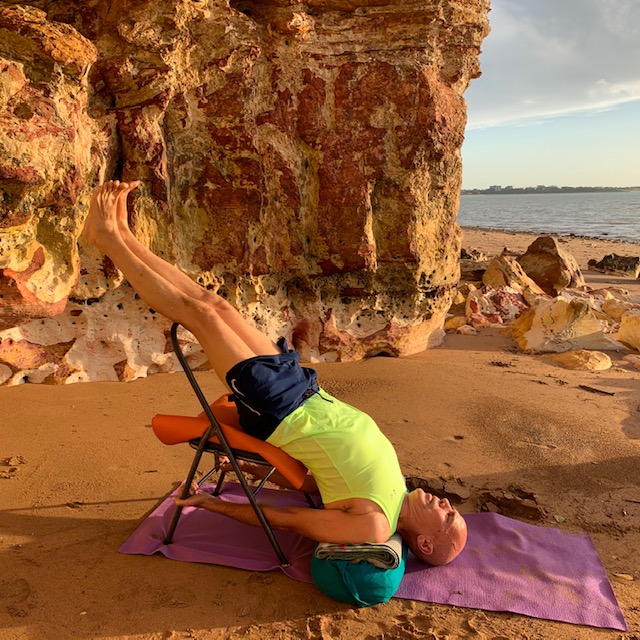
A supported shoulderstand on a chair: a gentler way in for stiff necks and higher blood pressure.
Can you do Shoulderstand with high blood pressure?
Often, yes, in a supported form. Dr Arjun von Caemmerer, a Tasmanian GP and experienced Iyengar teacher, wrote that “not all inversions are contra-indicated as is commonly thought” (Yoga Vaani 86, June 2006, p. 17). He listed supported Plough (Halasana), Shoulderstand, Bridge Pose and Legs Up The Wall among the cooling poses that suit people with raised blood pressure. He also warned that beginners can strain in Sarvangasana, which is exactly why the chair and the blankets matter.
Read more in Can you do yoga with high blood pressure? and our high blood pressure guide.
How Sarvangasana is taught at Flametree in Darwin
In our beginner classes you meet Shoulderstand slowly: first Bridge Pose and the chair, then the wall, then the blankets on their own. Later, in non-beginner classes, it becomes a regular part of the end of class, often held for several minutes, with Plough Pose and Bridge Pose. In Darwin’s build-up, when the heat wears people out, the cooling, supported versions come into their own.
Classes run at Woolner and Coolalinga, and live online across Australia, so you can learn supported Sarvangasana with a teacher watching wherever you are. Chris Lalor, a Senior Iyengar Yoga Teacher with more than thirty years of teaching, and our team set up the blankets and chairs with you until you know your own height.

Chris Lalor in Salamba Sarvangasana. Learn it in Woolner, Coolalinga or live online.
New to yoga? Start with our half price beginner deal with 2 classes free. Done yoga before, or coming back? Try the 2 free classes plus 10 at half price starter deal. Or check the timetable.
Sarvangasana with props: common questions
Why do you put blankets under the shoulders in Sarvangasana?
The blankets lift the shoulders so the head rests lower than them. That keeps the neck’s natural curve and puts the weight on the shoulders instead of the neck. It also leaves the throat soft so you can breathe easily.
How many blankets do I need for a supported shoulderstand?
Most people use two to four firm, neatly folded blankets, with the folded edges lined up. Stiffer necks need more height. A teacher checks the height with you in class, because the right stack depends on your neck and shoulders.
What is chair Sarvangasana?
Chair Sarvangasana is a supported shoulderstand where you lie back through a folding chair, shoulders on a bolster or blankets, hands holding the chair legs and legs resting over the backrest. It is restful, opens the chest and lets you stay for several minutes.
How does a wall help me learn Shoulderstand?
The feet walk up the wall until the hips are over the shoulders, then the legs come away one at a time. Coming down, the feet return to the wall. It builds confidence in going up and coming down safely.
Can people with high blood pressure do a supported shoulderstand?
Often, yes. Senior Iyengar teachers use supported and chair versions for people with raised blood pressure, because they are cooling and calming. The full, unsupported pose waits until blood pressure is steady and your teacher agrees.
Why is Shoulderstand done after Headstand?
In Iyengar teaching Headstand is stimulating and Shoulderstand is calming, so Shoulderstand or Legs Up The Wall always follows Headstand to balance it. A practice is not finished with Headstand alone.
Should I do Sarvangasana during my period?
Iyengar teaching leaves out Shoulderstand and other inversions during the period. Supported Bridge Pose and restful forward bends are used instead, and inversions return once the period has finished.
What did Geeta Iyengar say about Sarvangasana and the thyroid?
Geeta Iyengar taught that Sarvangasana improves circulation around the thyroid. For an overactive thyroid she used the chair version with the throat soft, which she likened to Savasana on the throat. Our thyroid guide has more.
Sources: Yoga Vaani, the journal of Iyengar Yoga Australia: issue 62 (September 2000, Geeta S Iyengar, Restorative Asanas for Men), issue 86 (June 2006, Arjun von Caemmerer on hypertension; convention panel with Kay Parry, Susan Robertson, Peter Scott and Rod Saines), issue 95 (September 2008, BKS Iyengar talk; Geeta Iyengar answers questions) and issue 100 (December 2009, Building Immunity). Geeta S Iyengar, Yoga: A Gem for Women. This page is general information, not medical advice. Flametree Yoga Studio, Darwin and live online. Follow us on Facebook.



