
Yoga For Spondylolisthesis, Bulging Discs And Scoliosis: What Iyengar Teachers Have Known For Decades
Yoga for spondylolisthesis, bulging discs and scoliosis: the short answer
Your scan comes back with a long word on it. Spondylolisthesis. A bulging disc. Scoliosis. Suddenly every yoga class looks risky, and every stretch looks like it might make things worse.
Here is the good news. Yoga for spondylolisthesis, a bulging disc or scoliosis is very likely to help, as long as it is the right kind of yoga, taught in the right order. Senior Iyengar teachers, some of them physiotherapists and doctors, have been writing about exactly these backs in the Iyengar Yoga Australia journal, Yoga Vaani, since the 1980s. And two American trials of Iyengar yoga for back pain found big drops in pain and disability.
This article pulls that knowledge together in plain English. In short form:
- Iyengar yoga is a careful, prop-based style that suits a back with a diagnosis.
- A 2005 Iyengar trial cut pain by 64% and disability by 77%.
- A bigger 2009 trial confirmed it, with gains still there six months later.
- The order matters: rest first, then length, then strength. Backbends come last.
- Spondylolisthesis: stability first, and go slowly with backbends.
- Bulging disc: make space between the bones, and learn good pain from bad pain.
- Scoliosis: lengthen the spine first, rather than chase even ribs.
- Start with a beginner class in Darwin or LIVE online, and tell your teacher.

Rest comes first. A back that feels safe is a back that will lengthen.
First, what is Iyengar yoga, and why does it matter for backs?
Flametree teaches in the Iyengar yoga style. During the 20th century, Mr BKS Iyengar was the major person who set down traditional Indian yoga, through a number of seminal books and very wide teaching. He also pioneered the use of props (blocks, belts, chairs, bolsters and wall ropes) and other techniques to make yoga work even better. His style is sometimes called modern classical yoga. It is the style we teach at Flametree, in Darwin and LIVE online.
Why does this matter for a sore back? Because the props let a teacher change a pose to suit your back today. A pose that would hurt on the floor can become comfortable with a chair under the hands, a belt around the foot, or a rope taking the weight of the hips.
Iyengar teachers also train for a long time. They do a minimum of three years as an Iyengar student, then at least three more years of teacher training, and then a panel of senior teachers assesses them. Teachers who take on more complicated backs have usually trained for longer again.
All yoga is useful. In our view, Iyengar yoga is even more useful for backs, for the reasons below. If you want the longer version of that argument, we explain it in Yoga or Iyengar yoga: what is the difference?
Where does this knowledge come from?
Yoga Vaani is the journal of Iyengar Yoga Australia, the national body for Iyengar teachers (it started life as the newsletter of the BKS Iyengar Yoga Association of Australia). For almost forty years it has carried articles by senior teachers, physiotherapists and doctors about how Iyengar yoga helps particular problems. Many of its back articles first appeared in Yoga Rahasya, the Iyengar journal published from Pune, India, by the Ramamani Iyengar Memorial Yoga Institute, where Mr Iyengar taught.
The back pain articles we drew on for this post are:
- Derek French MD, “A Painful Back”, and Donna Farhi, “Understanding The Back: The Lumbar Spine”, and Roger Cole, “The Sacroiliac Joint And Yoga”, all in Yoga Vaani 14, September 1988.
- Dr Sam Motiwala and Dr Rajvi Mehta, “Treating Chronic Ailments With Yoga: Lower Back Pain”, in Yoga Vaani 50, September 1997.
- Karen Wilde, “Spondylolysis And Spondylolisthesis”, Part 1, and Elise B. Miller, “Yoga For Teens With Scoliosis”, in Yoga Vaani 88, December 2006.
- Karen Wilde, Part 2 and “Physiotherapy For Spondylolisthesis”, Kimberly Williams on the Iyengar back pain trial, and Lucy Brown, “Yoga For Scoliosis: A Personal Journey”, in Yoga Vaani 89, March 2007.
The issues sit in the Iyengar Yoga Australia members’ e-library, so you may need a member login to open them. Everything below is our own summary of what the writers say, not a copy of their programmes.
What did the Iyengar yoga back pain trials find?
They found that Iyengar yoga helped a lot. The first trial was run by Dr Kimberly Williams and her team at West Virginia University, with senior Iyengar teacher Lois Steinberg guiding the yoga. It was published in the journal Pain in 2005 (Williams et al, Pain 2005, 115:107-117).
- Who: 60 adults with long-term (chronic) low back pain, on average for about 11 years. 42 finished the study.
- What: 16 weeks of Iyengar yoga, one 90-minute class a week, plus encouragement to practise at home. The comparison group got 16 weeks of newsletters about managing back pain.
- Result: the yoga group had 64% less pain, 77% less disability (meaning everyday tasks got easier) and 88% less use of pain medication. The gains held at the three-month follow-up.
Those figures are from the paper’s own summary on PubMed.
The second trial was bigger and longer, and was published in the medical journal Spine in 2009 (Williams et al, Spine 2009, 34(19):2066-2076).
- Who: 90 adults with chronic low back pain. 43 did yoga; 47 carried on with their usual medical care.
- What: two 90-minute Iyengar classes a week for 24 weeks, plus home practice on the other days.
- Result: the yoga group had much bigger falls in disability and pain than the usual care group, and their low mood (depression) dropped too. Six months after the classes ended, they were still clearly better.
So, two trials, the same teaching method, and the same answer: Iyengar yoga eased chronic back pain, and the benefit lasted. We have written more about these and other trials in Yoga for back pain: what the research says, and Raj’s story, and in our encyclopaedia guide, Back pain and yoga.

A scan is not the whole story. Many people with disc changes on a scan have no back pain at all.
The catch nobody mentions: who was left out
Karen Wilde, a physiotherapist and senior Iyengar teacher, pointed out something important in Yoga Vaani 89. Like most first trials, the 2005 trial did not include people with spondylolisthesis, a prolapsed (slipped) disc, nerve root compression, spinal stenosis (a narrowed spinal canal) or structural scoliosis. So its numbers are about general chronic back pain, not these named conditions.
For spondylolisthesis, disc problems and scoliosis, the best guide we have is a different kind of evidence: decades of careful practice by senior teachers, written down in journals like Yoga Vaani. Not yet tested in a trial is not the same as not working. It just means modern research has not caught up yet.
How does Iyengar yoga treat a sore back? Rest first, then length, then strength
The trial write-up in Yoga Vaani 89 describes the teaching order clearly, and it matches what senior teachers have written for decades. Here it is in our own words.
- Rest and relief first. The programme began with restorative poses: lying down, fully supported on bolsters and blankets, sometimes with gentle traction (a pull that lengthens the spine) or a sandbag for weight. The aim was simply to ease pain and muscle tension.
- Then length, with the spine still supported. Next came poses that lengthen the muscles attached to the spine and pelvis while the back is held safe, such as lying leg stretches with a belt.
- Then standing poses, with support. Standing poses like Triangle Pose were done at a wall, a chair or a trestle (a wooden frame), to open the hips and teach the arms and legs to lengthen the back.
- Then twists, gently. Twists were added to reach the deeper layers of back muscle and to help create space between the bones.
- Then supported inversions. Upside-down poses with full support were added to reverse the squashing effect of gravity on the discs.
- No backbends at this stage. The researchers deliberately left backbends out, to lower the risk of setting the back off again.
That last point surprises people. Backbends can feel wonderful for a healthy back. For a back that is still sore, the Iyengar method waits until the back is stronger and steadier.
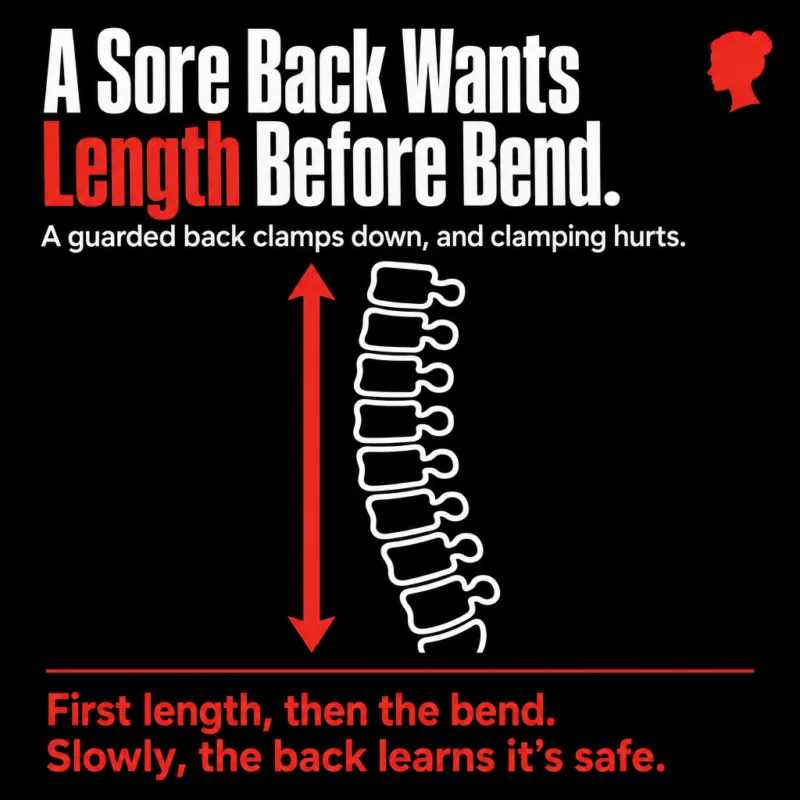
Length before bend: the order the Iyengar back pain programmes follow.
Why rest comes first
Karen Wilde made a simple point about people in pain: “Back pain makes a student often fearful of movement.” (Karen Wilde, “Physiotherapy For Spondylolisthesis”, Yoga Vaani 89, 2007.)
A frightened back clamps down. Clamping hurts, so the back clamps harder. Lying fully supported, with the breath slowing, breaks that circle. Once the back feels safe, it is far more willing to lengthen.
This is why a gentle, prop-based class works so much better than a strong, fast one for a sore back. In our experience at Flametree, strong fast yoga hurts too much and often scares people off yoga altogether.

A supported lying leg stretch: the belt and bolster keep the lower back safe on the floor.
What do the props actually do for the back?
The props are not a crutch. They are how the teacher makes a pose safe and useful for your back on that day. Across the Yoga Vaani articles, the same few tools come up again and again.
- Wall ropes for traction. A rope around the top of the thighs pulls the hips back while the hands reach forward. That gentle pull in two directions lengthens the lower back. Dr Motiwala and Dr Mehta describe Downward Facing Dog in a rope as a way to take pressure off a bulging disc.
- Chairs and walls for standing poses. The back of a chair, a wall or a window sill lets you stay steady while the spine lengthens sideways or turns.
- Belts for lying leg stretches. A belt around the foot lets you stretch the back of the leg while your lower back stays flat and safe on the floor.
- Bolsters, blankets and weights for rest. These let the back drop its guard. Some programmes add a sandbag on the pelvis to settle the lower back.
- Supported inversions. A rope headstand, where the ropes take the weight and the head hangs clear of the floor, or a supported Shoulder Stand on a chair, gives the spine a rest from gravity without loading the neck.

Rope traction: the rope pulls the hips back while the hands reach forward, lengthening the lower back.

Downward Facing Dog in a rope, a pose the Yoga Vaani writers use to take pressure off a bulging disc.
Why does the back hurt in the first place?
The short answer from the Yoga Vaani writers: usually it is how the back is used, not a disease. Derek French, a medical doctor writing in 1988, said that in most back problems, once all the tests are done, no clear cause is found. The problem is in how the back is used.
He used a lovely picture. Hold a green willow stick by both ends and you can bend it back and forth all day, because the bend spreads along its whole length. Move your hands close together and bend it in one spot, and it soon cracks. Most of us bend our backs in one spot.
Donna Farhi, a senior yoga teacher writing in the same 1988 issue, made the same point about the lower back with a piece of wire. Most of our forward and backward bending happens at the very bottom of the lumbar spine (the lower back), where it meets the sacrum (the flat bone at the back of the pelvis). Bend there over and over and the wire breaks. Spread the bend along the whole spine, and it lasts.
Dr French listed the usual ways we misuse the back. These are in our own words:
- Not moving the spine through its full range, so it gets stiff.
- Bending at the waist instead of folding from the hips with a long back.
- Holding the breath and a stiff diaphragm (the main breathing muscle), which stiffens the lower back too.
- Slumped standing and sitting.
- Weak or unbalanced muscles.
- Stiff hips, hamstrings (the muscles at the back of the thigh) and shoulders, which make the back do work it was never built to do.
Every item on that list is something a good yoga class works on. That is why he wrote that yoga has a great contribution to make to back problems.

Fold from the hips, not the waist. A chair keeps the back long while the hamstrings stretch.
Is yoga safe with a bulging or herniated disc?
Yes, when it is the right yoga, introduced gradually. In Yoga Vaani 50, Dr Sam Motiwala and Dr Rajvi Mehta, writing first in Yoga Rahasya, explain what is going on inside the back and how to work with it.
What a disc is, and what goes wrong
Each disc sits between two bones of the spine. It has a tough outer ring and a soft, jelly-like centre, and it works as a shock absorber. If one side of the spine is always over-stretched and the other side is under-used, the disc gets strained. Part of it can bulge out. If the bulge presses on a nerve, you feel pain in the back, the buttock or down the leg.
They also clear up a common fear. In a herniated disc, the outer ring weakens and the soft centre pushes out. The disc does not actually slide out of place. As they put it, the phrase “slip disc” is a slip in the terminology. (Motiwala and Mehta, “Treating Chronic Ailments With Yoga: Lower Back Pain”, Yoga Vaani 50, 1997.)

A herniated disc does not slide out of place. The soft centre pushes out through a weakened outer ring.
What yoga aims to do for a disc
Their approach has two aims. First, ease the pain by making more space between the bones, so the pressure on the nerve drops. Second, strengthen the back muscles so the problem is less likely to come back.
The poses they describe all keep the lower back long and never squeezed. Examples include Downward Facing Dog in a wall rope, Triangle Pose against a wall, lying leg stretches with a belt, gentle seated and standing twists at a wall, and a rope headstand where the ropes take the weight. They describe the poses giving relief for a couple of hours at first, and then, with regular practice, the back muscles getting stronger.
We are not reproducing their programme here, and you should not try to build one from a list. The details (how far apart the feet are, which pose first, how long to stay) are exactly what a teacher adjusts for you.
Good pain and bad pain
One of the most useful ideas in their article is how to tell good pain from bad pain.
- Good pain comes with a sense of relief, and it stops when you come out of the pose. It is often the feeling of a weak, under-used part of the body starting to work.
- Bad pain is sharp, and it stays after you come out of the pose. That is a sign to stop and ask your teacher what to change.

Good pain or bad pain? A simple test from the Yoga Rahasya writers.
They close the section with a line they credit to Prashant Iyengar, Mr Iyengar’s son: “Yoga cures what cannot be endured and endures what cannot be cured.” (Quoted by Motiwala and Mehta, Yoga Vaani 50, 1997.)
For more on discs, see our post Slipped disc: what helps it feel better, and what your scan does not tell you. If the pain runs down your leg, our post on yoga for sciatica goes further, and our Sciatica And Yoga guide sets out what each yoga authority says.
What is spondylolisthesis, and can yoga help it?
Yes, yoga can help, with the emphasis on stability first. Karen Wilde, a physiotherapist of 35 years and a senior Iyengar teacher who teaches in Warrnambool, Victoria, wrote a two-part series on it in Yoga Vaani 88 and 89.
The two long words, in plain English
- Spondylolysis (a stress crack in the back of a spine bone). It usually forms in late childhood or the teens, often in sports that bend the back backwards a lot, such as gymnastics, diving or fast bowling. Ms Wilde gives it as about 6% of people, and says only a small share of them ever get back pain from it.
- Spondylolisthesis (a spine bone that has slipped forward on the one below). The word comes from Greek words for “spine” and “slip”. In older adults it can also come from wear in the discs and joints, without a crack.
Slips are graded from I (a small slip) to IV (a big one). Ms Wilde notes that most mild cases settle with conservative care such as rest, movement and exercise, and that grades I and II do not usually need surgery.
How the Iyengar approach works with a slip
Her approach, as a physiotherapist and an Iyengar teacher, has a few clear themes. In our own words:
- In a flare-up, rest comes first. Restorative poses with the spine fully supported, using props and weights.
- Then standing poses, at a wall or frame. These teach you to use your legs and arms to lengthen the back if you are stiff, and to steady it if you are very flexible.
- Core stability is the priority. Poses that build the deep muscles of the belly and back come before anything ambitious.
- Twists are introduced in standing, with support.
- Backbends wait. She says back bending poses often aggravate spondylolisthesis, so they come only once core stability is well established, and with an experienced teacher.
- Simple supported inversions first. In the early stage she prefers easy supported poses to a rope headstand, because getting in and out of the ropes can make muscles spasm.
She also stresses something we see often at Flametree: the student needs to understand their own back, and needs patience. Results come from steady practice over months, with the practice changed on good days and bad days.

Standing poses at a wall give a back with a slip or a curve the support to lengthen safely.
Spondylolisthesis: yoga poses to avoid, at least at first
Putting her points together, the things to hold back on early are:
- deep backbends, such as Wheel Pose or Camel Pose;
- anything that pushes the lower back into a deep arch with no support;
- getting in and out of rope inversions during a flare-up;
- forcing range when you are already very flexible. A flexible back needs steadiness more than stretch.
Ms Wilde also notes that leg pain spreading from the back usually means a person needs individual attention, rather than a general class. If that is you, tell your teacher before class. That is exactly the sort of thing we want to know.
Can yoga help scoliosis?
Yes. Scoliosis (a sideways curve of the spine) was the reason Lucy Brown came to yoga, and the reason she stayed.
Lucy Brown’s story
At 19, about to leave London for university in Edinburgh, Lucy was told she had a 20-degree curve in her lower spine. The specialist said it did not need surgery, but that nothing could be done for it, and that back pain later in life was inevitable.
A second opinion sent her to Iyengar classes. She writes that simply learning Iyengar yoga brought almost immediate relief from her backache. Twenty years later she was an Iyengar teacher herself, teaching at Edinburgh University with three students with scoliosis in her class.
Her main lesson for other people with a curve is a surprising one. Rather than trying to make the ribs, waist and shoulders look even, she found it much better to focus on lengthening the spine. Correct the spine first, she says, and the ribs tend to start evening up by themselves.
She also found that what feels straight to someone with scoliosis is often still crooked, so alignment has to be relearnt with a teacher’s eye. And she ends with a line every teacher will recognise: some students come because of their scoliosis, “but it will be the yoga that keeps them coming back.” (Lucy Brown, “Yoga For Scoliosis: A Personal Journey”, Yoga Vaani 89, 2007.)

Side-stretching standing poses like Triangle Pose help people with scoliosis feel both sides of the spine.
What helped her, in broad terms
- Standing poses that stretch the sides, such as Triangle Pose and Extended Side Angle Pose, which taught her to feel the two sides of her spine.
- Twists, which she found made forward and backward bending easier afterwards.
- Downward Facing Dog in the ropes, for length and freedom in the spine.
- Supported inversions on a chair, once her neck started to complain with age.
- Slow, gradual backbends, starting very small and building up.

A chair twist: simple enough to concentrate on turning the curve, steady enough to keep the pelvis still.
Teenagers with scoliosis
Elise B. Miller, a senior American Iyengar teacher known for her work with scoliosis, wrote about teenagers in Yoga Vaani 88. She notes that scoliosis affects two to four percent of people, and most often shows up in girls during the teenage growth spurt.
Her advice, in short: keep a teenager’s practice short at first (about 20 minutes), make it fun but challenging, use a simple chair twist to teach them to turn the curve back, and always finish lying down. On that last point she writes, “You will be surprised how open teens are to relaxing deeply.” (Elise B. Miller, “Yoga For Teens With Scoliosis”, Yoga Vaani 88, 2006.)
Our encyclopaedia guide, Scoliosis and yoga, goes into the research in more detail.
What about the sacroiliac joint?
The sacroiliac joints (often called the SI joints) are where the base of the spine meets the pelvis, one on each side. Roger Cole, a senior Iyengar teacher, wrote about them in Yoga Vaani 14 in 1988.
His main point was that these two joints carry the weight of the whole spine. So if they are out of line, the rest of the back, and especially the lower back, has to compensate.
He named the poses most likely to upset a sore SI joint: twists and forward bends, done too hard or too often to one side. He singled out twists with one leg crossed over the other. That does not mean you can never twist. It means a sore SI joint needs twists done gently, evenly on both sides, and with the pelvis kept steady, which is exactly what a teacher watches for.
Backbends: why they come last, not never
Every one of these writers treats backbends with care when a back is sore. The 2005 trial left them out entirely. Karen Wilde holds them back until core strength is well established. Lucy Brown builds them up slowly.
But none of them says backbends are bad. A strong, healthy back bends well, and in the right order a backbend opens the chest and strengthens the back. The point is timing. Length and steadiness first, then the bend. In a well-run Iyengar class, the teacher decides when your back is ready.

Backbends come last, not never. Once the back is long and strong, a supported backbend opens the chest.
What we see at Flametree
We have taught people with sore backs in Darwin for decades, and the pattern in these journals matches what we see in our own classes. People who come with a diagnosis are often frightened. Once they have rested in a supported pose and felt their back soften, they relax. Then the work of lengthening and strengthening can begin.
Based on our experience, yoga for backs is very likely to help, and certainly worth trying. It also tends to keep helping, because people stay. As Lucy Brown found, the problem brings people in, and the yoga keeps them coming back.
Please tell your teacher about your back before class, so they can set you up with the right props. Feel free to check with your professional advisers if you wish, but also give yoga a try.

Supported inversions give the spine a rest from gravity, with props taking the load off the neck.
How do I start yoga with a back condition in Darwin or online?
Start with a beginner class, or with a gentle class, in Darwin or LIVE online. Classes start gently, use plenty of props, and the teacher adjusts every pose to suit the people in the room or on the screen.
- New to yoga? Our main starting deal is half price beginner classes plus two classes free, in Darwin and online.
- Done yoga before, or coming back after a break? Try the non-beginner starter deal: two classes free plus ten classes at half price.
- Want to see class times? Check the beginner timetable.
- Want to read more first? Download our free ebook, Happy Backs, on Iyengar yoga for back pain.
If you are over 50, our post on yoga for back pain over 50 covers the extra care thin bones need. Our Bones And Balance guide and Healthy Ageing guide go further. And for gentle moves to try at home between classes, see lower back stretches, in the right order. Our back care notes collect everything else we have written on backs.

In a rope headstand the ropes take the weight, and gravity gently lengthens the spine.
Frequently asked questions
Is yoga good for spondylolisthesis?
Yes, when it focuses on stability first. Physiotherapist and senior Iyengar teacher Karen Wilde describes supported rest during a flare-up, then standing poses at a wall, core strength and supported twists, with backbends held back until the core is strong. Tell your teacher about the slip before class.
What yoga poses should I avoid with spondylolisthesis?
Early on, hold back on deep backbends such as Wheel Pose and Camel Pose, and anything that arches the lower back without support. Karen Wilde notes that backbends often aggravate spondylolisthesis, so they come later, once core stability is well established, with an experienced teacher.
Is yoga safe with a bulging or herniated disc?
Yes, when it keeps the lower back long and is introduced gradually. Dr Motiwala and Dr Mehta describe poses that make space between the spine bones, such as Downward Facing Dog in a wall rope and Triangle Pose at a wall, followed by strengthening to stop the problem coming back.
Can yoga help scoliosis?
Yes. Iyengar teacher Lucy Brown, who has a 20-degree lower spine curve, found Iyengar yoga brought almost immediate relief from her backache. Her key advice is to focus on lengthening the spine rather than trying to make the ribs and shoulders look even.
What did the Iyengar yoga back pain trial find?
In a 2005 trial in the journal Pain, 16 weeks of Iyengar yoga cut pain by 64%, disability by 77% and pain medication use by 88% in adults with chronic low back pain, compared with an education group. A bigger 2009 trial in Spine found the gains still there six months later.
Why does Iyengar yoga use props for back pain?
Props let the teacher change each pose to suit your back today. Wall ropes give gentle traction, chairs and walls steady the standing poses, belts protect the lower back in leg stretches, and bolsters let a guarded back relax. Mr BKS Iyengar developed most of them while teaching people with injuries.
Should I do backbends with a sore back?
Not at first. The 2005 Iyengar trial left backbends out to lower the risk of setting the back off again. Rest, length and strength come first. Backbends are added later, gradually, once the back is steady and your teacher thinks you are ready.
Where can I learn yoga for a back condition in Darwin or online?
Flametree Yoga Studio teaches Iyengar yoga in Darwin, at Woolner and Coolalinga, and LIVE online across Australia. Start with a beginner or gentle class, tell your teacher about your back, and use the half price beginner deal with two free classes.
By Chris Lalor, Certified Senior Iyengar Yoga Teacher and certified Yoga Therapist, Flametree Yoga Darwin, with Stuart McGill, yoga teacher, Flametree Yoga Darwin.
This article is general information about yoga. It summarises, in our own words, articles from Yoga Vaani, the journal of Iyengar Yoga Australia, with short quotes credited to their authors. The Yoga Vaani issues are held in the Iyengar Yoga Australia members’ e-library.
Sources
- Williams K and others (2005). Effect of Iyengar yoga therapy for chronic low back pain. Pain 115(1-2):107-117. doi:10.1016/j.pain.2005.02.016 (via PubMed).
- Williams K and others (2009). Evaluation of the effectiveness and efficacy of Iyengar yoga therapy on chronic low back pain. Spine 34(19):2066-2076. doi:10.1097/BRS.0b013e3181b315cc (via PubMed).
- French D, “A Painful Back”; Farhi D, “Understanding The Back: The Lumbar Spine”; Cole R, “The Sacroiliac Joint And Yoga”. Yoga Vaani 14, September 1988.
- Motiwala SN and Mehta RH, “Treating Chronic Ailments With Yoga: Lower Back Pain”, reprinted from Yoga Rahasya. Yoga Vaani 50, September 1997.
- Wilde K, “Spondylolysis And Spondylolisthesis”, Part 1; Miller EB, “Yoga For Teens With Scoliosis”. Yoga Vaani 88, December 2006.
- Wilde K, “Spondylolysis And Spondylolisthesis”, Part 2, and “Physiotherapy For Spondylolisthesis”; Williams K, “Scientific Evidence For Efficacy Of Iyengar Yoga In Treating Low Back Pain” (reprinted from Yoga Rahasya); Brown L, “Yoga For Scoliosis: A Personal Journey”. Yoga Vaani 89, March 2007.



