
Knee Pain Relief: Why Your Knees Hurt, And The Yoga That Lets You Keep Moving
Knee pain relief: the short answer
Knee pain relief usually comes from moving the knee well, not from resting it. In trials of people with knee osteoarthritis (wear and change in the joint), yoga eased pain and stiffness, in some trials within weeks. The method matters: props such as a chair, blocks, a belt and a wall let the hip and ankle do their share, so the knee is not asked to do it all. Here is the article in short form:
- Rest tends to bring more stiffness, so keep moving gently.
- The knee is a hinge: the hip and ankle must do the turning.
- 36 women, average age 72, had less knee pain after 8 weeks.
- In 250 people, yoga cut morning stiffness by about two thirds in 2 weeks.
- A review of 8 trials and 756 people found less pain and stiffness.
- Standing poses with a chair or wall take weight off the knee.
- In Darwin, learn it in a beginner class or online.
Last updated: 25 October 2026.
A quick word on Iyengar yoga. Iyengar yoga is the style developed by Mr BKS Iyengar. In the 20th century he did more than anyone to set down traditional Indian yoga, through his books and his teaching, and he pioneered the use of props. It is the style we teach at Flametree, in Darwin and live online.

A standing pose with a wall and a block. The legs work, the knee is not twisted.
What eases knee pain without stopping movement?
Gentle, supported movement. It sounds backwards, because a sore knee makes you want to stop. But stopping has a cost. Writing about sore, arthritic joints, Mr Iyengar described a “vicious circle”: “Reduced movement due to pain leads to more stiffness due to inactivity.”
There is a reason movement helps. Cartilage (the smooth cushion over the ends of the bones) has no blood supply. Andrew McGonigle (a doctor and yoga teacher) and Matthew Huy (an exercise physiologist) explain in The Physiology of Yoga that cartilage (the smooth cushion in a joint) is fed by fluid seeping in and out. The fluid moves when the joint moves and is loaded. They suggest “wear and repair” in place of “wear and tear”: tissues adapt to the loads we give them. That is an explanation drawn from physiology, not a trial of yoga, but it fits what people with sore knees often report: they feel better when they move well.
The key word is well. A knee that is forced, twisted or loaded unevenly complains. A knee that is supported, aligned and moved slowly tends to settle.
Why do my knees hurt when I bend them?
There are many causes, and we cannot diagnose from a distance. But in Iyengar teaching one pattern is clear: the knee is a hinge, so when the hip or ankle is stiff, the knee is asked to make up the difference. A hinge that is asked to twist is a hinge in trouble.

The knee is a hinge. It bends and straightens well, but it hates being twisted, so the hips and ankles must turn.
Chairs make this worse. Geeta Iyengar, Mr Iyengar’s daughter and senior teacher, wrote that because “everyone sits in chairs these days”, the knees, ankles, hips or spine begin to give trouble. A life of sitting leaves the hips and ankles stiff, and the knees pay.

Warrior II. The front knee points the same way as the toes and sits over the ankle, so the knee bends like a hinge.
Mr Iyengar warned about knees especially. People who badly want a deep seated pose say, “I think I can do it!” His reply, in The Tree of Yoga: “Unfortunately, the thinking is in the head, but the doing is in the knee!” Force the knee, he wrote, and it will break. But “if you understand the stiffness as well as the mobility of the knee, and go step by step to remove the stiffness and increase the range of mobility, then there is no danger at all.”
What does research say about yoga for sore knees?
Several trials have tested yoga for knee osteoarthritis, the commonest long-term knee complaint. They were small, so treat them as encouraging, not final.
- Older women, 2014. 36 women with knee osteoarthritis, average age 72, did an 8-week yoga programme (a weekly class with home practice) or waited. The yoga group had less pain and stiffness, and could stand up from a chair more easily. No yoga-related harm was seen (Cheung and colleagues, BMC Complementary and Alternative Medicine).
- Morning stiffness, 2012. 250 people aged 35 to 80 with knee osteoarthritis had the same physiotherapy machines, then either yoga or physiotherapy exercises for two weeks. Morning stiffness fell by about two thirds with yoga (68.6%), against about two fifths with exercises (38.6%). The yoga was a mix of loosening practices, poses, relaxation and breathing (Ebnezar and colleagues, International Journal of Yoga).
- Knee-friendly poses, 2018. In a Canadian trial, 31 women with knee osteoarthritis were split into three groups. One did 12 weeks of yoga poses chosen to go easy on the knee. One did leg strengthening on machines. One did meditation with no exercise. The yoga group had clearly less pain and better daily function than the meditation-only group, and similar gains to the strengthening group (Kuntz and colleagues, PLoS One).
- Review, 2024. A review of 8 trials with 756 people found yoga reduced pain and stiffness and improved physical function (Lu and colleagues, PLoS One).
The American College of Rheumatology’s 2019 guideline for osteoarthritis of the hand, hip and knee lists yoga among its recommended options. It is a conditional recommendation, which means it depends on the person (Kolasinski and colleagues, Arthritis Care and Research, 2020).

A standing leg stretch, heel on a chair, belt round the foot. The standing leg works, and the chair takes the weight.
What are good stretches for knee pain?
Stretches that work the hips, hamstrings and calves around the knee while the knee is supported. Ask about these in a class:
- Standing leg stretch with the heel on a chair. A belt round the foot lets you hold it without strain. The standing leg stays straight and strong.
- Triangle Pose (Trikonasana) at a wall. Both legs stay straight, the wall steadies you, and the hips open.
- Forward bend at a chair. Rest your hands or head on the chair seat, so you fold from the hips and the knees stay quiet.
- A rolled cloth behind the knee. In a bend, a wrapped block or rolled blanket behind the knee gives space in the joint.
The last tip comes from Mr Iyengar himself. In San Francisco he met a man with surgical clips in both knees who, after three years of trying alone, could bend them barely a centimetre. Mr Iyengar wrapped a block in cloth and placed it behind the man’s knees, and for the first time since his surgery the man found he could bend them more. One man’s story, not a promise, but it shows how much a prop can do.

A lying leg stretch with a belt. The floor holds you up, so the hip opens and the knee is not asked to take the strain.
Always hold steadily, never bounce, and breathe out slowly as you go a little further. For a full guide to props and poses, see Iyengar Yoga For Knees, and for joints in general Yoga For Arthritis.

A chair and a belt make a forward bend gentle on the knees.
How long does it take for yoga to ease knee pain?
Weeks, not years, though it varies. Stiffness moved within two weeks in the 250-person trial, and the 36 older women improved within eight weeks. A 2026 review of 14 studies with 1,183 people found programmes of eight weeks or more gave the most consistent results (Zhou and colleagues, Journal of Back and Musculoskeletal Rehabilitation).
Stuart, who teaches many of Flametree’s beginner classes, injured his own knee in a fall, and lost more movement and muscle to surgery and the years that followed. Physiotherapy alone did not turn it around. Coming back to Iyengar yoga, with the same props and techniques taught in our classes, did.
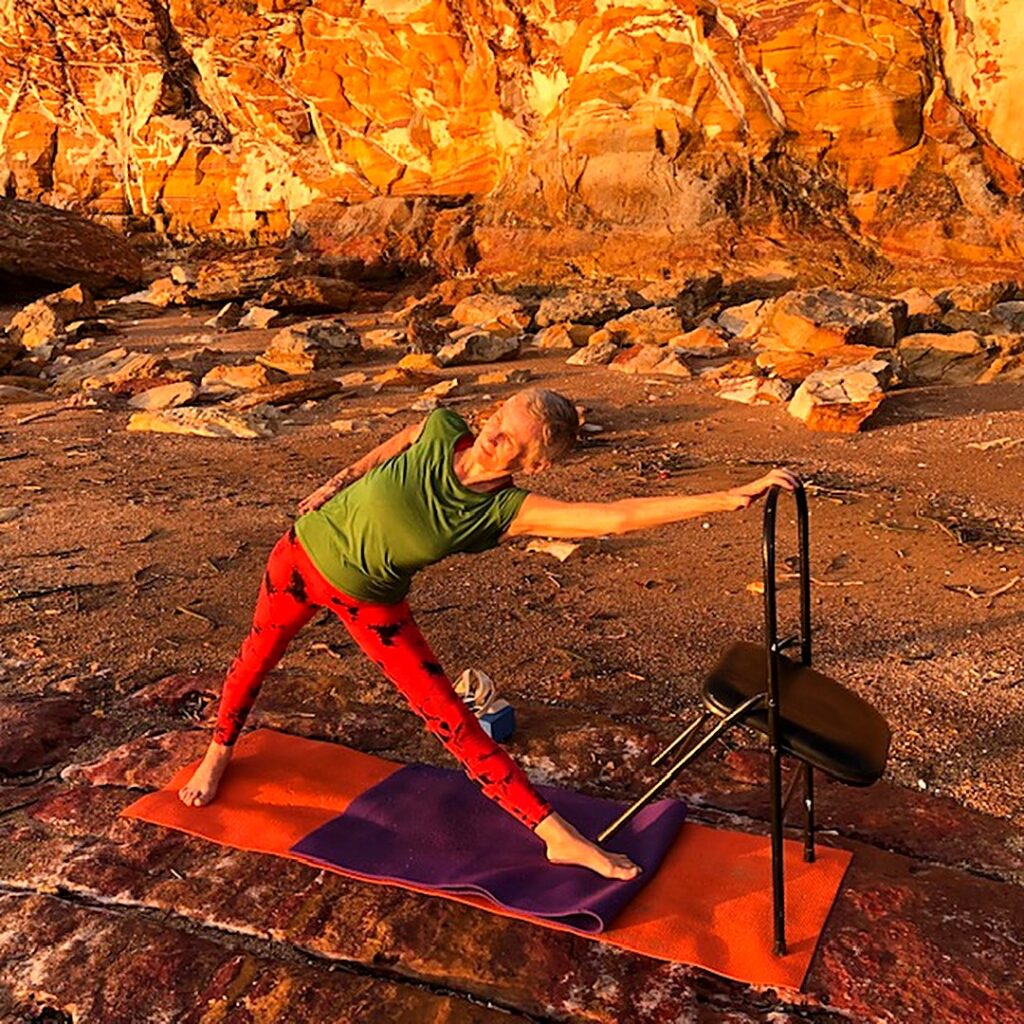
Triangle Pose with a chair. Both legs stay straight, and the chair takes the weight so the knees do not have to.
Get the free ebook Too Stiff For Yoga?. New to Flametree, or away for 3 months or more? You get 2 free classes + 2 ebooks, only available via this offer. Already coming to class? You can still get the book.
Where can I get help with knee pain in Darwin?
For knee pain relief in Darwin, come to a beginner class at Flametree’s Woolner studio or join live online from anywhere in Australia. Every class uses chairs, blocks, belts and a wall, and the teacher adjusts each pose to your knees. Tell your teacher about a sore knee before class so they can set you up with the right props. You do not need to be flexible to start. More on stiffness is in Yoga For Flexibility.
Frequently asked questions
Should I rest a sore knee or keep moving?
Gentle, supported movement usually serves a sore knee better than complete rest. Mr Iyengar described a vicious circle: reduced movement due to pain leads to more stiffness. Move slowly, use props, and make each pose smaller if the knee complains.
Why do my knees hurt when I bend them?
The knee is a hinge, so when the hips or ankles are stiff it is asked to make up the difference. Sitting in chairs all day stiffens the hips and ankles. Propped poses that move the hip and ankle share the work and ease the knee.
What are the best stretches for knee pain?
Stretches that work the hips, hamstrings and calves while the knee is supported: a standing leg stretch with the heel on a chair, Triangle Pose at a wall, and a forward bend at a chair. Hold steadily, never bounce, and breathe out slowly.
How long does yoga take to ease knee pain?
Often weeks. Morning stiffness fell in two weeks in a 250-person trial, and 36 older women had less pain after eight weeks. A 2026 review of 14 studies found programmes of eight weeks or more gave the most consistent results.
What did research find for knee pain in older women?
In a 2014 trial, 36 women with knee osteoarthritis, average age 72, did 8 weeks of yoga with a weekly class and home practice. Compared with a waiting group they had less pain and stiffness and could stand from a chair more easily.
Which props help sore knees?
Chairs, blocks, belts, a wall and a rolled or wrapped cloth. A chair takes weight in a forward bend, a wall steadies a standing pose, and a wrapped block behind the knee gives space in a bend. A teacher will pick the right one for you.
Why are my knees stiff when I stand up after sitting?
Because the hips and legs have been folded and still. Geeta Iyengar wrote that because everyone sits in chairs these days, the knees, ankles, hips and spine begin to give trouble. Regular standing poses wake the legs up.
Where can I get help with knee pain in Darwin?
Flametree Yoga Studio teaches Iyengar yoga at Woolner in Darwin and live online. Beginner classes use chairs, blocks, belts and a wall, and the teacher adjusts each pose to your knees. You do not need to be flexible to start.
Where to next
- New to yoga, or coming back? Start with our half price 10 class pass with 2 classes free, in Darwin or live online.
- For a workplace, team or group: book private yoga classes for groups, online, at a Flametree studio or at your venue.
- Want to see class times first? Look at the beginner timetable.
Flametree Yoga Studio, Darwin and live online. This article is general information, not medical advice.
Sources: Cheung C and colleagues, Yoga for managing knee osteoarthritis in older women: a pilot randomized controlled trial, BMC Complementary and Alternative Medicine, 2014; Ebnezar J and colleagues, Effect of integrated yoga therapy on pain, morning stiffness and anxiety in osteoarthritis of the knee joint, International Journal of Yoga, 2012; Kuntz AB and colleagues, Efficacy of a biomechanically-based yoga exercise program in knee osteoarthritis, PLoS One, 2018; Lu J and colleagues, The impact of yoga on patients with knee osteoarthritis, PLoS One, 2024; Zhou J and colleagues, Effects of yoga on pain, physical function, and biomechanical/impairment outcomes in knee osteoarthritis, Journal of Back and Musculoskeletal Rehabilitation, 2026; Kolasinski SL and colleagues, 2019 ACR/Arthritis Foundation guideline for the management of osteoarthritis of the hand, hip, and knee, Arthritis Care and Research, 2020; McGonigle A and Huy M, The Physiology of Yoga; BKS Iyengar, The Tree of Yoga. Full references are in the Too Stiff For Yoga? ebook.



