
Pigeon Pose For Tight Hips: How To Do It Safely, With Props, And Without Cranky Knees
Pigeon pose: the short answer
Pigeon pose suits tight hips when the hip does the turning and the knee stays quiet. The way in is a prop: a folded blanket under the front hip, a chair, or lying on your back with a belt. Hold each side for 15 to 30 seconds, breathe out slowly, and go in again. In Iyengar yoga the floor version is taught as a preparation for Eka Pada Rajakapotasana (One-Legged King Pigeon Pose), and a stiff beginner starts with support. Here is the article in short form:
- The hip turns, the knee only bends.
- Start with a prop, not the floor.
- Chair and lying-down pigeon are real pigeon.
- Hold 15 to 30 seconds, then repeat.
- The back leg gives you the hip movement chairs take away.
- If the knee complains, the hip is not yet ready.
- In Darwin, learn it in a beginner class or online.
Last updated: 25 October 2026.
A quick word on Iyengar yoga. Iyengar yoga is the style developed by Mr BKS Iyengar. In the 20th century he did more than anyone to set down traditional Indian yoga, through his books and his teaching, and he pioneered the use of props. It is the style we teach at Flametree, in Darwin and live online.

Triangle Pose warms and opens the same hips, with both legs working. A good lead-in to pigeon.
What does pigeon pose stretch?
Two things at once. The front hip turns outwards, which stretches the deep muscles on the outside of the hip (the ones that turn the thigh out). The back leg reaches behind you, which opens the front of the hip.
That back-leg movement has a name: hip extension (taking the leg back behind you). It is the hip movement we lose most. A large American survey measured the hips and knees of 1,683 people (Roach and Miles, Physical Therapy, 1991). Up to age 74, most movements lost only 3 to 5 degrees, but hip extension lost more than a fifth of its range. The chair is the likely cause: sit, drive, sit again, and hardly anything takes the thigh back.
It can come back. In a 2005 American study, 19 healthy people aged 62 to 83 did eight weeks of Iyengar yoga (DiBenedetto and colleagues, Archives of Physical Medicine and Rehabilitation). Their hips extended further and their stride grew longer. It was a small study without a comparison group, and it was not about pigeon pose, but it shows the movement pigeon works on can be given back.

The back leg reaching behind you is the part of pigeon that opens the front of the hip.
How do you do pigeon pose safely when your hips are tight?
Let the hip do the turning, and give it a prop so it can. The knee is a hinge (it bends and straightens, it does not twist). If the hip cannot turn, the knee is the next joint to be asked, and it complains.
- Warm up first. Two or three standing poses, such as Triangle Pose, wake the hips up.
- Fold a blanket and bring it close. Start on hands and knees. Slide one knee forward and turn the shin across in front of you. Slide the blanket under the front hip so it sits level.
- Keep the front foot flexed (toes pulled back, as if standing on your heel), so the ankle supports the knee.
- Stretch the back leg long behind you and press the top of the foot down.
- Lift the chest, then fold from the hips. Rest your hands on two blocks or a chair seat. Do not round the back to get lower.
- Breathe out slowly as you go a little further. Never hold your breath.
- Come out slowly, then do the other side.
Mr Iyengar warned about forcing knees. People who badly want a deep hip pose say, “I think I can do it!” His reply, in The Tree of Yoga: “Unfortunately, the thinking is in the head, but the doing is in the knee!” Go step by step, he wrote, and “there is no danger at all.”
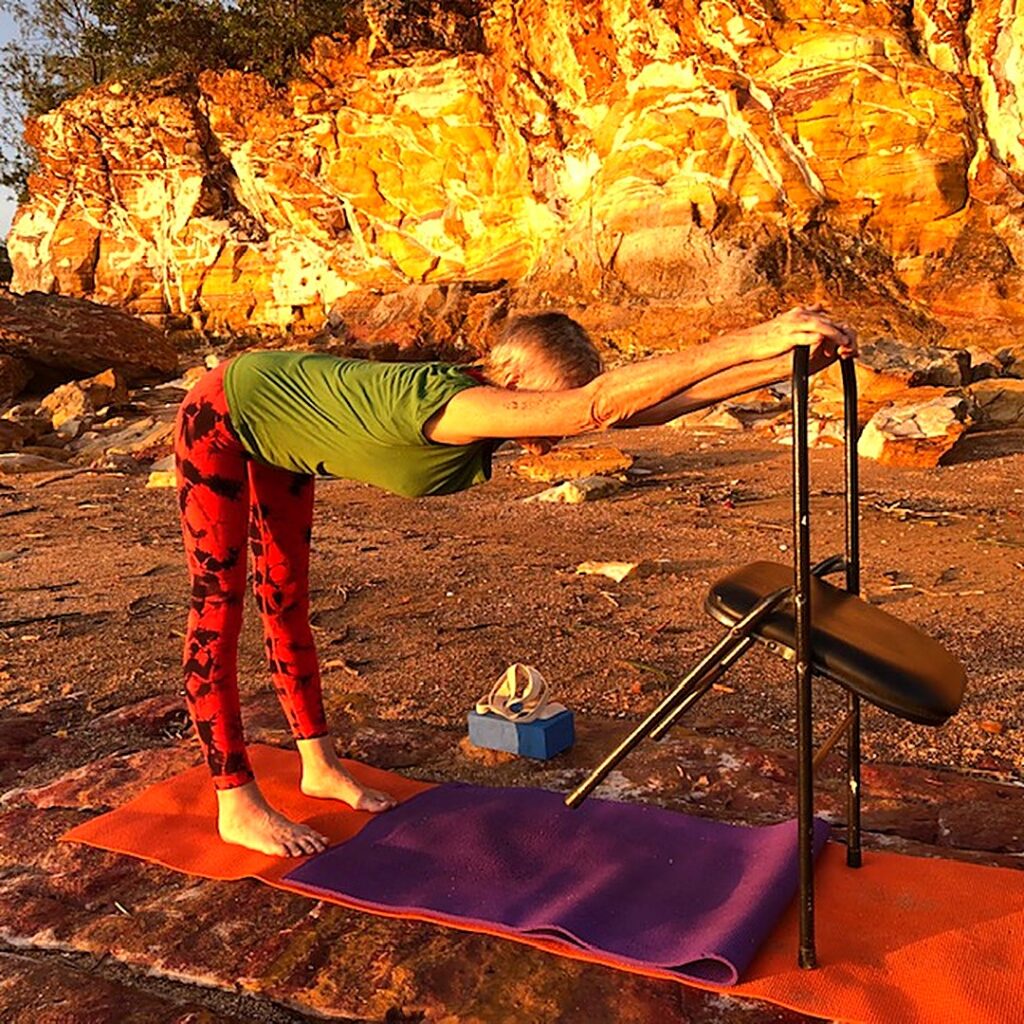
Fold from the hips with a long back and a chair for the hands. The same hinge makes pigeon work without strain.
Is there a chair version of pigeon pose?
Yes, and for many people it is the better place to start. The hip is turned out in the same way, with no weight on the knee.

Pigeon pose three ways: in a chair, lying down, or on the floor. Start with the one that feels kindest to your knee.
- Seated pigeon. Sit tall near the front of a chair. Rest one ankle on the opposite thigh, just above the knee, with the foot flexed. Keep the back long and fold forward from the hips until you feel the outer hip stretch.
- Lying-down pigeon. Lie on your back with both knees bent and feet on the floor. Rest one ankle across the opposite thigh. Wrap a belt around the lower thigh and hold the ends, so your head and shoulders stay on the floor and your neck stays soft.
Both are a proper way into pigeon, not a lesser one. In Iyengar yoga, props are how we get the benefit of a pose without the cost. A stiff hip that is supported lets go sooner than one that is forced.

Lying down with a belt takes the effort out of the hold. Here, a related hip stretch, Reclining Big Toe Pose II (Supta Padangusthasana II).
How long should you hold pigeon pose?
Short holds, repeated, work well. In a 1994 American trial, 57 people with tight hamstrings held a stretch for 15, 30 or 60 seconds, five days a week for six weeks, or did not stretch (Bandy and Irion, Physical Therapy). Thirty seconds worked as well as 60, and both beat 15 seconds or none. A 1997 follow-up of 93 people found the same.
Those were hamstring stretches, not pigeon, so treat them as a guide. They fit what Iyengar teachers do with stiff beginners: go in, hold for 15 to 30 seconds, come out, and go in again a little further.
Why does a short hold work? In a 1996 Danish study, seven healthy people stretched their hamstrings for three weeks (Magnusson and colleagues, Journal of Physiology). Their range grew, but the muscle pushed back just as hard at the same angle. They could simply tolerate more stretch. Slow, steady, calm holds teach the nervous system that the position is safe. Force and a held breath teach it the opposite.
Can you do pigeon pose with bad knees?
Often yes, with changes, and the knee is your guide. If the front knee complains in the floor version, do one of these:
- Lift the front hip higher on more blankets, until the knee feels nothing.
- Bring the front heel closer to you, so the shin points more forward and the turn is smaller.
- Move to the chair or lying-down version, where the knee carries no weight.
A strong pull on the outside of the hip is fine. Sharp or pinching discomfort in the knee means stop and make the pose smaller. For much more on knees, see Iyengar Yoga For Knees. Tell your teacher about a sore knee before class, and they will set you up with the right props.
What else helps tight hips, besides pigeon pose?
Standing poses. In Triangle Pose and Warrior 2 the legs work hard while the hips open, and a stronger hip trusts itself to move further. Our guide to tight hips explains why chairs and Darwin’s air-conditioning stiffen them, and Yoga For Hip Pain covers sore hip joints. Pigeon is one pose in a hip routine, not the whole routine.

Warrior II. The back leg is straight and the front knee sits over the ankle, so the hips work without the floor.
Get the free ebook Too Stiff For Yoga?. New to Flametree, or away for 3 months or more? You get 2 free classes + 2 ebooks, only available via this offer. Already coming to class? You can still get the book.
Where can I learn pigeon pose in Darwin?
For pigeon pose in Darwin, come to a beginner class at Flametree’s Woolner studio or join live online from anywhere in Australia. Every class uses chairs, blocks, belts and blankets, and the teacher adjusts the pose to your hips and knees. You do not need to be flexible to start. More on stiffness is in Yoga For Flexibility.
Pigeon is also an Iyengar preparation for a backbend, which is why a teacher builds up to it with standing poses first.
Frequently asked questions
Is pigeon pose good for tight hips?
Yes, when it is done with support. Pigeon turns the front hip outwards and takes the back leg behind you, the movement chairs take away. A prop under the front hip lets a tight hip settle in without the knee taking the strain.
Why does pigeon pose hurt my knee?
Usually because the hip cannot turn far enough, so the knee is asked to twist. The knee is a hinge. Lift the front hip on a blanket, bring the heel closer, keep the foot flexed, or try the chair or lying-down version instead.
How long should I hold pigeon pose?
Hold each side for 15 to 30 seconds, come out, and repeat. In a 1994 trial of 57 people with tight hamstrings, 30 seconds of stretch worked as well as 60. Breathe out slowly as you go a little further.
Is there a chair version of pigeon pose?
Yes. Sit near the front of a chair, rest one ankle on the opposite thigh with the foot flexed, keep the back long and fold forward from the hips. It turns the hip out in the same way, with no weight on the knee.
Can I do pigeon pose with bad knees?
Often, with changes. Raise the front hip on blankets, make the turn smaller, or lie on your back with a belt. A strong stretch in the outer hip is fine. Sharp or pinching discomfort in the knee means make the pose smaller.
What is the Iyengar version of pigeon pose?
Eka Pada Rajakapotasana (One-Legged King Pigeon Pose) is a backbend. Iyengar teachers build up to it with a preparation: front shin forward, back leg long, hips level on a blanket, and hands on blocks or a chair. Props let a stiff body learn it step by step.
What muscles does pigeon pose stretch?
The deep muscles on the outside of the front hip, which turn the thigh out, and the front of the hip on the back leg. The back leg works hip extension, taking the leg behind you, the movement that loses the most range with a life in chairs.
Where can I learn pigeon pose in Darwin?
Flametree Yoga Studio teaches Iyengar yoga at Woolner in Darwin and live online. Beginner classes use chairs, blocks, belts and blankets, and the teacher adjusts pigeon to your hips and knees. You do not need to be flexible to start.
If the floor is too far away for pigeon, try the seated butterfly stretch with a blanket and blocks first.
Where to next
- New to yoga, or coming back? Start with our half price 10 class pass with 2 classes free, in Darwin or live online.
- For a workplace, team or group: book private yoga classes for groups, online, at a Flametree studio or at your venue.
- Want to see class times first? Look at the beginner timetable.
Flametree Yoga Studio, Darwin and live online. This article is general information, not medical advice.
Sources: Roach KE and Miles TP, Normal hip and knee active range of motion: the relationship to age, Physical Therapy, 1991; DiBenedetto M and colleagues, Effect of a gentle Iyengar yoga program on gait in the elderly, Archives of Physical Medicine and Rehabilitation, 2005; Bandy WD and Irion JM, The effect of time on static stretch on the flexibility of the hamstring muscles, Physical Therapy, 1994; Bandy WD, Irion JM and Briggler M, Physical Therapy, 1997; Magnusson SP and colleagues, A mechanism for altered flexibility in human skeletal muscle, Journal of Physiology, 1996; BKS Iyengar, The Tree of Yoga. Full references are in the Too Stiff For Yoga? ebook.



