Yoga For Flexibility: Your Muscles Don’t Get Longer, So What Actually Changes?
Yoga for flexibility: the short answer
Yoga for flexibility works, and it works faster than most people expect. Stiffness starts to change within weeks, because most of it is not a short muscle. It is the nervous system guarding the muscle. Slow, steady yoga poses teach that guard to let go, while the legs and back get stronger at the same time.
This article sums up our free ebook, Too Stiff For Yoga? Where To Start And Why Yoga Works, by Chris Lalor. Here it is in short form:
- Most stiffness is a guard, not a short muscle.
- Range starts to grow in three to eight weeks.
- Age takes far less than most people think.
- Chairs take the movement we lose most.
- Yoga beat walking for leg strength after 60.
- Hold the pose, don’t bounce.
- Stiff is the best reason to start.
A quick word on Iyengar yoga. Iyengar yoga is the style developed by Mr BKS Iyengar. In the 20th century he did more than anyone to set down traditional Indian yoga, through his books and his teaching, and he pioneered the use of props. It is the style we teach at Flametree, in Darwin and live online. And it began with a stiff body: as a sickly teenager, Mr Iyengar wrote, “My arms barely reached my knees when I bent down.”

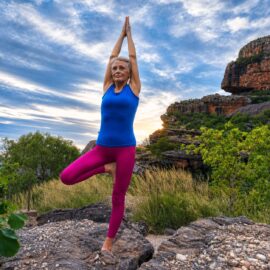
Chris Lalor in Triangle Pose. She started so stiff she could barely drop her head forward.
Why do stretched muscles not get longer?
Because the brain, not the muscle, sets most of the limit. When you reach the end of a stretch, four things can hold you back: the muscle, the joint capsule, the fascia (the web of connective tissue round every muscle) and the nervous system. The nervous system does most of the work.
Here is the proof. Under a general anaesthetic, people become far more flexible. The muscles have not changed. The guard has simply gone to sleep.
A 2025 Australian review pulled together 65 studies with 1,542 adults. After weeks of regular stretching, people could accept a bigger stretch, and the muscle became a little less stiff. But the muscle fibres did not get longer at all. The brain’s “stop” point moved.

Stretching further is mostly your brain. A 2025 review of 65 studies found the muscle fibres did not get longer.
Mr Iyengar saw it long before the research: “It is the mind that thinks that the body is stiff and it cannot bear any strain.” That is good news. A guard can learn that a movement is safe.
How long does yoga for stiffness take to work?
Weeks, not years. A 2018 review of 26 stretching studies, each three to eight weeks long, found people could move further and tolerate more stretch, mostly because the nervous system relaxed. A 2023 review then found that three to twelve weeks of held stretching made the muscles themselves measurably less stiff.
One student, Lynden, noticed it in her wardrobe after four months of classes: “I really AM taller!! … I can hang my clothes to air on the rail I couldn’t reach before.” She had not grown. Her shoulders had loosened.
And if you miss a few weeks? A 2025 review of 13 studies found people lost a little range after two to six weeks off, but stayed well above where they started.
Is stiffness just getting older?
Much less than you think. A large American health survey measured the hips and knees of 1,683 people. Up to age 74, most movements had lost only 3 to 5 degrees. The big exception was hip extension, taking the leg back behind you, which had lost more than a fifth.

Up to age 74, most joints lose only 3 to 5 degrees. A big loss of movement is not just age, which is good news for yoga for stiff joints.
That is the very movement a chair stops us doing. Sit, drive, sit on the couch: the hip folds all day. The American mobility coaches Kelly and Juliet Starrett add up a typical day and get about 12 hours in a chair.
In a small 2005 study, people aged 62 to 83 did eight weeks of gentle Iyengar yoga. Their hips extended further and their walking stride grew longer.
What is inside the Too Stiff For Yoga ebook?
The book has three parts: stiff beginners and their stories, the science of stiffness, and how an Iyengar class actually loosens a stiff body. Here are some highlights.
The stories
- Sam’s “concrete hamstrings”. A runner with a sore knee and a sore back, he wondered if he was “a step even before a beginner”. Eighteen months later: “Now that I can touch my toes, there’s no stopping me.”
- “For you, it’s probably never!” What Chris’s first teacher told her about getting her heels down in Downward Dog. She took it as a challenge, and found the heels were never the point.
- A sleepless night, then a yoga class. Chris came to yoga in her late 30s after her mother died. That night she slept “hugely better” than she had for months.
- Enrico, who did not want props. Good at soccer, athletics and sailing, “but as a young male, I still ended up very STIFF”.
- Dino, 52, from toes to palms. A reader of Mary Flaherty’s Does Yoga Work?, he reckons he also gained 20 metres on his golf drive.
- Warren, 76, rafting the Grand Canyon for 16 days in 40 degree heat. His secret: “I’ve also been moving my entire life.”
The intriguing facts
- The floor test. In a Brazilian study of 2,002 adults aged 51 to 80, those who needed the most help to sit on the floor and stand up again had more than five times the risk of dying over about six years. A sign, not a cause.
- Hips in Beijing. A 2002 study found hip osteoarthritis 80 to 90% less common in older people in Beijing than in older white Americans. Squatting and floor sitting may be part of the reason.
- Stretch your hamstrings, and your neck bends further. A 2016 German study found exactly that. The pull seems to travel along chains of fascia.
- A cold muscle is a stiff muscle. Cooling a calf by about six degrees raised its resistance by about a fifth.
- Humid days, achier joints. In a European study of 810 older people with arthritis, joint pain rose with the humidity. Darwin, take note.

The floor test. Getting down to the floor and up again is a sign of strength, flexibility and balance working together.
Get the free ebook Too Stiff For Yoga?. New to Flametree, or away for 3 months or more? You get 2 free classes + 2 ebooks, only available via this offer. Already coming to class? You can still get the book.
A few tips on how we do things
- Stand first. A class starts with Mountain Pose and standing poses, not sitting cross-legged.
- Short holds, repeated. Ten to twenty seconds, going a little further each time.
- Breathe out into it. “When we hold the breath, the brain becomes stiff,” wrote Mr Iyengar.
- Start later in the day if you can. Geeta Iyengar advised beginners to start “when the muscles are elastic”.
- No prizes for going deepest. A long spine in a modest pose beats a rounded back in a deep one.
Does yoga help flexibility after 60?
Yes, and it does more than stretch. In 2019 a team at the University of Edinburgh pooled 22 trials of yoga in people over 60. Yoga improved balance, lower body flexibility and leg strength. Against other exercise, such as walking or chair aerobics, yoga still gave more leg strength and more lower body flexibility. The reviewers called it “robust evidence”.

Stretching for seniors, and more. Yoga gave people over 60 more leg strength and lower body flexibility than walking.
Iyengar yoga has been tested in older people directly. In a 2013 Sydney trial, 54 people with an average age of 68 did twelve weeks of Iyengar standing poses. They had better balance, faster walking and faster getting up from a chair than a group given a booklet.
Is yoga good for stiff joints?
Yes, especially stiff, sore knees, where most of the research has been done. A 2019 review of 9 trials with 640 people found yoga eased pain, improved function and reduced stiffness in knee osteoarthritis (wear and change in the joint), and did better than other exercise. In an Indian trial of 250 people, morning stiffness fell by about two thirds in two weeks with yoga, against about two fifths with physiotherapy exercises.
The American College of Rheumatology’s 2019 guideline for osteoarthritis of the hand, hip and knee lists yoga among its recommended options.

A held stretch with a belt. Steady and calm, never bounced: this is how the back of the leg learns to let go.
Should you hold a stretch or bounce?
Hold it. Bouncing gives a small, short-term gain. A held pose does more. It keeps the muscle’s automatic tightening quiet, it changes the muscle itself over weeks, and a 2024 review of 77 studies found held stretches gave more lasting range than bouncing.
Research also suggests most of the slow lengthening of a muscle happens in the first 15 to 20 seconds. That fits the Iyengar way with stiff beginners: short holds, repeated, rather than one long strain.

Hold or bounce? Both add some range, but a steady hold does more, which is why yoga for flexibility holds the poses.
As Mr Iyengar told teachers about students over 65: “Do not try force, correct little by little. Even if you increase mobility 5-10% it is good.”
Where can I start yoga for flexibility in Darwin?
Any of Flametree’s beginner classes is built for stiff bodies, in our Darwin studios or live online across Australia. Props such as chairs, belts and blocks bring each pose to you, so a stiff body does the real pose, correctly, from the first class. If you feel stiffer in the build-up and the wet season, you are not imagining it, and a class in the cooler part of the day suits a stiff body well.
Right now it is the build-up in Darwin, the hot, sticky months locals call mango madness, and it runs on into the wet. Heat and humidity bring more stiff, puffy joints and less energy. This is when gentle and restorative classes, and slow breathing, earn their keep. Our restorative yoga classes are a good place for a stiff, hot body to start.

Too Stiff For Yoga?, our free ebook for stiff bodies, from Darwin and online.
Your free copy of Too Stiff For Yoga? is waiting. New to Flametree, or away for 3 months or more? You get 2 free classes + 2 ebooks, only available via this offer. Already coming to class? You can still get the book.
We have written more on this elsewhere. Read Yoga For Stiff Guys, Or Anyone, Chris Lalor’s story of starting yoga stiff and Yoga For Arthritis.
Frequently asked questions
Is yoga good for stiff joints?
Yes. Most research is on knees: a 2019 review of 9 trials (640 people) found yoga eased pain, improved function and reduced stiffness in knee osteoarthritis, and did better than other exercise. Movement also feeds the joint, because cartilage has no blood supply and is nourished by fluid moving in and out as the joint is used.
Do muscles actually get longer when you stretch?
Not much. A 2025 Australian review of 65 studies found that after weeks of stretching, people could tolerate a bigger stretch and their muscles were a little less stiff, but the muscle fibres did not get longer. Most new range comes from the nervous system relaxing its guard.
Is it too late to get more flexible at 60 or 70?
No. A 2019 Edinburgh review of 22 trials in people over 60 found yoga improved lower body flexibility, leg strength and balance. In a small 2005 study, people aged 62 to 83 gained hip extension and a longer stride after eight weeks of gentle Iyengar yoga.
Is it better to hold a stretch or bounce?
Hold it. Bouncing gives a small, short-term gain. A 2024 review of 77 studies found held stretches gave more lasting range, and held stretches also quieten the muscle’s automatic tightening and soften the muscle over weeks.
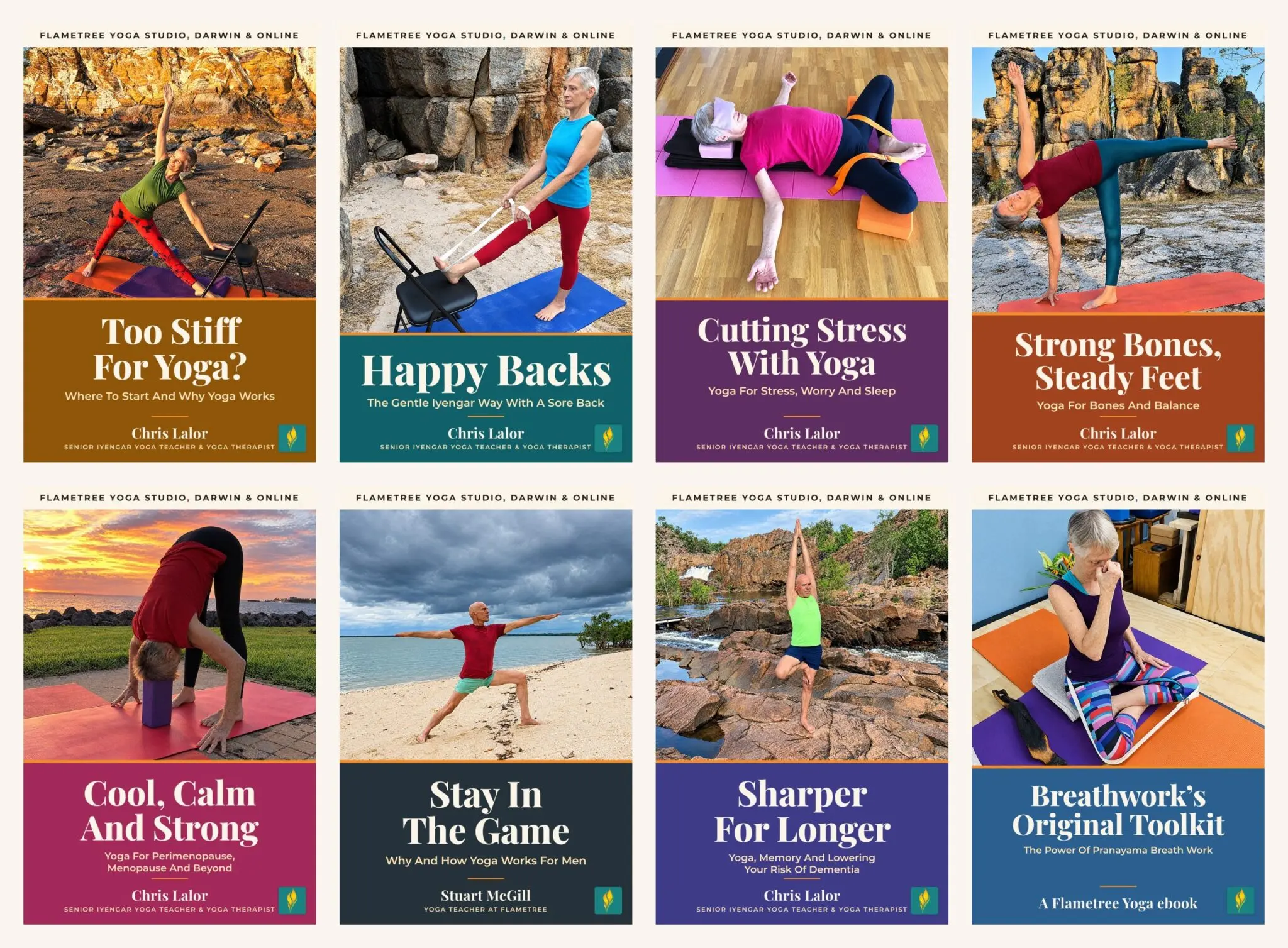
All eight free Flametree ebooks. New students choose two, with 2 free classes: Too Stiff For Yoga? is one of them.
Is yoga once a week enough for flexibility?
Once a week helps, and more often helps more. In research on knee osteoarthritis, many effective programmes were a weekly supervised class plus practice on other days. Range grows in weeks and fades a little when you stop, so regular classes are what keep it.
What is the sit-and-rise floor test?
It scores how easily you can sit on the floor and stand up again without using hands or knees. In a Brazilian study of 2,002 adults aged 51 to 80, people needing the most support had more than five times the risk of dying over about six years. It is a marker of strength, flexibility and balance, not a cause.
Does yoga help morning stiffness?
It can. In an Indian trial of 250 people with knee osteoarthritis, morning stiffness fell by about two thirds in two weeks with yoga, against about two fifths with physiotherapy exercises. Mr Iyengar wrote that the body is stiff in the morning and that regular practice conquers it.
Why do I feel stiffer in Darwin’s build-up and wet season?
Several reasons. In a European study of 810 older people, joint pain rose on more humid days. Heat can bring swelling in hands and ankles, sweat leaves you underwatered, and moving from heat into air-conditioning cools the muscles, and cooler muscles are stiffer. Drink more, keep moving, and choose a class in the cooler part of the day.
Where to next
- New to yoga, or coming back? Start with our half price 10 class pass with 2 classes free, in Darwin or live online.
- For a workplace, team or group: book private yoga classes for groups, online, at a Flametree studio or at your venue.
- Want to see class times first? Look at the beginner timetable.
Flametree Yoga Studio, Darwin and live online. This article is general information, not medical advice. Feel free to check with your professional advisers if you wish, but also give yoga a try.
Sources: 2025 Australian review of 65 stretching studies (1,542 adults); Magnusson and colleagues, Danish hamstring study, 1996; 2018 review of 26 stretching studies; 2023 review of 10 studies on muscle stiffness; Roach and Miles, US survey of joint movement in 1,683 people, 1991; Brazilian sit-and-rise study of 2,002 adults aged 51 to 80; Sivaramakrishnan and colleagues, Edinburgh review of 22 trials in people over 60, 2019 (IJBNPA); Tiedemann and colleagues, Sydney Iyengar yoga trial, 2013; DiBenedetto and colleagues, Iyengar yoga and hip extension, 2005; American College of Rheumatology guideline, 2019; Andrew McGonigle and Matthew Huy, The Physiology of Yoga (2022); Kelly and Juliet Starrett, Built to Move (2023). Full references are in the Too Stiff For Yoga? ebook.