
Yoga And The Immune System: Sleep, Stress, Lymph And What Is Still Unproven
Yoga for immune system: the short version
When a cold is going round, it is natural to ask whether anything you do makes a difference. For yoga, the honest answer is that nobody has shown that it strengthens a healthy person’s immune system. What research does show is that poor sleep and high stress go with catching colds more easily, and many people use yoga to wind down and rest. Here is what is known about yoga for the immune system, how strong that evidence is, and what is still unproven.
This note in short form
- Sleep: in a trial of 164 healthy adults exposed to a cold virus, the odds of a cold were about 4.5 times higher for people sleeping under 5 hours than for those sleeping over 7.
- Stress: in 394 healthy volunteers exposed to cold viruses, more stress went with more infections and colds.
- Yoga trials: a 2018 review of 15 trials found a pattern of lower inflammation markers, with small and inconsistent evidence.
- Iyengar trial: a small trial in breast cancer survivors with fatigue found changes in inflammation-related gene activity.
- Not shown: that yoga boosts immunity, changes how often you get infections or improves lymph flow.
- Next step: try a restful class in the studio or LIVE online. Your first class is free if you’re new.
Back to our Stress and Sleep notes.
What does research say about sleep, stress and catching colds?
Two well known studies exposed healthy volunteers to cold viruses and then watched who became ill. Neither tested yoga. They tell us about sleep and stress.
In the first, Prather and colleagues (Sleep, 2015) measured the sleep of 164 healthy men and women, aged 18 to 55, with a wrist monitor for a week. The volunteers were then quarantined and given nasal drops containing a cold virus. People who slept less than 5 hours a night had about 4.5 times the odds of developing a cold compared with people who slept more than 7 hours, and people sleeping 5 to 6 hours had about 4.2 times the odds. People sleeping 6 to 7 hours were not at significantly higher risk.
In the second, Cohen, Tyrrell and Smith (New England Journal of Medicine, 1991) gave 394 healthy volunteers nasal drops containing one of five respiratory viruses, after they had completed questionnaires about stress. The more stressed they were, the more likely they were to become infected and to develop a cold. Clinical colds ranged from about 27 percent to 47 percent, from the least to the most stressed. Factors such as age, smoking, exercise and quality of sleep did not explain the link.
That is the research rung of the ladder, and it is a limited one. These were healthy adults and a controlled exposure, so everyday life will differ. The studies show a link, and they do not show that fixing your sleep or stress will stop you catching a cold.

A seated forward bend with the head and arms resting on a bolster, by the sea at sunset. A restful, supported pose is one way people wind down.
Why does stress matter to the immune system?
The Stanford scientist Robert Sapolsky explains one idea well in his book Why Zebras Don’t Get Ulcers. A zebra runs for its life when a lion appears, and then goes back to grazing as if nothing had happened. Its stress response switches off when the danger goes. People are different. We can keep the lion running in our heads for days or years, with the bills, the test results and the 3am “what if”.
Sapolsky’s argument is that the stress response is built for short emergencies, and the trouble starts when it never switches off. That is a scientist’s explanation of why long-term stress is linked to illness, and it is not a test of yoga. It does tell us why researchers ask whether practices that calm the stress response might matter.
It also explains why we avoid the word boost. A stronger immune system is not always a better one, and the aim is a system that switches on when needed and settles afterwards. Nobody has shown that yoga can improve that balance in healthy people.
What have trials of yoga found?
A 2018 systematic review (Falkenberg and colleagues, Journal of Behavioral Medicine) looked at 15 randomised trials of yoga and immune function. The evidence was not entirely consistent, but a general pattern emerged of lower pro-inflammatory markers, particularly a decrease in IL-1 beta, with some signs of reductions in IL-6 and TNF-alpha. The authors suggested yoga may be a complementary approach in groups with inflammatory conditions, and said longer periods of practice may be needed. They also said the field is young and that the evidence is small.
One of the trials was in Iyengar yoga. Bower and colleagues (Psychoneuroendocrinology, 2014) randomised 31 breast cancer survivors with persistent fatigue to a 12 week restorative Iyengar yoga program (16 women) or a health education program (15 women). Genes and signals linked to inflammation were less active in the yoga group, including NF-kB, and one marker of inflammation stayed stable in the yoga group while it rose in the control group. There were no significant changes in C reactive protein, IL-6 or cortisol. It was a small trial, in a particular group of women, so it cannot be applied to everyone.
Our note on yoga and inflammation covers the inflammation side in more depth.
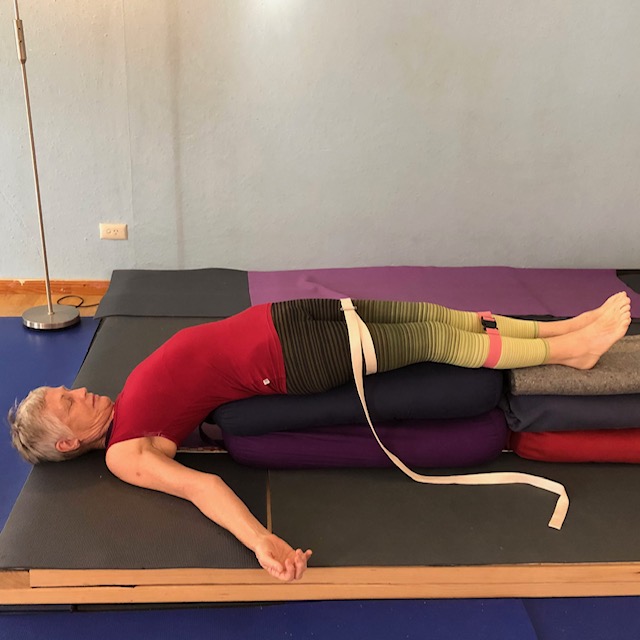
Supported bridge pose over bolsters, with a belt around the thighs to hold the legs without effort.
What about lymph and inversions? (still being studied)
In the yoga tradition, inversions such as legs up the wall are said to help fluid return from the legs, and lymph flow is often mentioned. That is the practice rung: what teachers have long taught. When we searched, we did not find a good trial showing that yoga improves lymph flow in healthy people, so whether it does is still being studied. Not yet tested is not the same as wrong, but it is not proven either.
What students notice is their own experience. Legs up the wall is a restful pose that many people enjoy at the end of a hard day, and our note on legs up the wall shows how to set it up. Our post on yoga inversions explains who should take care.
Iyengar yoga is the style developed by Mr BKS Iyengar. In the 20th century he did more than anyone to set down traditional Indian yoga, through his books and his teaching, and he pioneered the use of props. It is sometimes called modern classical yoga, and it’s the style we teach at Flametree.
What can help when sleep and stress are the problem?
If the research on sleep and stress is the part you want to act on, then the useful question is how to wind down. In an Iyengar class that often means supported poses with bolsters, a long breath out, and time to rest at the end. Many students tell us they sleep better on the night of a class, especially after a restful, supported pose. That is their own experience and not a trial result.
Our post on yoga for sleep covers the sleep research and six easy poses, and our note on how to calm your nervous system explains why the breath matters. For hot, sticky Darwin nights, see yoga for Darwin’s Build-Up.
Who should check first?
Yoga is not a substitute for medical care of an infection or an immune condition. If you are unwell, have a condition affecting your immune system, or are worried about your health, see your doctor. Talk to your yoga teacher, yoga therapist, and your doctor if you wish, if you have glaucoma, a heart condition or high blood pressure that is not under control. Skip legs up the wall during your period. Poses can be changed with props, and you can come out of any pose if you feel pain, numbness or dizziness.
Practise this at Flametree
Your first class is free if you’re new to Flametree. New students, and anyone who has been away three months or more, can also get a half price 10 class pass with 2 extra classes free, to use online, in the studio, or both. We teach in the studio at Woolner in Darwin and LIVE online. For the studio, just come along. For an online class, click the class time you want and we email you the link to join.
- Beginners: see the half price 10 class pass for new and lapsed students
- Not a beginner: see the half price 10 class pass for new and lapsed students
- The timetable, including online classes
Can’t make a class? Practise at home with our video courses.
Questions people ask about yoga and the immune system
Can yoga boost the immune system?
Nobody has shown that. A 2018 review of 15 trials found a pattern of lower inflammation markers after yoga, but the evidence was small and not entirely consistent. We would not claim that yoga boosts immunity, and we would not use the word boost.
Does yoga help you avoid colds?
That has not been shown. Studies of healthy volunteers found that poor sleep and high stress go with catching colds more easily, but those studies did not test yoga. Yoga is one way people wind down, and that is as far as we can go.
How does sleep affect your immune system?
In one study, 164 healthy adults were given a cold virus. Those who slept under 5 hours a night had about 4.5 times the odds of developing a cold compared with those who slept more than 7. It shows a link, in a controlled setting.
Does stress make you more likely to catch a cold?
In a 1991 study of 394 healthy volunteers exposed to cold viruses, higher stress went with more infections and more colds, in a step-by-step pattern. The study did not test yoga, and it shows a link.
Does yoga reduce inflammation?
Possibly, in some groups. A 2018 review found a pattern of lower markers such as IL-1 beta, and a small Iyengar trial in breast cancer survivors with fatigue found less inflammation-related gene activity. The evidence is early and small.
Does yoga help lymph flow?
In the yoga tradition, inversions are said to help fluid return, but we did not find a good trial showing that yoga improves lymph flow in healthy people. It is still being studied.
Is legs up the wall good for immunity?
It is a restful pose that many people enjoy, and rest and sleep matter. There is no evidence that the pose itself improves immunity. Skip it during your period, and talk to your doctor first if you have glaucoma or a heart condition.
Where can I learn restful yoga in Darwin?
Flametree Yoga Studio teaches Iyengar yoga, including restorative classes with bolsters, in the studio at Woolner in Darwin and LIVE online. Your first class is free if you’re new to Flametree.
Flametree Yoga Studio, Darwin NT, teaching Iyengar yoga in the studio and LIVE online. This note is general information, not medical advice.
Sources
- Prather AA, Janicki-Deverts D, Hall MH, Cohen S. Behaviorally assessed sleep and susceptibility to the common cold. Sleep, 2015. doi:10.5665/sleep.4968
- Cohen S, Tyrrell DA, Smith AP. Psychological stress and susceptibility to the common cold. New England Journal of Medicine, 1991. doi:10.1056/NEJM199108293250903
- Falkenberg RI, Eising C, Peters ML. Yoga and immune system functioning: a systematic review of randomized controlled trials. Journal of Behavioral Medicine, 2018. doi:10.1007/s10865-018-9914-y
- Bower JE, Greendale G, Crosswell AD, and others. Yoga reduces inflammatory signaling in fatigued breast cancer survivors: a randomized controlled trial. Psychoneuroendocrinology, 2014. doi:10.1016/j.psyneuen.2014.01.019
- Sapolsky RM. Why Zebras Don’t Get Ulcers.



