
Iyengar Yoga Poses: Pose And Practice Notes From Flametree
Iyengar yoga poses: the short version
Have you ever looked at a photo of a yoga pose and thought, my body will never do that? In an Iyengar class you do not have to wait until it can. Iyengar yoga poses are taught in steps, with a chair, a block, a belt or the wall, so you learn the real shape from your first class. This page gathers every Flametree note and article on single poses and on how to practise, from Mountain Pose to headstand. Iyengar yoga is the style developed by Mr BKS Iyengar. In the 20th century he did more than anyone to set down traditional Indian yoga, through his books and his teaching, and he pioneered the use of props. It is sometimes called modern classical yoga, and it’s the style we teach at Flametree.
Iyengar yoga poses in short form
- Start here: Mountain Pose, Downward Facing Dog and the notes on props and sequencing.
- Standing poses: Triangle, the Warriors, Half Moon and more.
- Upside down and on your hands: headstand, shoulderstand, handstand and Chaturanga.
- Bending and twisting: backbends, forward bends and twists.
- Resting poses: Legs Up The Wall and Savasana.
- How to practise: levels, sequencing, props and practising in the heat.
- First class free: for newcomers, plus a half price pass.
This page is one of the topic hubs in Yoga Notes From Flametree.
Why are poses taught in steps?
Because the order you learn them in matters as much as the poses themselves. In the Iyengar way, standing poses come first, then forward bends, seated poses and twists, and later inversions and backbends. The standing poses build the legs and a long spine that every other pose needs.
So each pose note on this page starts with the propped version a beginner meets, and is honest about the poses that are advanced. The note on sequencing explains why the order is built that way.
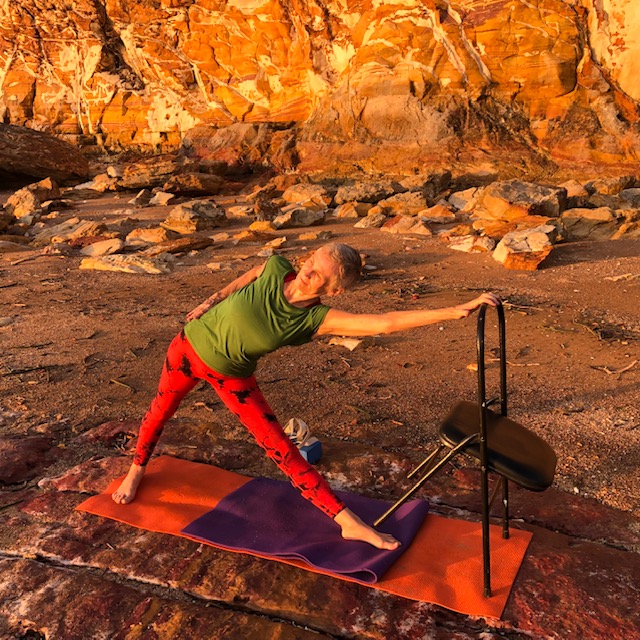
Chris in Triangle Pose with a chair. The chair lets the legs stay straight and the chest open while the pose is learned.
Do you have to be flexible to do these poses?
No. Flexibility is what the poses build, not what they need. A block brings the floor closer, a belt lengthens your arms, and the wall steadies you, so a stiff body can still do the pose properly.
What each pose asks for is attention: feet placed with care, legs firm, breath steady. Our note on using props in yoga shows why that is not cheating.

Chris in a standing balance by the sea in Darwin. Balances like this come after the two-footed standing poses.
Start here: the main pose and practice articles
If you are new, read these first. Each answers one main question in depth.
- Mountain Pose (Tadasana): How To Stand Properly, the base of every standing pose.
- Downward Facing Dog: How To Do It Without Strain.
- Using Props In Yoga: Are They Cheating Or Teaching?.
- Why The Order Of Yoga Poses Matters: How Iyengar Sequencing Works.
- How Long To Hold Yoga Poses? Why The Pose Begins When You Want To Leave.
Yoga Notes and articles on Iyengar yoga poses
Every Flametree note and article on a single pose, one line each, grouped by family.
Standing poses
- Triangle Pose (Trikonasana): why it feels hard, and how a block or chair helps.
- Warrior 2 And Warrior 3: standing strong, with a wall and a chair.
- Wide Angle Standing Forward Bend (Prasarita Padottanasana): steps and props.
- Half Moon Pose: why straight legs bring strength and balance.
- Eagle Pose: balance, shoulders and focus.
- Pelvic Tilt In Yoga: should you tuck your tailbone?
- Yoga For Feet: why your arches change everything.
- Duck Feet Posture: why Iyengar yoga teaches the feet parallel.
Upside down and on your hands
- Yoga Headstand (Sirsasana): how to learn it safely with a wall and a teacher.
- Shoulderstand, the queen of yoga poses, learned before headstand.
- Yoga Inversions: benefits, beginner poses and who should take care.
- How To Do A Handstand: learning it at the wall, and forearm balance.
- Chaturanga Dandasana: how to do it with a belt and without strain.
- Lolasana (Pendant Pose): building core strength to lift up.
- Yoga For Wrists: props for sore or weak wrists in weight-bearing poses.
Backbends, forward bends and twists
- Wheel Pose (Urdhva Dhanurasana): props, ropes and the fear of dropping back.
- Backbend Yoga: the energy and calm of opening the chest.
- Seated Forward Bend: why it feels so hard, and how to surrender into it.
- Upavistha Konasana: the wide seated pose worth learning after 40.
- Are Twists Bad For Your Back? How to twist safely.
- Cow Face Pose: short arms, or a closed chest?
Resting poses
- Legs Up The Wall: what it does and how to set it up.
- Savasana: how to relax properly at the end of class.
- Yoga When You Are Tired Or Travelling: rejuvenation poses that need little gear.
- Stillness In Yoga: why a still pose is never just holding on.
How to practise
- Yoga Class Levels Explained: when to move up from beginners.
- Yoga For Darwin’s Build-Up: how to change your practice in the heat.
- Desk Yoga: poses for sitting and driving all day.
- Starting Yoga Stiff: Chris Lalor’s story.
- Nose Or Mouth? How you breathe while you practise.
- How To Use A Yoga Strap: six ways Iyengar teachers use the belt.
- Rope Yoga: what the Iyengar wall ropes do.
- The Yoga Sandbag, a quiet prop with a big effect.
- How A Yoga Pose Makes Energy, while building muscle and bone.
- How Often Should You Do Yoga? How many times a week makes it stick.

Stuart in a half forward bend held by the wall ropes, hands on a chair. The ropes take the weight so the spine can lengthen.
Classes where you learn these poses
- The beginner timetable, in the studio and LIVE online.
- Beginner class options.
- Gentle yoga, for a slower start.
Practise this at Flametree
Your first class is free if you’re new to Flametree. New students, and anyone who has been away three months or more, can also get a half price 10 class pass with 2 extra classes free, to use online, in the studio, or both. We teach in the studio at Woolner and Coolalinga in Darwin and LIVE online. For the studio, just come along. For an online class, click the class time you want and we email you the link to join.
- Beginners: see the half price 10 class pass for new and lapsed students
- Not a beginner: see the half price 10 class pass for new and lapsed students
- The timetable, including online classes
Can’t make a class? Practise at home with our video courses.
Questions about this poses page
What will I find on the Flametree Iyengar yoga poses page?
Every Flametree Yoga Note and blog article about a single pose or about how to practise, in one list. Each link answers one question, such as how to learn headstand or why a class goes in a set order, so you can go straight to the pose you want.
Which yoga pose should a beginner learn first?
Start with the standing poses, beginning with Mountain Pose, then Triangle and Warrior 2, and learn Downward Facing Dog early. The notes on Mountain Pose and Downward Facing Dog are the best first reads. Headstand, handstand and wheel pose come much later, with a teacher.
Are the advanced poses on this page safe to try at home?
Not on your own at first. Headstand, handstand, forearm balance, wheel pose and Chaturanga Dandasana are advanced, and each note says so and shows the propped steps that come first. Learn them with a teacher, in the studio or LIVE online, before you practise them at home.
Why does every Flametree pose note use props?
Because props let you do the real shape of a pose before your body can do it unaided. A block, a belt, a chair or the wall keeps the legs straight and the spine long, which is how Mr BKS Iyengar taught. Our note on using props in yoga explains more.
Where can I learn Iyengar yoga poses in Darwin?
Flametree Yoga Studio teaches Iyengar yoga in the studio at Woolner and Coolalinga in Darwin, and LIVE online. If you’re new to Flametree, your first class is free: in the studio, just come along, and online, click the class time you want and we email you the link to join.
How often are new pose notes added to this page?
New Yoga Notes are published in batches of about twenty, and this page is updated each time a pose or practice note goes live. Older Flametree blog articles on single poses stay linked here too.
Flametree Yoga Studio teaches Iyengar yoga in Darwin, at Woolner and Coolalinga, and LIVE online anywhere.
General information only, not medical advice. Advanced poses are for people who have learned them with a teacher. Talk to your yoga teacher, yoga therapist, and your doctor if you wish, before changing what you do.
