Eagle Pose: How To Do It, And The Benefits For Balance, Shoulders And Focus
Eagle pose: the short answer
Eagle Pose (Garudasana) is a standing balance where you bend one knee, wrap the other leg around it, and wrap one arm around the other in front of your face. The main eagle pose benefits are better balance and steadiness on one leg, stronger legs and ankles, a stretch between the shoulder blades, and sharper focus, because you cannot hold it with a wandering mind. In a Sydney pilot study, Iyengar yoga built around standing poses improved the main risk factors for falls in older adults. Beginners can use a wall, a chair or a block, in Darwin or LIVE online.
Here is the article in short form:
- What it is: a one-legged standing pose with wrapped arms and legs.
- Balance: standing on one bent leg trains steadiness.
- Legs and ankles: the standing leg and foot work hard.
- Shoulders: the arm wrap stretches between the shoulder blades.
- Focus: the pose needs a steady mind and eyes.
- The research: Iyengar standing poses improved balance in a Sydney pilot.
- Next step: learn it with support, in Darwin or LIVE online.

Eagle Pose (Garudasana) at East Point, Darwin. The standing knee bends, the other leg wraps around it, and the arms wrap in front.
How do you do eagle pose?
Bend, wrap, wrap, and lift. Here is how it is commonly taught in an Iyengar class:
- Stand in Mountain Pose (Tadasana), feet together, weight even.
- Bend both knees a little, as if starting to sit.
- Wrap the leg: shift onto your left foot, lift the right leg and cross the right thigh over the left. If you can, hook the right foot behind the left calf. If not, rest the right toes on the floor or a block.
- Wrap the arms: stretch the arms forward, cross the left arm over the right at the elbows, bend the elbows and bring the palms toward each other.
- Lift: raise the elbows to shoulder height and move the hands away from the face.
- Steady: keep the hips level, the trunk upright and the eyes still. Breathe evenly.
- Come out slowly and repeat on the other side.
Eagle Pose is usually held for a short time, and repeated. Most people find one side wobblier than the other. That is normal.

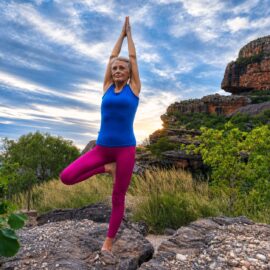
Eagle Pose at sunset. The thigh wrap works the outer hips as well as the balance.
What are the benefits of eagle pose?
Balance, strong legs, open shoulders and a focused mind. From long practice in the Iyengar tradition, eagle pose:
- improves balance and coordination, because you stand on one bent leg with the other wrapped around it;
- strengthens the legs and ankles, as the foot and ankle work to keep you steady;
- stretches the upper back and shoulders, between and around the shoulder blades;
- works the hips and outer thighs through the wrapping action;
- sharpens concentration, since steady attention is the only way to stay up;
- builds body awareness (proprioception, your sense of where your body is);
- calms the mind as the breath deepens and steadies.
Some yoga traditions also hold that the squeeze and release of the wrap refreshes the joints and the organs near them, and that the intertwined limbs symbolise bringing the two sides of ourselves together. Those ideas are known from tradition rather than tested by modern research.
Is eagle pose good for balance and falls?
Standing balance poses are central to how Iyengar yoga improves balance. In a Sydney pilot study published in 2013 in the Journals of Gerontology, 54 people with an average age of 68 did 12 weeks of Iyengar yoga focused on standing poses, twice a week. Compared with the control group, they improved their standing balance, their balance on one leg with eyes closed, their walking speed and how fast they could get up from a chair. Those are the main risk factors for falls. No serious adverse events occurred.
Eagle Pose is one of many standing poses that train the same skills: steadiness on one leg, strong ankles and legs, and attention. For the wider research on yoga, balance and falls, see Flametree’s Falls & Yoga Studies page.
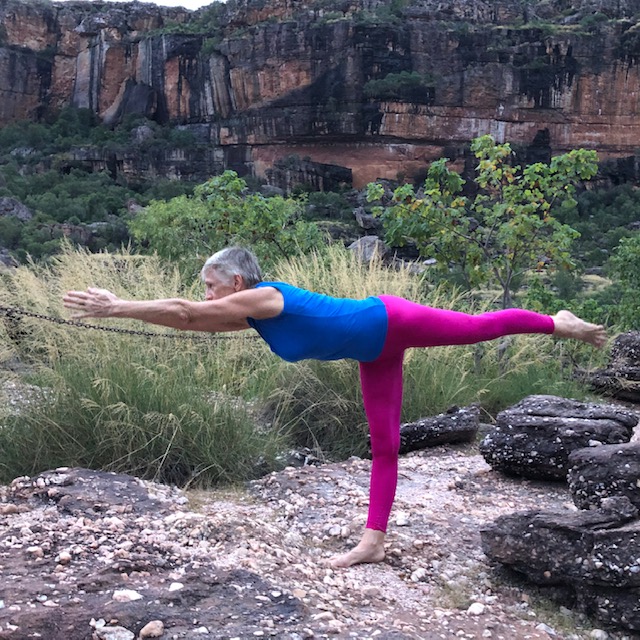
Warrior III (Virabhadrasana III), another standing balance that builds steadiness on one leg.
How can beginners make eagle pose easier?
Use support, and do the arms and legs separately at first. Iyengar yoga breaks poses into stages, and props make them doable:
- Back to the wall: stand with your back near a wall so you can lean if you wobble.
- Hand on a chair: do the leg wrap holding a chair, and the arms separately.
- Toes down: rest the toes of the wrapped leg on the floor or a block instead of hooking the foot.
- Arms only: Eagle arms can be done seated, and are a lovely stretch for the upper back on their own.
- Short holds: a few breaths, rest, and repeat.
Our post How Long To Hold Yoga Poses explains how holds build over time.

A chair for support in Warrior III. The same idea helps in Eagle Pose: steady first, then less support.
Who should take care with eagle pose?
Anyone with knee, ankle or shoulder problems. The wrap puts a twist through the knee and a strong stretch through the shoulders.
- Knee or ankle injury: skip the leg wrap, or keep the toes down with support.
- Shoulder injury: hold the opposite shoulders (a self hug) instead of wrapping the forearms.
- Unsteady balance: always use a wall or chair.
- Dizziness or low blood pressure: come out slowly, and tell your teacher.

Tree Pose (Vrksasana) by the sea. Simpler one-legged balances like Tree prepare you for Eagle Pose.
Learn eagle pose in Darwin and live online
Flametree Yoga Studio teaches Iyengar yoga in Darwin and LIVE online, with Christine (Chris) Lalor, Senior Iyengar Yoga Teacher. Standing poses and balances, with walls and chairs for support, are the backbone of Iyengar yoga for beginners.
- New to Flametree? Your first class is free. See the beginner timetable, or book a class here.
- Keep going at half price. The half price 10 class pass with 2 classes free works in the studio, online or both.
Related reading: Falls & Yoga Studies, yoga for seniors, cow face pose and yoga for hip pain.
Eagle pose: frequently asked questions
What are the benefits of eagle pose?
From long practice, Eagle Pose (Garudasana) improves balance and coordination, strengthens the legs and ankles, stretches the upper back and shoulders, works the outer hips, and sharpens concentration. In a Sydney pilot study, Iyengar yoga focused on standing poses improved balance and other main risk factors for falls in older adults.
How do you do eagle pose step by step?
Bend both knees, cross one thigh over the other and hook the foot behind the standing calf if you can. Cross one arm over the other at the elbows, bring the palms together, and lift the elbows to shoulder height. Keep the hips level and breathe evenly, then change sides.
Is eagle pose good for balance?
Yes. Standing on one bent leg with the other wrapped around it trains steadiness, ankle strength and attention. A 2013 Sydney pilot found 12 weeks of Iyengar yoga built on standing poses improved standing balance and one-leg balance with eyes closed in people averaging 68 years.
What does eagle pose stretch?
The arm wrap stretches the upper back and the muscles around and between the shoulder blades. The leg wrap stretches the outer hips and thighs, while the standing leg and ankle work to hold you up.
Why is eagle pose so hard to balance?
Your base is one bent leg, and the wrap removes the usual ways of catching yourself. Bending the standing knee more, fixing the eyes on one spot, and using a wall or chair all help.
Can beginners do eagle pose?
Yes, with support. Beginners stand near a wall or hold a chair, rest the toes of the wrapped leg on the floor or a block, and practise the arms seated. Holds start short and build up.
Who should avoid eagle pose?
Take care with knee, ankle or shoulder injuries. Skip the leg wrap or keep the toes down, hold the opposite shoulders instead of wrapping the forearms, and always use support if your balance is unsteady.
Where can I learn eagle pose in Darwin or online?
Flametree Yoga Studio teaches Iyengar yoga, including standing balances with walls and chairs for support, in Darwin and LIVE online with Senior Iyengar Yoga Teacher Christine (Chris) Lalor. Your first class is free if you are new to Flametree.
This article is general information, not medical advice. If you have a knee, ankle or shoulder injury, or a history of falls, check with your doctor before starting. Flametree Yoga Studio, Darwin and LIVE online.
Sources: Tiedemann A, O’Rourke S, Sesto R, Sherrington C, A 12-week Iyengar yoga program improved balance and mobility in older community-dwelling people: a pilot randomized controlled trial, Journals of Gerontology Series A, 2013, doi 10.1093/gerona/glt087. Chris Lalor’s own practice and teaching.