Backbend Yoga: The Energy, Uplift And Calm Of Opening The Chest
Backbend yoga: the short answer
Backbend yoga poses open the chest and front of the body and strengthen the back, which is why so many students, me included, love the boost in energy and mood they give straight away. The main benefits of backbends are better posture against a day of slouching, a freer chest for breathing, a stronger back, and a lift in energy with a calm mind underneath. In Iyengar yoga, a chair, bolsters and blocks make backbends doable from the beginning, in Darwin or LIVE online. Here is what each backbend benefit means, what research has found, and how to start safely.
Here is the article in short form:
- Posture: backbends reverse the slump of desks and phones.
- Breathing: an open chest gives the lungs room.
- Strength: the back, shoulders and hips get stronger.
- Energy and mood: many students feel more awake and uplifted.
- Calm under stress: staying steady in a strong pose carries into life.
- Start supported: a chair or bolster makes them doable.
- Next step: learn them with a teacher, in Darwin or LIVE online.
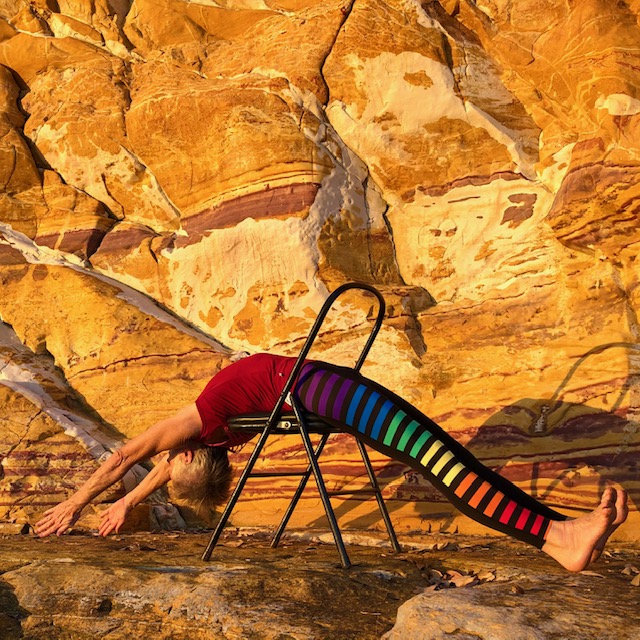
Two-Legged Inverted Staff Pose over a chair (Dwi Pada Viparita Dandasana). The chair supports the back so you can stay and breathe.
What are the benefits of backbends in yoga?
Posture, breathing, strength, energy and calm. Like many people, I love the boost in energy and mood that backbends deliver almost immediately. The experienced pose in the photo above is not where you start, but the benefits below apply to any backbend, to a greater or lesser extent.
From long practice in the Iyengar tradition, backbends:
- improve posture by reversing the slouch from sitting at a desk or looking at a phone;
- strengthen the back, shoulders, chest and hips, supporting a healthy, stable spine;
- increase mobility in the spine, chest and hip flexors (the muscles at the front of the hips), so you move more easily;
- relieve tightness in the back, neck and shoulders, including after a lot of forward bending;
- open the chest, giving the lungs more room to breathe deeply;
- lift energy and alertness, so you feel more awake and less tired;
- help release stress and emotional tension, and build the confidence to face a challenge.
These are mostly known from practice. The next section covers what research has tested.

Camel Pose (Ustrasana) at Umbrawarra Gorge. The thighs stay upright while the chest lifts and opens.
What has research found about backbends and posture?
Research supports two pieces of the picture. Neither study tested backbends alone, but both bear on why opening the chest matters.
- Slumping squeezes the lungs. A 2006 study of 70 adults in the Archives of Physical Medicine and Rehabilitation measured breathing in different postures. Slumped sitting significantly reduced lung capacity and the force of breathing out, compared with upright sitting and standing.
- Yoga can reduce a rounded upper back. A 2009 trial in the Journal of the American Geriatrics Society gave 118 people aged 60 and over, all with a rounded upper back (hyperkyphosis), yoga classes three times a week for 24 weeks. Compared with the control group, one measure of the curve improved by 4.4% and another by 5%. Other measures, including physical performance, did not change significantly.
In plain terms: a slumped chest restricts breathing, and a regular yoga programme designed for a rounded upper back can improve it a little. The other benefits listed above are known from practice and not yet tested by modern research.
Flametree has also published on posture in Yoga For Posture, and on other benefits of yoga elsewhere on the blog.

Bridge Pose with the feet on a chair and the shoulders on blankets. A beginner-friendly backbend.
Why do backbends make you feel energised?
Students commonly describe backbends as waking them up. In the Iyengar tradition, backbends are taught to bring energy and alertness, and they are often practised when people feel dull or tired. Many students find their mood lifts and they feel more confident, because a backbend asks you to face a challenge and let go of fear.
At the same time, staying steady and breathing evenly in a strong pose trains the body to stay calm under stress. That carries over into everyday life. It is uplift and calm together, which is the mix I love.
Those effects are known from long practice. If you want the science of calming the system, see How To Calm Your Nervous System.
How do you start backbend yoga safely?
With support, slowly, and with a teacher. You can work towards Two-Legged Inverted Staff Pose simply by lying back over a chair, with your teacher setting it up. Use a mix of supports to take it further step by step.
- Start supported: lying over a bolster, blocks or a chair.
- Prepare first: standing poses and chest openers before deeper backbends.
- Go slowly: build up over weeks, using smaller backbends to extend and strengthen the back.
- Keep the breath smooth: no holding the breath, no forcing.
- Come out gently: and follow with a twist or a gentle forward bend if your teacher suggests it.
Take extra care, and tell your teacher, if you have back or neck problems, osteoporosis (thin, fragile bones), high blood pressure, or are pregnant. Supported versions are usually taught instead.
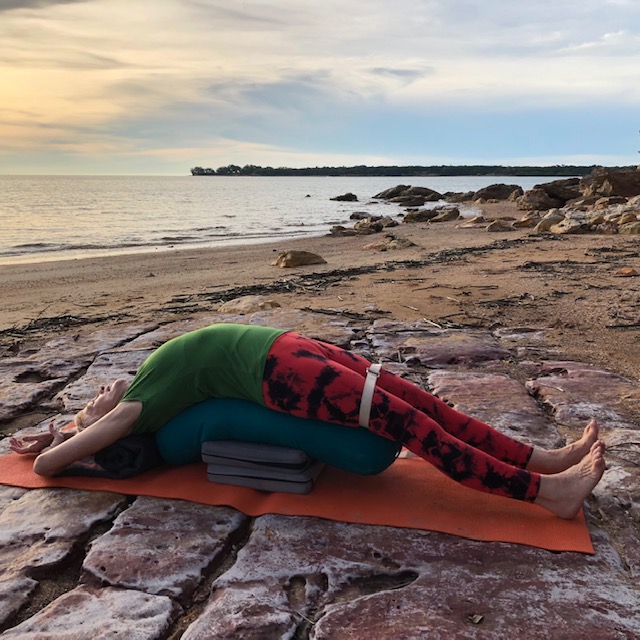
A resting backbend over a bolster and blankets. Supported backbends open the chest with very little effort.
Backbend yoga poses taught in Iyengar classes
Common backbends, from gentle to strong, include:
- Supported backbends over a bolster, blocks or crossed bolsters;
- Bridge Pose (Setu Bandha Sarvangasana), with or without a chair;
- Cobra and Upward Facing Dog;
- Camel Pose, often with the hands on blocks or a chair at first;
- Two-Legged Inverted Staff Pose over a chair;
- Wheel Pose (Urdhva Dhanurasana), for experienced students.

Wheel Pose (Urdhva Dhanurasana), an experienced backbend built up to over time.
Backbend yoga in Darwin and live online
Flametree Yoga Studio teaches Iyengar yoga in Darwin and LIVE online, with Christine (Chris) Lalor, Senior Iyengar Yoga Teacher. Backbends are taught with chairs, bolsters and blocks, step by step, in the studio or online.
- New to Flametree? Your first class is free. See the beginner timetable, or book a class here.
- Keep going at half price. The half price 10 class pass with 2 classes free works in the studio, online or both.
Related reading: yoga for posture, seated forward bend, yoga for neck pain and yoga inversions.
Backbend yoga: frequently asked questions
What are the benefits of backbends in yoga?
From long practice, backbends improve posture, strengthen the back, shoulders and hips, open the chest for breathing, ease tightness in the upper back and neck, and lift energy and mood. Research has shown slumped sitting reduces lung capacity, and that a yoga programme can modestly reduce a rounded upper back.
Are backbends good for posture?
Backbends open the chest and strengthen the back muscles, the opposite of a desk slump. A 2009 trial of 118 people aged 60 and over found 24 weeks of yoga improved measures of a rounded upper back by about 4 to 5% compared with a control group.
Do backbends help breathing?
An open chest gives the lungs room. A 2006 study of 70 adults found slumped sitting significantly reduced lung capacity compared with upright sitting and standing. Backbends counter the slump, which many students feel as easier, deeper breathing.
Why do backbends give you energy?
Students commonly feel more awake and uplifted after backbends, and in the Iyengar tradition they are taught to lift energy and mood. This is known from practice rather than tested in research.
Are backbends safe for beginners?
Supported backbends are, when taught well. Beginners start lying over a bolster, blocks or a chair, and in Bridge Pose, and build up slowly. Tell your teacher about back or neck problems, osteoporosis, high blood pressure or pregnancy.
What is chair backbend yoga?
In Iyengar yoga, a chair supports the back in poses such as Two-Legged Inverted Staff Pose (Dwi Pada Viparita Dandasana). The chair lets you stay longer and breathe, so the chest opens without strain.
Should I do a forward bend after a backbend?
Teachers often follow backbends with a gentle twist or forward bend to settle the spine. Your teacher will sequence the class so the back is looked after.
Where can I learn backbend yoga in Darwin or online?
Flametree Yoga Studio teaches Iyengar yoga, including supported backbends with chairs and bolsters, in Darwin and LIVE online with Senior Iyengar Yoga Teacher Christine (Chris) Lalor. Your first class is free if you are new to Flametree.
This article is general information, not medical advice. If you have a back condition, osteoporosis or high blood pressure, check with your doctor before starting. Flametree Yoga Studio, Darwin and LIVE online.
Sources: Lin F and colleagues, Effect of different sitting postures on lung capacity, expiratory flow, and lumbar lordosis, Archives of Physical Medicine and Rehabilitation, 2006, doi 10.1016/j.apmr.2005.11.031. Greendale GA and colleagues, Yoga decreases kyphosis in senior women and men with adult-onset hyperkyphosis: results of a randomized controlled trial, Journal of the American Geriatrics Society, 2009, doi 10.1111/j.1532-5415.2009.02391.x. Chris Lalor’s own practice and teaching.