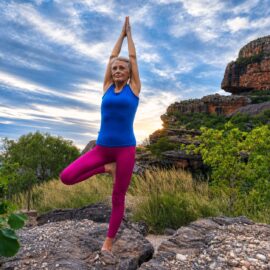
Half Moon Pose: Why Straight Legs Bring Strength, Balance And Energy
Half Moon Pose: the short answer
Why do Iyengar teachers keep saying “straighten the leg”? Half Moon Pose (Ardha Chandrasana) is the clearest answer. You balance on one straight leg, with the other leg lifted level and both arms stretched in one line, and the effort of straightening everything wakes the whole body up. In a 2021 study, Half Moon Pose produced the highest buttock muscle activity of five common poses tested. Iyengar teaching holds that the same straight lines let energy move more freely, which is why so many students say this pose lifts their mood.
Here is the whole article in short form:
- What it is: a standing balance on one straight leg, the body turned to the side.
- Why straight legs: they build strength and steadiness, and take full attention.
- What research found: very high buttock muscle work in both legs.
- What tradition teaches: straight lines let prana (life energy) flow.
- How to start: a block under the hand and your back to a wall.
- Common mistakes: a bent standing knee and a hip that rolls forward.

Chris Lalor in Half Moon Pose (Ardha Chandrasana) by the sea at Darwin. Standing leg straight, lifted leg level, arms in one line.
What is Half Moon Pose?
Half Moon Pose is a standing yoga pose where you balance on one leg with your body turned to the side. The lower hand rests on the floor or a block, the top arm reaches up, and the free leg lifts until it is level with the hip.
The Sanskrit name is Ardha Chandrasana. Ardha means half, chandra means moon, and asana means pose. In Iyengar yoga it is one of the standing poses, usually taught after Triangle Pose (Trikonasana), because it grows out of it.
It looks like a balance. It is also strength work, because one leg carries your whole body, and the other leg has to hold itself up against gravity.
Why do Iyengar teachers insist on straight legs?
Because straightening is what turns a shape into a pose. When the standing leg is straight, the kneecap lifts, the thigh firms, and the weight travels down through the bone into the foot. The leg becomes a column instead of a bent spring.
Straight legs are not locked legs. The knee is not jammed backwards. The muscles all around the thigh work evenly, so the joint is held, not hung on.
Chris teaches it in short instructions. Lift the kneecap. Press the heel of the lifted leg away. Turn the top hip back. Reach the top arm up. Each one is a straightening, and each one asks for your attention.

Chris Lalor in Half Moon yoga pose at the Lost City, Litchfield. Every limb is straight: that is what makes the pose steady and strong.
What are the benefits of Half Moon Pose?
It helps to say where each benefit comes from. Some are measured by research. Some are known from long practice in the yoga tradition. Both matter.
What research has measured
In 2021, researchers in the International Journal of Sports Physical Therapy measured buttock muscle activity in 31 healthy adults during five common yoga poses. Half Moon Pose came out on top. The big buttock muscle (gluteus maximus) worked at about 63% of its maximum on the lifted leg and about 62% on the standing leg. The side hip muscle (gluteus medius) worked at about 42% on the lifted leg.
That is a lot of work for a pose where nothing seems to move. Those side hip muscles are the ones that keep the pelvis level when you walk, climb stairs or stand on one leg to put on your shoes.
The study used young adults, aged 18 to 35, so it says nothing directly about beginners over 50. Our article Can Yoga Build Muscle? explains how held poses build strength.
Balance, and the Sydney pilot study
In a Sydney pilot study, Iyengar yoga improved the main risk factors for falls. Fifty-four people with an average age of 68 did 12 weeks of Iyengar-based yoga focused on standing poses, twice a week. Their standing balance, walking speed, speed getting up from a chair, and one-leg balance with eyes closed all improved, with no serious adverse events (Tiedemann and colleagues, Journals of Gerontology, 2013).
Half Moon Pose, with a wall and a block, is exactly that kind of standing pose. Our article on falls and yoga studies sets out that research in full.

Kim in Half Moon Pose with a block under her hand. The block brings the floor up, so the standing leg can stay straight.
What the Iyengar tradition teaches about energy
Iyengar teaching holds that straightening the limbs creates clear lines of energy through the body. In yoga’s own language, prana (life force) moves through nadis (energy channels), and straight, extended limbs let it move more freely. This is known from practice, over a very long time. It has not yet been tested by modern research, which has no way to measure prana.
What our students describe is simpler. They feel more awake after Half Moon Pose. Many say it is the pose that lifts their mood most.
Five ways straightening helps in the pose
- It creates lines. Straight legs, straight arms and a long spine give the body clear directions to reach in.
- It makes space. Lengthening the limbs draws the joints gently apart and lets unneeded tension go.
- It works the muscles. Holding a leg straight and lifted is strength work, as the 2021 study showed.
- It builds stamina. Staying steady on one straight leg asks more each week, so the body adapts.
- It focuses the mind. You cannot keep a leg straight without paying attention, so the mind stops wandering.
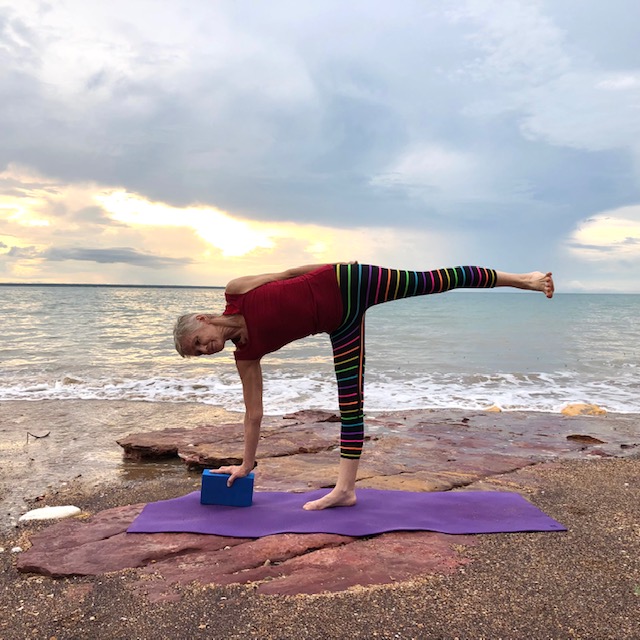
Half Moon Pose on a rock shelf by the sea. Straight lines through both legs and both arms give the body clear directions to reach in.
How do you do Half Moon Pose, step by step?
For most students, the best way to learn Ardha Chandrasana is with your back to a wall and a block under your hand. The wall takes the fear of falling away, so you can work on the straight legs.
- Stand with your back close to a wall. Step your feet wide and come into Triangle Pose to the right.
- Bend the right knee. Put the right hand on a block about 30 centimetres in front of the right foot, a little to the little-toe side.
- Bring the left foot in a little, then straighten the right leg as you lift the left leg until it is level with the hip.
- Lift the right kneecap and firm the right thigh. The standing leg is straight.
- Press the left heel away from you, toes pointing forward, not up.
- Turn the left hip back towards the wall and stretch the left arm up, in line with the right arm.
- Breathe evenly. Stay for 20 to 30 seconds. Come down the way you went up, and repeat on the left.

Half Moon Pose with the back to the wall. The wall holds you, so you can straighten both legs without wobbling.
What are the most common mistakes in Half Moon Pose?
- The standing knee bends. Use a higher block so the leg can straighten.
- The lifted leg drops. Lift it from the inner thigh, and press the heel away.
- The top hip rolls forward. Turn it back, towards the wall.
- The weight goes into the hand. The hand is a helper. The leg does the work.
- The breath stops. If you are holding your breath, come down, rest, and try again.
How does Half Moon Pose grow out of Triangle Pose?
Triangle Pose teaches the same straight front leg with both feet on the floor. Once the front leg can stay straight and steady in Triangle, Half Moon Pose simply lifts the back leg off the floor and asks the same leg to carry everything.
That is why our classes nearly always teach Triangle first. The legs learn to straighten on two feet before they try it on one.

Chris Lalor in Triangle Pose at Umbrawarra Gorge. Both legs straight on two feet first, then Half Moon Pose asks the front leg to do it alone.
Who should take care with Half Moon Pose?
Most people can learn a version of it with a wall and a block. Take more care, and tell your teacher, if you have a recent hip, knee or ankle injury, low blood pressure that makes you dizzy, or very poor balance. In those cases the pose is often done with the back on the wall and the lifted foot on a chair or a ledge.
Where can I learn Half Moon Pose in Darwin or online?
Flametree Yoga Studio teaches Iyengar yoga at Woolner and Coolalinga in Darwin, and LIVE online across Australia. Half Moon Pose is part of our standing pose work, taught with walls, blocks and chairs so every level can do it. For more on how the Iyengar method works in Darwin, see Iyengar Yoga Darwin.
If you are new, the easiest way in is our half-price 10-class pass, with 2 classes free, in the studio or live online. You can see the class times on the timetable.
Frequently asked questions
What are the benefits of Half Moon Pose?
Half Moon Pose builds strength in the legs and hips and trains balance. A 2021 study found it produced the highest buttock muscle activity of five common yoga poses. Iyengar teaching also holds that its straight lines help energy move freely, which many students feel as a lift in mood.
What is Ardha Chandrasana in English?
Ardha Chandrasana is Half Moon Pose. Ardha means half, chandra means moon, and asana means pose.
Why do Iyengar teachers say to straighten the legs?
A straight leg carries weight through the bone, makes the muscles around the knee work evenly, and asks for your full attention. Straight is not locked: the kneecap lifts and the thigh firms, without jamming the knee backwards.
Is Half Moon Pose good for balance?
Yes. It is a one-leg standing balance. In a Sydney pilot study, 12 weeks of Iyengar yoga focused on standing poses improved balance, walking speed and getting up from a chair in people with an average age of 68.
How long should I hold Half Moon Pose?
Start with 20 to 30 seconds on each side, with your back to a wall. Stay only as long as the standing leg stays straight and the breath stays even.
What if I cannot reach the floor in Half Moon Pose?
Put a block, or a stack of books, under your lower hand. Raising the floor lets the standing leg stay straight, which matters more than touching the ground.
Is Half Moon Pose safe for beginners over 50?
Most people can learn it safely with their back to a wall and a block under the hand. Tell your teacher about any hip, knee or ankle injury, or dizziness, so the pose can be adapted.
Where can I learn Half Moon Pose in Darwin?
Flametree Yoga Studio teaches it in Iyengar yoga classes at Woolner and Coolalinga in Darwin, and live online across Australia, with walls and blocks for every level.
Sources
- Lehecka BJ et al. Gluteal muscle activation during common yoga poses. International Journal of Sports Physical Therapy, 2021. doi.org/10.26603/001c.22499
- Tiedemann A, O’Rourke S, Sesto R, Sherrington C. A 12-week Iyengar yoga program improved balance and mobility in older community-dwelling people: a pilot randomized controlled trial. Journals of Gerontology Series A, 2013. doi.org/10.1093/gerona/glt087
- Iyengar BKS. Light on Yoga. HarperCollins, 1966 and later reprints. The entry for Ardha Chandrasana.
Flametree Yoga Studio, Darwin and live online. Written by Christine Lalor, from her own teaching notes. Last updated 1 October 2026. This article is general information, not medical advice. If you have a health condition or injury, talk to your doctor, and tell your yoga teacher before class.